
Quick Answer
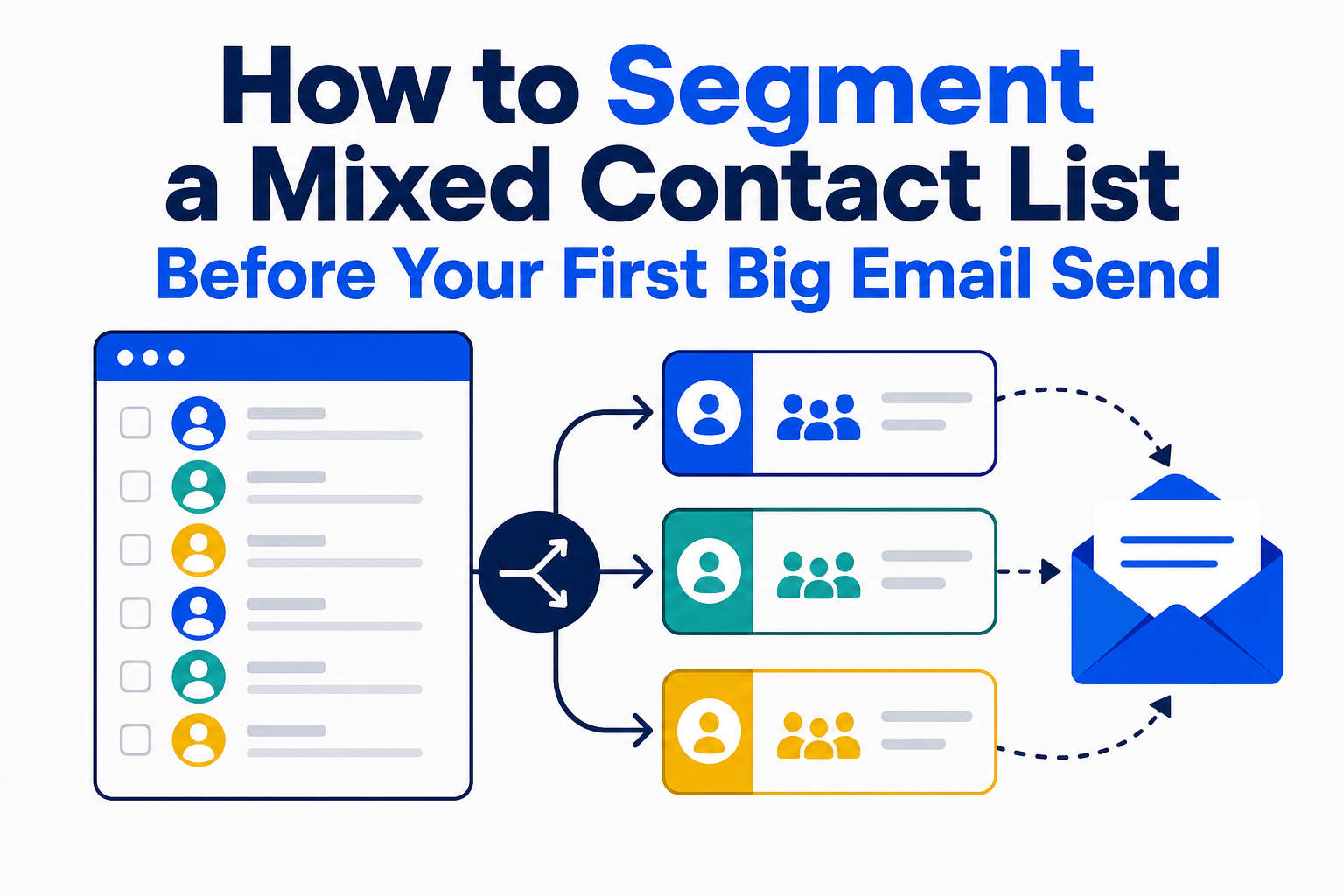
Segmenting a mixed contact list means assigning every contact a type — prospect, customer, colleague, partner, influencer, vendor — and emailing each type differently, or not at all. It matters most right before a first big send: a blended list produces misleading metrics (colleagues clicking don't mean prospects are interested), burns deliverability with people who never asked to hear from you, and wastes paid marketing-contact capacity on people who shouldn't be emailed. This guide gives you the segmentation model, the HubSpot mechanics, and the pre-send checklist. Vantage Point builds segmentation foundations like this as a standard first engagement for teams standing up outbound marketing.
Key Takeaways (TL;DR)
- The problem: Mixed lists make campaign metrics lie — clicks from colleagues and vendors look like prospect interest.
- The fix: One custom "contact type" property plus a handful of active lists covers most segmentation needs.
- The rule: Different contact types get different treatment — some get campaigns, some get newsletters only, some get nothing.
- Best for: Teams about to run their first large email send from an imported or blended database.
- How Vantage Point helps: Segmentation design and list cleanup inside your HubSpot portal before the send goes out.
Why Mixed Lists Wreck Your First Campaign
Here's what a mixed list does to a real campaign. You send to 10,000 contacts. A thousand people open, a hundred-plus click — and when you dig in, a large share of the clickers are colleagues, former coworkers, and industry contacts who clicked out of curiosity, not buying intent. Your "engaged" list is contaminated. Your next campaign optimizes toward people who will never buy.
The damage isn't just analytical:
- Deliverability. Recipients who didn't expect the email mark it as spam. Even a small spam-report rate erodes sender reputation for every future send.
- Unsubscribe churn. Colleagues and casual contacts unsubscribe at high rates, shrinking the audience you actually want.
- Wasted tier capacity. Every non-prospect holding marketing contact status occupies paid capacity. (See what counts toward your HubSpot contact limit — a companion piece to this one.)
- Bad decisions. If colleagues are 30% of your clicks, subject-line and CTA tests tell you what colleagues like, not what prospects want.
None of this means don't send. It means segment first, then send.
A Segmentation Model That Works: Contact Type
The simplest durable model is a single custom property — call it Contact Type — with a small, enforced set of values:
| Contact type | Who they are | Email treatment |
|---|---|---|
| Prospect | People who could plausibly buy | Campaigns, nurture, newsletters |
| Customer | Current clients | Newsletters, product updates, expansion campaigns |
| Partner / Referral source | People who send you business | Newsletters, relationship touches — not sales campaigns |
| Influencer | Analysts, regulators, industry voices, connectors | Newsletters only |
| Vendor | People who sell to you | Nothing, or operational notices only |
| Colleague / Network | Former coworkers, friends of the firm | Nothing by default; occasional announcement at most |
| Unverified | Imported, not yet qualified | Nothing until verified |
Two design rules make this work. First, every contact gets exactly one type — multiple-type logic collapses under its own weight fast. Second, no contact reaches a campaign list without a type. "Untyped" becomes a staging state, not a destination.
How to Build It in HubSpot
The mechanics take hours, not weeks:
- Create the property. Settings → Properties → create "Contact Type" as a dropdown on the contact object with the values above.
- Backfill in bulk. Export, classify in a spreadsheet (domain, job title, source, and relationship usually decide it), re-import with the property set. For large lists, classify the top segments first — you don't need 100% coverage to send safely.
- Build active lists per type. One active list per contact type keeps audiences self-maintaining as new contacts arrive.
- Build suppression lists. "Colleagues," "Vendors," and "Unverified" become suppression lists applied to every marketing send.
- Fix the inflows. Set type on forms, imports, and integrations so new contacts arrive typed. A segmentation model that only exists for the backlog is obsolete within a quarter.
- Deduplicate first if you haven't. Segmentation on a duplicated database double-counts people and splits engagement history. HubSpot's native tools handle this well — see mastering HubSpot's deduplication tools.
Send Mechanics: Getting the First Campaign Right
Segmentation is the foundation; a few send-level decisions protect it:
- One primary CTA per email. Every extra link — logos that link to your homepage, social icons, secondary buttons — dilutes click tracking. If five links are clickable, "143 clicks" tells you almost nothing. Direct everything to one action.
- Connect the sending inbox. Reply tracking requires a connected inbox. Replies are often your highest-intent responses, and you can't route what you can't see.
- Use engagement-based suppression. HubSpot can automatically suppress contacts who haven't engaged across a run of sends. Turn it on — it compounds deliverability protection over time.
- Send to the smallest honest audience first. A first send to the verified-prospect segment beats a blast to everyone. Early engagement rates train inbox providers how to treat you.
Beyond Type: Behavioral Segmentation Comes Second
Contact type answers "who is this person to us?" Once that's solid, a second layer answers "what are they doing?" Engagement-based segments — opened recently, clicked recently, visited key pages, went quiet six months ago — sit on top of type and drive the cadence decisions: who gets the next campaign, who gets a re-engagement sequence, who gets rested.
The sequencing matters. Behavioral segmentation on an untyped list optimizes toward whoever clicks most, which on a mixed list means colleagues and influencers. Type first, then behavior, and the engagement layer starts measuring the audience you actually care about. A simple maturity path works for most teams: type segmentation this quarter, engagement overlays next quarter, lifecycle-stage automation the quarter after that. Each layer assumes the one beneath it is trustworthy.
What Businesses Should Do Next
Before the next campaign: create the Contact Type property, classify your top segments, build the suppression lists, and strip extra links from your template. If a data quality audit hasn't happened recently, run one in parallel — segmentation layered on dirty data just organizes the mess.
How Vantage Point Helps
Vantage Point sets up segmentation as a working system, not a spreadsheet exercise: the property model, backfill and classification, active and suppression lists, import and form fixes, and the campaign templates with clean CTA tracking. Through our HubSpot technology services and CRM and marketing automation practice, you work with senior consultants only — no junior handoffs; the experts you meet are the experts who deliver. We also reserve time in every engagement for knowledge transfer, so your team can run segments and sends independently afterward.
First Big Send Coming Up?
Vantage Point can segment your list, clean the data underneath it, and set up your campaign tracking before the send — typically inside a small block of hours, with knowledge transfer built in. Contact Vantage Point to scope it, or explore our HubSpot services.
Frequently Asked Questions
What is contact list segmentation in a CRM?
Contact list segmentation is dividing your database into groups — by type, behavior, or attributes — so each group gets appropriate treatment. The most durable starting model is a single "contact type" property (prospect, customer, partner, influencer, vendor, colleague) that drives which emails each group receives, if any.
Why can't I just send one campaign to my whole list?
You can, but a blended list makes metrics lie: colleagues and vendors click out of curiosity, so "engaged" audiences fill with non-buyers. It also hurts deliverability — unexpected emails generate spam reports — and wastes paid marketing-contact capacity on people who should never receive campaigns.
What's the minimum segmentation I need before a first send?
Three groups: a verified prospect segment (your actual audience), a suppression segment (colleagues, vendors, unverified imports), and everyone else held out until classified. You can refine later — you cannot un-send the first campaign.
How do I segment contacts in HubSpot?
Create a custom dropdown property (e.g., "Contact Type"), backfill it via export/classify/import, then build active lists per value for audiences and suppression. Set the property at every inflow point — forms, imports, integrations — so new contacts arrive classified.
Should colleagues and industry contacts get my marketing emails?
Generally no. Colleagues and industry contacts distort campaign analytics and rarely want recurring marketing email. If you want to stay in front of them, a separate occasional newsletter — not your prospect campaigns — is the right vehicle.
How does segmentation affect email deliverability?
Directly. Sending only to appropriate, verified audiences raises engagement rates and cuts spam complaints — the two signals inbox providers weight most. Engagement-based suppression compounds the effect by automatically resting contacts who stop responding.
How often should we re-segment the list?
Segmentation is continuous, not a project: contact types get set at every inflow, and engagement-based segments refresh automatically as behavior changes. Review the type definitions and suppression lists quarterly — businesses drift, and lists drift with them.
Can Vantage Point set this up for us?
Yes. Vantage Point builds segmentation models, cleans and classifies the list, configures HubSpot lists and suppression, and transfers the knowledge to your team — usually as a first block-of-hours engagement before a major send.
Vantage Point is a boutique CRM consulting firm helping businesses transform with Salesforce, HubSpot, and AI. Learn more at vantagepoint.io.