
Quick Answer
HubSpot bills you on marketing contacts, not total contacts. You can store a very large number of contacts in HubSpot at no additional cost, but only the contacts you mark as "marketing contacts" count toward the contact tier on your subscription — and only marketing contacts can receive marketing emails or be included in ad audiences. This distinction matters for any team importing large lists or running its first big campaigns: mark the wrong people as marketing contacts and you pay for a higher tier you don't need; mark too few and your campaign can't reach your real audience. Vantage Point helps teams audit contact status, set up segmentation, and right-size their HubSpot tier before the next billing cycle locks it in.
Key Takeaways (TL;DR)
- What counts: Only contacts with "marketing contact" status count toward your HubSpot contact tier. Total stored contacts can be far larger.
- What marketing contacts can do: Receive marketing emails and appear in ad audiences. Non-marketing contacts can still be emailed one-to-one from the CRM.
- The catch: Marketing contact status updates on a monthly cycle — you generally can't rotate contacts on and off marketing status mid-month.
- Best for: Teams importing large lists, running first campaigns, or staring at a tier upgrade they suspect they don't need.
- How Vantage Point helps: A HubSpot portal audit identifies who truly needs marketing status before your reset date.
What Is a Marketing Contact in HubSpot?
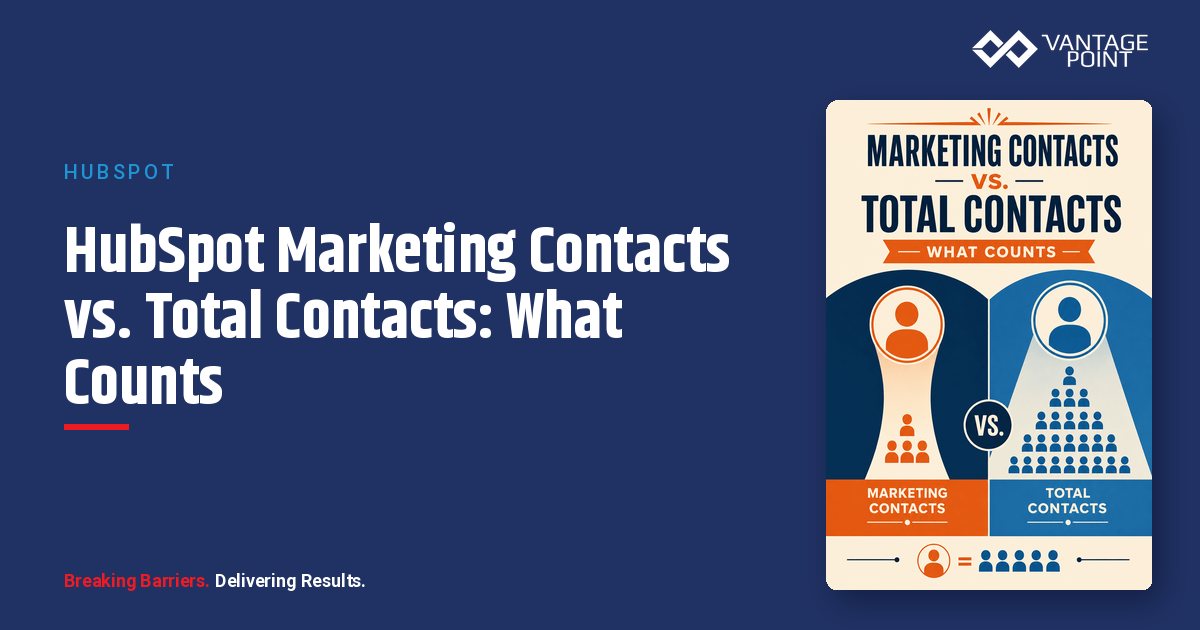
A marketing contact is any contact in your HubSpot portal that you've designated as marketable. That single flag controls two things: whether HubSpot counts the contact toward your paid contact tier, and whether the contact can receive marketing emails or be synced to ad audiences.
Every other contact in your portal — and you can store far more of them — is a non-marketing contact. Non-marketing contacts still live fully in the CRM. Sales can see them, log activities against them, enroll them in sequences, and send one-to-one emails. They just can't be on the receiving end of marketing sends, and they don't inflate your bill.
The practical upshot: the number of contacts in your database and the number you pay for are two different numbers, and managing the gap between them is one of the easiest cost levers in HubSpot.
Marketing Contacts vs. Total Contacts: Side by Side
| Question | Marketing contacts | Non-marketing (total) contacts |
|---|---|---|
| Count toward your paid contact tier? | Yes | No |
| Can receive marketing emails? | Yes | No |
| Can be in ad audiences? | Yes | No |
| Visible and usable in the CRM? | Yes | Yes |
| Can receive one-to-one sales emails and sequences? | Yes | Yes |
| Can be changed to the other status? | Yes — on the monthly cycle | Yes — anytime (takes effect on the cycle) |
How the Monthly Marketing Contact Cycle Works
The detail that trips up most teams: marketing contact status changes are not instant and not daily. HubSpot processes marketing contact updates on a monthly reset tied to your subscription. You can queue changes during the month — marking this group as marketing, that group as non-marketing — but they take effect on the reset date.
Three implications:
- Plan before a big import. If you import 10,000 contacts and they default into marketing status, they count against your tier until the next reset lets you demote them. Set status correctly at import time.
- Rotation is monthly, not continuous. Some teams rotate segments in and out of marketing status — prospects this month, a re-engagement list next month. That works, but only on a monthly rhythm. Mid-month campaign pivots have to work with the marketing list you already have.
- Your tier is measured at the reset. The number that matters for billing is your marketing contact count when the cycle turns over — which makes the week before the reset the right time for a status audit.
We covered a related failure mode — workflows silently flipping contacts to marketing status — in how workflows can inflate your marketing contacts bill, and there's a real recovery story in how one workflow created 250K marketing contacts overnight.
Who Should Actually Be a Marketing Contact?
The mistake we see most often is treating "everyone we might ever email" as the marketing set. A better test: who are we actively marketing to in the next 30–60 days?
Usually that's a fraction of the database:
- Active prospects in nurture or campaign audiences — yes, marketing contacts.
- Customers receiving newsletters or product updates — often yes, depending on your motion.
- Colleagues, partners, vendors, and personal contacts — almost never. They don't need marketing emails, and every one of them occupies paid capacity.
- Cold or unverified imports — hold as non-marketing until they've been qualified or verified. Emailing them immediately hurts deliverability anyway.
- Long-term nurture or re-engagement lists — rotate into marketing status in the month you actually plan to email them.
If your database mixes prospects with colleagues, industry contacts, and vendors, segmentation comes first — the status decision is only as good as the segments underneath it. A HubSpot data quality audit is the fastest way to see what you're actually storing.
How to Audit and Right-Size Your Marketing Contact Count
A practical audit takes an afternoon:
- Pull the current number. In HubSpot, check your marketing contact count against your tier limit and your reset date.
- Build a "currently marketing" list. Active list, filter: marketing contact status = marketing contact.
- Overlay engagement. Split the list by recent engagement — opened or clicked in the last 90–180 days. The unengaged majority is your reduction candidate pool.
- Flag non-audience segments. Colleagues, vendors, partners, competitors, test records, and hard-bounced or unsubscribed contacts should not hold marketing status.
- Queue the demotions before the reset. Set the flagged group to become non-marketing on the next cycle date.
- Fix the inflows. Check imports, forms, integrations, and workflows so new records land with the right default status. (Workflows are the usual culprit — see the billing post linked above.)
Common Marketing Contact Mistakes to Avoid
Five patterns show up in nearly every portal audit:
- Defaulting imports to marketing status. A list import that lands 8,000 unverified contacts as marketing contacts is a tier increase waiting for the reset. Default to non-marketing; promote after qualification.
- Workflows that set marketing status as a side effect. A workflow built to assign a lifecycle stage or enroll a sequence quietly flips marketing status on every record it touches. Audit any workflow that touches contact properties for status side effects.
- Treating the newsletter list as everyone. Colleagues, vendors, and partners rarely need recurring marketing email. They inflate the tier and, worse, contaminate engagement metrics.
- Forgetting the reset date. Demotions queued after the reset date sit for a full cycle. Put the reset date on a team calendar and run the audit the week before it.
- Never promoting legitimately engaged non-marketing contacts. The reverse mistake: a prospect filling out forms and clicking sales emails while sitting in non-marketing status can't be nurtured. The audit should look in both directions — demote the waste, promote the engaged.
What Businesses Should Do Next
If you suspect you're paying for contacts you don't market to, do three things this month: confirm your reset date, run the engagement overlay on your current marketing list, and queue demotions before the cycle turns. Then make it a monthly habit — the same 30 minutes before every reset keeps the tier matched to reality instead of to whatever your biggest import happened to be.
How Vantage Point Helps
Vantage Point's HubSpot consultants run marketing contact audits as a standard part of portal health checks: status and tier analysis, segment cleanup, workflow and import fixes that stop marketing-status creep, and a monthly rotation process your team can run without us. Through our HubSpot technology services and CRM and marketing automation practice, senior consultants work directly in your portal — senior consultants only, no junior handoffs; the experts you meet are the experts who deliver.
Paying for Contacts You Don't Market To?
Vantage Point can audit your marketing contact count, fix the workflows and imports inflating it, and put a monthly rotation process in place before your next reset date. Contact Vantage Point for a portal review, or explore our HubSpot services to see how we support teams end to end.
Frequently Asked Questions
What is the difference between a marketing contact and a total contact in HubSpot?
A marketing contact is designated to receive marketing emails and ad audiences, and counts toward your paid contact tier. A total (non-marketing) contact is fully usable in the CRM — visible, emailable one-to-one, enrollable in sequences — but costs nothing against your tier and can't receive marketing sends.
Do non-marketing contacts cost anything in HubSpot?
No. Non-marketing contacts don't count toward your marketing contact tier. You can store a very large database of them and pay only for the marketing contacts you've designated.
Can I email non-marketing contacts at all?
Yes — one-to-one sales emails and sales sequences work with non-marketing contacts. What they can't receive is marketing email (campaigns, newsletters, nurtures) or inclusion in ad audiences.
How often can I change a contact's marketing status?
Status changes are processed on a monthly cycle tied to your subscription reset date. You can queue changes any time, but they take effect at the reset — so plan rotations monthly, not mid-campaign.
What happens if I import a big list and they all become marketing contacts?
They count toward your tier until the next reset lets you demote them — and if the total exceeds your tier, you can be bumped into a higher one. Always set marketing status deliberately at import, and default unverified lists to non-marketing.
How do I find out how many marketing contacts I have?
In HubSpot, go to your account's billing or usage section to see the current marketing contact count, your tier limit, and your reset date. Then build an active list filtered on marketing contact status to see exactly who is in that count.
Can Vantage Point help reduce our HubSpot contact costs?
Yes. A Vantage Point portal audit identifies contacts holding marketing status unnecessarily, fixes the imports and workflows creating the problem, and sets up a monthly rotation process — typically before your next reset date, so the savings show up on the next cycle.
Vantage Point is a boutique CRM consulting firm helping businesses transform with Salesforce, HubSpot, and AI. Learn more at vantagepoint.io.