
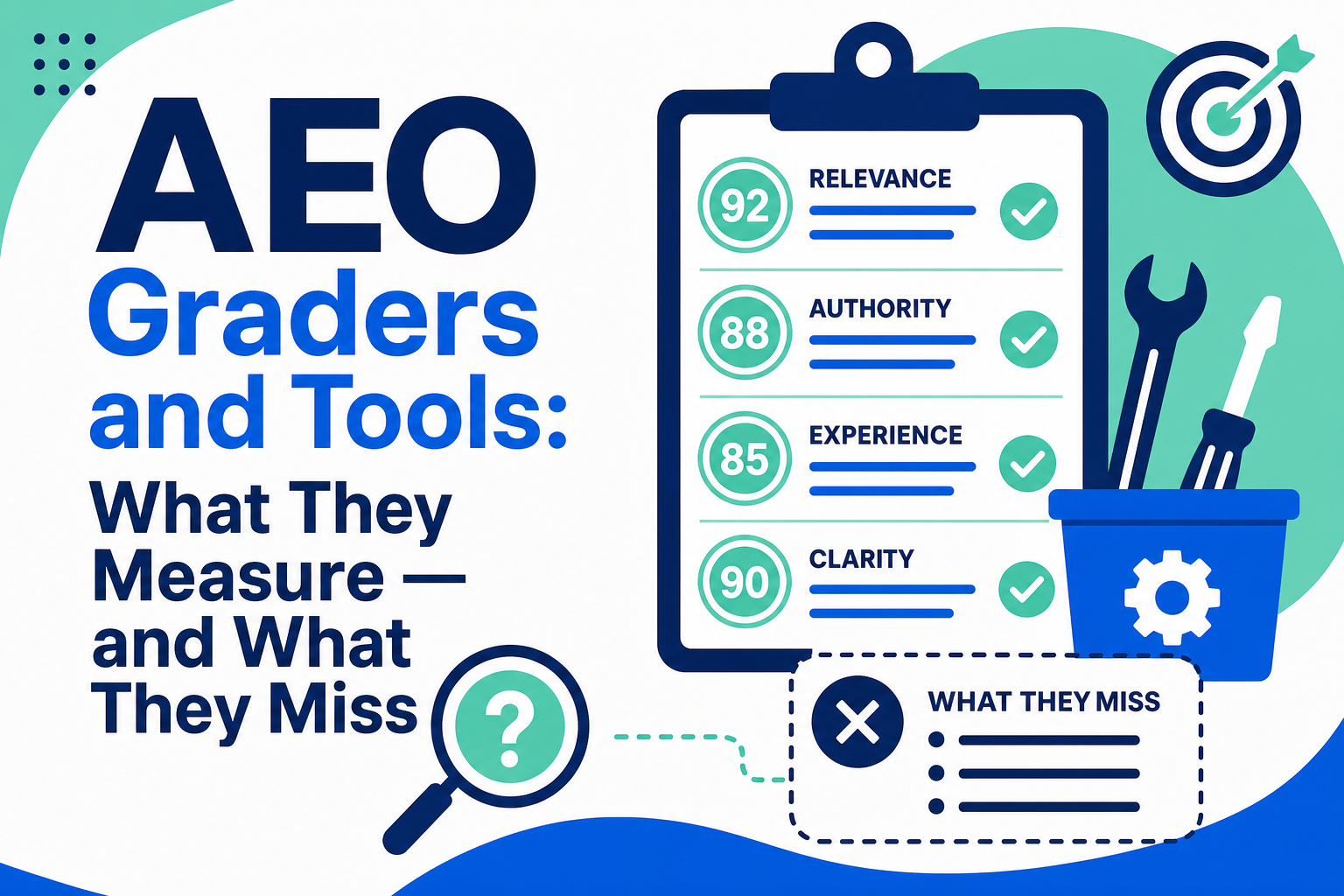
Quick answer: AEO graders score how your brand shows up in AI answer engines like ChatGPT, Gemini, and Perplexity — HubSpot's free AEO Grader, for example, evaluates dimensions such as sentiment, brand recognition, and share of voice, per HubSpot's product pages. These tools are a genuinely useful baseline, but they cannot tell you whether AI engines cite you for the queries that actually drive revenue, whether your content demonstrates real expertise, or what to write next. Treat a grader score as a starting diagnostic, not a strategy.
What is an AEO grader?
Answer engine optimization (AEO) is the practice of improving how often — and how accurately — your business appears in AI-generated answers. An AEO grader is a scoring tool that automates the first diagnostic step: it checks how AI platforms currently characterize your brand and, in some cases, how well your website is structured for machine consumption.
The most visible example is HubSpot's AEO Grader (also surfaced as the AI Search Grader), a free tool that produces a one-time snapshot of a brand's visibility in AI search. Per HubSpot's product documentation, it scores how ChatGPT, Gemini, and Perplexity characterize a brand across five dimensions: sentiment, presence quality, brand recognition, share of voice, and market position. HubSpot pairs it with a broader HubSpot AEO product for ongoing prompt tracking, competitor analysis, and prioritized recommendations.
Other vendors offer comparable prompt-monitoring and AI-visibility tools. The category is young, methodologies differ, and scores from different tools are not directly comparable — which is exactly why it helps to understand what any grader can and cannot see.
What do AEO graders actually measure?
Most tools in this category evaluate some combination of the following:
- Brand presence in AI answers. Whether the major engines mention your brand at all when prompted about your category, and how prominently.
- Sentiment and framing. Whether AI-generated descriptions of your company are positive, neutral, or muddled — and whether they are accurate.
- Share of voice. How often you appear relative to competitors across a sample of prompts.
- Content structure signals. Some audits look at whether pages lead with direct answers, use clear headings, include FAQ content, and carry structured data (schema markup) that machines can parse.
- Entity clarity. Whether your company, products, and people are described consistently enough across the web for an AI model to understand who you are and what you do.
- Crawlability. Whether AI crawlers can actually access and render your content.
That is real, useful information — especially the outside-in view of how engines describe you, which most marketing teams have never checked systematically.
What can't an automated grader tell you?
Here is the honest part. A grader score, on its own, misses several things that determine whether AEO investment pays off:
- Whether you get cited for the queries that matter. Graders sample prompts. Your buyers ask specific, high-intent questions — "best CRM for a 200-person insurance agency," not "tell me about CRMs." A strong aggregate score can coexist with zero visibility on your money queries.
- Content quality and expertise. No automated tool can judge whether your content reflects genuine, first-hand experience — the thing AI engines increasingly reward and buyers ultimately trust.
- Competitive context. A score of 70 means little without knowing whether your closest competitors score 40 or 90 on the same prompts, and why.
- Attribution to pipeline. Graders measure visibility, not outcomes. Connecting AI-referred traffic and mentions to actual deals requires your CRM, not a grader.
- Volatility. AI answers vary by phrasing, session, and model version. A single snapshot can swing meaningfully between runs, so one-time scores should be read as directional.
How do grader checks compare with human judgment?
| Dimension | What an automated grader can check | What still requires human judgment |
|---|---|---|
| Brand mentions | Whether engines mention you across sampled prompts | Whether those prompts match your real buying questions |
| Sentiment | Positive/neutral/negative framing of your brand | Whether the description is strategically accurate and current |
| Structure | Headings, schema markup, answer-first formatting | Whether the answer itself is correct, specific, and expert |
| Share of voice | Mention frequency vs. named competitors | Which competitors actually matter in your deals |
| Content gaps | Topics where you are absent from answers | Which gaps are worth the cost of closing |
How do you run a practical AEO self-audit?
You can get most of the way to a credible baseline in an afternoon:
- List 15–25 real buyer questions. Pull them from sales calls, support tickets, and your highest-converting search queries — phrased the way a buyer would ask them.
- Ask the engines directly. Run each question through ChatGPT, Gemini, and Perplexity. Record whether you are mentioned, cited, or invisible — and who is cited instead.
- Run a grader for the outside-in view. A free tool such as HubSpot's AEO Grader gives you a repeatable baseline score to track over time.
- Check your best pages for answer-readiness. Does each page open with a direct 2–4 sentence answer? Are H2s phrased as questions? Is there FAQ schema? Can the content be understood without images?
- Verify entity consistency. Confirm your company description, service names, and leadership details match across your site, LinkedIn, and directory listings.
- Confirm crawler access. Review your robots.txt and any bot-blocking rules to make sure you are not unintentionally shutting out AI crawlers you want.
How should grader output feed your content plan?
The score is not the deliverable — the prioritized fix list is. A sensible sequence:
- Fix accuracy problems first. If engines describe your business incorrectly, correct the source material (site copy, about pages, key profiles) before creating anything new.
- Close high-intent gaps next. Write answer-first content for the buyer questions where competitors are cited and you are not.
- Retrofit your best existing pages. Adding quick answers, question-style headings, and FAQ schema to pages that already rank is usually faster than net-new content.
- Re-measure monthly, not daily. AI answers are volatile; track the trend across a consistent prompt set rather than reacting to single-run swings.
For the full playbook on structuring content for AI engines, see our complete guide to HubSpot answer engine optimization.
Frequently asked questions
Is HubSpot's AEO Grader free?
Yes. Per HubSpot's product pages, the AEO Grader is a free tool that produces a one-time snapshot of your brand's visibility in AI search. HubSpot positions its paid HubSpot AEO product for ongoing prompt tracking, competitor analysis, and prioritized recommendations beyond that initial baseline.
How often should we re-check our AEO scores?
Monthly is a practical cadence for most mid-market teams. AI answers fluctuate between sessions and model updates, so what matters is the trend across a consistent set of prompts — not any single reading. Re-check sooner after publishing a significant batch of new content or fixing structural issues.
Do AEO graders replace SEO tools?
No. SEO tools measure rankings, backlinks, and technical health in traditional search; AEO graders measure how AI engines characterize and cite your brand. The disciplines overlap — well-structured, authoritative content helps both — but you should track them separately because buyers now research through both channels.
Can a high grader score guarantee AI citations?
No tool can guarantee citations. Engines weigh many signals, change frequently, and generate different answers to differently phrased prompts. A strong score indicates your foundations are sound; sustained citations come from consistently publishing accurate, expert, answer-first content on topics where you have genuine authority.
Should we grade our competitors too?
Yes — it is one of the highest-value uses of a free grader. Running the same assessment on two or three direct competitors turns an abstract score into context: you learn where they are cited and you are not, which is precisely the gap list your content plan should attack.
How Vantage Point helps
Vantage Point helps mid-market teams turn AEO diagnostics into pipeline. We audit how AI engines currently describe your brand, prioritize the fixes that matter for your actual buyer questions, and build the HubSpot foundation — content structure, schema, and reporting — that connects AI visibility to revenue in your CRM and marketing automation stack. Senior consultants only — no junior handoffs; the experts you meet are the experts who deliver. If your grader score has you wondering what to do next, that conversation is where we start.