
TL;DR / Key Takeaways
| What is it? | A 56-week enterprise Salesforce build that replaced a failed legacy CRM and codified a brokerage's proprietary sales methodology |
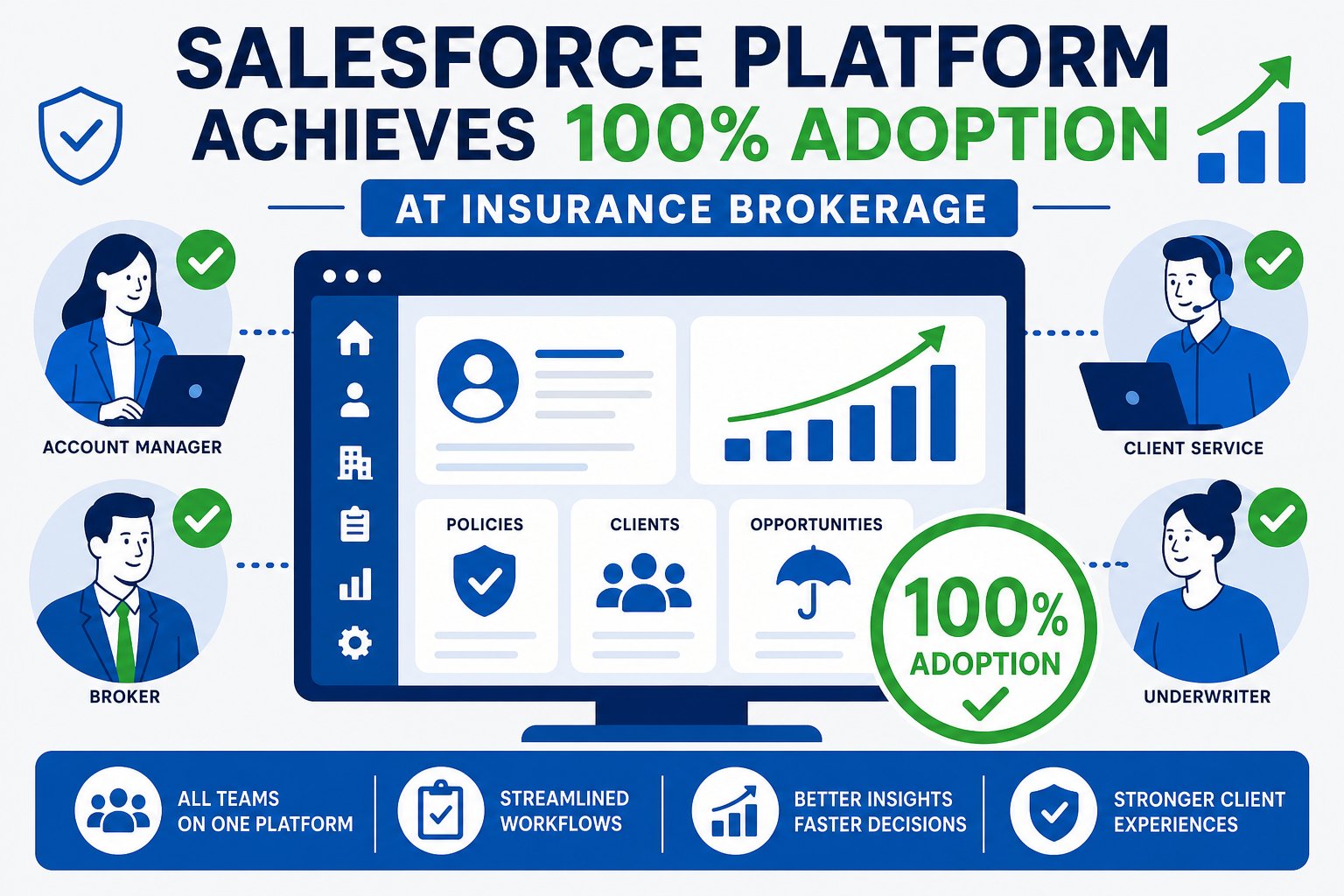
| Key Benefit | 100% user login rate at go-live after three prior failed CRM attempts |
| Industry | Insurance brokerage and benefits consulting |
| Platform | Salesforce Sales Cloud, Account Engagement (Pardot), Agentforce |
| Best For | Insurance brokerages with a history of failed CRM adoption and a dual-pronged growth strategy (organic plus M&A) |
| Bottom Line | Adoption failures are usually a process and accountability problem, not a software problem: fixing both together is what makes a CRM stick |
Most insurance brokerages that have been through a failed CRM rollout assume the next platform will fail too. This case study covers how a regional insurance brokerage and benefits consultancy broke that pattern, working with Vantage Point to replace a legacy CRM with a Salesforce platform that hit 100% user adoption at launch.
Quick Answer
This case study explains how a regional insurance brokerage and benefits consultancy, after three failed CRM implementations, replaced Microsoft Dynamics with a Salesforce platform that achieved 100% user login within 30 days of go-live. It matters for insurance brokerages and agencies with a history of low CRM adoption, shadow-IT spreadsheets, and disconnected sales methodologies. It's directly relevant to organizations evaluating Salesforce Account Engagement for marketing automation or Agentforce for AI-driven service, and shows where Vantage Point's Salesforce implementation and change management expertise applies to insurance distribution.
The Challenge: Three Failed CRMs and a Growing Shadow-IT Problem
The firm is a premier insurance and financial services brokerage operating two distinct growth engines: a fully integrated commercial division serving complex sectors such as agribusiness, construction, and transportation, and an aggressive Main Street acquisition model that acquires local agencies at a pace of roughly one integration per month.
This rapid, dual-pronged growth created serious technology fractures. The firm's legacy Microsoft Dynamics CRM failed to capture the nuanced sales methodologies its elite producers relied on, driving widespread user abandonment and the proliferation of shadow IT: mainly decentralized Excel spreadsheets used for pipeline management. Three prior CRM implementations had all failed to achieve meaningful adoption, and leadership recognized that sustaining growth across both business models required a unified, enterprise-grade platform rather than another software swap.
The Solution: A 56-Week Enterprise Transformation Built on Accountability
The firm's executive leadership retained Vantage Point to architect and deploy a centralized Salesforce platform designed to replace Microsoft Dynamics and codify the firm's proprietary sales methodology. Using a structured project methodology, Vantage Point delivered a comprehensive 56-week transformation across four major phases.
Phase 1: Core Build
Vantage Point delivered extensive opportunity and pipeline configuration, custom page layouts tailored to each division's terminology (agribusiness, construction, transportation), automated case management with escalation rules, and integrations with the firm's telephony system and Microsoft SharePoint for document management.
Phase 2: Codifying the Firm's Sales Methodology
Rather than digitizing flawed processes, Vantage Point hardcoded the firm's proprietary, consultant-based sales methodology directly into the platform. This included a gamified activity tracker for producer engagement, visual dashboards separating revenue-generating activities from administrative tasks, and automated book-of-business analysis surfacing cross-sell opportunities and at-risk accounts directly on each producer's dashboard.
Phase 3: Marketing Automation
The team deployed Salesforce Account Engagement (Pardot) to centralize all prospect engagement data, replacing a legacy marketing automation tool. Vantage Point engineered lead routing across the firm's diverse divisions, multi-touch nurture campaigns, and event management integration, establishing Salesforce as the single source of truth for the entire customer journey.
Phase 4: AI-Powered Personal Lines Transformation
Vantage Point deployed Agentforce service agents to autonomously resolve tier-one client inquiries across digital channels, implemented a data foundation merging structured CRM data with unstructured documents, and built a unified advisor desktop with AI-generated cross-sell recommendations: reducing the significant administrative burden carried by personal lines advisors.
Three Pillars of Accountability
The firm's CIO established a zero-tolerance accountability framework enforced from the CEO down, built on three pillars: system functionality delivering tangible efficiency gains without friction, data integrity establishing the CRM as the undeniable single source of truth, and user engagement with no shadow IT and no workarounds. This top-down sponsorship, reinforced weekly by senior leadership, broke the organization's history of failed CRM deployments.
The Results: From Adoption Failure to Full Engagement
CRM user adoption moved from three prior failed attempts to a 100% login rate within 30 days of go-live. Pipeline visibility shifted from fragmented Excel spreadsheets to centralized, real-time forecasting. Campaign ROI tracking moved from a disconnected process unable to attribute results to closed-loop automated attribution. Administrative burden on personal lines advisors (previously consuming the majority of their time on non-revenue tasks) is now partly absorbed by AI agents handling tier-one inquiries autonomously.
Leadership targeted a 3:1 return on investment within 12 months of go-live and gave the rollout an internal executive grade of "A-minus." As one executive put it: "Even if IT executes the best system implementation in history with perfectly clean data, the project is a complete failure if the staff does not actively engage with it. System One delivered on all three pillars."
Key Technologies and Integrations
- Salesforce Sales Cloud
- Salesforce Account Engagement (Pardot)
- Salesforce Agentforce (AI service agents)
- Salesforce Pipeline Inspection and Engagement Studio
- CTI telephony integration
- Microsoft SharePoint integration
- Event management integration
- Data foundation merging structured and unstructured data
Why It Matters: Lessons for Similar Organizations
Insurance brokerages that have been through multiple failed CRM rollouts often blame the software rather than the underlying accountability structure. This case shows that adoption failure is usually a process and leadership problem: without top-down enforcement of system functionality, data integrity, and user engagement, even a well-configured CRM will lose to shadow-IT spreadsheets. The fix isn't a better tool alone. It's pairing the tool with a genuine accountability framework reinforced from the top of the organization.
It also demonstrates the value of hardcoding a firm's actual sales methodology into the CRM rather than forcing producers into a generic, out-of-the-box process. Brokerages with established, proven sales approaches should expect their CRM to reflect that methodology, not the other way around. For any organization considering how Agentforce or AI service agents fit into personal lines or high-volume service operations, this case shows a practical, phased path: get core adoption right first, then layer in AI-driven automation.
If your brokerage has a history of failed CRM rollouts or shadow-IT spreadsheets, Salesforce implementation and advisory paired with advisory and change management support is the right starting point for an assessment.
Frequently Asked Questions
Why do CRM implementations fail at insurance brokerages even after multiple attempts? Failed CRM rollouts are usually a symptom of weak accountability and process design, not just a software choice problem. If a platform doesn't reflect the firm's actual sales methodology, or leadership doesn't enforce consistent usage, producers revert to spreadsheets regardless of how the CRM is configured.
What does it mean to "hardcode" a sales methodology into Salesforce? It means building the CRM's page layouts, dashboards, and automation to match a brokerage's existing, proven sales process, rather than forcing producers to adapt to a generic, out-of-the-box workflow. This typically increases adoption because the system supports how producers already work.
How does Salesforce Agentforce apply to personal lines insurance service? Agentforce can be configured to autonomously resolve tier-one client inquiries across digital channels, handling routine, repetitive service requests so human advisors can focus on complex cases and cross-sell opportunities. It requires clean underlying data and clear escalation rules to work reliably.
What accountability structure supports high CRM adoption? A strong accountability framework typically includes clear system functionality expectations, treating the CRM as the single source of truth for data integrity, and enforcing user engagement with no exceptions for shadow-IT workarounds: reinforced consistently by leadership at every level.
How long does an enterprise Salesforce build take for a brokerage with a dual-growth model (organic and M&A)? This engagement was delivered over 56 weeks across four major phases: core build, methodology codification, marketing automation, and AI-powered personal lines transformation. Timelines depend on the number of divisions, integrations, and the complexity of the sales methodology being codified.
What is Salesforce Account Engagement (Pardot) used for in an insurance brokerage context? It centralizes prospect engagement data and automates lead routing, nurture campaigns, and event management across multiple business divisions, giving the brokerage a single source of truth for the full customer journey from first touch through policy placement.
How can a brokerage measure ROI on a Salesforce transformation? Common metrics include user adoption rate, pipeline visibility improvements, marketing attribution accuracy, and time savings on administrative tasks. This brokerage targeted a 3:1 return on investment within 12 months, tracked alongside its 100% adoption rate at launch.
Ready to Transform Your Operations?
Vantage Point specializes in Salesforce and HubSpot implementations for growth-focused and regulated organizations alike, from financial services and insurance to multifamily real estate and beyond. With a senior-only, AI-augmented team, we bring deep expertise to every project.
Contact Vantage Point to discuss your transformation journey.
A regional insurance brokerage and benefits consultancy is one of many organizations that have partnered with Vantage Point to modernize their operations. Names and identifying details have been changed to protect client confidentiality.