
Quick Answer
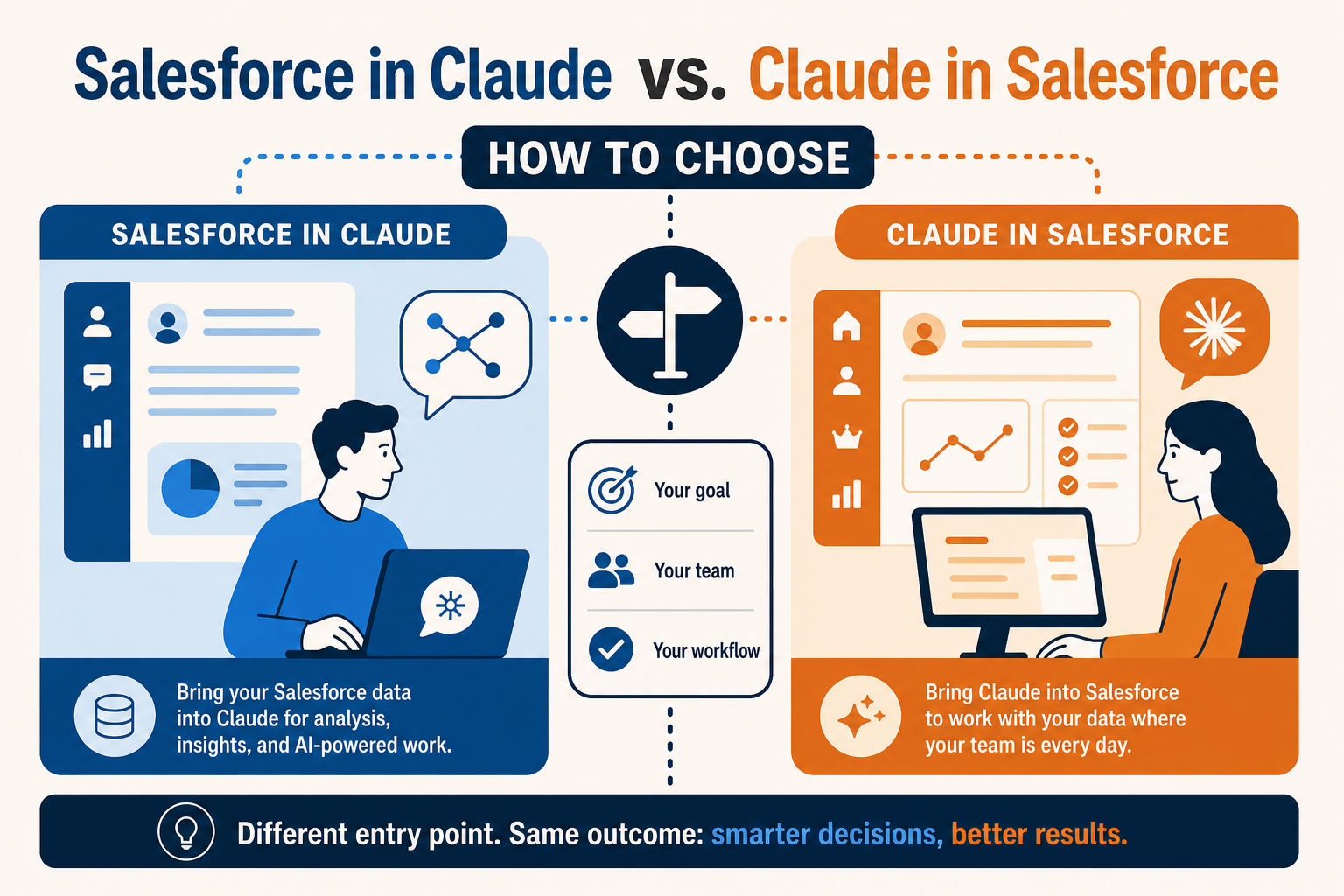
Salesforce in Claude brings Salesforce data and actions into the Claude chat window through a plugin. Claude in Salesforce puts Claude models inside Agentforce, so the work happens in Salesforce. The deciding question is where your people already work. If they live in Claude or need to pull from several tools at once, start with Salesforce in Claude. If they work in Salesforce records and need governed automation, start with Claude in Agentforce. Many financial services firms will use both for different teams. Either way, settle governance and data readiness first. Vantage Point helps regulated firms make that call.
Key Takeaways (TL;DR)
- Salesforce in Claude: a plugin with 37 sales skills, announced August 26, 2026 and released in beta September 15. Salesforce approves organizations through a beta sign-up.
- Claude in Salesforce: Claude models running inside Agentforce. Salesforce's release notes show Anthropic as a model option since July 2025.
- Shared safeguard: in both directions, Claude works under each user's existing Salesforce permissions.
- Different risk: the Agentforce path runs inside Salesforce's Trust Boundary. The Claude path adds a second vendor and a new place where CRM data is read and drafted.
- Before you switch either on: name who approves, scopes, logs and reviews, then clean up duplicates, ownership and permission sets.
Two announcements now sit side by side. Salesforce data can show up inside Claude, and Claude can run inside Agentforce. Firms keep asking whether these are competing options.
They are two doors into the same room. The useful question isn't which product is better. It's which door your people will actually walk through. This guide compares them, gives you a checklist by role, and lists the governance and data questions to answer first. It's written with banks, credit unions, RIAs and insurers in mind, and the logic holds for other regulated and mission-driven organizations. Vantage Point is a Claude Partner Network Member.
Status as of September 29, 2026: facts below come from Salesforce and Anthropic pages on that date. Both products are changing quickly, so recheck before you commit.
What is Salesforce in Claude, and how available is it?
Salesforce in Claude is a plugin built by Salesforce and Anthropic that lets sellers work with CRM data from inside Claude. Salesforce announced it on August 26, 2026 as the first product of the Claudeforce partnership. Anthropic released it in beta on September 15.
It bundles 37 sales skills, a Salesforce connector, a Slack connector and a setup skill that personalizes the plugin to a user's role. Anthropic's blog and Help Center describe workflows such as account research, call prep, renewal prep, pipeline review, quarterly business review decks and follow-up drafts. We couldn't find an official page that lists all 37 skills by name, so we don't list them here.
Is Salesforce in Claude generally available?
No. It's a beta. Anthropic says it is available in beta on all paid Claude plans. Its admin setup guide adds a limit: the plugin is for organizations Salesforce approves through its AgentExchange beta sign-up. It says eligibility requires the latest Sales Cloud Enterprise Edition, and that it currently works in Claude chat and Claude Cowork on web and desktop.
Is Salesforce in Claude in Claude's connector directory?
Partly. The Salesforce MCP server is listed in Claude's directory, labeled a beta service. Anthropic says it can be installed directly from the marketplace. The full plugin, with the skills, is distributed through a Salesforce marketplace in Claude's organization plugin settings after Salesforce approves your access.
What is Claude in Salesforce, and has it really been live for a year?
Claude in Salesforce means Claude models powering Agentforce agents inside your Salesforce org. It has been available for more than a year, but the earliest release was limited. Salesforce's release notes say choosing Anthropic on Amazon Bedrock for Agentforce began the week of July 21, 2025. The first step required contacting Salesforce, and admins could select it in Setup from August. On October 14, 2025, Salesforce and Anthropic expanded the partnership with a focus on regulated industries.
The August 2026 announcement says Claude is a reasoning model for the Atlas Reasoning Engine, powers Agentforce Vibes and Agentforce Coworker by default, and is available in Agent Builder. Salesforce's model option page also shows this isn't automatic for every agent. It recommends the Salesforce Default mix, and lists an AWS-Hosted option that uses Claude Haiku 4.5 on Bedrock. Someone has to choose it and test the agents afterward.
On data handling, that page says LLM traffic stays inside Salesforce's virtual private cloud, model providers can't access customer data, and nothing is persisted or used for training. Salesforce's Einstein Trust Layer adds data masking, zero-data retention agreements with model providers, and audit logging in Data 360.
Salesforce in Claude vs. Claude in Salesforce: how do they compare?
| Question | Salesforce in Claude | Claude in Salesforce (Agentforce) |
|---|---|---|
| Where do users work? | In Claude chat or Cowork, across Salesforce, Slack and other connectors | In Salesforce, or through agents that run on Salesforce's platform |
| Data path | Claude reads Salesforce through an MCP connection. Data is handled in Claude under your Anthropic plan terms. | Model traffic stays inside Salesforce's Trust Boundary on the AWS-Hosted option |
| Permissions | Each user signs in with their own Salesforce account. Object, field-level and sharing rules apply. | Governed by the agent's configuration and Salesforce's grounding and permission controls |
| Audit | Salesforce says its audit trail attributes MCP actions to the user. Claude adds admin controls, and audit logs on Enterprise plans only. | Trust Layer audit trail, with prompts and responses logged in Data 360 |
| Best fit | Prep, research, pipeline review, drafting CRM updates for a person to approve | In-record actions, case work, and agents that run with less human driving |
| What admins configure | Salesforce beta access, MCP server, External Client App, Claude plugin and connector settings | Model option, agent design, actions, Trust Layer settings, required add-on licenses |
| Status | Beta, Salesforce-approved organizations | Available in Agentforce, with licenses that vary by agent type |
Where do your people already work?
That question does most of the deciding. People adopt the tool that's already open on their screen. Use this table as a starting point by role and workflow.
| Role or workflow | Lean toward | Why |
|---|---|---|
| Relationship managers and advisors prepping meetings from CRM, email and Slack | Salesforce in Claude | The prep work spans several tools, and a person reviews the output |
| Sales leaders reviewing pipeline and drafting forecast notes | Salesforce in Claude | It's a conversation across many records, with drafts for approval |
| Service and operations teams working cases in the Salesforce console | Claude in Agentforce | The work is in-record and repeatable, and it belongs in Salesforce |
| Customer-facing or high-volume automation | Claude in Agentforce | It needs the Trust Boundary, defined actions and monitoring |
| Compliance and supervision staff | Neither at first | Give them a review role in the rollout before broad access |
| Admins and developers | Pilot in a sandbox | Salesforce's MCP guidance singles these roles out because they carry wide-ranging permissions |
If a team splits across rows, that's normal. The same person can prep a meeting in Claude in the morning and work a service case in Salesforce that afternoon. Don't force one choice per person. Choose per workflow, and keep a short written list of which tool is approved for which task, so staff know where each kind of client data belongs.
A firm might give advisors Salesforce in Claude and build service agents in Agentforce. For more on that split, see our Agentforce vs. Claude decision guide and our comparison of Agentforce vs. Claudeforce.
Which governance questions should you answer before turning either on?
Permission inheritance is a strong start, not a governance program. Salesforce's own MCP documentation tells admins to be deliberate about the permissions granted at the client level. Answer these first:
- Who approves? Name one owner for each direction, with compliance and security at the table.
- Who gets access? The Claude plugin can be installed by default, available to install or required for groups. Start with a pilot group, not the whole firm.
- What can it write? By default Claude asks the user to approve each change. The user can choose "Always allow," so decide whether your policy permits that.
- What gets logged? Map where each side records activity, and who can pull those records. Claude's audit logs are for Enterprise organizations only, and chat content isn't in them, though Primary Owners can export chat inputs and outputs.
- What is retained? Confirm data-handling terms for your plan on both sides, including how the beta is covered.
- What must be kept? Ask compliance whether prompts, drafts and AI-assisted client communications fall under your recordkeeping policies.
- How is the vendor reviewed? Claude adds Anthropic to the data path. Our Trust Boundary guide covers what to add to your vendor questionnaire.
- When is it reviewed again? Set a cadence, because beta features and skill lists are still changing.
Pricing is the one area where official facts are thin. Salesforce says pricing and packaging are subject to change, and the Claude setup guide names only the Sales Cloud edition needed for the beta. Salesforce's help pages say Agentforce add-on licenses vary by agent type. Get your edition and licensing confirmed in writing by your account team. Our licensing budget post covers what executives have said publicly.
How do you check data readiness first?
Both directions read your CRM at conversation speed, so gaps show up faster. Permission inheritance also means an over-broad permission set stays over-broad. This is the step most firms skip. Check these five items:
| Check | What to look for |
|---|---|
| Duplicates | Repeated accounts, contacts or households that give an agent two answers |
| Ownership | Records with no owner, or owners who have left |
| Field hygiene | Unused, unclear or stale fields that Claude might summarize as fact |
| Permission sets | Sets built for an old org chart, or broader than the job requires |
| Sharing model | Sharing rules and field-level security that still match who should see what |
Run this check on the pilot group's slice of the org first. It's faster than a full audit and shows you what Claude will actually see.
What should you do next?
- Map your teams to the role table above and pick one pilot group per direction.
- Answer the governance questions in writing, and record the approver.
- Run the data-readiness check on the records that group can reach.
- Request beta access and test in a sandbox before production.
- Review the pilot, then widen access on a schedule.
How Vantage Point Helps
Vantage Point helps regulated firms decide where Claude belongs alongside Salesforce. We map teams to the right direction, clean up the data and permissions Claude will inherit, configure Agentforce and the Claude connection, and document the approvals. Our compliance and security solutions team ties those controls to your written policies.
Senior consultants only — no junior handoffs; the experts you meet are the experts who deliver.
Decide Where Claude Belongs in Your Salesforce Org
Not sure whether your advisors, service teams or operations staff should start in Claude, in Agentforce or both? Vantage Point can review your teams, permissions and data, then hand you a rollout plan. Talk to Vantage Point about your Claude and Salesforce rollout.
Frequently Asked Questions
What is the difference between Salesforce in Claude and Claude in Salesforce?
Salesforce in Claude brings Salesforce data and actions into the Claude chat window through a plugin. Claude in Salesforce uses Claude models inside Agentforce, so the work stays in Salesforce. The first suits people who work in Claude. The second suits people who work in Salesforce.
Is Salesforce in Claude generally available?
Not yet. As of September 29, 2026, Anthropic describes it as a beta on all paid Claude plans, and Salesforce approves organizations through an AgentExchange beta sign-up. Salesforce says additional prebuilt skills begin launching in late 2026.
Does Salesforce in Claude respect Salesforce permissions?
Yes, according to both companies. Each user signs in with their own Salesforce account, and Claude reads only what that user's permissions allow. Salesforce's MCP documentation says object, field-level, sharing and permission set rules all apply. Permissions don't fix messy data or over-broad access, so audit them first.
Can Salesforce in Claude change records without approval?
By default it asks the user to approve each proposed change before it is written. Users can choose "Allow once," "Always allow" or "Deny." Decide up front whether your policy allows "Always allow," especially for client-facing records.
Does Claude in Agentforce keep data inside Salesforce?
On the AWS-Hosted model option, Salesforce says LLM traffic stays inside its virtual private cloud, model providers can't access customer data, and nothing is persisted or used for training. Salesforce also says some tasks, such as classification or citations, may use Salesforce-owned models.
Should we choose one direction or use both?
Many firms will use both. Choose by team: Salesforce in Claude for people doing cross-tool research and prep, and Agentforce for in-record actions and higher-volume automation. The governance and data-readiness work is largely shared, so doing it once helps both.
What does each option cost?
Official pricing is limited. Salesforce says pricing and packaging are subject to change. The Claude setup guide says the beta needs the latest Sales Cloud Enterprise Edition, and Agentforce add-on licenses vary by agent type. Confirm your edition, seats and license needs in writing with Salesforce and Anthropic.
Sources
- Salesforce and Anthropic Announce Claudeforce — Salesforce, August 26, 2026
- Claudeforce — Salesforce
- Bringing Salesforce into Claude — Anthropic, September 15, 2026
- Set up Salesforce in Claude for your organization — Claude Help Center
- Use Salesforce in Claude — Claude Help Center
- Salesforce MCP Server — Claude connector directory
- Headless 360 MCP Server (Beta) — Salesforce Developers
- Select Anthropic for Agentforce — Salesforce release notes
- Select Agentforce Model Option — Salesforce Help
- Einstein Trust Layer — Salesforce Help
- Anthropic and Salesforce Expand Strategic Partnership — Salesforce, October 14, 2025
- Salesforce in Claude beta access — AgentExchange
Vantage Point is a boutique CRM consulting firm helping businesses transform with Salesforce, HubSpot, and AI. Ready to decide where Claude belongs? Start a conversation with Vantage Point or learn more at vantagepoint.io.