
Most CRM and AI initiatives do not stall because the technology is weak or the budget is too small. They stall because of how they are scoped. The big-bang project tries to boil the ocean and collapses under its own weight. The open-ended pilot drifts for months and never produces anything a business leader can point to. Both fail for the same reason: there is no early, undeniable proof that the work is worth continuing.
There is a better way to start. Instead of buying a giant project or funding an experiment with no finish line, scope a short, time-boxed accelerator that produces one working artifact tied to a real workflow. Prove value on something narrow and real, then expand from evidence instead of optimism.
This is a strategic brief for operations, RevOps, and IT leaders who are tired of stalled initiatives and want a practical, lower-risk way to start a CRM or AI project that actually reaches production.
Quick Answer
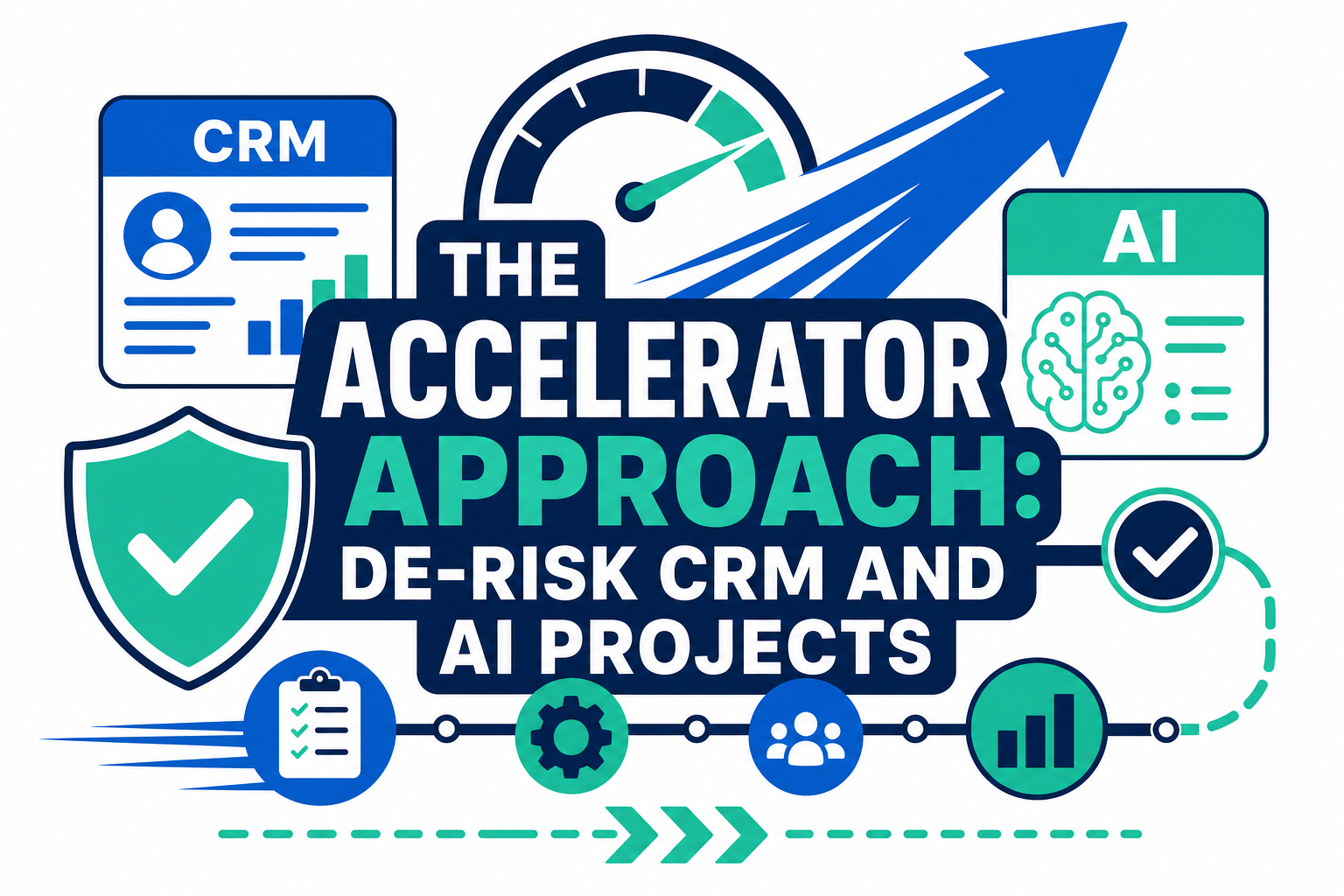
The accelerator approach is a short, scoped engagement that solves one real workflow and produces a working artifact before you commit to a large program. It matters for any leader deciding how to start a CRM or AI investment without betting the budget on a multi-month plan that may never ship. The decision it supports is simple: choose a narrow, time-boxed first step over a big-bang rollout or an open-ended pilot. Vantage Point uses this model to take teams from discovery to a working proof of concept, then expand only what works.
TL;DR
- What it is: A short, time-boxed accelerator that solves one real workflow and ships a working artifact before any large CRM or AI program is approved.
- Why it matters: Big-bang projects and open-ended pilots both stall; a scoped first step gives leaders early proof and a clear go or no-go decision.
- Best for: Operations, RevOps, and IT leaders starting a CRM or AI initiative who need to control risk and show value fast.
- Decision point: Prefer a narrow, working proof of concept over a slide deck or an experiment with no finish line.
- How Vantage Point helps: We run focused accelerators across Salesforce, HubSpot, and AI in your CRM, then scale what proves out.
What Is an Accelerator Approach to CRM and AI Projects?
An accelerator approach is a deliberately small, time-boxed engagement that delivers one working outcome instead of a full program plan. Rather than scoping every requirement up front, you pick a single high-value workflow, set a tight deadline, and build something real that people can use and judge. The output is not a strategy deck or a sandbox demo — it is a working artifact connected to live data and a genuine business process.
The point of the accelerator is to compress the distance between intent and evidence. A leader should be able to look at the result within weeks and answer one question: did this make a real workflow measurably better? If yes, you expand. If no, you stop, having spent a fraction of a full project budget.
Why Big-Bang Projects and Open-Ended Pilots Both Stall
The two most common ways teams start a CRM or AI initiative are also the two most common ways they fail.
The big-bang project tries to design the entire future state before delivering anything. Requirements balloon, timelines slip, and by the time the first usable feature ships, the business has moved on. Risk is concentrated at the very end, which is the worst possible place for it.
The open-ended pilot has the opposite problem. It starts small but never defines what success looks like or when it ends. The team experiments, the demo looks promising, and then it quietly drifts because no one can say whether it is ready to scale. A demo-grade result is not a production-grade result, and the gap between them is where most pilots go to die.
The accelerator avoids both traps by being small and finite, with a defined outcome and a hard stop.
How the Accelerator Approach Works
A good accelerator follows a simple, repeatable sequence:
- Pick one painful workflow. Choose a single process that is high-frequency, clearly owned, and visibly broken — not the most ambitious idea, the most concrete one.
- Time-box it. Set a short, fixed window. The constraint forces hard scoping decisions and prevents the work from sprawling.
- Build a working artifact. Deliver something usable on real data — an automation, a clean data flow, a scoped agent, or a configured process — not a mockup.
- Put it in front of real users. Let the people who do the work try it. Their reaction is the only proof that matters.
- Decide with evidence. Use the result to make an explicit go, adjust, or stop decision before scaling.
- Expand from proof. Once one workflow is undeniably better, extend the pattern to adjacent processes with confidence and a template to follow.
This sequence works the same way for a workflow automation project, a CRM cleanup, or a first AI use case. The discipline — narrow scope, working artifact, hard stop — is what makes it repeatable.
Accelerator vs Big-Bang Project vs Open-Ended Pilot
| Dimension | Big-Bang Project | Open-Ended Pilot | Accelerator Approach |
|---|---|---|---|
| Scope | Everything at once | Loosely defined | One real workflow |
| Timeline | Long, often slips | Indefinite | Short and fixed |
| Output | Plan, then late delivery | Demo or experiment | Working artifact on real data |
| When risk shows up | At the end | Never resolved | Up front and contained |
| Decision point | After heavy spend | Unclear | Early go / no-go |
| Best for | Mature, well-understood needs | Pure research | Most CRM and AI starts |
For most teams, the accelerator column is the right answer. The big-bang approach only makes sense when the requirements are genuinely well understood and stable, and a true open-ended pilot belongs in research, not in a revenue-critical workflow.
Free Pilot vs Paid Proof of Concept: Which Should You Choose?
This is where many initiatives quietly go wrong, so it deserves a direct opinion: a scoped, paid proof of concept almost always beats a free, open-ended pilot.
A free pilot sounds low-risk, but it usually has no committed scope, no clear owner on either side, and no deadline. Because no one has skin in the game, it is easy to let it drift and easy to abandon. The hidden cost is months of ambiguity and a team that concludes "AI isn't ready" when the real problem was the lack of a defined outcome.
A paid, time-boxed proof of concept changes the incentives. It forces both sides to agree on a single success criterion, a deadline, and a deliverable. The result is a working artifact you own and can build on — not a sunk experiment. The modest cost is the price of focus, and focus is exactly what stalled initiatives are missing.
If your team is weighing a CRM or AI investment, Vantage Point can run a focused accelerator that turns a single painful workflow into a working proof of concept — then give you an honest go, adjust, or stop recommendation before you commit to a larger program.
What Businesses Should Do Next
- List the workflows your team complains about most, then pick the one that is high-frequency and clearly owned.
- Define a single success criterion you could verify in weeks, not quarters.
- Set a hard time box and resist adding scope once it starts.
- Insist on a working artifact connected to real data — not a slide deck or a sandbox demo.
- Schedule the go / no-go decision before the work begins, so the finish line exists from day one.
- Plan the expansion path in advance: if it works, which adjacent workflow comes next?
How Vantage Point Helps
Vantage Point is a senior-led Salesforce and HubSpot consulting partner built around exactly this model: prove value on something small and real before scaling. We help organizations start CRM and AI initiatives that actually reach production by keeping the first step narrow, fast, and tied to a working outcome.
- Stand up a focused first use case with Salesforce implementation and advisory or HubSpot, depending on your stack.
- Turn a single broken process into a shipped result through workflow automation and process optimization.
- Make a first AI use case safe and useful with AI-driven personalization and analytics.
- Protect adoption as you expand with advisory and change management.
If a previous pilot stalled, our related guide on moving AI from proof of concept to production covers what it takes to scale once the accelerator proves out. When you are ready, Vantage Point can co-build an accelerator with your team — discovery, a working proof of concept, and a clear plan to expand only what works.
FAQ
What is an accelerator approach to CRM and AI projects?
It is a short, time-boxed engagement that solves one real workflow and produces a working artifact before you approve a large program. Instead of scoping everything up front or running an experiment with no finish line, you prove value on something narrow and real, then expand from evidence.
Why do so many AI and CRM pilots stall?
Most pilots stall because they have no defined success criterion and no end date, so a promising demo never becomes a production decision. The gap between a demo-grade result and a production-grade one is where these projects drift. A scoped accelerator with a hard stop forces an early go or no-go call.
Is a big-bang implementation ever the right choice?
Occasionally. A big-bang project can work when requirements are genuinely well understood, stable, and unlikely to change during delivery. For most CRM and AI initiatives, where the right design only becomes clear once people use something real, an accelerator is far lower risk.
Should we run a free pilot or a paid proof of concept?
A scoped, paid proof of concept usually wins because it forces both sides to commit to a deadline, an owner, and a single success criterion. Free pilots tend to drift without those commitments and are easy to abandon. The result of a paid proof of concept is a working artifact you own and can build on.
How long should an accelerator take?
Short enough that the time box forces real scoping decisions — typically weeks, not quarters. The exact length depends on the workflow, but the principle is the same: a fixed, near-term deadline that ends in a working result and a clear decision.
What should the accelerator actually produce?
A working artifact connected to live data and a real process — an automation, a cleaned-up data flow, a configured workflow, or a scoped AI agent that real users can try. A strategy deck or a sandbox demo does not count, because neither proves the work will hold up in production.
How does Vantage Point run an accelerator?
Vantage Point starts with a focused discovery to pick one high-value workflow, then builds a working proof of concept on your real data within a fixed window. We finish with an honest go, adjust, or stop recommendation and a plan to expand only what proves out, so you scale from evidence rather than optimism.