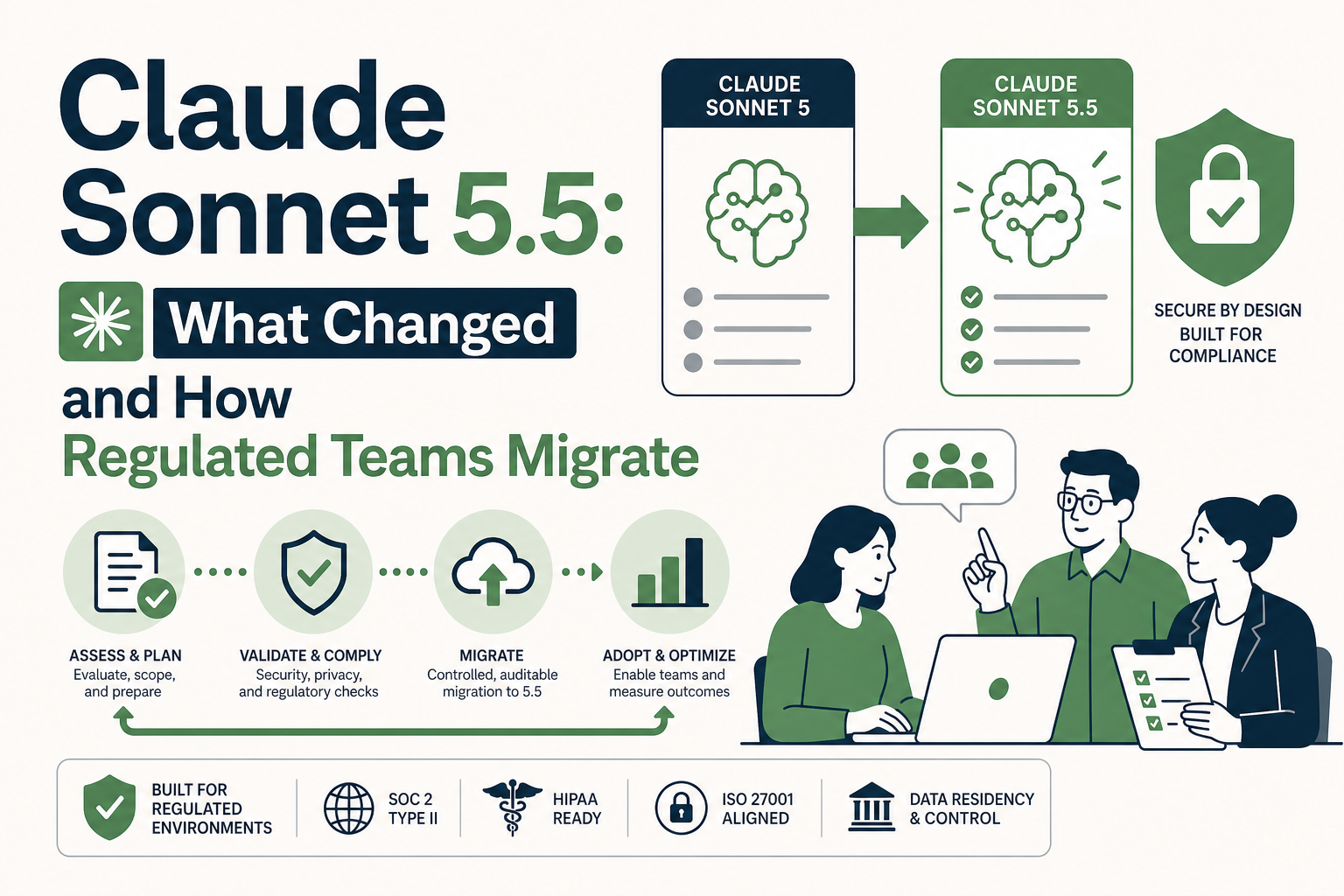
Status as of September 29, 2026: Claude Sonnet 5.5 is available now. For firms using Claude in customer-facing operations or sensitive internal workflows, this is a model-selection and migration decision: not a reason to switch every workload overnight.
Quick Answer
Claude Sonnet 5.5 is Anthropic’s faster, lower-cost-per-task successor to Sonnet 5 for well-scoped work. Regulated teams should pilot it against their own CRM, document, and coding tasks; retain Opus 5.5 where judgment matters more than throughput; and test two API-breaking changes before an API rollout: disabled thinking and forced tool choice both return errors. This is not an automatic update; for many integrations the starting change is the model string, but every integration needs request and response tests. Check model fallback, data handling, and account-bound reasoning too. Vantage Point, a registered Claude Partner Network Member, helps connect that evaluation to governed Salesforce and HubSpot workflows.
TL;DR
- Release: Claude Sonnet 5.5 is available in Claude apps, Claude Code, the Claude Platform, AWS, Google Cloud, and Microsoft Azure, according to Anthropic.
- Price versus work: Standard API list prices match Sonnet 5: $2 per million input tokens, $10 output, $0.20 cache reads, and $2.50 cache writes. Anthropic claims 30%+ faster output and up to 30% lower cost per task; validate both in your workload.
- Migration: This is not automatic: change the model ID to
claude-sonnet-5-5for most Claude API integrations, but test first. Disabled thinking and forced tool choice (anyor a namedtool) now return 400 errors; usebetween_toolsandtool_choice: auto, respectively. - Governance: Cyber safeguards can visibly switch certain requests in Claude apps to Sonnet 5; API fallback has separate, opt-in behavior. Preserved thinking affects account switches and conversation replay.
- Decision: Use Sonnet for bounded work, Opus for complex judgment, and wait for Haiku 5.5 only if the current light-duty tier already meets your needs. Align the pilot with compliance and security controls.
What changed with Claude Sonnet 5.5?
Anthropic announced Sonnet 5.5 on September 28 for routine knowledge work and code fixes, not as a replacement for Opus on every open-ended task. Haiku 5.5 will follow in the coming weeks, without a stated date in the Sonnet 5.5 announcement.
The measured gains are vendor-reported. Anthropic reports 70.6% on Terminal-Bench 4.0 for Sonnet 5.5 versus 10.3% for Sonnet 5, and 1844 versus 1846 for Sonnet 5.5 and Opus 5.5 respectively on GDPval-AA v2.1. The Sonnet 5.5 system card provides evaluation context and safety findings. Neither benchmark predicts accuracy on your records, policies, or approval chains; these are Anthropic’s results, not Vantage Point outcomes.
A CRM summary grounded in approved fields might suit Sonnet; an ambiguous exception may justify Opus plus human review. Anthropic cites high-volume financial analysis and polished short documents, decks, and spreadsheets as Sonnet candidates: test rather than assume regulated suitability.
Who is affected across Claude apps, API, integrations, and Claude Code?
Claude app users can select the model and should check which model actually answered after a safety-triggered switch. Plan access is separate from model choice; see our Claude plans and tiers guide. API owners must validate request parameters, response handling, model IDs, provider settings, and billing. Salesforce and HubSpot teams should test the integration layer (permissions, retrieved fields, redaction, logging, and write approvals) not merely the chat response. Claude Code users should run the existing test suite and review code changes for scope, security, and business logic.
Underwriting summaries or service-case triage remain subject to data-access and human-approval rules; model release is not compliance certification. Anthropic says zero data retention is available, but confirm your contract, provider, connector, and retention path.
When should a firm choose Sonnet 5.5, Opus 5.5, or wait for Haiku 5.5?
Anthropic’s own rule of thumb: when Sonnet 5.5 joined Opus 5.5 in the Claude model selector, Anthropic summarized the choice this way on its official Claude LinkedIn page (September 29, 2026): “When you know what done looks like, Sonnet 5.5 gets you there faster and for less. When you’re still working that out, start with Opus 5.5.”
In practice, ask three questions before picking a model in the Claude app or an agent workflow:
- Can you describe the finished output? A defined template, checklist, field mapping, or acceptance test points to Sonnet 5.5.
- Is the problem still being framed? Open-ended analysis, unclear requirements, or trade-off decisions point to Opus 5.5 first; switch to Sonnet 5.5 once the approach is settled.
- What happens if the answer is wrong? Model choice does not replace review. Keep human approval on client-facing, regulatory, or financial decisions whichever model you use.
| Choice | Good starting use | Trade-off and control |
|---|---|---|
| Sonnet 5.5 now | Scoped CRM research, document preparation, bug fixes, agent steps with clear rules | Benchmark real task quality, elapsed time, token use, and exception handling; do not assume a lower bill from equal list pricing. |
| Opus 5.5 | Ambiguous, high-stakes analysis, architecture, multi-step judgment, difficult escalations | Higher standard API input/output price ($4/$20 per million tokens); use human review on consequential decisions. |
| Fable 5.1 | Demanding reasoning and long-horizon agentic work when your Opus evaluation still falls short | Anthropic lists $10 input and $50 output per million tokens and slower comparative latency; validate whether its added capability merits that cost for the specific workload. |
| Current lightweight model; reassess Haiku 5.5 later | Simple, high-volume classification or extraction that already meets your thresholds | Haiku 5.5 has no announced release date or verified pricing here. Keep current controls and compare when it ships. |
Anthropic’s standard price table lists Sonnet 5.5 at $2 input, $10 output, $2.50 cache writes, and $0.20 cache reads per million tokens, against $4, $20, $5, and $0.20 for Opus 5.5. Check the current Claude API pricing for provider, batching, and caching differences. Anthropic’s “up to 30% less per task” reflects its tests of lower token consumption; it is not a 30% list-price cut or a budget promise. The related AI model cost-planning analysis explains why application and governance costs still matter.
Effort changes the comparison. Anthropic says Medium is the default in Claude apps and Claude Code, while High is the Claude Platform default. Compare like with like: its public effort guidance recommends a fresh sweep because Sonnet 5.5 levels were recalibrated. Start at Medium or Low for latency-sensitive chat, and try High when a well-scoped agentic task needs more depth. If Low produces an incomplete answer, step up and retest; if High makes unnecessary extra tool calls or edits, step down and constrain task scope. Those are test adjustments, not guaranteed model behavior. Do not treat a benchmark at Max effort as default-production economics.
How should API and Claude Code teams migrate safely?
- Inventory calls and contracts; test before switching. This is not an automatic model update. For most integrations, change the model string to
claude-sonnet-5-5, but identify SDK versions, cloud-specific IDs, prompt templates, tool schemas, downstream parsers, and data-retention arrangements first. Run failing-request tests in staging before shifting production traffic. - Fix breaking change 1: disabled thinking returns a 400 error. Sonnet 5.5 uses adaptive thinking by default. A request with
thinking: {"type":"disabled"}fails; replace it withthinking: {"type":"between_tools"}if you need no up-front thinking. This can still return progress-thinking blocks between tool calls, so do not interpret it as zero thinking. Anthropic says it works at Low, Medium, or High, but not Xhigh or Max; test effort and response parsing together. - Fix breaking change 2: forced tool choice returns a 400 error. Sonnet 5.5 rejects
tool_choicetypeanyor a namedtool. The public migration guide says to usetool_choice: {"type":"auto"}, prompt for when to call the tool, and mark eligible toolsstrict: trueto constrain tool inputs. Auto does not guarantee a tool call. For a guaranteed JSON answer format, use structured outputs and validate the result; on Amazon Bedrock, where Sonnet 5.5 strict tools/structured outputs are not available in Anthropic’s guide, use auto, prompt explicitly, and validate in application code. Also test legacy thinking budgets, non-default sampling parameters, and assistant prefill where applicable; these can return 400 errors. Update SDK types and response parsers for text, thinking, tool use, refusals, and fallback. - Replay representative work. Test routine questions, sensitive-field access, ambiguous records, contradictory documents, refusal cases, and approved tool writes. Compare quality, latency, input/output/cache tokens, and cost per completed task. Keep a human reviewer on external communications and consequential decisions.
- Roll out in stages. Start read-only; then allow approved writes with permission checks, confirmation steps, audit logs, rollback, and an owner for failures. Track the answering model when possible, not only the requested model. A Claude Code upgrade also needs normal code review, tests, and secret-scanning.
In Salesforce or HubSpot, retrieve authorized fields, draft updates with provenance, and require human approval. Vantage Point can design the governed integration and data flow.
What changes in cyber safeguards and preserved thinking?
Anthropic says Sonnet 5.5 is the first Sonnet model launched with cyber safeguards and fallbacks similar to its more capable models, alongside classifiers that prevent industrial-scale reasoning extraction. In Claude apps, a narrow range of higher-risk cyber requests can fall back to Sonnet 5 or be blocked; ordinary secure coding remains supported. The Sonnet 5.5 model-switching explanation details app behavior. Biology safeguards remain those of Sonnet 5; a harmful request can be blocked rather than sent to another model.
Do not infer that API fallback is automatic. Anthropic’s migration guide describes optional server-side fallback through fallbacks: "default", a beta feature on the Claude API. It retries certain cyber and frontier_llm declines on Sonnet 5, not every refusal category. API owners should test the enabled path, log the actual model and refusal details, and set expectations for any application-level fallback. The user-visible app switch and this API setting are related but not interchangeable.
Anthropic’s preserved-thinking documentation adds a second migration issue: Sonnet 5.5 thinking blocks are bound to the account that created them, or a linked account. If a different account submits those blocks, the API drops them and the request can succeed without the earlier reasoning. A switch between models can also drop blocks unreadable by the new model. Test cross-account handoffs, multi-tenant routing, transcript replay, cache behavior, and any Claude Code account switching; never assume intact visible messages mean intact hidden reasoning. For accounts created on or after August 31, 2026, Anthropic says the API enforces the unchanged-prefix check by default: keep system instructions, tool definitions, and prior messages append-only when replaying signed thinking blocks, or expect a 400 error (or dropped blocks if that behavior is selected). Return thinking blocks unchanged in tool loops, including empty blocks; this matters for new accounts even without a cross-account move. Preserve the original conversation where authorized, and design a safe summary-and-restart path.
What is the rollout timeline and next decision?
Now: Confirm model availability and IDs in your provider and region, then inventory critical integrations.
Next pilot cycle: Run a bounded, reviewed comparison on your own tasks; verify thinking settings, cyber refusals, audit logs, access boundaries, and contract terms. Set go/no-go criteria for regulated data and write actions. There is no universal migration deadline in the announcement. As of September 28, Anthropic’s model-deprecations page does not list a Sonnet 5 deprecation or retirement date; partner-operated clouds may set different schedules. Do not convert “new model released” into an invented Sonnet 5 sunset.
Later: Reassess Haiku when details are published; document workload owners and rollback. This is operational, not legal, advice.
How Vantage Point helps
Vantage Point is a registered Claude Partner Network Member and a Salesforce and HubSpot consulting partner. We help teams choose an evaluation set, map Claude access to CRM roles, design approval gates and logging, and stage integration changes against real business workflows. For regulated teams, our work connects model selection with evidence, security review, and operating ownership, not a claim that a model alone makes a process compliant. Senior consultants only. No junior handoffs; the experts you meet are the experts who deliver.
Plan a governed Sonnet 5.5 pilot
If your team is weighing Sonnet against Opus across Salesforce, HubSpot, Claude Code, or internal documents, Vantage Point can help scope a small, measurable pilot and the controls needed before production. Talk with Vantage Point about your AI and CRM workflow.
Frequently Asked Questions
Is Claude Sonnet 5.5 replacing Claude Sonnet 5 immediately?
No. Anthropic has released Sonnet 5.5, but its model-deprecations page did not list a Sonnet 5 retirement date as of September 28, 2026. Check the model lifecycle page and your cloud provider’s schedule rather than assuming an immediate cutoff.
Is Sonnet 5.5 cheaper than Sonnet 5?
Its standard API list prices are the same: $2 per million input tokens, $10 output, $2.50 cache writes, and $0.20 cache reads. Anthropic says lower token use can make its own tested tasks up to 30% cheaper; actual savings depend on your prompts, effort, cache use, and completion rate.
When should we choose Opus 5.5 instead of Sonnet 5.5?
Choose Opus 5.5 for difficult, ambiguous, long-horizon work where stronger judgment is worth the higher list price, then validate it against your own cases. Sonnet 5.5 is a good pilot for well-scoped CRM, document, and code tasks with clear acceptance criteria and review.
What happens if our API request disables thinking?
On Sonnet 5.5, thinking: {"type":"disabled"} returns a 400 error. Use thinking: {"type":"between_tools"} for no up-front thinking at Low, Medium, or High effort, and test the response blocks and SDK behavior before rollout.
Will Sonnet 5.5 always fall back to Sonnet 5 on a cyber request?
No. Some higher-risk requests may switch models in Claude apps or be blocked. On the Claude API, the documented server-side fallback is a beta setting that retries specified refusal categories when enabled; it is not a blanket or automatic retry for every request.
Does zero data retention mean our CRM connector is compliant?
No. Anthropic says Sonnet 5.5 is available with zero data retention, but a firm must verify its own contract, provider, connector, access permissions, data flow, logs, and retention settings. Vantage Point can help map Salesforce and HubSpot workflows to those control decisions; legal and compliance teams should approve the policy.
What should a team do about preserved thinking when switching accounts?
Test the handoff before routing a Sonnet 5.5 conversation across accounts. Anthropic says thinking blocks created by Sonnet 5.5 are usable only in the original or a linked account; other accounts can have those blocks dropped while the request succeeds, so preserve context appropriately or start a governed summary-based session.
Can we still force Sonnet 5.5 to call a specific tool?
No. Anthropic says tool_choice types tool and any return a 400 error on Sonnet 5.5. Use auto and, where supported, strict tool schemas to validate inputs; the model may still answer without calling a tool. For a guaranteed answer format, use structured outputs and test the schema; on Amazon Bedrock, validate tool input in your code because strict tool use is unavailable for this model.
Sources
- Anthropic: Introducing Claude Sonnet 5.5 (September 28, 2026).
- Anthropic: Sonnet 5.5 migration guide.
- Anthropic: Preserved thinking.
- Anthropic: Sonnet 5.5 model overview and Fable 5.1 model overview.
- Anthropic: Why Claude switched models in a Sonnet 5.5 conversation.
- Anthropic: Sonnet 5.5 system card.
- Anthropic: Model deprecations.
Vantage Point · Updated September 29, 2026 · Information current as of the date above; verify model documentation and contractual terms before implementation.