
On August 20, 2026, Anthropic moved four agent-building capabilities on the Claude Platform to general availability: computer use, a new browser use tool, the Skills API, and the Files API. For operations and technology leaders at regulated firms, the headline is not the feature list. It is that computer use is now eligible for HIPAA-regulated workloads under Anthropic's Business Associate Agreement (BAA).
For years, one objection has stopped more automation projects in financial services and insurance than any other: "We can't automate that system: it has no API." Carrier portals, custodial platforms, policy administration, and claims systems were built for humans with browsers, not for integration. The only ways in were brittle RPA scripts or swivel-chair manual work.
That objection just got weaker. This post explains what went GA, why "no API" is no longer a hard wall, what HIPAA eligibility under a BAA does and does not allow, and the governance checklist to work through first. Everything below is based on Anthropic's official August 20 announcement.
Quick Answer
What happened: On August 20, 2026, Anthropic took computer use, a new browser use tool, the Skills API, and the Files API to general availability on the Claude Platform: meaning production-supported, not beta. Computer use is also now eligible for HIPAA-regulated workloads under Anthropic's BAA.
Who it matters for: Operations, claims, and technology leaders at regulated firms (carriers, custodians, banks, and any organization handling PHI or sensitive client data) whose highest-friction work lives in portals and legacy systems with no modern API.
What to do with it: Pick one high-friction, portal-based workflow, confirm your compliance posture (BAA, audit logging, human review), and run a governed pilot before scaling. Vantage Point designs governed AI workflows for regulated firms: see our compliance and security solutions.
TL;DR
- What went GA: Claude computer use, a new browser use tool, the Skills API, and the Files API are now generally available on the Claude Platform as of August 20, 2026.
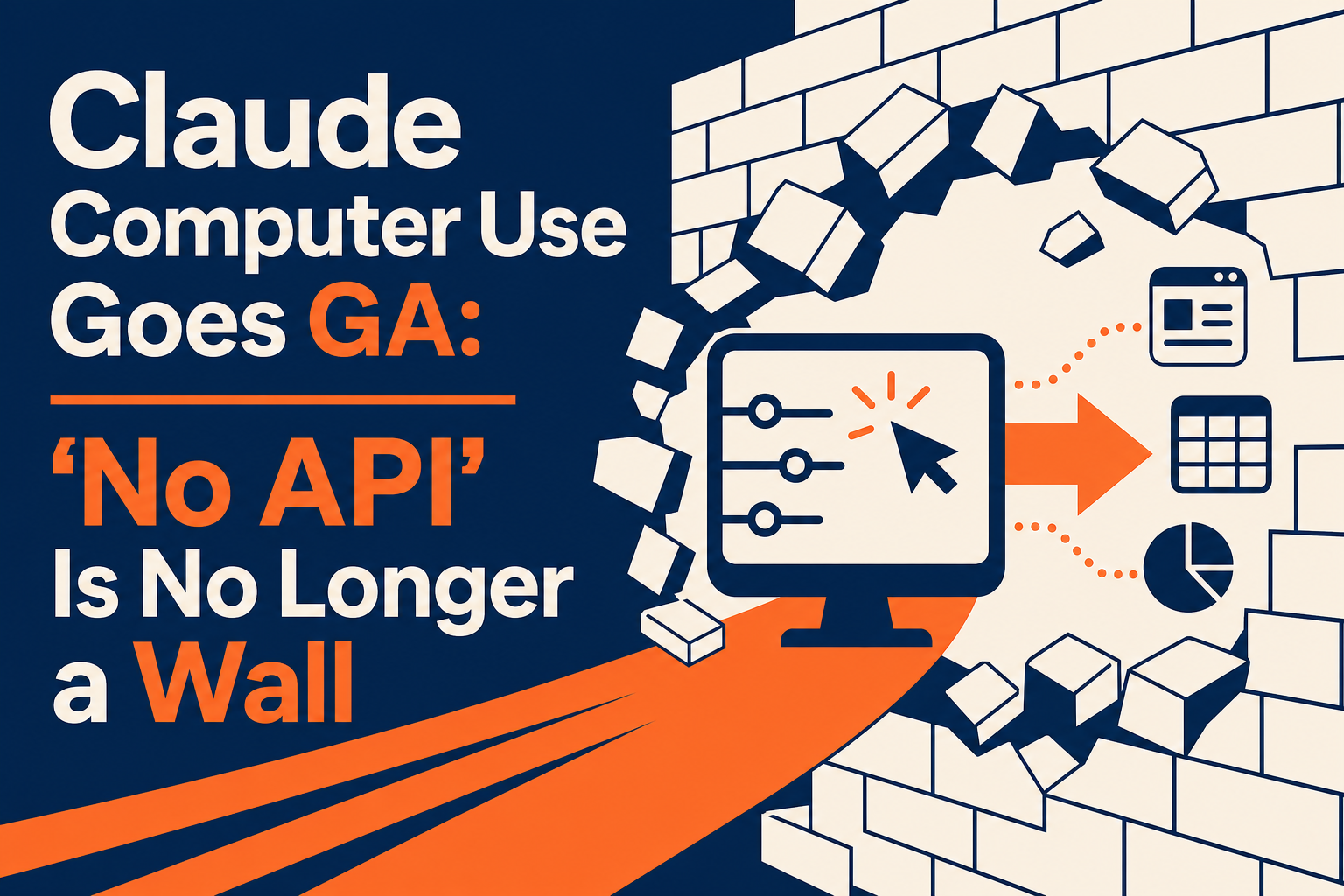
- The strategic shift: Agents can now operate software the way a person does (see the screen, click, type, navigate) so "that system has no API" is no longer a hard wall for automation.
- The compliance milestone: Computer use is now HIPAA-eligible under Anthropic's BAA: necessary but not sufficient. Your own controls, logging, and human oversight still carry the compliance weight.
- Proof point from the source: Anthropic's announcement includes a customer whose longest claims workflow dropped from 32 minutes to 13 at roughly 30% lower cost: Anthropic's published claim, not a Vantage Point client result.
- Bottom line: The technology is production-ready. Start with one portal-based workflow, a signed BAA, audit logging, and a human in the loop on consequential actions.
What Went GA on August 20: The Four Capabilities
General availability means these capabilities are production-supported on the Claude Platform: not beta. Existing beta integrations keep working while you migrate. Here is what each one does in plain English:
| Capability | What it does | What is new with GA |
|---|---|---|
| Computer use | Builds agents that operate software they can see. Given a screenshot, the agent clicks, types, and scrolls the way a person at the keyboard would. | The updated tool takes several actions per turn instead of one per model call, so tasks finish in fewer calls and less time. Now eligible for HIPAA-regulated workloads under Anthropic's BAA. |
| Browser use tool | Extends computer use to web applications. Alongside the screenshot, the agent reads the structure of the page and acts on a specific field or button rather than a position on screen. | New with this release. Uses the same multi-action turns and targets web elements more reliably than pixels alone. |
| Skills API | Lets you upload and version your own skills. Folders of instructions, scripts, and templates that Claude loads only when a task calls for them. | A simpler API for uploading and versioning skills. Skills run in Claude's hosted code execution sandbox, so there is nothing for you to host. |
| Files API | Storage for the documents an agent reads and writes. Upload a PDF or spreadsheet once, reference it by ID in later requests, and download the files the agent creates. | Automatic file expiration, 5x higher rate limits, and 1 TB of storage per organization. |
All four are available now on the Claude Platform. Per Anthropic, the Skills API and Files API are also available through Microsoft Foundry, and the updated computer use and browser use tools are coming soon to Google Cloud's Vertex AI. Anthropic's documentation covers computer use, the browser use tool, the Skills API, and the Files API.
Why 'No API' Is No Longer a Wall
Most enterprise automation has been API-first: if a system exposes a modern API, you integrate it; if it does not, you either pay for brittle RPA or assign a person to re-key data between screens. In insurance and financial services, that second bucket is enormous. Carrier portals, custodial platforms, policy administration systems, and industry utilities that were never built for integration.
Computer use changes the interface requirement. The interface is the screen itself. An agent that can see the screen and act on it can work in applications that were never built for automation: the same portals your operations team logs into today.
Anthropic's announcement walks through exactly this pattern: a claims agent that reads the intake document from the Files API, follows a skill encoding the team's filing procedure, completes the submission in an insurer's web portal with the browser use tool, and saves the confirmation back as a file.
The browser use tool matters more than it might appear. Traditional RPA breaks when a button moves three pixels; the browser use tool targets a named field or button by structure, and the model reasons about what it sees, so these agents are far more resilient to UI changes than recorded scripts. More resilient does not mean unsupervised, which brings us to the section regulated firms should read twice.
Computer Use and HIPAA: What the BAA Does, and Doesn't, Allow
This is the piece of the announcement that matters most for carriers, custodians, and any firm handling PHI or sensitive client data, so it is worth being precise.
What changed: Computer use is now eligible for HIPAA-regulated workloads under Anthropic's BAA. A covered entity or business associate can execute a Business Associate Agreement with Anthropic and run HIPAA-regulated workloads on the Claude Platform. Until now, the absence of HIPAA eligibility made computer use a non-starter for exactly the systems (claims, policyholder records, patient-adjacent data) where it is most valuable. That precondition now exists.
What it does not mean: HIPAA eligibility is not HIPAA compliance. The BAA makes the workload permissible; it does not make your deployment compliant. Your Security Rule obligations do not transfer to Anthropic, risk analysis, access controls, audit controls, minimum-necessary data handling, and incident response remain yours. An agent clicking through a claims portal is, in compliance terms, a workforce member with system access, and it needs to be governed like one.
The proof point, properly attributed: In Anthropic's announcement, Davide Locatelli, a research engineer at Asteroid, described agents that "work inside healthcare and insurance systems that have no API" and reported that "our longest claims workflow went from 32 minutes to 13, cost per task fell about 30% across every workflow we tested, and completion hit 100%, with no changes to our prompts." That is Anthropic's published customer claim (directional evidence, not a Vantage Point client result) and your own pilot is the only benchmark that will matter to your leadership.
Governance Checklist for Regulated Firms Before Turning This On
HIPAA eligibility under a BAA is the door opening, not permission to run through it:
- Execute the BAA before any PHI touches the system. Confirm in writing which services, models, and environments the agreement covers.
- Keep a human in the loop on consequential actions. Claim submissions, payments, denials, and client-facing communications require human approval until accuracy is proven over a meaningful sample.
- Log everything. Capture screenshots, actions, timestamps, and agent identity for every run. If you cannot reconstruct what the agent did, you cannot defend it.
- Use dedicated, least-privilege credentials. Give agents their own service accounts with only the access the workflow requires: never shared human credentials.
- Write the acceptable-use policy first. Define which systems agents may operate, what data they may touch, and the escalation path when something looks wrong. Our guide to Claude AI acceptable use policies that work covers the framework.
- Apply data minimization. Give the agent only the PHI or client data the specific task requires.
- Pilot in a test environment. Measure accuracy, exception rates, and cycle time against your manual baseline before production.
- Have a kill switch. Define how you halt the agent, revoke its access, and trigger your incident response process.
If this list looks familiar, it should. It is the discipline you would apply to a new employee with portal access, compressed into software. For more, see our posts on deploying Claude safely with Salesforce and HubSpot data and AI for regulated industries.
What Businesses Should Do Next
- Inventory your "no API" backlog. List the workflows your team runs in portals and legacy systems, ranked by volume and error cost. That list is now a candidate pipeline.
- Pick one workflow and baseline it. Measure current cycle time, cost, and error rate manually so your pilot has numbers to beat.
- Confirm the compliance envelope. BAA status, logging architecture, credential strategy, and human-review points: documented before the first run.
- Run a bounded pilot. One workflow, test environment, human approval on every consequential action, weekly accuracy review.
- Scale only what you can govern. Expand when the pilot proves accuracy and your controls demonstrably hold.
If you are evaluating how computer use applies to your portals, CRM, and compliance obligations, Vantage Point can help identify the right first workflow and build a governed implementation plan.
How Vantage Point Helps
Vantage Point is a senior-led Salesforce and HubSpot consulting partner and a Claude Partner Network Member: an official Claude partner. We help regulated firms move from "we can't automate that" to governed, production AI workflows: identifying the right first use case, designing the workflow automation and process optimization around it, and standing up the compliance and security controls (BAAs, audit logging, human-in-the-loop design, acceptable-use policy) that regulated operations require.
Book an AI Automation Readiness Session
Want to know which "no API" workflow is your right first candidate for agent automation, and what governance it needs? Book a Vantage Point AI automation readiness session. We will review your portal-based workflows, compliance requirements, and CRM landscape, and give you a practical pilot plan. Explore our compliance and security solutions to get started.
Frequently Asked Questions
What did Anthropic make generally available on August 20, 2026?
Anthropic took four agent-building capabilities to general availability on the Claude Platform: computer use, a new browser use tool, the Skills API, and the Files API. General availability means they are production-supported rather than beta, and existing beta integrations keep working while teams migrate.
What is Claude computer use in plain English?
Computer use lets you build agents that operate software they can see. Given a screenshot, the agent clicks, types, and scrolls the way a person at the keyboard would, so it can work in applications, like carrier portals or custodial platforms, that were never built with an API for automation.
Is Claude computer use HIPAA compliant?
Computer use is HIPAA-eligible under Anthropic's Business Associate Agreement, which is different from being compliant out of the box. The BAA makes HIPAA-regulated workloads permissible on the platform; your own controls (risk analysis, access management, audit logging, data minimization, and human oversight) are what make your specific deployment compliant.
Does 'no API is no longer a wall' mean RPA is dead?
Not overnight, but the case for traditional RPA is much weaker. Recorded scripts break when a screen layout changes; agents using the browser use tool target page elements by structure and reason about what they see. Expect RPA to be displaced first in workflows where UI changes and exceptions made scripts expensive to maintain.
How should a regulated firm start with computer use safely?
Start with one high-volume, portal-based workflow in a test environment, with the BAA executed, dedicated least-privilege credentials, full audit logging, and human approval on every consequential action. Measure accuracy and cycle time against your manual baseline before expanding. Vantage Point helps regulated firms scope exactly this kind of governed pilot.