
Quick Answer
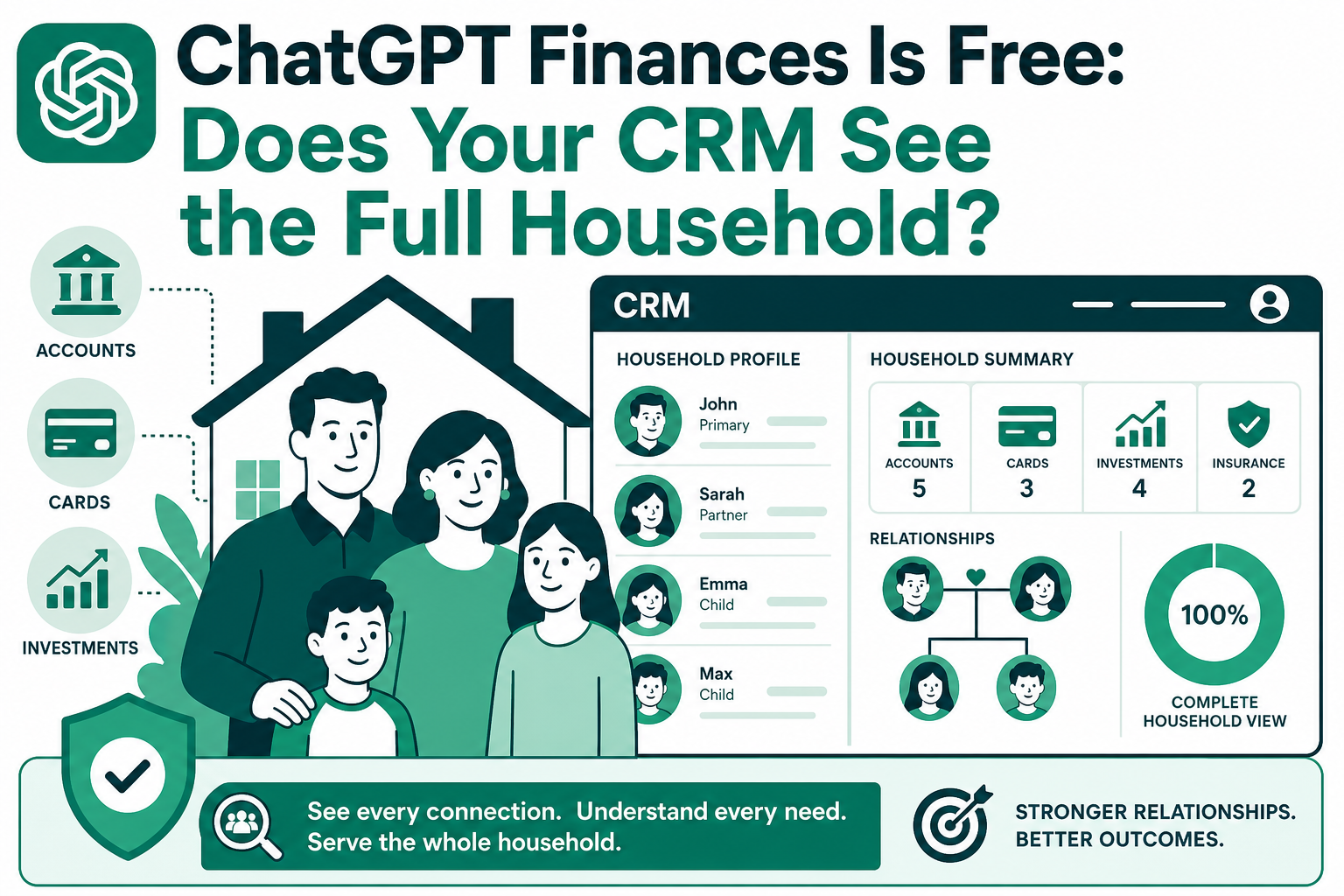
As of October 2026, ChatGPT Finances is rolling out to Free and Go users in the U.S. A client can choose to connect eligible financial accounts through Plaid and a credit report through Experian, then view spending, bills, net worth, investments, and credit information in one place. That does not turn ChatGPT into an adviser, broker, or system that can move money. It does raise a practical CRM question for RIA, bank, and credit-union leaders: can your firm model the client household's held-away assets, liabilities, relationships, data sources, and refresh dates before that client arrives at a review meeting with a broader picture than the firm record? Vantage Point helps teams turn that question into CRM data-model, integration, and governance work.
Key Takeaways (TL;DR)
- What changed: OpenAI's October 2, 2026 release notes say Finances in ChatGPT is rolling out to U.S. Free and Go users on web, iOS, and Android.
- What a client may see: Depending on connected data, the Finances page can show spending, bills, subscriptions, net worth, portfolio information, and an Experian credit score.
- The CRM gap: A consumer-connected view can include accounts or liabilities a firm's custodian, core-banking, or manual CRM process does not capture.
- What it does not do: ChatGPT says it is not a fiduciary, registered investment adviser, or broker-dealer, and it cannot move money, pay bills, or make trades.
- What to do before Q4 reviews: Create a household-data model for held-away assets and liabilities, assign sources and owners, and give advisors a governed way to validate the picture with clients.
- Bottom line: The response is not to copy a consumer AI dashboard. It is to make the CRM a more complete, explainable system of record for the advisor-client relationship.
Status as of October 5, 2026: Finances availability, account coverage, and product behavior can change.
What changed with ChatGPT Finances on October 2?
As of this weekend, an eligible client in the United States can begin connecting personal financial information to ChatGPT without a paid plan. OpenAI's October 2, 2026 ChatGPT release notes say Finances is rolling out to Free and Go users on web, iOS, and Android. The wording matters: it is a rollout, not a guarantee that every user or every institution is immediately available.
For leaders, the behavioral change matters: a client may enter a Q4 review with an outside account, liability, spending pattern, or credit factor already visible in a personal AI workspace.
The operational risk is not that ChatGPT has become the client's adviser. OpenAI explicitly says it is not a fiduciary, registered investment adviser, broker-dealer, tax preparer, or law firm. It also says ChatGPT cannot move money, pay bills, alter account settings, make trades, or open or close accounts. The risk is a data-completeness gap: a client may be looking at a broader personal financial picture than the advisor can see in the CRM.
What can a client connect and see in ChatGPT?
OpenAI's Finances in ChatGPT help page describes two separate connections. A user may connect supported financial accounts through Plaid and may separately connect credit-report data through Experian. The user chooses which accounts to connect, and either connection can be used on its own.
Plaid says it builds and maintains connections to more than 12,000 financial institutions. That is broad coverage, not a promise that every account or data field will be available. OpenAI notes that a successful connection can still have limited history, holdings, loan details, APRs, or due dates. A useful CRM likewise separates known, reported, and verified data.
Depending on the available data, the dashboard can show spending, payments, subscriptions, bills, net worth, portfolio distribution, market updates, and an Experian credit score. Users can also share unsupported accounts, assets, loans, and goals as financial memories. The comparison, then, is an evolving client financial context versus the firm's governed client record.
Why could ChatGPT show more than the advisor's CRM?
Many RIA and bank CRM environments are built around the data their organization owns or receives: custodian feeds, core-banking data, portfolio systems, loan systems, onboarding forms, and advisor-entered notes. Those sources are valuable, but they often do not create a complete, current household view of held-away assets, credit-card debt, mortgages, outside brokerages, or accounts that entered the relationship after onboarding.
ChatGPT Finances does not solve that problem for the firm. Its data belongs to the client experience, may be incomplete, and should not be copied into a firm system without consent, policy, and verification. But its arrival can expose the gap quickly. The client may ask, “Why is this account in ChatGPT but not in our planning discussion?” The right answer should be an operating model, not an excuse about a missing integration.
| Client-visible context | Why the CRM may miss it | Operational response |
|---|---|---|
| Outside bank, card, or brokerage accounts connected by the client | The CRM may rely on custodian feeds or manual discovery and may not distinguish held-away from managed assets. | Model account type, ownership, held-away status, source, as-of date, and verification status at the household level. |
| Credit-report factors and reported liabilities | Credit data is usually outside the CRM, and a credit report can lag live balances or include data the advisor has not discussed. | Capture only approved, consented fields; record source and date; route material discrepancies to the right review process. |
| Spending, recurring bills, and subscriptions | Planning notes may contain only what was discussed at a prior review, not current transaction-level behavior. | Use a structured review checklist and a client-confirmed summary rather than trying to ingest every transaction. |
| Client-supplied goals, loans, or property context | Manual details can sit in free-text notes, emails, or nowhere in the system of record. | Define governed fields and relationship objects, with an owner for follow-up and an expiration or refresh date. |
What should an RIA, bank, or credit union do before Q4 reviews?
Do not try to replicate a consumer finance dashboard inside Salesforce, HubSpot, or another CRM. Start by deciding which household facts the firm needs to know to serve the client, meet its obligations, and make the next review useful. Then make those facts auditable and easy for an advisor to update.
- Define the household, not just the primary contact. Map individuals, joint owners, trusts, entities, and the professional relationships around them. If the relationship model is unclear, a list of accounts will not make it clear.
- Create a held-away asset and liability model. At minimum, include asset or liability type, institution, ownership, estimated value or balance where policy permits, managed-versus-held-away status, source, as-of date, consent, and verification state.
- Separate data source from data confidence. “Client reported,” “document verified,” “custodian feed,” and “advisor confirmed” are different facts. They should not be buried in a note.
- Design a review-meeting workflow. Give advisors a short, approved prompt: ask what the client is seeing, confirm whether it is appropriate to record, resolve discrepancies, and schedule follow-up. The goal is a trusted conversation, not a screenshot upload.
- Set privacy and access controls before expanding visibility. Financial details should have clear consent, retention, field-level access, audit, and escalation rules. A better household view is only better if the firm can explain who can see it and why.
- Prioritize integrations after the model is stable. Once the data model and workflow are agreed, evaluate whether a custodian, planning, core, portfolio, or data-platform integration should automate a specific part of it. Integration cannot repair an undefined business concept.
This work fits naturally with Financial Services Cloud strategy and implementation, but the pattern is platform-neutral. A bank or credit union can apply the same discipline to a core-banking CRM. Teams that need to connect source systems should begin with a governed data map and system integration and data-migration plan, not a blanket mandate to collect more data.
How should leaders balance completeness, consent, and trust?
More data is not automatically better service. The client owns the connected ChatGPT experience, and a firm should not casually transfer personal-AI details into the CRM or assume they are complete and current. OpenAI notes that account history may be limited, some fields may be unavailable, and credit-report updates are monthly.
Use only useful, consented, and explainable data. Give advisors an approved field, verification step, and escalation path for a client-volunteered held-away account or liability, then retain its source and as-of date. Use role-based access, field-level controls, and audit trails for sensitive household data. Vantage Point's compliance and security solutions can align CRM permissions with policy, while an AI roadmap defines appropriate uses of customer context.
What does a practical 30-day response look like?
A focused 30-day response can establish direction before Q4 reviews; it is not a full enterprise transformation. First, inventory household, account, and liability fields and identify where held-away data lives. Next, agree on a minimum data model, access rules, and a source-and-verification taxonomy with operations, advisors, privacy, and compliance. Then pilot the model and review checklist with a representative advisor group. Use the results to prioritize fields, integrations, permissions, and consent decisions.
For perspective, this CRM and integration discipline helped a $30B+ independent RIA achieve a 350% improvement in data completeness, 95% adoption in 90 days, and 14 integrations. At a separate multi-acquisition RIA that grew from $1B to more than $14B, the work integrated 17+ acquisitions. These are CRM and integration outcomes, not ChatGPT Finances outcomes.
How Vantage Point helps turn client context into usable CRM data
Vantage Point helps financial-services teams translate a client-data problem into a practical architecture: household and relationship design, data-quality rules, integration sequencing, advisor workflow, permissions, and change management across Salesforce Financial Services Cloud, HubSpot, data platforms, and connected systems.
Vantage Point brings senior CRM, integration, and AI advisors to adoption-critical operating details. For Q4 review readiness, start with the household-data model and advisor workflow; then use Salesforce implementation and advisory services to make the prioritized backlog durable.
Make the Client Record Ready for the Next Review
If your advisors could see a client-held-away account or liability only when the client shows a ChatGPT screen, the gap is operational—not a reason to chase another AI tool. Vantage Point can assess the household data model, source-system map, permissions, and review workflow, then build a practical implementation plan. Contact Vantage Point about a household-data readiness assessment or explore our integration and data-migration services.
Frequently Asked Questions
What is ChatGPT Finances?
ChatGPT Finances is a personal-finance experience in ChatGPT that eligible U.S. users can use to connect supported financial accounts through Plaid and credit-report data through Experian. Depending on the connected data, it can show spending, bills, subscriptions, net worth, investments, and a credit score, then answer questions using that financial context.
Is ChatGPT Finances free in the United States?
As of October 2, 2026, OpenAI says Finances in ChatGPT is rolling out to Free and Go users in the United States on web, iOS, and Android. Availability is a rollout, so individual access and account support can vary.
What financial information can ChatGPT Finances see?
ChatGPT Finances can use the information a user chooses to connect through Plaid and Experian, plus financial context a user chooses to share. Available details can include account balances, transactions, investments, reported credit information, spending, bills, subscriptions, net worth, and credit-score factors, but coverage and history can be incomplete.
Can ChatGPT Finances move money or make investment trades?
No. OpenAI says ChatGPT cannot move money, pay bills, change account settings, make trades, change retirement contributions, open or close financial accounts, or file taxes. It also says ChatGPT is not a fiduciary, registered investment adviser, broker-dealer, tax preparer, or law firm.
Why might ChatGPT Finances show more than an advisor's CRM?
ChatGPT Finances may include personal accounts, liabilities, credit information, or client-supplied context that a firm's CRM does not receive through custodian, core-banking, planning, or manual processes. That does not make the consumer view a system of record; it makes a clear household-data model, consent, verification, and source tracking more important for the firm.
What should an RIA or bank add to its CRM data model?
An RIA or bank should model household relationships and approved held-away assets and liabilities with fields for ownership, institution, source, as-of date, consent, and verification status. It should also define a review workflow so advisors know how to confirm and update the information without treating a client screenshot as verified data.
Does a ChatGPT Finances credit score update in real time?
No. OpenAI says the credit-score feature uses a VantageScore 3.0 score based on an Experian credit report and updates monthly after connection. A recent payment or purchase may appear in a linked account before it appears in the credit report.
Sources
- OpenAI, ChatGPT Release Notes — “Finances expands to Free and Go users,” October 2, 2026
- OpenAI Help Center, “Finances in ChatGPT,” accessed October 5, 2026
Vantage Point is a boutique CRM consulting firm helping organizations transform with Salesforce, HubSpot, integrations, and AI. Vantage Point brings senior consultants to CRM strategy, implementation, data, and change-management work. Visit vantagepoint.io.