
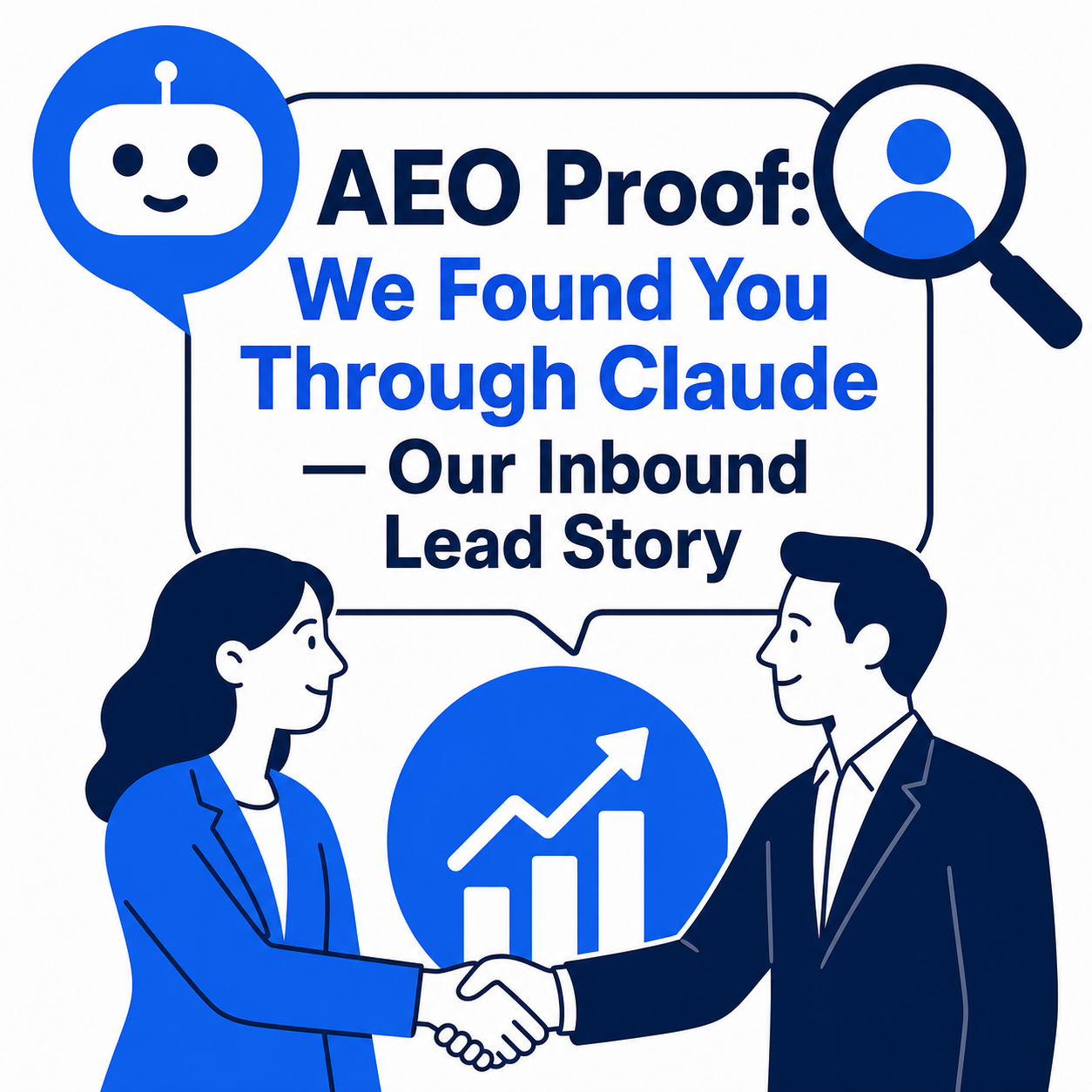
A professional-services firm recently contacted Vantage Point about a CRM consulting engagement. In the first conversation, their team explained how they found us: they asked Claude, Anthropic's AI assistant, for CRM consulting recommendations — and Claude pointed them to Vantage Point.
No paid ad. No cold outreach. No Google search results page. An AI assistant recommended our firm because of the content we publish, and a real buyer showed up already convinced we were worth a conversation.
This post tells that story (fully anonymized), explains the answer engine optimization (AEO) discipline behind it, and lays out what any business can do to become the company AI assistants recommend.
Quick Answer
What happened: A real inbound prospect — a professional-services firm — told Vantage Point, "We found you through Claude." They asked an AI assistant for CRM consulting recommendations, and our answer-ready content earned the citation.
What it proves: Answer engine optimization (AEO) produces real inbound pipeline, not just visibility metrics.
Who it matters for: Any B2B organization whose buyers ask AI assistants like Claude and ChatGPT for vendor shortlists before visiting a website.
Why Vantage Point is relevant: We run our own AEO content program, and this lead is first-party proof it works. We help clients build the same capability through our CRM and marketing automation and AI-driven personalization and analytics services.
TL;DR
- What happened: A professional-services firm found Vantage Point by asking Claude for CRM consulting recommendations — a direct result of our answer engine optimization (AEO) content program.
- What AEO is: Structuring content so AI assistants can extract, verify, and cite it when answering buyer questions.
- Why it matters: AI referral traffic is small but growing fast, and AI-referred buyers arrive pre-educated and further along in the decision process.
- What gets cited: Answer-first pages with clear definitions, question-based headings, comparison tables, and FAQ blocks.
- How Vantage Point helps: We build answer-ready content programs connected to CRM and pipeline, so AI visibility turns into revenue conversations.
The Story: What Actually Happened
Here is what we can share. A professional-services firm reached out through our website to discuss a CRM consulting engagement. During the introductory conversation, their team explained their path: they asked Claude for recommendations on CRM consulting partners, Claude surfaced Vantage Point, they reviewed our site and content, and they contacted us. We will not share the firm's name, the people involved, or any details about the engagement — the story matters because of the mechanism, not the logo.
Three things stood out to our team:
- The prospect arrived pre-educated. Claude had synthesized our published content into a recommendation, so the first call skipped the "so what do you do?" stage entirely.
- The content did the qualifying. Our AEO program is built on answer-first posts, clear service definitions, comparison tables, and FAQ blocks — the same structure we describe in AEO Isn't a Campaign—It's Your Content Baseline. That structure is what made our content easy for an AI assistant to extract and cite.
- The lead source was unambiguous. When a buyer voluntarily says "we found you through Claude," attribution is not a modeling exercise. It is a direct statement about how a real purchasing process now starts.
One lead is an anecdote, not a trend, and we will not pretend otherwise. But it confirms the mechanism end to end: publish answer-ready content, AI assistants cite it, and buyers arrive pre-qualified. That is the chain every AEO program is trying to build — and we just watched it produce a real opportunity.
What Is Answer Engine Optimization (AEO)?
Answer engine optimization (AEO) is the practice of structuring your digital content so AI-powered assistants — Claude, ChatGPT, Gemini, Microsoft Copilot, and Google's AI Overviews — can understand it, trust it, and cite it when they generate answers to user questions.
Traditional SEO asks: "How do we rank our page in a list of ten blue links?" AEO asks a different question: "How do we become the source the AI names when a buyer asks for a recommendation?"
| Dimension | Traditional SEO | Answer Engine Optimization (AEO) |
|---|---|---|
| Primary goal | Rank a URL in search results | Be cited or named inside an AI-generated answer |
| Unit of success | Position, impressions, clicks | Citations, recommendations, AI-referred visits and leads |
| Content format | Keyword-optimized pages | Answer-first pages: definitions, Q&A pairs, tables, FAQs |
| Where the buyer starts | A search results page | A conversation with an AI assistant |
| Buyer state on arrival | Early research, comparing links | Pre-educated, often pre-qualified |
| Measurement | Search Console, rank trackers | Lead-source capture, referral analytics, branded search trends |
AEO does not replace SEO. The same authority signals — content depth, technical health, credible mentions — feed both. AEO adds a formatting discipline on top: if an AI assistant cannot cleanly extract your answer, it will cite someone whose answer it can extract.
Why AI Assistants Are the New Front Door for B2B Buyers
Buyers have changed how they build vendor shortlists. Instead of opening ten tabs from a search results page, a growing share of B2B buyers open an AI assistant and ask: "Who are the best CRM consulting firms for a company like mine?"
The data shows the direction clearly:
- AI referral traffic to websites grew roughly 16x between 2024 and 2026, according to SE Ranking's AI traffic research.
- AI referrals are still about 1% of total web traffic, per Conductor's 2026 AEO/GEO benchmarks — small, but growing every month, and concentrated among the research-heavy buyers B2B firms care about.
- Claude's share of AI referral traffic grew roughly 320% year over year, per the same SE Ranking study, with StatCounter data showing Claude's referral share up nearly tenfold since April 2025. ChatGPT still drives the majority of AI referrals, but the market is fragmenting across several assistants.
Two implications matter more than the raw numbers. First, AI assistants do not show ten options — they name a few, so the difference between being cited and being invisible is total. Second, AI-referred visitors arrive having already read a synthesized summary of who you are — which is why our prospect's first sales conversation started several steps further along than a typical cold inquiry.
What Content Gets Cited by AI Assistants?
Citation-behavior research keeps converging on the same patterns. Analysis of ChatGPT citation behavior finds that many citations come from the first third of a page, and most cited pages structure key information in lists and clean heading hierarchies. The Princeton and Georgia Tech research behind generative engine optimization found that adding clear citations, statistics, and quotations materially improved how often content appeared in AI-generated answers.
In practice, the content patterns that earn citations are:
- Answer-first structure. State the direct answer in the first one or two sentences of the page and of each section. Do not make the model dig.
- Clear, plain-English definitions. "Answer engine optimization (AEO) is…" is extractable. Three paragraphs of throat-clearing is not.
- Question-based headings and Q&A pairs. Headings that match how buyers phrase questions map directly onto the prompts buyers type into AI assistants.
- Comparison tables and structured lists. Tables give models clean, unambiguous facts to reuse.
- Visible FAQ blocks. Self-contained questions and answers are the most directly extractable format on the web.
- Consistent, specific claims. AI systems cross-check what you say against the rest of the web, so consistent descriptions of what you do and who you serve build the confidence to cite you.
This is not theory for us. The Vantage Point content program follows these patterns deliberately — direct answers up top, question-shaped headings, FAQ blocks on every post — and the inbound lead from Claude is the proof point that the patterns compound into pipeline.
What Any Business Can Do to Become Citable
You do not need a new platform or a large budget to start. You need discipline about what you publish and how it is structured:
- Mine your CRM for real buyer questions. The best AEO research already exists in your sales call notes, discovery recordings, form submissions, and support tickets. Pull the 20–30 questions prospects actually ask before they buy.
- Publish one answer-ready page per question. Lead each page with a 40–60 word direct answer, then expand. Use the question itself as the heading.
- Add FAQ blocks to your core pages. Five to eight self-contained questions and answers on every important service and topic page.
- Tighten your service pages. AI assistants cite service pages that clearly state what you do, who you do it for, and how engagements work. Vague marketing copy is invisible to answer engines.
- Keep your facts consistent everywhere. Your website, partner directories, review profiles, and social profiles should describe the same company in the same terms.
- Protect your SEO fundamentals. AI assistants lean on the same authority signals search engines do, so technical health and credible third-party mentions remain the foundation.
- Ask every inbound lead how they found you — and record it. Add "AI assistant (Claude, ChatGPT, etc.)" as an explicit option in your lead-source fields and intake scripts. You cannot learn from a channel you do not capture.
For the page-level mechanics, see our HubSpot AEO guide; AI Visibility Starts With CRM Basics covers the CRM data foundation underneath it.
What This Means for Your CRM and Marketing Strategy
An AI-referred lead is not just a new value in a picklist. It changes how marketing and sales should operate together.
Capture the source honestly. Add AI assistants to your lead-source options in Salesforce or HubSpot, train intake teams to ask "how did you hear about us?" on every first call, and review AI referrers (claude.ai, chatgpt.com, gemini.google.com) in your web analytics. When a buyer tells you an AI assistant recommended you, that is first-party attribution — record it verbatim.
Let CRM data drive the content roadmap. The questions buyers ask your sales team are the questions the next buyer is asking an AI assistant. A tight loop between CRM notes and the content calendar is the most reliable AEO research process there is.
Adjust the sales conversation. AI-referred prospects arrive having already consumed a synthesized version of your positioning. Repeating your pitch wastes the advantage. Validate what they learned, correct anything the AI got wrong, and move faster to fit and scoping.
Connect content to pipeline, not pageviews. The point of AEO is not a visibility score — it is conversations like the one that started with "we found you through Claude." Measure the program the way you measure any demand channel: sourced and influenced pipeline, captured in your CRM.
How Vantage Point Helps
Vantage Point is a boutique, senior-led Salesforce and HubSpot consulting partner — and we run the exact AEO content program described in this post on our own site. The inbound lead from Claude is our proof point, and we help clients build the same capability:
- CRM and marketing automation strategy: Align content, lead capture, and nurture so AI-referred demand flows cleanly into pipeline.
- AI-driven personalization and analytics: Build the data foundation and measurement discipline that connect content to revenue.
- HubSpot services: Structure HubSpot content operations — topic clusters, answer-ready pages, and CRM attribution — for AI-era discovery.
- Salesforce implementation and advisory: Configure lead-source capture, attribution, and reporting so new discovery channels are visible in your pipeline data.
If your buyers are asking AI assistants for recommendations — and they are — the practical question is whether your content gives those assistants something worth citing. We can help you assess that honestly and build a plan around it.
FAQ
What is answer engine optimization (AEO)? Answer engine optimization (AEO) is the practice of structuring your content so AI assistants like Claude, ChatGPT, and Gemini can understand, trust, and cite it when generating answers. Where traditional SEO optimizes for ranking in a list of links, AEO optimizes for being named inside the answer itself.
How is AEO different from traditional SEO? SEO earns a position on a search results page; AEO earns a citation inside an AI-generated answer. AEO content is built around direct answers, clear definitions, question-based headings, and FAQ blocks. The two share the same authority foundation, so strong SEO makes AEO easier — but ranking well does not guarantee an AI assistant will cite you.
Can AI assistants really generate inbound B2B leads? Yes — it happened to us. A professional-services firm contacted Vantage Point after asking Claude for CRM consulting recommendations, and they told us so directly. AI referral traffic is still a small share of web traffic, but it is growing quickly, and AI-referred buyers tend to arrive pre-educated.
What types of content do AI assistants cite most often? Answer-first pages, clear definitions, question-based headings, comparison tables, step-by-step guidance, and visible FAQ blocks with self-contained answers. Research consistently shows that content stating its answer early and structuring information cleanly gets cited far more than long, unstructured pages.
How do we know if AI assistants are sending us traffic or leads? Check your web analytics for AI referrers such as claude.ai and chatgpt.com, watch branded search trends in Google Search Console, and — most importantly — ask every inbound lead how they found you and record the answer in your CRM. Adding "AI assistant" as a lead-source option makes the channel visible in your pipeline reporting.
Does AEO replace SEO? No. AI assistants rely on many of the same authority signals as search engines — content depth, technical health, and credible third-party mentions — so SEO fundamentals remain the foundation. AEO adds a formatting and clarity discipline on top. Treat them as one program with two outcomes: rankings and citations.
How long does it take for AEO content to produce results? There is no fixed timeline, and anyone promising one is guessing. In Vantage Point's case, the inbound lead from Claude came after months of consistently publishing answer-first, FAQ-structured content. Like SEO, AEO compounds over time.
The Bottom Line
A buyer asked Claude for CRM consulting recommendations, Claude recommended Vantage Point, and that buyer became a real inbound opportunity. That is answer engine optimization working exactly as designed: answer-first content, clear structure, and consistent facts gave an AI assistant something worth citing — and the citation became pipeline.
Your buyers are already asking AI assistants who to work with. The only question is whether your content is built to be the answer.
Ready to make your content citable? Talk to Vantage Point about an AEO readiness assessment that connects your content program to CRM-measured pipeline.
Resources
- SE Ranking: AI Traffic Research Study
- Search Engine Land: Conductor 2026 AEO/GEO Benchmarks
- MediaPost: StatCounter AI Referral Data
- Princeton/Georgia Tech: GEO — Generative Engine Optimization
- Vantage Point: AEO Isn't a Campaign—It's Your Content Baseline
- Vantage Point: HubSpot AEO Guide to AI Search Visibility
Vantage Point is a boutique CRM consulting firm helping businesses transform with Salesforce, HubSpot, and AI. Our team is senior-only and AI-augmented. Learn more at vantagepoint.io.