
Quick Answer
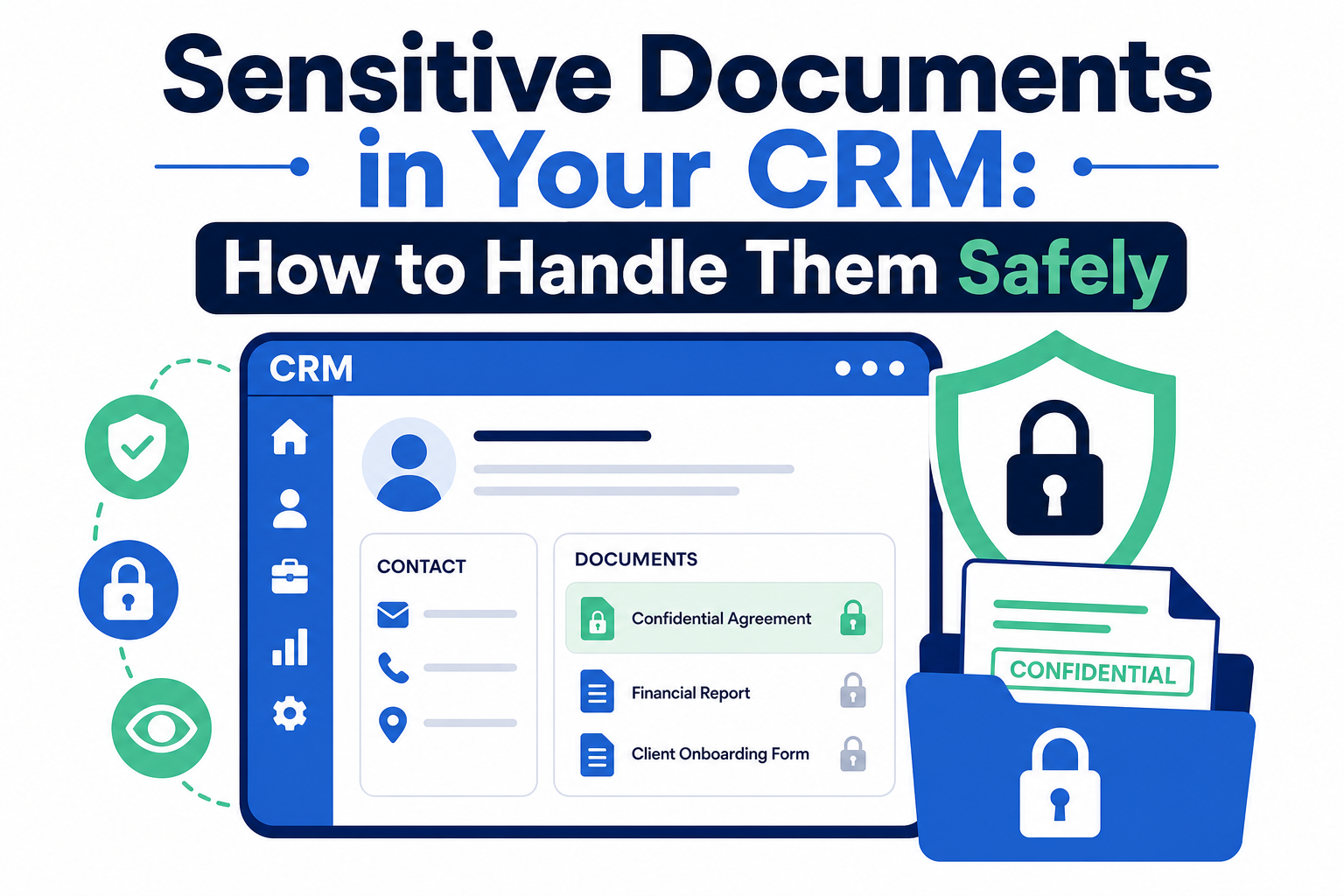
Some documents that pass through a sales or account relationship (financial records, personally identifiable information (PII), regulatory filings, signed contracts with sensitive terms) need much tighter access than the rest of your CRM data. The right pattern is not "keep it out of the CRM" or "give everyone access," but a secure intake workflow: a controlled upload point, access restricted to a small set of privileged users, and a visible confirmation-of-receipt status that the rest of the team can see without ever opening the file itself. This matters for any business that regularly collects sensitive documents from clients or partners (professional services, energy and financial services counterparties, healthcare-adjacent vendors) and needs the sales or account team to know a document arrived without being able to view its contents. Vantage Point designs this workflow as part of CRM implementations so sensitive data intake is controlled without creating a parallel, disconnected system.
TL;DR
- What it is: A workflow pattern that restricts a sensitive document to a small group of privileged users while giving the wider team a visible "received" status they can act on.
- Why it matters: Broad CRM access is usually a feature, not a bug. Except for a small category of documents (PII, financial records, regulated filings) that genuinely should not be viewable by most of the team.
- The core decision: whether the file lives inside your CRM with restricted permissions, or in a separate secure store with only a reference and status synced back to the CRM.
- Best for: Any business that collects sensitive client or partner documents as part of onboarding, underwriting, or ongoing account management.
- How Vantage Point helps: our HubSpot, Salesforce, and compliance and security teams design the intake point, permission model, and confirmation workflow together.
Most CRM access debates run in one direction: give more people visibility so nothing falls through the cracks. But a specific category of document breaks that logic entirely. The file that a handful of privileged users must be able to retrieve, and that almost nobody else should ever open, even though the wider team absolutely needs to know it arrived.
Financial statements, Social Security or tax ID numbers, signed regulatory filings, and similar records show up constantly in onboarding, underwriting, and account management workflows. Treating them the same way as a standard attachment, visible to anyone with access to the account, is usually a compliance and trust problem waiting to surface. Treating them as something that must live entirely outside your CRM creates a different problem: a disconnected system nobody can find things in when they need to.
What Does "Secure Document Intake" Actually Mean?
A secure intake workflow has three parts, regardless of which platform hosts it:
- A controlled upload or drop point. A single, defined place the sensitive file goes, not an email attachment, not a general-purpose shared drive folder anyone on the account team can browse.
- Access restricted to a small, named group. Only the people who genuinely need the file's contents (often a specific ops or compliance role, not the whole account team) can open it.
- A visible confirmation status for everyone else. The account or sales team can see "Received: Yes" (and often a timestamp and who confirmed it) without being able to open the underlying file. This is the piece that gets missed most often. Teams lock down the file and forget that the rest of the organization still needs to know something happened.
Why It Matters in 2026
Two things are pushing this from a nice-to-have into a real design requirement. First, the volume of sensitive documents flowing through CRMs has grown as more onboarding and underwriting workflows move online. What used to arrive by mail now arrives as an upload, and it lands somewhere in the CRM's orbit whether or not anyone planned for it. Second, AI features inside CRMs raise the stakes on this specific category of data: a file sitting in a general-access folder is now potentially visible not just to any team member who happens to click into it, but to AI-assisted search, summarization, or "ask a question about this account" features that weren't a consideration when the access model was first designed.
Where Should the File Actually Live?
This is the real architecture decision, and it depends on what your CRM and existing tools support:
| Option | How it works | Best for |
|---|---|---|
| Restricted file storage inside the CRM | Upload directly into the CRM's file tool with folder- or permission-based access limited to a named group | Teams that want everything in one system and can configure granular file permissions |
| Secure external store with a CRM reference | File lives in a purpose-built secure repository; the CRM record holds a status field and a link visible only to privileged users | Organizations with an existing secure document system, or documents with regulatory retention rules the CRM doesn't natively support |
| Hybrid: encrypted attachment plus status property | File attaches to the record but sits behind a restricted permission set; a separate, widely visible property carries the received/confirmed status | Most mid-size implementations: balances simplicity with genuine access control |
For most businesses without a dedicated document management platform already in place, the hybrid model is the practical starting point: it keeps the file discoverable in context without requiring a second system, as long as the permission structure is actually enforced rather than left to informal trust.
Building the Confirmation-of-Receipt Layer
The part of this pattern that makes it usable, rather than just locked down, is the status layer everyone else can see:
- A simple status property on the record: Not Received / Received / Verified, visible to the whole account team regardless of file permissions.
- An automated notification to the account owner when status changes, so the sales or service team knows to move forward without needing file access themselves.
- A timestamp and confirming user logged automatically, which doubles as an audit trail if the receipt is ever questioned later.
- A clear escalation path if the file needs review or is missing information, routed to the privileged group, not back to the wider team.
This layer is what prevents the common failure mode: a compliance-minded team locks the file down correctly, and then the sales team has no idea whether the client's information ever arrived, so they either chase the client again unnecessarily or assume it's handled when it isn't.
What Businesses Should Do Next
- Inventory what actually needs this treatment. Not every attachment is sensitive, apply the restricted pattern to a specific, defined list of document types (financial records, PII, signed regulatory filings), not everything uploaded to the CRM.
- Decide the privileged group by role, not by convenience. The people with access should be the ones who genuinely need the contents, which is often a smaller list than "everyone on the deal team."
- Design the status property before the permission structure. If you can't answer how the wider team will know a document arrived, the security work isn't finished yet: it's just locked down.
- Check retention and deletion requirements. Sensitive documents, especially PII and financial records, often carry retention rules that differ from your general CRM data lifecycle: confirm these before deciding where the file lives long-term.
- Test the permission model, don't just configure it. Log in as a non-privileged user and confirm the file is genuinely inaccessible, not just hidden from the default view.
How Vantage Point Helps
Vantage Point designs secure document workflows as part of CRM implementations across HubSpot and Salesforce, working with our compliance and security solutions team to get the intake point, permission model, and confirmation-of-receipt layer right together, rather than solving access control and team visibility as two separate, uncoordinated problems. Senior consultants only. No junior handoffs; the experts you meet are the experts who deliver.
Handling Sensitive Documents Without a Clear Process?
If your team is still routing sensitive files through email or a shared folder everyone can browse, it's worth fixing before it becomes an incident. Contact Vantage Point to design a secure intake workflow, or explore our compliance and security solutions.
Frequently Asked Questions
Should sensitive documents be stored inside the CRM at all?
It depends on your tools and retention requirements. A hybrid approach (a restricted attachment or a reference to a secure external store, paired with a visible status property) works for most businesses without a dedicated document management platform already in place.
How do I let the sales team know a sensitive document arrived without giving them access to it?
Add a simple status property (Not Received / Received / Verified) visible to everyone with access to the record, updated automatically or by the privileged group when the file is reviewed. The status is visible; the file itself is not.
Who should be in the privileged group with file access?
Only the roles that genuinely need the document's contents (often a specific compliance, operations, or underwriting function) rather than the full account or deal team. Define the list by role and review it periodically.
Does this require a separate secure document management system?
Not necessarily. Many CRMs support folder- or permission-based restrictions on file storage that are sufficient for most businesses. A separate system becomes worthwhile when regulatory retention rules or document volume outgrow what the CRM's native file tools handle well.
What's the biggest mistake teams make with sensitive document workflows?
Locking down file access correctly but forgetting to build a visible confirmation layer for everyone else. Without it, the rest of the team has no reliable way to know whether a required document has arrived, which usually causes more operational friction than the access restriction solves.
Do AI features change how sensitive documents should be handled?
Yes. Files sitting in broadly accessible storage may also be reachable by AI-assisted search or summarization features, which weren't necessarily considered when the original access model was set up. Review file-level AI data access settings alongside permission structure, not separately.
How often should the privileged access list be reviewed?
At least annually, and whenever roles change. Access lists for sensitive document handling tend to accumulate former employees or shifted responsibilities if nobody owns a periodic review.
Vantage Point is a boutique CRM consulting firm helping businesses transform with Salesforce, HubSpot, and AI. Learn more at vantagepoint.io.