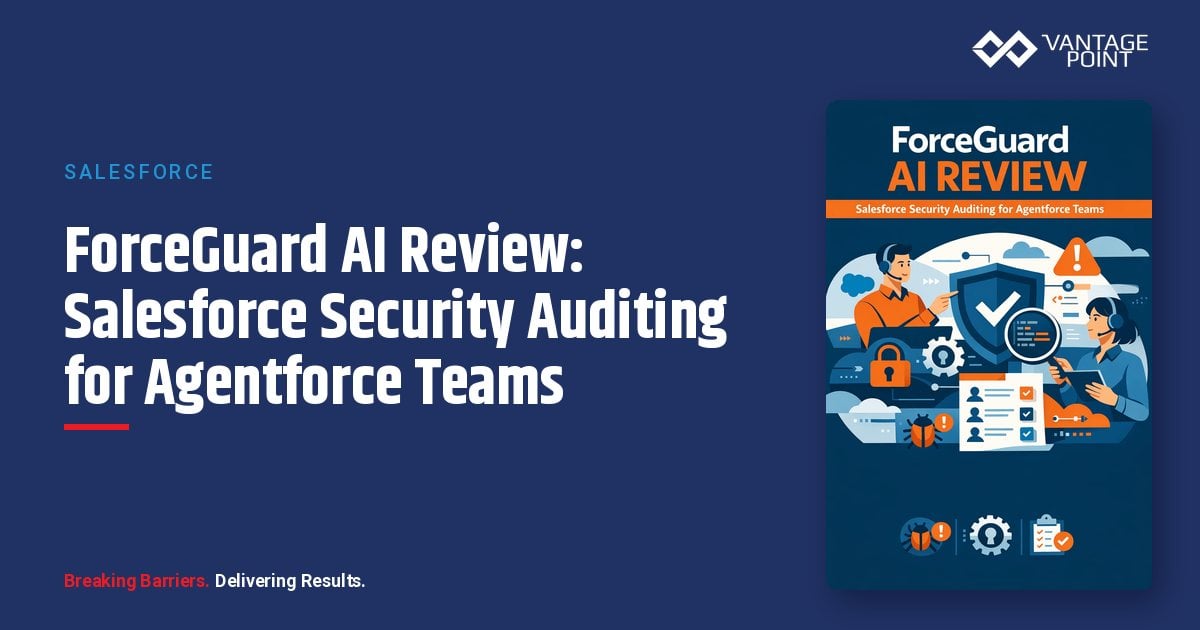
Salesforce security work gets harder as Agentforce, automation, permission sets, integrations, and temporary access patterns expand across the org. ForceGuard AI is a free Salesforce Labs AgentExchange solution designed to help admins diagnose access issues, compare users, review security posture, and explain Salesforce permissions in plain language.
View the listing: ForceGuard AI: Security Auditor on Salesforce AgentExchange
Quick Answer
ForceGuard AI is a Salesforce Labs AgentExchange agent that performs conversational diagnostics across Salesforce security settings, including profiles, permission sets, sharing rules, org-wide defaults, hidden permissions, and user access differences. It is useful for Salesforce admins, IT teams, and RevOps leaders who need faster answers to “why can this user see or edit this record?” questions, but it should be implemented with clear governance, testing, and human review before teams rely on it for production security decisions.
TL;DR
- What it is: ForceGuard AI is a free AgentExchange security auditor from Salesforce Labs for Salesforce permission and access troubleshooting.
- Why it matters: It can shorten investigation time for access issues by turning complex security layers into explainable diagnostics.
- Best fit: Salesforce teams with Agentforce enabled, growing permission complexity, or frequent “insufficient privileges” tickets.
- Decision point: Treat it as an admin decision-support tool, not a replacement for formal security review.
- Vantage Point relevance: Vantage Point helps teams connect tools like ForceGuard AI to broader Salesforce implementation and advisory, security governance, and managed services practices.
What Is ForceGuard AI?
ForceGuard AI is an Agentforce-powered Salesforce security auditor listed on AgentExchange by Salesforce Labs. The listing describes it as an “AI-powered Salesforce security diagnostics and permission troubleshooting” solution with one agent, one action, and 14 subagents.
Its core purpose is practical: help Salesforce teams understand why users can or cannot access certain data, what security settings contribute to that result, and which changes may affect users before an admin makes updates.
The listing highlights use cases such as root-cause analysis for insufficient privilege errors, natural language security questions, health scoring, user and profile comparison, bulk security auditing, permission impact analysis, hidden permission detection, and optimization recommendations.
Because ForceGuard AI comes from Salesforce Labs, it is free, but Salesforce Labs solutions are community-style contributions rather than official Salesforce products with standard support. That makes validation especially important.
Why Does Salesforce Security Auditing Matter More in the Agentforce Era?
Salesforce security auditing matters more in the Agentforce era because agents can depend on CRM permissions, user context, integrations, and record visibility to complete work. If those controls are messy, over-permissive, or poorly understood, AI-assisted workflows can amplify the wrong access model.
Traditional Salesforce security reviews already required admins to consider profiles, permission sets, permission set groups, sharing rules, role hierarchy, public groups, org-wide defaults, teams, territories, and managed package permissions. Agentforce adds another layer: teams must understand which agent actions are available, which records are in scope, what data can be surfaced, and how behavior is audited.
That does not mean every AI project should stop until the org is perfect. It means teams should know where access risk exists before they scale agent-driven workflows.
How Does ForceGuard AI Help Salesforce Admins?
ForceGuard AI helps Salesforce admins by translating multi-layer access questions into guided diagnostics. Instead of manually checking every possible cause of a security issue, an admin can ask a natural language question and review the agent’s explanation of the access path.
Common questions include:
- Why can one user edit Opportunities while another cannot?
- Which permission set gives this user access to a sensitive object?
- What would change if we removed this permission set group?
- Which users appear to have elevated access compared with their role?
- Where are redundant or overlapping permissions creating admin debt?
For lean teams, that can make Salesforce security troubleshooting more approachable. For larger teams, it can create a shared diagnostic layer across admins, RevOps, IT, and compliance stakeholders.
Where Does ForceGuard AI Fit in a Salesforce Governance Program?
ForceGuard AI fits best as a diagnostic and education layer within a broader Salesforce governance program. It can help identify and explain access patterns, but the organization still needs decision rules for what should be changed, who approves changes, and how security updates are tested.
| Governance need | How ForceGuard AI can help | What still needs human ownership |
|---|---|---|
| Permission troubleshooting | Explains likely access paths and blockers | Admin validates finding before changes |
| User comparison | Highlights differences between users, profiles, and permission sets | Business owner confirms intended access |
| Security health review | Surfaces risk categories and potential over-permissioning | Security team defines acceptable risk |
| Change impact analysis | Shows who or what may be affected by a permission change | Release owner tests and schedules change |
| Admin education | Explains Salesforce security architecture in plain language | Center of excellence documents standards |
The most useful outcome is not just faster answers. It is a cleaner operating model for Salesforce security decisions.
What Are the Main Use Cases for ForceGuard AI?
The main use cases for ForceGuard AI are permission troubleshooting, access review, security cleanup, and admin enablement.
Permission troubleshooting
Salesforce access issues are often difficult because the answer rarely lives in one place. ForceGuard AI can help trace the combined effect of profiles, permission sets, sharing rules, and org-wide defaults so admins can identify the likely source of a problem.
User and profile comparison
When two users in similar jobs have different access, admins need to find the delta quickly. ForceGuard AI’s user and profile comparison capabilities can support side-by-side analysis and reduce manual review effort.
Security cleanup
Many orgs accumulate redundant permission sets, temporary access, and legacy profile logic. ForceGuard AI can help identify consolidation opportunities, though cleanup should still go through formal change management.
Agentforce readiness
Before deploying more autonomous workflows, teams should understand whether Salesforce permissions are consistent and intentional. ForceGuard AI can support that readiness review, especially when paired with workflow automation and process optimization planning.
What Should Teams Check Before Installing ForceGuard AI?
Teams should confirm licensing, sandbox testing, access boundaries, support expectations, and governance fit before installing ForceGuard AI.
Use this checklist before rollout:
- Confirm Agentforce prerequisites. The listing indicates that ForceGuard AI requires Agentforce.
- Install in a sandbox first. Review behavior against realistic permission scenarios before production use.
- Limit who can run diagnostics. Security diagnostics may expose sensitive access patterns.
- Define what the agent can and cannot decide. Treat recommendations as decision support, not automatic policy.
- Document review steps. Decide who approves permission changes and how changes are tested.
- Validate support expectations. Salesforce Labs apps are free but not the same as fully supported Salesforce products.
- Connect findings to backlog work. Use diagnostics to prioritize cleanup, not just answer one-off tickets.
What Are the Pros and Cons of ForceGuard AI?
ForceGuard AI is promising because it meets admins where security complexity actually lives. It also requires disciplined implementation because security analysis should never become a black box.
| Pros | Considerations |
|---|---|
| Free Salesforce Labs AgentExchange solution | Salesforce Labs solutions may not include standard Salesforce product support |
| Uses natural language for security questions | Outputs still need admin validation |
| Covers multiple security layers | Requires clean enough metadata and permission structures to interpret effectively |
| Supports user comparison and impact analysis | Access to diagnostics should be restricted |
| Helps explain security concepts | Should be paired with governance standards and documentation |
The practical verdict: ForceGuard AI is worth evaluating for Salesforce teams with permission complexity, but it should be deployed through a controlled governance process.
How Should Businesses Implement ForceGuard AI Safely?
Businesses should implement ForceGuard AI in phases: sandbox validation, narrow admin pilot, documented use cases, formal review, and production adoption.
Start with three to five real permission issues from the admin backlog. Run ForceGuard AI against those scenarios in a sandbox or controlled environment. Compare the output to manual admin analysis. Then decide which diagnostics are reliable enough to incorporate into the support process.
Next, define which roles can use the agent. A Salesforce admin may need full diagnostic visibility, while a RevOps analyst may only need summarized explanations. Compliance or IT may need reporting access, not operational access.
Finally, connect ForceGuard AI to a broader security operating model. Vantage Point often sees the most value when AI tools are paired with clear ownership, clean documentation, and practical release management.
How Vantage Point Helps
Vantage Point helps organizations evaluate, implement, and optimize Salesforce and HubSpot based on their operating model, data needs, adoption goals, and growth strategy. For ForceGuard AI specifically, that means helping teams decide whether the tool fits their security model, how it should be tested, and which permission-cleanup work should happen before broader Agentforce adoption.
Vantage Point can help with:
- Salesforce security and permission architecture through Salesforce implementation and advisory
- AI and CRM readiness planning through AI-driven personalization and analytics
- Data and access cleanup through system integration and data migration
- Compliance and governance reviews through compliance and security solutions
- Ongoing admin backlog and optimization support through managed services
If your team is evaluating ForceGuard AI, Agentforce, or Salesforce security governance, Vantage Point can help assess the right next step and build a practical implementation plan.
Resources
- View ForceGuard AI: Security Auditor on Salesforce AgentExchange
- Salesforce guidance on AI agent security
- Salesforce Help: Agentforce and Einstein Generative AI
- Vantage Point Salesforce implementation and advisory
- Vantage Point compliance and security solutions
FAQ
Is ForceGuard AI free?
Yes. The AgentExchange listing identifies ForceGuard AI as a free Salesforce Labs solution that never requires payment. Teams should still account for implementation, testing, governance, and internal enablement effort.
Does ForceGuard AI require Agentforce?
Yes. The listing states that ForceGuard AI requires Agentforce. Teams should confirm their Salesforce environment, licensing, and readiness before planning a production rollout.
What problems does ForceGuard AI solve?
ForceGuard AI helps diagnose Salesforce permission and access issues. It can support root-cause analysis for insufficient privilege errors, user comparisons, permission impact review, hidden permission detection, and security health checks.
Can ForceGuard AI replace a Salesforce security review?
No. ForceGuard AI can support a Salesforce security review, but it should not replace human validation, policy decisions, or compliance oversight. Vantage Point recommends using it as decision support within a documented governance process.
Who should use ForceGuard AI?
ForceGuard AI is best suited for Salesforce admins, platform owners, IT teams, RevOps teams, and compliance stakeholders who need faster visibility into Salesforce access behavior. Access to the tool should be limited to trusted users because security diagnostics can reveal sensitive permission patterns.
Should ForceGuard AI be installed directly in production?
No. Teams should test ForceGuard AI in a sandbox first, validate its recommendations against known permission scenarios, and document usage rules before production adoption. That approach reduces risk and helps admins build confidence in the outputs.
How does ForceGuard AI support Agentforce readiness?
ForceGuard AI supports Agentforce readiness by helping teams understand whether Salesforce permissions are consistent, explainable, and governed. Clean security architecture matters because agentic workflows can rely on the same access model that controls users, records, and actions.