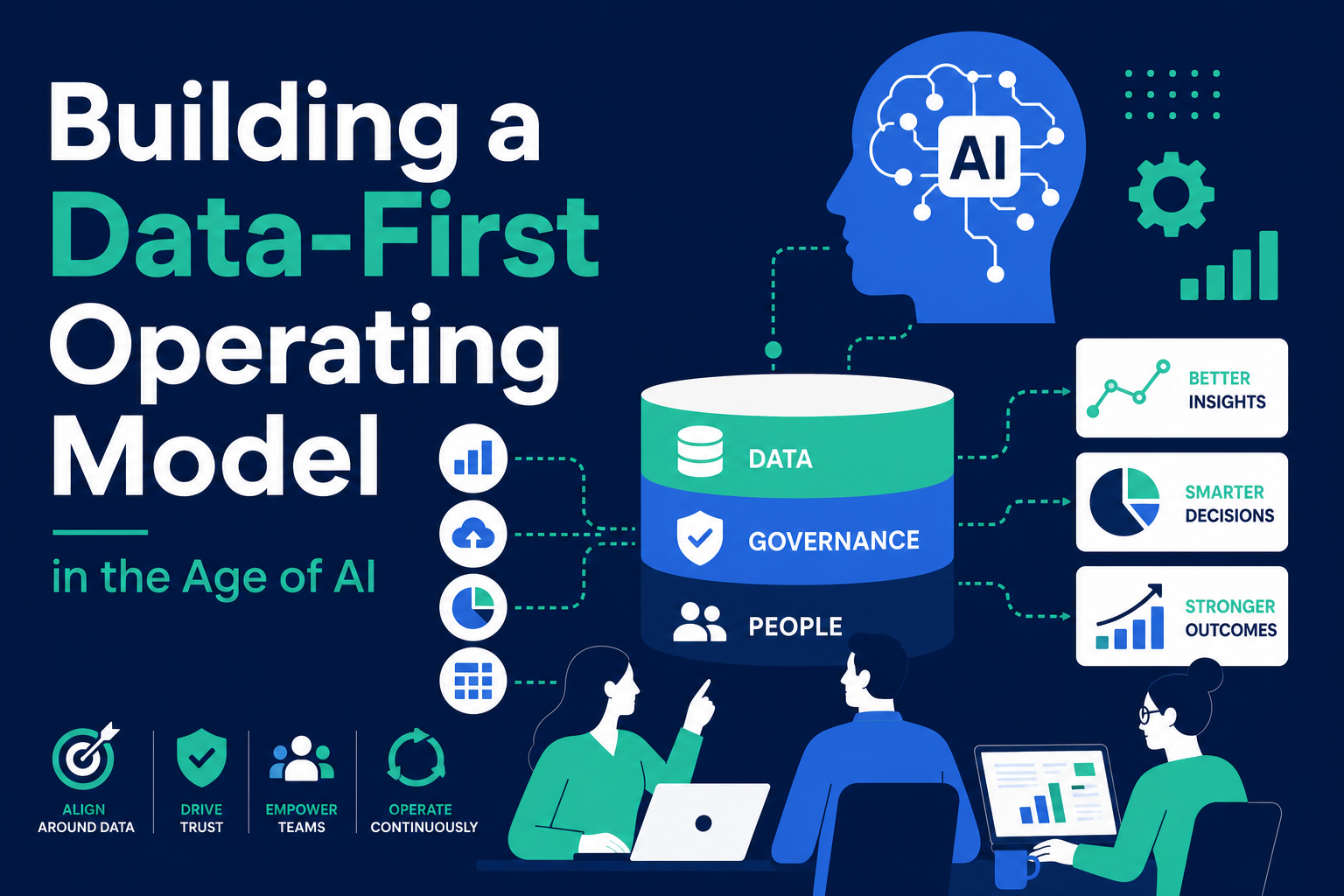
Most organizations already know their AI initiatives depend on good data. Fewer have actually restructured how decisions get made, who owns data quality, and how CRM processes are governed to reflect that dependency. A data-first operating model closes that gap by making data ownership and quality part of how the business runs, not a side project owned by IT.
Quick Answer
A data-first operating model is an organizational structure where data ownership, quality standards, and governance are built into how business decisions and processes work, rather than treated as an IT afterthought. It matters for executives and CRM/RevOps leaders planning AI investments across Salesforce or HubSpot. This article helps readers decide what structural changes their organization needs before scaling AI. Vantage Point is relevant because we help organizations build the data governance and CRM process foundation AI initiatives depend on.
TL;DR
- What it is: An operating model where data ownership and quality are built into business roles and processes, not left to IT alone.
- Why it matters: AI tools amplify whatever data foundation already exists — good or bad — so structure has to change before scale does.
- Best for: Organizations moving from AI pilots to broader deployment across CRM and adjacent systems.
- Decision point: Whether data ownership in your organization is currently assigned to specific roles or left undefined.
- How Vantage Point helps: We help design data governance and CRM process structure through our system integration and data migration services.
What Is a Data-First Operating Model?
A data-first operating model is a way of organizing roles, processes, and decision rights so that data quality and governance are explicit responsibilities, not implicit assumptions. In practice, this means specific people own specific data domains, data quality is measured and reviewed on a schedule, and process changes are evaluated for their data impact before they're approved.
Why This Matters in 2026
AI tools like Salesforce Agentforce and HubSpot Breeze don't fix bad data — they act on it faster and at greater scale. An organization with fragmented ownership and inconsistent data entry will get inconsistent AI output, just faster than before. Building a data-first operating model matters now because the gap between "we have a data quality problem" and "our AI initiative failed because of it" has gotten much shorter.
How a Data-First Operating Model Works
A functioning data-first operating model typically includes:
- Named data domain owners — specific people responsible for the accuracy and completeness of specific data sets (customer records, product data, financial data).
- Data quality metrics reviewed on a cadence — not just measured once during a migration project, but tracked ongoing.
- A change control process that includes data impact — new fields, processes, or integrations get reviewed for how they affect existing data before they ship.
- Cross-functional governance, not siloed IT ownership — sales, service, marketing, and IT all have a seat in defining data standards that affect their work.
- Clear escalation paths when data quality issues are discovered, so they get fixed rather than worked around.
Old Operating Model vs. Data-First Operating Model
| Dimension | Traditional Model | Data-First Operating Model |
|---|---|---|
| Data ownership | Assumed to be "IT's job" | Assigned to named business and IT owners |
| Data quality review | Ad hoc, usually after a problem surfaces | Scheduled and measured on a regular cadence |
| Process changes | Approved without data impact review | Evaluated for data impact before approval |
| Governance | Centralized in IT | Cross-functional across business and IT |
| AI readiness | Assumed based on tool capability | Verified based on data and process maturity |
What Businesses Should Do Next
- Assign named owners to your core data domains — customer, product, financial — rather than leaving ownership implicit.
- Add a data quality review to your existing governance cadence, even if it's only quarterly at first.
- Require any new process, field, or integration change to include a brief data impact review before approval.
- Bring sales, service, and marketing representatives into data governance discussions, not just IT.
- Before scaling any AI initiative, verify data quality and ownership are in place — not just tool licensing.
How Vantage Point Helps
Vantage Point helps organizations build the operating model structure that makes AI investments sustainable, not just the technology layer. Our system integration and data migration practice designs data governance frameworks tailored to your existing team structure, and our advisory and change management service helps get cross-functional buy-in for the process changes a data-first model requires. For organizations specifically preparing for AI rollout, see our related guide on why data quality is the foundation of every AI success story.
If your team is evaluating whether your current operating model can support AI at scale, Vantage Point can help assess the gaps and build a practical plan to close them.
FAQ
What is a data-first operating model? A data-first operating model is an organizational structure where data ownership, quality standards, and governance are explicitly built into business roles and processes, rather than assumed to be handled informally by IT.
Why can't AI tools just fix data quality problems on their own? AI tools act on the data they're given — they don't independently verify or correct it. Poor data quality gets reflected in AI output at greater speed and scale, rather than being resolved by the AI itself.
Who should own data quality in a data-first operating model? Ownership should be assigned to named individuals for specific data domains, such as customer records or product data, with both business and IT representation rather than IT holding sole responsibility.
How is a data-first operating model different from a data governance policy? A governance policy is a set of rules; an operating model is how those rules get embedded into actual roles, decision rights, and day-to-day processes so the policy is followed in practice, not just documented.
Do we need a data-first operating model before starting any AI pilot? A small, contained pilot can often proceed without a full operating model change, but scaling beyond a pilot without addressing data ownership and quality typically leads to inconsistent or unreliable AI results.
How long does it take to build a data-first operating model? Timelines vary by organization size and current maturity. Assigning data owners and adding data impact review to change processes can start within weeks, while full cross-functional governance maturity typically develops over several months.
What's the biggest sign an organization needs this shift? A common sign is when multiple teams can't agree on which version of a customer or product record is accurate, or when data quality issues are only discovered after an AI or reporting initiative fails.
Does this apply to both Salesforce and HubSpot environments? Yes. Data ownership and governance principles apply regardless of CRM platform, though the specific tools used to enforce data quality — validation rules, workflows, deduplication tools — differ between Salesforce and HubSpot.