
Quick Answer
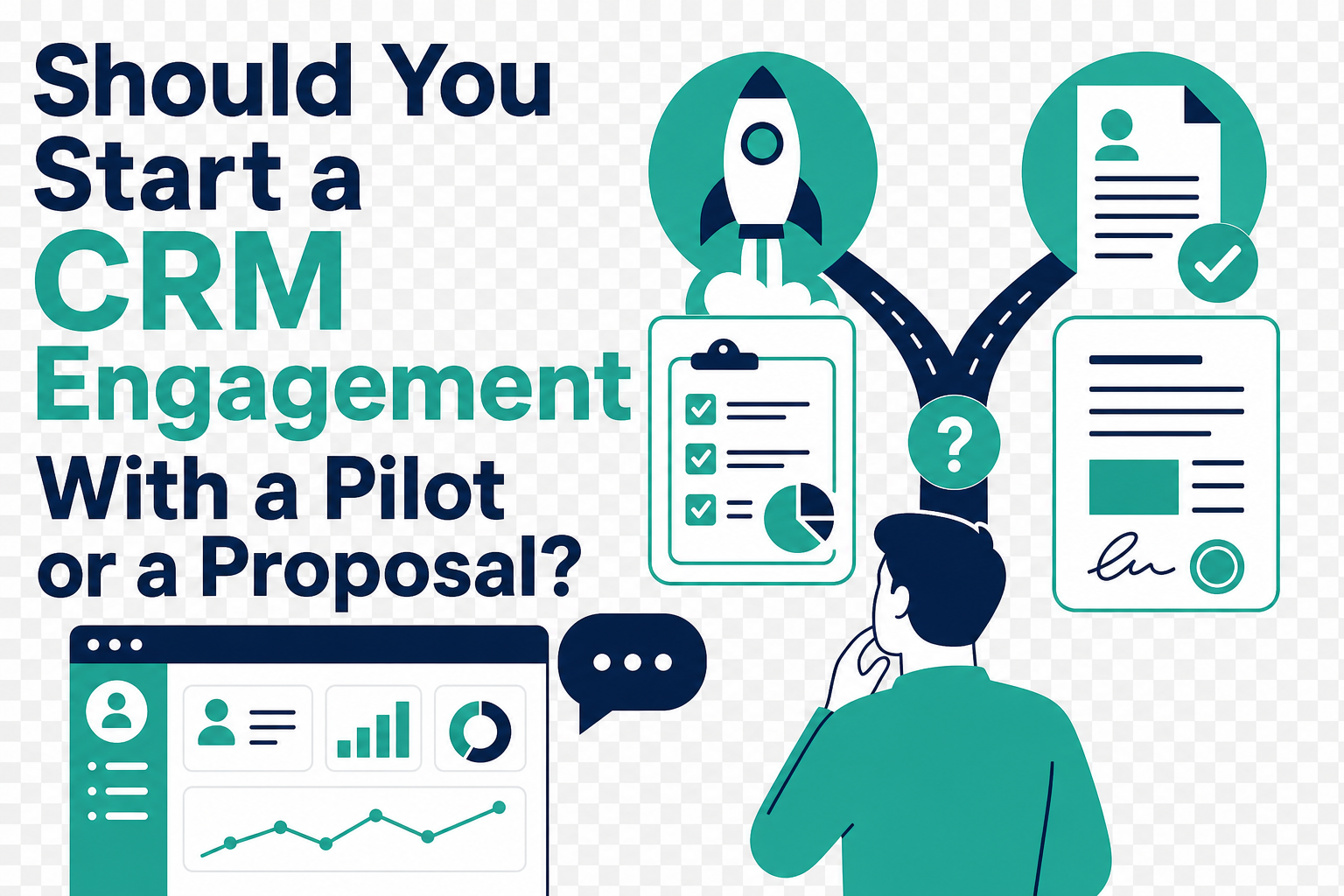
Buyers evaluating a CRM consulting partner increasingly face a choice at the very start of the relationship: sign a full proposal for the whole project, or start with a small, paid block of hours that proves the partner's approach before committing further. Neither is automatically right. A paid pilot lowers risk and lets both sides see real work before a bigger commitment, but it can also under-scope a project that genuinely needs a full discovery phase upfront. This guide gives buyers a framework for deciding which structure fits their situation, and what questions to ask a prospective partner either way.
Key Takeaways (TL;DR)
- What it is: A comparison of two common ways to start a CRM consulting engagement: a small paid pilot versus a full upfront proposal.
- Why it matters: The wrong structure either exposes you to a large commitment with an unproven partner, or under-scopes work that genuinely needs full discovery first.
- Best for: Buyers who have been burned by a past implementation, or who are evaluating a new partner without an existing track record together.
- Decision point: Whether your problem is well-defined enough to scope in a proposal, or whether you need to see the partner work before you can define it accurately.
- How Vantage Point helps: We offer both models and help you determine which fits your project: no pressure toward the bigger commitment.
Why This Decision Comes Up
Most organizations don't shop for a CRM partner often. When they do, it's frequently after a previous implementation went sideways, or because internal capacity finally ran out and something urgent needs outside help. That combination, infrequent buying and urgent need, is exactly the situation where buyers are most vulnerable to over-committing to an unproven relationship, and most tempted to under-invest in proper discovery to move fast.
Two structures have become common answers to that tension. The first is a paid pilot: a small, defined block of hours, often ten to twenty, used to scope a specific piece of work, deliver something real, and let both sides evaluate fit before anything bigger is signed. The second is a full proposal: a scoped statement of work covering the entire project, priced and timelined upfront, typically preceded by a discovery phase.
The Case for Starting With a Paid Pilot
A pilot's core value is that it replaces promises with evidence. Instead of evaluating a partner's proposal, references, and sales conversation, you evaluate their actual work on your actual data. For buyers who have been through a bad implementation before, that shift matters more than any amount of reassurance in a sales call.
- Lower financial exposure. A block of hours is a fraction of a full project's cost, which makes it easier to approve without a lengthy procurement cycle.
- Real work, not just a demo. A well-scoped pilot produces something usable (a cleaned segment, a working workflow, a scoped integration) rather than a slide deck.
- Built-in off-ramp. If the fit isn't right, you've lost a small amount of time and money instead of being locked into a multi-month contract.
- Knowledge transfer starts immediately. Reserving part of the pilot's hours for training your team means you're building internal capability from day one, not waiting for a formal handoff at project end.
Pilots work best when the task is genuinely scopable in a small block: a list segmentation and campaign cleanup, a specific workflow build, an integration audit, or a focused reporting fix. The common thread is that the outcome and the boundaries are both clear enough to define in a short conversation.
Where a Paid Pilot Falls Short
The same qualities that make a pilot low-risk also limit what it can tell you. A ten-hour engagement cannot validate how a partner handles a six-month data migration, a multi-system integration, or a project with real organizational complexity, those risks only show up at a scale the pilot doesn't reach. Pilots are also vulnerable to a specific failure mode: the small, well-defined task goes well, but the underlying project it was meant to preview turns out to need far more discovery than either side realized, because the pilot never touched the messiest parts of the problem.
There's also a sequencing risk. If your actual need is a full architectural decision (what to migrate, what to leave behind, how to restructure a broken process) a pilot that skips straight to building something can produce a fast, tidy deliverable that doesn't fit the eventual full solution, requiring rework later.
The Case for a Full Proposal Upfront
A full proposal, grounded in a proper discovery phase, forces both sides to define the problem before committing resources to solve it. For projects with genuine complexity (data migrations with unclear data quality, multi-department process redesign, integrations across several systems) that upfront definition work is not overhead; it's the part of the project most likely to prevent expensive rework later.
Discovery-first engagements also let a partner surface risks a pilot wouldn't reveal in time: incomplete source data, conflicting stakeholder requirements, or a scope that's actually two projects wearing one name. Buyers with a clear, well-documented current state and a defined future state are often better served skipping the pilot and going straight to a scoped proposal, because the ambiguity a pilot is designed to reduce doesn't exist in their situation.
Pilot vs. Full Proposal: A Decision Table
| Situation | Better fit | Why |
|---|---|---|
| First time working with this partner, no prior track record | Paid pilot | Evidence beats promises when trust hasn't been established yet |
| Previous implementation went badly; wary of big commitments | Paid pilot | Lower exposure and a built-in off-ramp if fit isn't right |
| Problem is well-documented with a clear current and future state | Full proposal | Ambiguity a pilot reduces doesn't exist in your situation |
| Project involves migration, multi-system integration, or org-wide process change | Full proposal (with discovery) | Risk lives at a scale a small pilot can't surface |
| Need is a specific, scopable deliverable (segmentation, one workflow, an audit) | Paid pilot | Task fits naturally inside a small block of hours |
| Underlying need is really an architectural decision | Full proposal | A fast pilot deliverable may not fit the eventual full solution |
Questions to Ask Before You Choose
- Can you describe exactly what "done" looks like for this engagement? If yes, in specific and testable terms, a pilot is often enough. If the answer is vague, you probably need discovery first.
- What happens to pilot work if we don't continue? A good partner should be able to tell you clearly what you keep either way: the deliverable should have standalone value.
- How much of the pilot's time goes to knowledge transfer versus delivery? Ask this explicitly; it's a fair question and the answer tells you how the partner thinks about your long-term independence.
- If we go the full-proposal route, what does discovery actually produce? It should be a concrete artifact (a data map, a process diagram, a scoped statement of work) not just a longer sales conversation.
- What's the partner's default recommendation, and why? A partner who defaults to the bigger commitment regardless of your situation is optimizing for their revenue, not your risk.
What Businesses Should Do Next
- Write down, in one paragraph, what "done" looks like for the work you need. If you can't, that's a signal you need discovery before a pilot or a proposal.
- Ask any prospective partner to explain both models and which they'd recommend for your specific situation: not just which one they prefer to sell.
- If choosing a pilot, insist on a defined, standalone deliverable and reserve part of the hours explicitly for training your team.
- If choosing a full proposal, make sure discovery produces a concrete artifact you can review before the build phase begins.
How Vantage Point Helps
Vantage Point offers both engagement models because the right one depends on the project, not on a fixed sales process. Smaller, well-defined blocks of hours let new clients see our approach on real work before committing further; for projects with genuine complexity, our Salesforce implementation and advisory and HubSpot implementation teams run a proper discovery phase before scoping the full proposal. Senior consultants only. No junior handoffs; the experts you meet are the experts who deliver.
Frequently Asked Questions
What's the difference between a paid pilot and a free trial or demo?
A paid pilot delivers real, standalone work (a cleaned segment, a built workflow, a completed audit) using your actual data. A free trial or demo typically shows the software's capabilities in a generic or sandboxed way without producing anything you keep.
How many hours should a typical CRM pilot include?
Common ranges are ten to twenty hours, sized to a specific, scopable deliverable. The exact number matters less than whether the scope and the definition of "done" are both clear before the work starts.
Will a pilot actually predict how a partner performs on a larger project?
It predicts communication style, responsiveness, and technical quality on a small scale, but it can't validate how a partner handles complexity that only shows up at a larger scope, like a multi-system integration or a large data migration.
Is a full proposal always more expensive than a pilot?
Not necessarily per hour, but the total commitment is larger because it covers the full project rather than a small block. The real comparison isn't cost. It's exposure and how well-defined the problem already is.
Can a pilot roll into a full proposal later?
Yes, and that's a common and reasonable path: use the pilot to build trust and produce something real, then scope the larger project once both sides have working experience together.
What should we keep if a pilot doesn't lead to a bigger engagement?
Ask this before starting. A properly scoped pilot should produce a deliverable with standalone value (documentation, a working workflow, a cleaned dataset) regardless of whether you continue with that partner.
Is discovery the same thing as a pilot?
No. Discovery is an analysis and scoping phase that typically precedes a full proposal and produces documentation (a data map, a process diagram, a statement of work). A pilot is paid delivery work that produces a usable outcome, not just documentation.
Not Sure Which Engagement Model Fits Your Project?
Vantage Point's senior consultants will tell you honestly whether your situation calls for a small paid pilot or a full discovery-led proposal: not just recommend whichever we'd rather sell. Contact Vantage Point to talk through your project, or explore our implementation and advisory services.
Vantage Point is a boutique CRM consulting firm helping businesses transform with Salesforce, HubSpot, and AI. Learn more at vantagepoint.io.