Key Takeaways (TL;DR)
- What is it? Claude Opus 4.7 is Anthropic's newest generally available frontier AI model, released April 16, 2026 — a significant upgrade over Opus 4.6 across coding, vision, instruction following, and long-running agentic tasks
- Key Benefit: Enterprises can now hand off their hardest work — complex coding, multi-step workflows, document analysis — with confidence that the model will self-verify, stay on task, and deliver production-ready results
- Cost/Investment: $5 per million input tokens / $25 per million output tokens (same pricing as Opus 4.6)
- Best For: Organizations using AI-powered CRM workflows, Agentforce agents, HubSpot automations, enterprise document analysis, and developer productivity tools
- Bottom Line: With 3x better vision, 21% fewer document reasoning errors, and the ability to work autonomously for hours, Opus 4.7 is the most capable generally available AI model on the market
Introduction: A New Standard for Enterprise AI
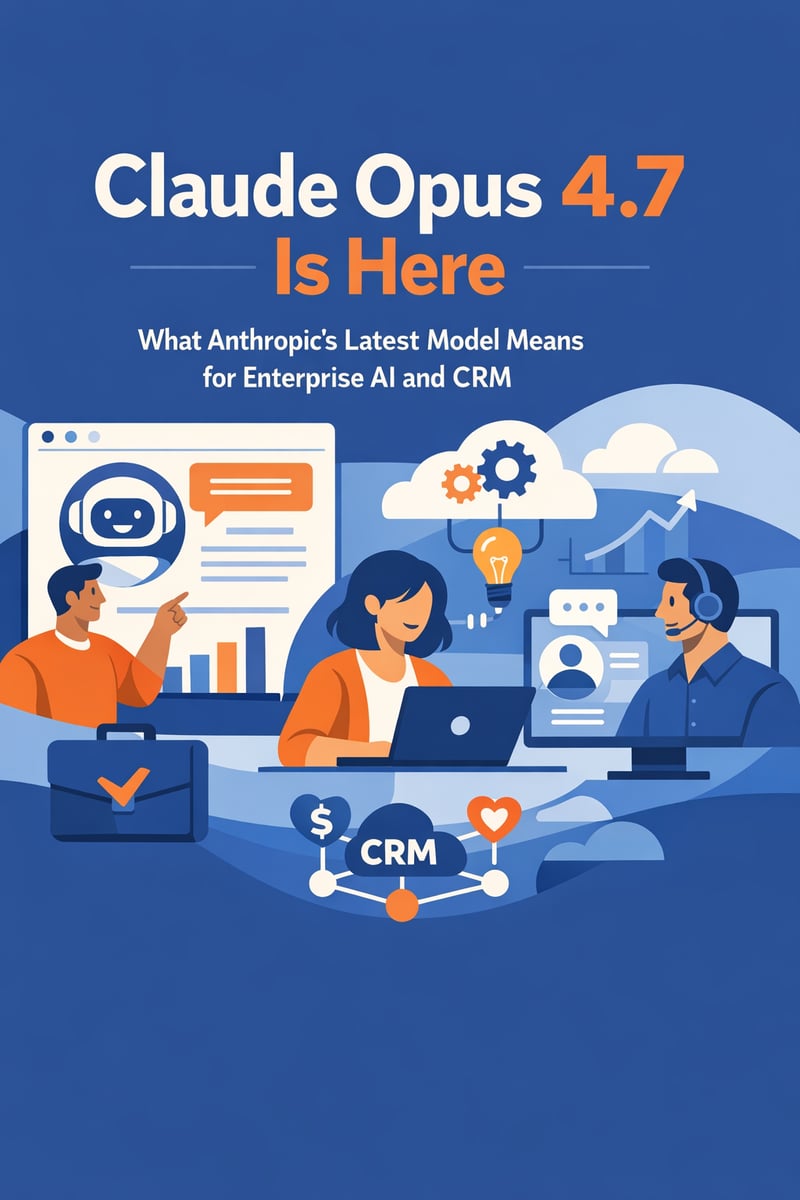
On April 16, 2026, Anthropic officially released Claude Opus 4.7 — the company's most capable generally available AI model. Available across the Claude API, Amazon Bedrock, Google Cloud Vertex AI, and Microsoft Foundry, Opus 4.7 represents a meaningful leap forward in the capabilities that matter most to enterprise teams: software engineering, document understanding, multi-step reasoning, instruction following, and sustained autonomous work.
For businesses already leveraging AI across their CRM, sales, service, and marketing workflows, this release is significant. Opus 4.7 doesn't just iterate on its predecessor — it fundamentally expands what AI agents can reliably accomplish without human supervision.
In this post, we'll break down everything you need to know: what's new, what the benchmarks say, what real-world partners are reporting, and — most importantly — what Opus 4.7 means for your enterprise AI and CRM strategy. As a member of Anthropic's Claude Partner Network, Vantage Point has been tracking this release closely, and we're here to help you understand the implications and plan your next move.
Official Announcement: Read the full Anthropic announcement →
What's New in Claude Opus 4.7: The Six Major Improvements
1. Advanced Software Engineering
Opus 4.7 delivers notable improvement in software engineering, with the biggest gains on the most difficult tasks. Where previous models needed close supervision on complex coding work, Opus 4.7 handles these tasks with confidence and consistency.
By the numbers:
- CursorBench: 70% vs. 58% for Opus 4.6 — a meaningful jump in real-world coding capability
- Rakuten-SWE-Bench: 3x more production tasks resolved than Opus 4.6, with double-digit gains in Code Quality and Test Quality
- Factory Droids: +14% task success over Opus 4.6, with fewer tool errors and more reliable follow-through on validation steps
For enterprises running automated code reviews, CI/CD pipelines, or AI-assisted development workflows, this is a direct productivity accelerator.
2. Substantially Better Vision (3x Resolution)
Opus 4.7 can process images up to 2,576 pixels on the long edge (~3.75 megapixels) — more than three times the resolution of prior Claude models. This is a game-changer for:
- Computer-use agents reading dense screenshots and navigating complex interfaces
- Document processing involving diagrams, charts, and technical drawings
- Data extraction from complex visual content
XBOW, an autonomous penetration testing firm, reported a staggering improvement: 98.5% on their visual-acuity benchmark versus 54.5% for Opus 4.6.
3. Instruction Following That Actually Follows Instructions
Opus 4.7 is substantially better at following instructions — and it takes them literally. This is critical for enterprise deployments where precision matters: compliance workflows, structured data extraction, CRM field updates, and automated reporting.
4. File System-Based Memory
The model is better at using file system-based memory, remembering important notes across long, multi-session work. This means AI agents can maintain context over extended workflows without requiring teams to re-feed context at every step — a critical capability for CRM implementations that span days or weeks.
5. Long-Running Task Excellence
Opus 4.7 handles complex, long-running tasks with rigor and consistency. It devises ways to verify its own outputs before reporting back — a behavior that dramatically reduces error rates in autonomous workflows.
6. Creative and Professional Quality
The model produces higher-quality interfaces, slides, presentations, and documents. For teams using AI to generate client-facing materials, proposals, or marketing content, the output quality is noticeably more polished and professional.
New Features Launching Alongside Opus 4.7
xhigh Effort Level
A new effort level between "high" and "max" gives developers finer control over the tradeoff between reasoning depth and response latency. For enterprise API integrations, this means better optimization of cost vs. quality for different use cases.
Task Budgets (Public Beta)
Developers can now guide Claude's token spend to prioritize work across longer runs. This is particularly valuable for agentic workflows where you want the model to allocate its reasoning budget strategically — spending more on critical decisions and less on routine steps.
/ultrareview Command
A dedicated review session in Claude Code that reads through changes and flags bugs and design issues a careful human reviewer would catch. For development teams using Claude in their workflow, this adds a quality gate that catches issues before they reach production.
Auto Mode for Max Users
An extended permissions option where Claude makes decisions on the user's behalf, enabling longer tasks with fewer interruptions. This is the direction enterprise AI is heading: trusted agents that operate autonomously within defined guardrails.
What the Partners Are Saying
The partner feedback for Opus 4.7 has been overwhelmingly positive. Here are some of the most compelling testimonials from organizations already using the model in production:
Cursor: "On CursorBench, Opus 4.7 is a meaningful jump in capabilities, clearing 70% versus Opus 4.6 at 58%. Anthropic has already set the standard for coding models, and Claude Opus 4.7 pushes that further as the state-of-the-art model on the market."
Notion: "Plus 14% over Opus 4.6 at fewer tokens and a third of the tool errors. It's the first model to pass our implicit-need tests, and it keeps executing through tool failures that used to stop Opus cold. This is the reliability jump that makes Notion Agent feel like a true teammate."
Devin (Cognition): "Claude Opus 4.7 takes long-horizon autonomy to a new level. It works coherently for hours, pushes through hard problems rather than giving up, and unlocks a class of deep investigation work we couldn't reliably run before."
Databricks: "Claude Opus 4.7 shows meaningfully stronger document reasoning, with 21% fewer errors than Opus 4.6 when working with source information. It is the best-performing Claude model for enterprise document analysis."
Harvey (Legal AI): "Claude Opus 4.7 demonstrates strong substantive accuracy on BigLaw Bench, scoring 90.9% at high effort. It correctly distinguishes assignment provisions from change-of-control provisions — a task that has historically challenged frontier models."
These aren't incremental improvements. Partners across coding, enterprise analytics, legal, and autonomous agent platforms are reporting step-change gains in reliability, accuracy, and autonomous capability.
What Opus 4.7 Means for Enterprise CRM and AI Strategy
Salesforce Agentforce Gets a Major Upgrade
Salesforce's Agentforce platform already supports Claude models, and Opus 4.7's improvements directly enhance what Agentforce agents can accomplish:
- Better instruction following means agents execute complex multi-step CRM workflows more reliably — updating records, routing cases, generating reports — exactly as configured
- Enhanced vision enables agents to process screenshots, scanned documents, and visual data within Salesforce workflows
- Long-running task capability means Agentforce agents can handle end-to-end processes (lead qualification → outreach → follow-up) without losing context or making errors mid-stream
- Self-verification reduces the need for human review checkpoints in automated workflows
With Salesforce's Headless 360 and MCP (Model Context Protocol) integration announced at TDX 2026, Claude Opus 4.7 can now interact with Salesforce data directly through conversational interfaces — reading, analyzing, and acting on CRM data without traditional dashboards or reports.
HubSpot Integrations Get Smarter
For organizations using HubSpot CRM, Opus 4.7's improvements translate to:
- More accurate contact and deal record updates via AI-assisted workflows
- Better email and content generation with the model's improved creative quality
- Smarter chatbot interactions that follow conversation scripts precisely while handling edge cases gracefully
- Document analysis capabilities that can process attachments, proposals, and contracts within HubSpot workflows
Enterprise Document Intelligence
Databricks reported 21% fewer errors in document reasoning with Opus 4.7. For businesses processing contracts, proposals, invoices, compliance documents, or client communications, this translates to more accurate data extraction, fewer manual corrections, and higher confidence in AI-generated summaries and analyses.
MuleSoft and Integration Workflows
For organizations using MuleSoft for system integration, Opus 4.7's improved coding capabilities mean AI can assist with more complex API integration development, better data mapping logic, more reliable automated testing, and improved troubleshooting through enhanced reasoning.
Security and Safety: Project Glasswing
Anthropic released Opus 4.7 with Project Glasswing cybersecurity safeguards — automated systems that detect and block requests indicating prohibited or high-risk cybersecurity uses.
Key security details:
- Automatic detection and blocking of prohibited cybersecurity use cases
- Cyber Verification Program for legitimate security professionals (pen testing, vulnerability research, red-teaming)
- Improved honesty and prompt injection resistance compared to Opus 4.6
- Similar overall safety profile to Opus 4.6, with a "largely well-aligned and trustworthy" assessment
For enterprise organizations concerned about AI safety and compliance, Anthropic's proactive approach to cybersecurity safeguards demonstrates the kind of responsible AI development that regulated industries require.
Migration Guide: Moving from Opus 4.6 to Opus 4.7
Tokenizer Changes
Opus 4.7 uses an updated tokenizer. The same input can map to 1.0–1.35x more tokens depending on content type. Monitor actual token usage on real traffic during migration and use effort parameters and task budgets to control costs.
Effort Level Tuning
Opus 4.7 thinks more at higher effort levels, particularly in agentic settings. Start with high or xhigh effort for coding and agentic use cases. Note that low-effort Opus 4.7 ≈ medium-effort Opus 4.6 (per Hex's evaluation), so you may be able to reduce effort levels while maintaining quality.
Prompt Re-Tuning
Because Opus 4.7 follows instructions more literally, review existing prompts for ambiguity or imprecision and test thoroughly before switching production workflows.
Net Effect
Despite the tokenizer changes, Anthropic's internal testing shows the net effect is favorable — improved token usage across all effort levels. The model is more efficient at getting to the right answer.
For detailed migration instructions, see Anthropic's official migration guide.
How Vantage Point Can Help
As a member of Anthropic's Claude Partner Network and a certified implementation partner for both Salesforce and HubSpot, Vantage Point is uniquely positioned to help organizations leverage Claude Opus 4.7 across their enterprise AI and CRM strategy.
- AI Strategy Assessment: We evaluate your current AI workflows and identify where Opus 4.7's capabilities can deliver the highest ROI
- Agentforce Implementation: We build and optimize Salesforce Agentforce agents powered by Claude
- HubSpot AI Integration: We configure Claude-powered workflows within HubSpot for smarter automation
- MuleSoft Integration: We connect Claude AI capabilities across your entire technology stack
- Data Cloud + AI: We help unify your data in Salesforce Data Cloud and apply Claude AI for intelligent customer experiences
- Migration Support: We manage the transition from Opus 4.6 to Opus 4.7, including prompt re-tuning and effort level configuration
Ready to explore what Claude Opus 4.7 can do for your business? Contact Vantage Point to schedule a consultation.
Frequently Asked Questions (FAQ)
What is Claude Opus 4.7?
Claude Opus 4.7 is Anthropic's latest and most capable generally available AI model, released on April 16, 2026. It delivers significant improvements over Opus 4.6 in software engineering, vision (3x resolution), instruction following, memory, long-running tasks, and creative quality. It is available via the Claude API, Amazon Bedrock, Google Cloud Vertex AI, and Microsoft Foundry.
How much does Claude Opus 4.7 cost?
Opus 4.7 is priced at $5 per million input tokens and $25 per million output tokens — the same as Opus 4.6. However, an updated tokenizer means the same input may use 1.0–1.35x more tokens depending on content type. Anthropic recommends monitoring token usage and using effort levels and task budgets to optimize costs.
How is Claude Opus 4.7 different from Claude Mythos Preview?
Claude Mythos Preview remains Anthropic's most powerful model overall, but it is available only in limited release. Opus 4.7 is the most capable generally available model and outperforms Opus 4.6 across most benchmarks. Mythos Preview also remains the best-aligned model Anthropic has trained.
Can I use Claude Opus 4.7 with Salesforce Agentforce?
Yes. Salesforce's Agentforce platform supports Claude models, and Opus 4.7's improvements in instruction following, vision, and long-running task handling directly enhance what Agentforce agents can accomplish. With Salesforce's MCP integration, Claude can interact with your CRM data conversationally.
What is the xhigh effort level in Claude Opus 4.7?
The xhigh effort level is a new option between "high" and "max" that gives developers finer control over the tradeoff between reasoning depth and response latency. It is now the default effort level in Claude Code. For enterprise API integrations, it provides an optimal balance of quality and speed for most use cases.
How do I migrate from Claude Opus 4.6 to Opus 4.7?
Key migration steps include: adjusting for tokenizer changes (1.0–1.35x more tokens for the same input), re-tuning prompts for Opus 4.7's more literal instruction following, and testing effort levels (low-effort Opus 4.7 ≈ medium-effort Opus 4.6). See Anthropic's official migration guide for detailed instructions.
What is Project Glasswing?
Project Glasswing is Anthropic's cybersecurity safeguard system that automatically detects and blocks requests indicating prohibited or high-risk cybersecurity uses. Opus 4.7 is the first model deployed with these safeguards. Legitimate security professionals can apply for Anthropic's Cyber Verification Program.
Conclusion
Claude Opus 4.7 represents a significant milestone in enterprise AI capability. With 3x better vision, dramatically improved coding and document reasoning, literal instruction following, and the ability to work autonomously for hours while self-verifying its outputs, this model changes what's possible for businesses leveraging AI in their CRM and operational workflows.
The partner testimonials speak for themselves: organizations across every sector are reporting step-change improvements in reliability, accuracy, and autonomous task completion. For businesses already invested in Salesforce, HubSpot, or enterprise AI workflows, Opus 4.7 is an upgrade worth implementing now.
As an Anthropic Claude Partner Network member with deep expertise in Salesforce, HubSpot, MuleSoft, and Data Cloud, Vantage Point is ready to help you harness the full potential of Claude Opus 4.7.
Contact Vantage Point today to discuss how Claude Opus 4.7 can transform your enterprise AI and CRM strategy.
About Vantage Point
Vantage Point is a technology consulting firm specializing in CRM implementation, AI integration, and digital transformation. As a certified partner for Salesforce, HubSpot, and a member of Anthropic's Claude Partner Network, we help organizations of all sizes leverage cutting-edge technology to drive growth, efficiency, and exceptional customer experiences.
Learn more at vantagepoint.io.
Resources: