
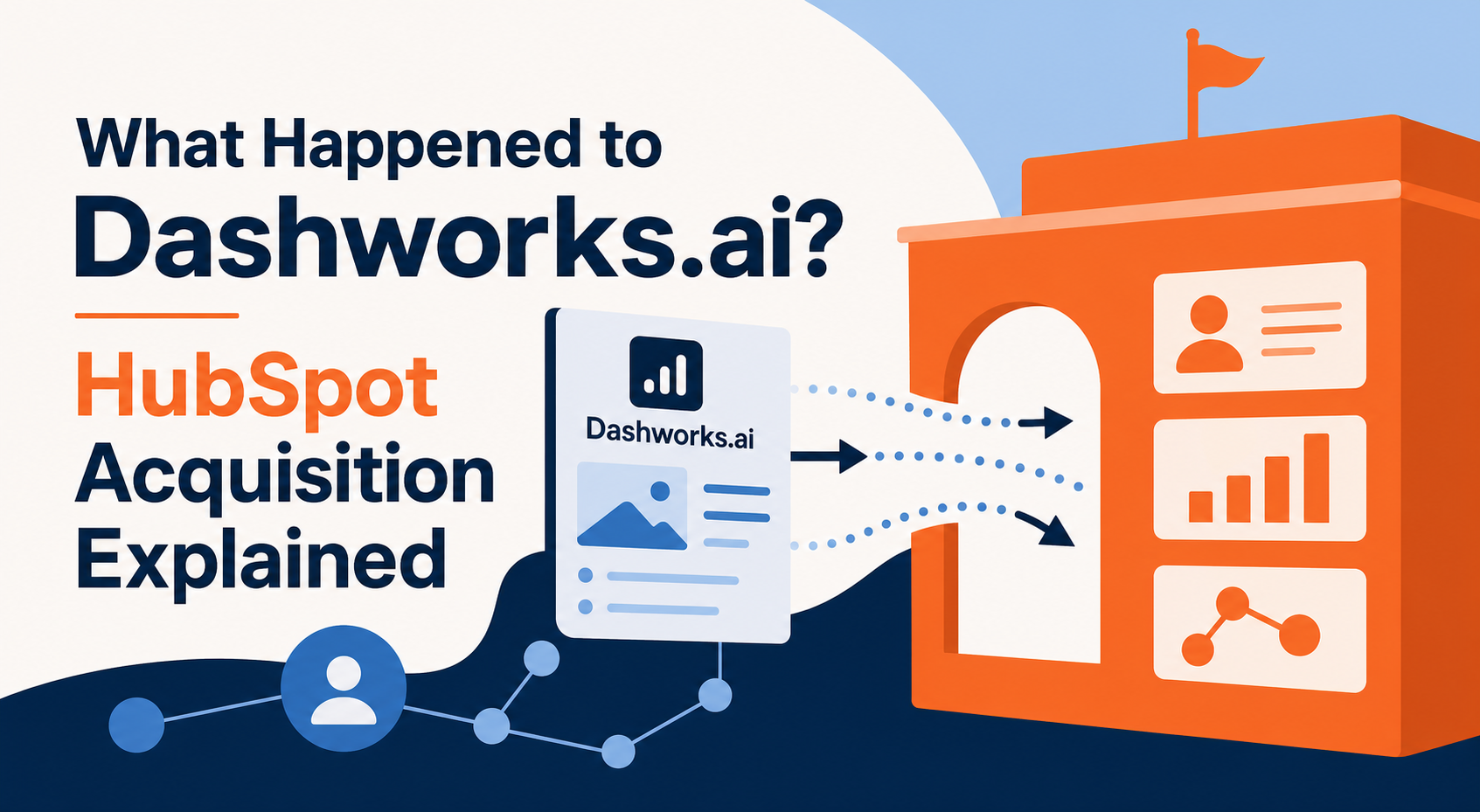
If you searched for Dashworks.ai recently, you may have noticed something odd: there is no way to sign up. The website carries a farewell note, the login page is gone, and the Slackbot that used to answer questions across your workplace apps no longer responds.
Here is the short version. HubSpot acquired Dashworks in April 2025, and the standalone Dashworks product was sunset on July 16, 2025. The Dashworks team and its search technology now live inside HubSpot, where they power search and context-gathering capabilities across HubSpot's Breeze AI.
This post covers the full story: what Dashworks was, how the acquisition unfolded, what HubSpot gained, what happened to customers, and what it teaches anyone evaluating AI knowledge tools in 2026.
Quick Answer
HubSpot acquired Dashworks in April 2025 and shut down the standalone product on July 16, 2025. Dashworks' AI search technology and team joined HubSpot's AI product group, where they enhance search and context gathering across Breeze Copilot, Agents, and embedded AI features. Former Dashworks customers received a 90-day export window, prorated refunds on prepaid amounts, and migration support before their data was securely deleted.
TL;DR
- What happened: HubSpot announced its agreement to acquire Dashworks on April 16, 2025. The deal closed May 1, 2025, and the standalone Dashworks app and Slackbot were sunset on July 16, 2025.
- Where the technology went: The Dashworks team joined HubSpot's AI product group to power deep search and context gathering across Breeze AI.
- Why it matters: If you are asking "what happened to Dashworks.ai," you are likely evaluating AI knowledge tools, and this acquisition is a case study in vendor consolidation risk.
- What customers received: A 90-day data export window, prorated refunds on prepaid amounts, and migration consultations for enterprise accounts.
- How Vantage Point helps: As a HubSpot Solutions Partner, we help teams get their HubSpot data ready for Breeze AI and build practical AI strategies on stable platforms.
What Was Dashworks.ai?
Dashworks was an AI knowledge assistant that let employees ask questions in plain English and get instant answers drawn from across their company's workplace apps. Founded around 2020 by Prasad Kawthekar and Pratyaksh Sharma and backed by Y Combinator, the company set out to solve a problem every growing business knows: critical information scattered across dozens of tools.
The product connected to more than 50 workplace applications (Google Drive, Slack, and many others) and used custom fine-tuned models for search, retrieval, and ranking. In 2023, the team rearchitected the platform from a search engine into a true AI assistant, launched a Slackbot that answered questions in the flow of work, and added custom bots and org-wide workflows with per-bot model and source configuration.
In 2024, Dashworks raised an extended seed round, reported VentureBeat. The company focused on small and mid-market businesses that had been locked out of enterprise search by complexity and cost, and by its own account, it was working. In its farewell post, Dashworks reported serving hundreds of customers, doubling usage every quarter for seven straight quarters, achieving 200%+ annualized net dollar retention, and answering hundreds of thousands of questions each month. These figures are self-reported by Dashworks.
On April 8, 2025, eight days before the acquisition announcement, Dashworks launched Deep Research, which it described as the first product offering deep, multi-step research across an organization's internal knowledge.
Why the Dashworks Acquisition Matters in 2026
This deal matters for three reasons beyond the companies involved.
First, it shows where AI value is consolidating: into the platforms that already hold your customer data. HubSpot did not buy Dashworks to sell a standalone search tool. It bought the ability to answer questions that span your CRM, documents, tickets, and messages: inside the platform where go-to-market teams already work.
Second, it is part of a clear consolidation wave in enterprise AI assistants and search. In 2025 alone, ServiceNow acquired Moveworks, Zendesk acquired Unleash, and HubSpot acquired Dashworks. Standalone AI knowledge tools are being absorbed into larger platforms.
Third, it is a reminder that vendor risk is real for AI tools. A product your team relies on daily can be acquired and sunset within months. That is not a reason to avoid AI tools. It is a reason to evaluate them with clear eyes, which we cover below.
The Dashworks Timeline: From Founding to Sunset
Here is the verified sequence, drawn from HubSpot's announcement, Dashworks' farewell post and migration guide, VentureBeat, and PitchBook.
| Date | Event |
|---|---|
| ~2020 | Dashworks founded by Prasad Kawthekar and Pratyaksh Sharma; Y Combinator-backed |
| 2023 | Platform rearchitected from search into an AI assistant; Slackbot launched |
| 2024 | Extended seed round raised (VentureBeat); growing customer love and G2 recognition |
| April 8, 2025 | Deep Research launched: agentic, multi-step research across internal knowledge |
| April 16, 2025 | HubSpot announces agreement to acquire Dashworks; new sign-ups stop; data export tools open |
| April 23, 2025 | Dashworks API discontinued |
| May 1, 2025 | Acquisition closes, per PitchBook |
| July 16, 2025 | Logins disabled for the Dashworks web app and Slackbot: standalone service sunset |
| Within 30 days of sunset | Customer data securely deleted; prorated refunds issued for prepaid amounts |
From announcement to sunset, the transition took exactly three months.
What HubSpot Breeze Gained from the Acquisition
HubSpot's vision, stated in its acquisition announcement, is to give every go-to-market team member (marketing, sales, and service) an AI assistant. Dashworks filled a specific gap: deep search and reasoning across unstructured data outside the CRM.
Concretely, the Dashworks technology and team strengthen Breeze in three ways:
- Cross-source search and context. Breeze can research business context inside and outside HubSpot, leveraging HubSpot's 1,800+ app integrations: pulling from documents, messages, and tickets, not just CRM records.
- Retrieval and ranking expertise. Dashworks brought custom fine-tuned models for search, retrieval, and ranking. The unglamorous engineering that determines whether an AI assistant's answer is right.
- Agentic research patterns. The Deep Research approach (multi-step, agentic research across internal knowledge) maps directly onto where Breeze Agents are headed.
Nicholas Holland, SVP and Head of AI at HubSpot, put it this way in the announcement: "What's impressive about Dashworks is its simplicity. Ask a question, and it instantly pulls information scattered across documents, messages, tickets, teams, and third-party apps. What used to take hours now takes seconds. We're excited to integrate this powerful search into Copilot to create a true go-to-market assistant."
Dashworks co-founder Prasad Kawthekar framed the fit from the other side: "Dashworks and HubSpot share a commitment to making powerful technology accessible to businesses of all sizes."
The use cases HubSpot cited are practical ones: a marketer asking for the latest brand guidelines, a sales rep asking about account status beyond what the CRM shows, a service rep searching the knowledge base mid-conversation.
For HubSpot users, the takeaway is straightforward: Breeze's search and context capabilities are stronger because of this acquisition, and they keep improving.
What the Sunset Meant for Former Dashworks Customers
By the standards of acquired-product shutdowns, this one was handled well. According to the Dashworks migration guide:
- Export window: From April 16 to July 16, 2025, customers could export workspace and personal data, bookmarks, app connections, files, answers, custom bots, workflows, Slack channel configurations, and topics/messages.
- One export per account, with downloads available for seven days.
- Refunds: Prorated refunds were issued for prepaid amounts.
- Enterprise support: Enterprise customers were offered migration consultations.
- Data deletion: Customer data was securely deleted within 30 days after the July 16 sunset.
Still, the practical reality was abrupt: a tool embedded in daily workflows disappeared within a single quarter. Alternative AI search vendors moved quickly to court displaced Dashworks customers.
The Bigger Picture: AI Vendor Consolidation Is Accelerating
Dashworks is not an isolated story. The enterprise AI assistant and search category consolidated rapidly in 2025:
| Acquirer | Acquired company | Category |
|---|---|---|
| ServiceNow | Moveworks | Enterprise AI assistant for employee support |
| Zendesk | Unleash | Enterprise AI search |
| HubSpot | Dashworks | AI knowledge assistant and workplace search |
The pattern is consistent: platform vendors are buying AI search and assistant capabilities to embed them where work already happens. For buyers, that changes the evaluation calculus.
Due-Diligence Questions to Ask Before Adopting an AI Knowledge Tool
- Who owns this company, and what is its likely exit? Venture-backed point solutions are acquisition targets. That is not a flaw, but plan for it.
- What happens to my data if the product shuts down? Ask about export formats, export windows, and deletion timelines before you sign.
- How portable are my configurations? Custom bots, workflows, and integrations represent real investment. Can they be rebuilt elsewhere?
- Is this capability converging with a platform I already own? If your CRM or ITSM vendor is building the same capability, a standalone tool may have a short shelf life.
- What is the vendor's runway and business model? Self-reported growth metrics are marketing; look for durable revenue and a credible path forward.
- What is my fallback plan? Know which platform-native alternative (for example, Breeze in HubSpot) could absorb the workload if the tool disappears.
What Businesses Should Do Next
Whether you are a former Dashworks customer, a HubSpot user, or a team evaluating AI knowledge tools, the playbook is similar:
- Inventory where AI answers questions today. List every tool employees ask questions of, sanctioned or not, and what data each one touches.
- Check what your existing platforms already do. HubSpot users should evaluate Breeze Copilot and Agents before buying another point solution; our complete guide to Breeze AI is a good orientation.
- Fix data readiness first. AI assistants are only as good as the data and permissions underneath them. Clean CRM data, organized knowledge bases, and clear access controls come first.
- Prefer portable configurations. Document prompts, workflows, and integrations so they can be rebuilt if a vendor changes course.
- Build governance before scale. Decide who can connect which data sources to which AI tools, and review those decisions quarterly.
How Vantage Point Helps
Vantage Point is a HubSpot Solutions Partner and boutique CRM consulting firm. Senior consultants only. No junior handoffs; the experts you meet are the experts who deliver.
For teams navigating exactly the questions this story raises, we help with:
- HubSpot and Breeze AI adoption: configuring Breeze Copilot and Agents around your real go-to-market workflows through our HubSpot consulting services.
- AI strategy and readiness: our AI-driven personalization and analytics practice helps you sequence AI investments on top of clean, governed data.
- Integration and data migration: if you are consolidating tools after a vendor sunset, our system integration and data migration team moves your data safely.
- Ongoing optimization: managed services and ongoing support keep your CRM and AI workflows healthy as platforms evolve.
FAQ
Is Dashworks.ai still available?
No. HubSpot acquired Dashworks in April 2025, and the standalone Dashworks web app and Slackbot were sunset on July 16, 2025. Logins are disabled, and new sign-ups have not been accepted since the acquisition announcement.
Who acquired Dashworks?
HubSpot acquired Dashworks. The agreement was announced on April 16, 2025, and the acquisition closed on May 1, 2025, according to PitchBook. The Dashworks team joined HubSpot's AI product group.
What happened to Dashworks customer data?
Customers could export their data between April 16 and July 16, 2025, using Dashworks' export tools. After the July 16 sunset, customer data was securely deleted within 30 days, and prorated refunds were issued for prepaid amounts, per the Dashworks migration guide.
What is HubSpot Breeze AI?
Breeze is HubSpot's AI layer: Copilot, Agents, and embedded AI features across the platform. The Dashworks acquisition strengthened Breeze's ability to search and reason across documents, messages, tickets, and third-party apps, not just CRM records.
Why did HubSpot buy Dashworks?
HubSpot's stated goal is to give every go-to-market team member an AI assistant. Dashworks brought deep search, retrieval, and ranking technology plus a team experienced in connecting AI to unstructured workplace data: capabilities HubSpot is integrating into Breeze.
What should I look for when evaluating AI knowledge tools?
Prioritize data export options, configuration portability, vendor stability, and overlap with platforms you already own. Ask what happens to your data and workflows if the vendor is acquired or the product is sunset: the Dashworks timeline shows how quickly that can happen.
Can Vantage Point help my team replace a sunset AI tool?
Yes. Vantage Point helps businesses evaluate platform-native AI options like HubSpot Breeze, migrate data from deprecated tools, and design AI workflows on stable, governed foundations. Contact us for a practical assessment.
The Bottom Line
What happened to Dashworks.ai is simple: HubSpot acquired it in April 2025, sunset the standalone product on July 16, 2025, and absorbed its team and technology into Breeze AI. For HubSpot users, that is good news: Breeze's search and context capabilities are stronger for it. For everyone else, it is a timely lesson in AI vendor due diligence.
If your team is weighing AI knowledge tools, rebuilding after a vendor sunset, or figuring out what Breeze can do inside your HubSpot portal, Vantage Point can help you assess the right next step and build a practical plan. Contact Vantage Point to start the conversation.