
Not every organization that needs HubSpot help is ready for a full onboarding engagement. Sometimes there's a launch coming up in a month, a specific campaign that needs to go out now, or a decision-maker who wants to see real value before committing to anything bigger. Full onboarding, with its multi-week discovery phase and broad scope, is the wrong shape for that problem.
This guide covers a different model: a scoped, time-boxed support engagement designed to solve one or two priority problems fast, prove value, and leave the door open to more without forcing a bigger commitment up front.
Quick Answer
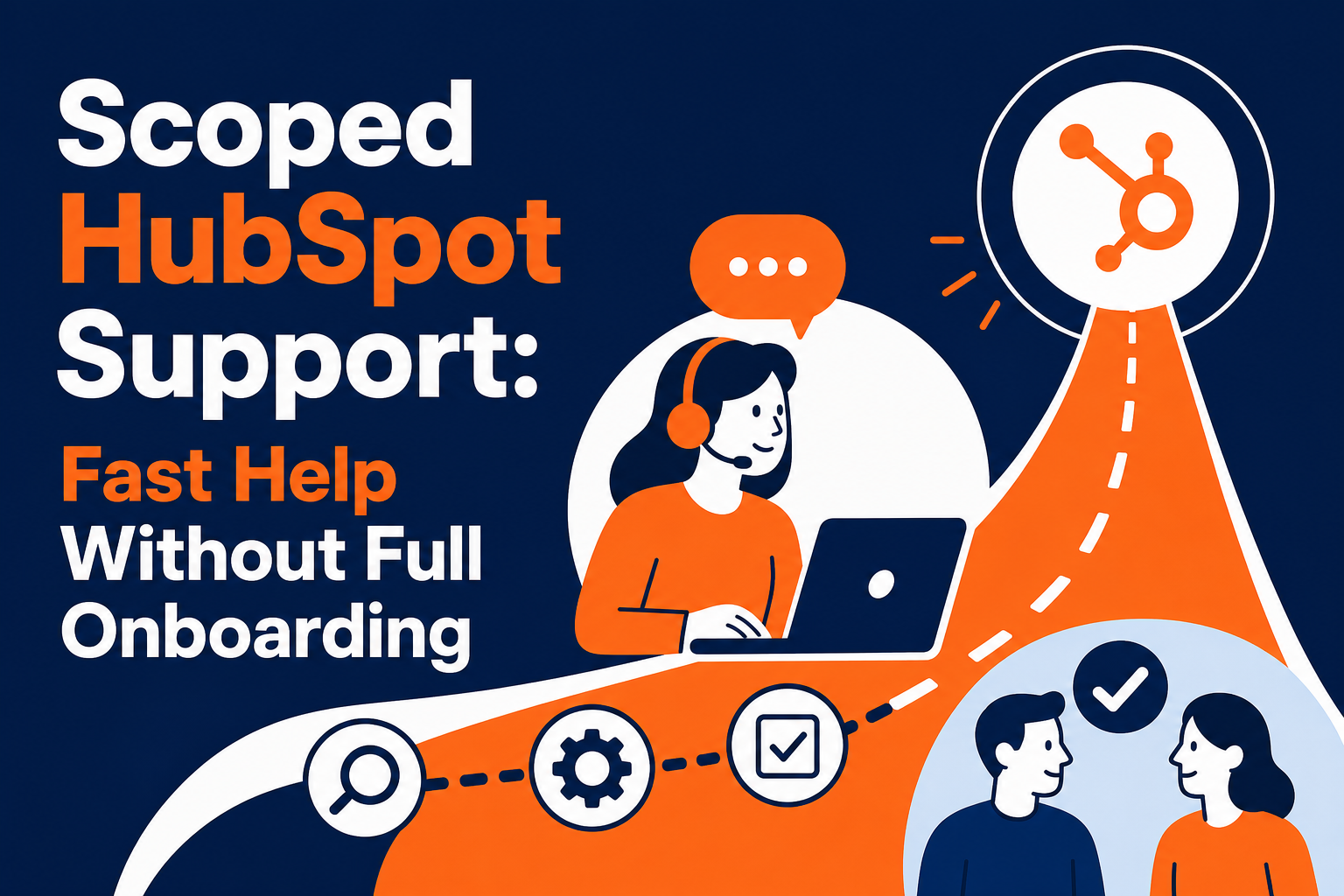
A scoped HubSpot trial engagement is a short, defined-length support arrangement, typically around 30 days, built around a specific business trigger and one or two priority initiatives, rather than a full platform onboarding. It works well for organizations facing urgency (a delayed launch, an upcoming campaign, a stalled evaluation) who need to see concrete progress before committing to a larger project. The engagement has a clear start, a midpoint check-in, and a defined finish, and it can begin even without an existing HubSpot instance, since contacts and setup can be imported during the engagement itself. Vantage Point runs these engagements through its HubSpot implementation services.
Key Takeaways (TL;DR)
- Scope beats size: a tight, well-defined engagement built around a real trigger outperforms a vague, broad one for building trust fast.
- Pick two priorities, not ten: identify the customer's highest-priority initiatives and ignore the rest for now.
- Structure matters more than hours: a defined start, midpoint check-in, and finish creates accountability that an open-ended retainer doesn't.
- No existing instance required: contacts, lists, and initial configuration can be imported and set up during the engagement itself.
- How Vantage Point helps: we scope a mutual success plan up front so both sides know exactly what "done" looks like before work starts.
What Problem Does a Scoped Trial Engagement Actually Solve?
Full onboarding is designed to configure a platform comprehensively (data model, automation, reporting, integrations) and it typically assumes weeks of runway before the first real business result shows up. That's the right approach when an organization is genuinely ready to commit to a platform for the long term.
It's the wrong approach when the real question is narrower: "can this help me hit a deadline that's already close," or "I need to see this work before I commit further." Forcing that situation into a full-onboarding sales process either stalls the decision entirely or produces a mismatched scope that frustrates both sides.
What Does a Well-Structured Scoped Engagement Look Like?
The pattern that works consistently has four defining characteristics:
- A real business trigger. Not "we should probably modernize eventually," but a specific, time-bound reason: a delayed product launch, an upcoming campaign, a contract renewal, a deadline that's already visible on the calendar.
- A limited, named scope. Two or three priority initiatives, agreed up front, rather than an open list that grows during the engagement. If it's not one of the agreed priorities, it waits for a later phase.
- A defined start and finish. A specific engagement length, commonly around 30 days, with a stated end point, not an ongoing arrangement with no natural checkpoint.
- A midpoint check-in. A structured point partway through to confirm the engagement is still tracking toward the agreed outcomes, and to adjust scope if something more complex surfaced.
None of this requires guessing at hours up front. A flexible starting block (enough time to make visible progress on the priority initiatives) that can expand if the engagement uncovers more complexity than expected keeps the arrangement honest without over-committing either side on day one.
Do You Need an Existing HubSpot Instance to Start?
No. One of the more common misconceptions is that a HubSpot engagement can't start until the organization already has an instance configured with data cleanly loaded. In practice, contacts, target lists, and the initial configuration needed to support the priority initiatives can all be imported and set up as part of the engagement itself. That removes a common excuse for delay, "we're not ready yet", when the actual barrier is prioritization, not readiness.
How Do You Identify the Right One or Two Priorities?
The fastest way to identify priorities is to go back to whatever conversations already exist (sales call recordings, prior notes, stated goals) rather than starting a fresh discovery process from scratch. Most organizations considering a scoped engagement have already talked about what they need; the job is to extract the two most pressing initiatives from that existing material rather than re-litigating the whole conversation.
A useful filter: does this initiative connect directly to the trigger that created the urgency? A delayed product launch points toward campaign and list-readiness work. A stalled evaluation points toward a concrete first win the prospect can see and feel, like a working newsletter send or a functioning lead-routing rule: not a comprehensive audit.
Trial Engagement vs. Full Onboarding: Which Fits?
| Signal | Favors scoped trial engagement | Favors full onboarding |
|---|---|---|
| Timeline | A specific near-term deadline is driving the decision | No immediate deadline; planning for the next 6-12 months |
| Commitment stage | Evaluating, not yet ready to commit to a full platform rollout | Already committed to the platform as the long-term system |
| Scope | One or two clear priorities | Multiple departments, workflows, and integrations |
| Existing setup | Little to no existing configuration, or starting fresh | Existing instance with data and process to migrate or expand |
What Should Go in the One-Page Success Plan?
The document that anchors a scoped engagement doesn't need to be long, but it needs to cover a few specific things clearly enough that either side can hold the other accountable to it:
| Element | Why it matters |
|---|---|
| The trigger | Names the reason for urgency, so scope decisions can be tested against it later |
| The two or three priorities | Keeps the engagement from quietly expanding into a full onboarding |
| Start and end dates | Creates a real deadline instead of an open-ended arrangement |
| Midpoint check-in date | Builds in a structured moment to confirm progress or adjust scope |
| What "done" looks like for each priority | Prevents disagreement at the end about whether the engagement delivered |
Because the plan is short, it can be drafted quickly, often from a single planning conversation, rather than requiring its own discovery phase. That speed is part of the point: a scoped engagement that takes two weeks just to define isn't actually solving the urgency problem it was meant to address.
What Should You Prepare Before Starting?
- Name the specific trigger creating urgency, and write it down as the reason for the engagement's timing.
- Identify the two or three priority initiatives, no more, that the engagement will address.
- Gather existing materials (call notes, target lists, prior proposals) instead of starting discovery cold.
- Agree on the engagement length and midpoint check-in date before work begins.
- Put the scope, timeline, and success criteria in a short, one-page plan both sides sign off on.
What Can Go Wrong With a Scoped Engagement?
The model breaks down in a few predictable ways. Scope creep is the most common: without a written plan, "just one more thing" requests accumulate until the 30-day engagement is effectively a full onboarding without the timeline or resourcing to match. A written one-page plan, referenced explicitly when a new request comes in, is the simplest defense.
The second failure mode is picking priorities that don't connect to the original trigger. If the urgency was a delayed launch, but the engagement's actual work drifts toward general platform cleanup, the customer won't see the result they were expecting by the deadline that mattered to them: even if the work itself was reasonable.
The third is skipping the midpoint check-in when things seem to be going fine. That checkpoint is where scope adjustments get made cheaply; skipping it means the first real conversation about progress happens at the deadline, when there's no time left to correct course.
How Vantage Point Helps
Vantage Point runs scoped, time-boxed HubSpot engagements for organizations that need fast, visible progress on a specific problem before committing to a larger rollout. Our HubSpot implementation services cover both the scoped-engagement model and full onboarding, and our managed services and ongoing support pick up where a scoped engagement leaves off if you decide to expand. We are employee-owned, with senior consultants only and no junior handoffs; the experts you meet are the experts who deliver.
Need Fast HubSpot Progress Without a Full Onboarding Commitment?
Vantage Point can scope a time-boxed engagement around your most urgent priority and show real progress within weeks. Talk to Vantage Point about a scoped engagement.
Frequently Asked Questions
What is a scoped HubSpot trial engagement?
It's a short, defined-length support arrangement, commonly around 30 days, built around a specific business trigger and one or two priority initiatives, rather than a full platform onboarding covering every department and workflow.
Do I need an existing HubSpot instance to start a scoped engagement?
No. Contacts, target lists, and the initial configuration needed for the priority initiatives can be imported and set up as part of the engagement itself, so a lack of existing setup isn't a barrier to starting.
How many initiatives should a scoped engagement cover?
Two or three, agreed up front. Keeping the scope tight is what makes a short engagement deliver visible results; anything beyond the agreed priorities should wait for a later phase rather than expanding the current one.
What happens at the midpoint of the engagement?
A structured check-in confirms the engagement is still tracking toward the agreed outcomes and gives both sides a chance to adjust scope if something more complex than expected has surfaced.
How is this different from a full HubSpot onboarding?
Full onboarding configures the platform comprehensively across data model, automation, reporting, and integrations, typically over a longer runway. A scoped engagement targets one or two priority problems tied to a specific, near-term trigger, with a defined start and finish.
Can a scoped engagement lead into a larger project later?
Yes. It's designed to prove value on a narrow problem first. Many organizations that start with a scoped engagement move into broader onboarding once they've seen concrete results, but the initial engagement doesn't require committing to that in advance.