
Key Takeaways (TL;DR)
- What is HubSpot Data Hub? The evolution of Operations Hub. An AI-powered data management platform that connects, cleans, and unifies customer data from every source into a single actionable foundation.
- Key Benefit: Eliminates data silos by combining CRM, third-party apps, spreadsheets, and data warehouses into one unified customer view: no coding required.
- Cost: Free tier available; Starter from $15/month per seat, Professional from $800/month, Enterprise from $2,000/month.
- Timeline: Initial setup in 1-2 weeks; full data unification across your tech stack in 4-8 weeks with an experienced implementation partner.
- Best For: Growing businesses with 3+ apps in their tech stack that need a single source of truth for marketing, sales, and service teams.
- Bottom Line: Organizations using unified data report 41% faster time to value, and 96% say personalized experiences driven by unified data have increased sales.
Introduction: Why Unified Customer Data Is No Longer Optional
Every business runs on data. But for most organizations, that data is scattered across a dozen systems, CRM records in one tool, marketing analytics in another, support tickets in a third, and critical context buried in email threads and call notes. According to research from Databricks, 80% of business data is trapped in unstructured formats like emails and calls, while the rest sits siloed across disconnected systems.
The result? Teams make decisions based on incomplete information. Marketing sends campaigns to the wrong segments. Sales reps miss crucial context about open support issues. Service agents lack visibility into a customer's purchase history. And AI tools, which could transform how your teams work, deliver underwhelming results because they're operating on fragmented data.
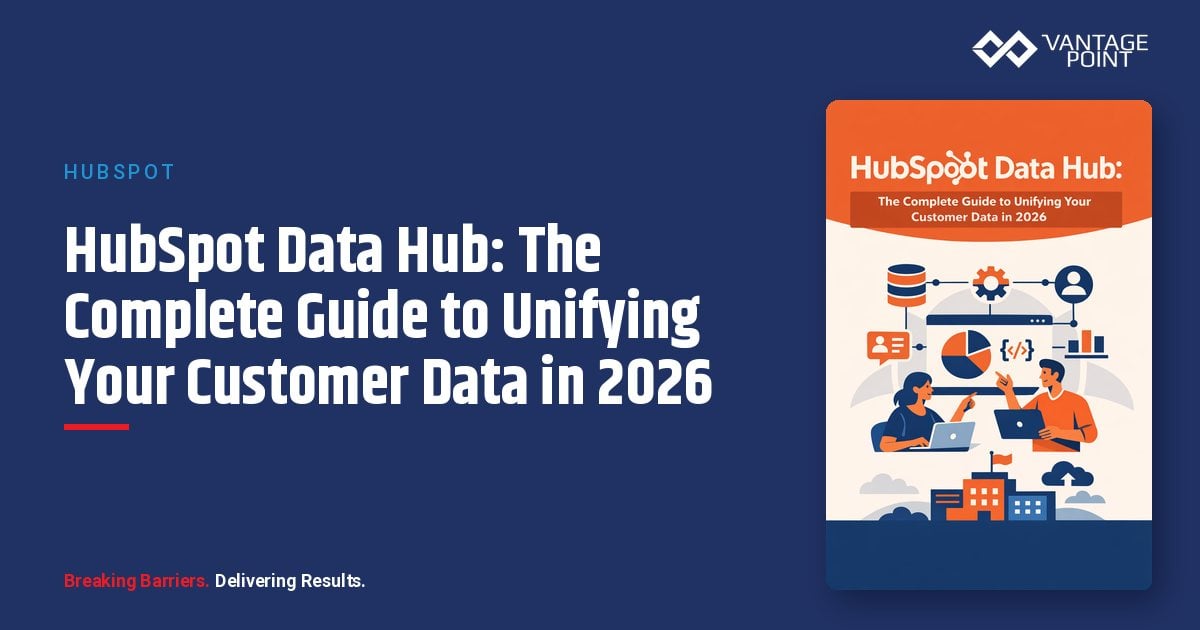
HubSpot Data Hub was built to solve this exact problem. Launched at INBOUND 2025 as the evolution of Operations Hub, Data Hub is a comprehensive data management platform that connects, cleans, and unifies data from any source (including external databases, spreadsheets, data warehouses, and 100+ app integrations) into a single, actionable customer foundation.
In this guide, we'll break down everything you need to know about HubSpot Data Hub: what it includes, how it differs from Operations Hub, how to implement it effectively, and how a certified HubSpot partner like Vantage Point can help you unlock its full potential.
What Is HubSpot Data Hub?
HubSpot Data Hub is a unified data management platform designed to give marketing, sales, and service teams a single source of truth: without requiring technical expertise. It replaces and expands upon the former Operations Hub, adding powerful new tools for data blending, AI-powered quality management, and cross-platform data activation.
The Core Components of Data Hub
Data Hub includes a comprehensive suite of tools organized around three pillars:
1. Combine Data Across Your Tech Stack
- Data Studio: An AI-powered, spreadsheet-like interface for blending first-party and third-party data from any source without writing code.
- Cloud Data Storage Integrations: Bidirectional sync with platforms like Snowflake, BigQuery, and Amazon Redshift.
- Data Sync Software: Real-time, two-way sync with 100+ popular business applications.
2. Enhance Data Quality Automatically
- Data Quality Overview: A centralized dashboard that continuously monitors data health, identifies duplicates, flags inconsistencies, and standardizes formats.
- Automation: Rules-based and AI-powered workflows that fix formatting issues and enforce data standards automatically.
- Dashboards & Reporting: Unified analytics powered by clean, complete data across every hub.
3. Activate Customer Intelligence
- Conversational and Intent Enrichment: Automatically updates contact and company records with insights extracted from emails, calls, and meeting notes.
- Smart Insights: AI-surfaced patterns, risks, and opportunities across your customer data.
- Flexible CRM Views: Tables, charts, and custom views to visualize records in whatever format helps your team work fastest.
How Is Data Hub Different from Operations Hub?
If you've been using HubSpot's Operations Hub, you might wonder what's changed. The short answer: Data Hub is Operations Hub plus a transformative new layer focused on data unification.
| Aspect | Operations Hub | HubSpot Data Hub |
|---|---|---|
| Primary Focus | Process automation & app integration | Data unification & activation |
| Flagship Feature | Programmable Automation, Data Sync | Data Studio (AI-powered data blending) |
| Primary User | Technical operations professionals | All teams: marketing, sales, RevOps, service |
| Core Value | Connecting systems and automating tasks | Creating a single source of truth to power smarter automation, reporting, and AI |
| Data Sources | HubSpot + connected apps | HubSpot + apps + spreadsheets + data warehouses + files |
Every feature from Operations Hub (Data Sync, Programmable Automation, Data Quality Automation, Duplicate Management, and Datasets) carries forward into Data Hub. They're now enhanced with AI capabilities and complemented by the powerful new Data Studio.
Deep Dive: Data Studio: The Game-Changer
Data Studio is the flagship feature that distinguishes Data Hub from its predecessor. It's a no-code workspace where non-technical users can combine data from multiple sources (HubSpot objects, connected apps, spreadsheets, data warehouses) into unified datasets that power segmentation, automation, and reporting.
What Makes Data Studio Different
Before Data Studio (the old way):
- Export contact data from your CRM
- Export product usage data from your analytics platform
- Combine spreadsheets manually using VLOOKUPs
- Clean formatting inconsistencies by hand
- Import the final static list back into HubSpot
Result: Hours of manual work, error-prone, and outdated the moment you finish.
With Data Studio (the new way):
- Connect your HubSpot CRM data and external data sources directly
- Use the AI-assisted interface to blend datasets, matching records automatically
- Create calculated fields using AI-generated formulas
- Save as a live, unified dataset that updates automatically
Result: A dynamic, always-current customer view that powers lists, reports, workflows, and AI tools in real time.
Key Capabilities
- Connect to Any Source: Databases, data warehouses, apps, spreadsheets, and files. Data Studio handles millions of records seamlessly.
- AI Pattern Detection: Automatically detects data patterns and suggests connections between sources.
- Calculated Columns: Create derived fields like customer lifetime value, engagement scores, or custom metrics.
- One-Click Activation: Unified datasets immediately power segments, workflows, dashboards, and Breeze AI tools.
- Familiar Interface: Spreadsheet-style design that any business user can navigate.
How Data Hub Enhances Every HubSpot Product
One of the most powerful aspects of Data Hub is how it amplifies every other HubSpot product in your stack:
Marketing Hub
- Smarter Segmentation: Build segments based on unified data from multiple sources, not just CRM fields.
- Better Personalization: Access complete customer profiles for truly personalized campaigns.
- Improved Attribution: Connect marketing touchpoints with downstream revenue data for clearer ROI reporting.
Sales Hub
- Complete Customer Context: Reps see every interaction, support ticket, and behavioral signal before making a call.
- AI-Powered Insights: Breeze AI can surface deal risks and opportunities using complete, unified data.
- Accurate Forecasting: Clean data means more reliable pipeline and revenue forecasts.
Service Hub
- 360-Degree Support: Agents see purchase history, marketing interactions, and sales conversations alongside support tickets.
- Proactive Issue Detection: Smart Insights flag at-risk customers before they churn.
- Consistent Experience: Every team member works from the same data, so customers never have to repeat themselves.
Content Hub & Commerce Hub
- Data-Driven Content: Use unified analytics to inform content strategy and personalization.
- Accurate Reporting: Commerce data combined with marketing and sales data delivers a complete picture of the customer journey.
HubSpot Data Hub Pricing: What to Expect
| Tier | Price | What's Included |
|---|---|---|
| Free | $0/month | Data sync between apps, basic data cleanup, default field mappings, access to all integrations |
| Starter | $15/month per seat | Custom field mappings, advanced data sync, basic quality tools, email & chat support |
| Professional | $800/month (1 seat included) | AI-powered dataset creation, data cleaning at scale, process automation, data health monitoring |
| Enterprise | $2,000/month (1 seat included) | Advanced datasets, data warehouse connections, calculated metrics, secure data sharing |
Credit System: Professional and Enterprise tiers include HubSpot Credits for using Data Studio. Credits are consumed when syncing data from external sources. All other Data Hub features are included in your subscription without additional credit usage.
Pro Tip: For most growing businesses, the Professional tier is the sweet spot. It unlocks Data Studio's AI capabilities and automated data quality, which deliver the highest ROI through time savings and improved data accuracy.
Implementation Best Practices: How to Unify Your Data with Data Hub
Successfully implementing Data Hub requires more than just turning on features. Here's a proven framework for maximizing your investment:
Step 1: Audit Your Current Data Landscape
Before configuring anything, map out your existing data ecosystem:
- Identify all data sources: CRM, marketing automation, support tools, accounting software, spreadsheets, and data warehouses.
- Catalog data types: Contacts, companies, deals, products, custom objects, and behavioral data.
- Assess data quality: Document known issues like duplicates, missing fields, inconsistent formatting, and outdated records.
- Define join keys: Identify how records link across systems (email addresses, company IDs, account numbers).
Step 2: Define Your Unified Data Model
Determine what your ideal customer record looks like:
- What fields do marketing, sales, and service teams need?
- Which external data points would improve decision-making?
- What calculated metrics (lifetime value, engagement scores) would drive better outcomes?
- How should records be deduplicated and merged?
Step 3: Configure Data Studio Connections
Start with your highest-impact data sources:
- Connect your primary CRM data objects
- Link external data sources (warehouse, spreadsheets, third-party apps)
- Define join logic and field mappings
- Create calculated columns for derived metrics
- Validate dataset accuracy with sample records
Step 4: Establish Data Quality Rules
Set up automated quality management:
- Configure duplicate detection rules with appropriate sensitivity
- Define formatting standards (phone numbers, addresses, naming conventions)
- Set up data enrichment workflows for missing fields
- Create monitoring alerts for data health degradation
Step 5: Activate and Iterate
Put unified data to work:
- Build segments using unified datasets
- Update reporting dashboards with cleaner, more complete data
- Enable Breeze AI tools with your unified data foundation
- Train team members on new capabilities
- Monitor, measure, and refine
Common Data Unification Challenges (and How Data Hub Solves Them)
Challenge: Siloed Data Across Departments
The Problem: Marketing uses one set of data, sales another, and service a third. No one has the complete picture.
Data Hub Solution: Data Studio connects all sources into a single dataset. When marketing adds a lead, sales sees the full engagement history. When service resolves a ticket, the sales team knows about it immediately.
Challenge: Manual Data Entry and Exports
The Problem: Teams spend hours each week exporting, cleaning, and re-importing data between systems.
Data Hub Solution: Real-time data sync and automated data quality tools eliminate manual data work. Live spreadsheet integration means external data stays connected and current without exports.
Challenge: Duplicate and Inconsistent Records
The Problem: Multiple records for the same customer create confusion and inflate metrics.
Data Hub Solution: AI-powered duplicate detection identifies matches: even when records aren't identical. Automated merge rules combine duplicates while preserving the most accurate data from each record.
Challenge: Poor AI Performance
The Problem: AI tools deliver mediocre results because they're working with incomplete data.
Data Hub Solution: With unified, clean data from Data Studio feeding Breeze AI, your AI tools have complete context for every customer interaction: leading to better predictions, smarter recommendations, and more effective automation.
How Vantage Point Helps You Get the Most from HubSpot Data Hub
Implementing Data Hub effectively requires strategic planning and technical expertise. As a certified HubSpot partner, Vantage Point helps organizations at every stage of their data unification journey:
Data Strategy & Assessment
We start by understanding your business goals and mapping your data landscape. Our team identifies quick wins, prioritizes data sources, and designs a unified data architecture tailored to your organization.
Implementation & Configuration
From Data Studio setup to quality rule configuration, our certified consultants handle the technical implementation. Ensuring your data sources are connected correctly, join keys are validated, and datasets are optimized for performance.
Integration Expertise
With deep expertise in HubSpot, Salesforce, MuleSoft, and Workato, Vantage Point connects Data Hub to your entire tech stack: including data warehouses, ERP systems, and custom applications.
Training & Enablement
We train your marketing, sales, and service teams to leverage Data Hub's capabilities independently, from building datasets in Data Studio to interpreting data quality reports and creating data-driven workflows.
Ongoing Optimization
Data unification isn't a one-time project. Vantage Point provides ongoing support to refine your data model, expand data sources, and ensure your unified data foundation evolves with your business.
Frequently Asked Questions
What is HubSpot Data Hub and how does it differ from Operations Hub?
HubSpot Data Hub is the evolution of Operations Hub, expanding its focus from process automation to comprehensive data unification and activation. It includes all Operations Hub features plus new tools like Data Studio for no-code data blending and enhanced AI-powered data quality management. The key difference is that Data Hub is designed for all teams: not just technical operations professionals.
How much does HubSpot Data Hub cost?
Data Hub offers four tiers: Free ($0/month with basic sync and cleanup), Starter ($15/month per seat with custom field mappings), Professional ($800/month with AI-powered Data Studio and automated quality tools), and Enterprise ($2,000/month with advanced datasets and data warehouse connections). Credits are only consumed for external data syncs and AI transformations.
Do I need technical skills to use Data Hub?
No. Data Hub's flagship feature, Data Studio, was specifically designed for non-technical users. Its spreadsheet-like interface and AI-powered assistance allow marketing, sales, and service team members to combine, clean, and activate data without writing any code. For more advanced configurations like data warehouse integrations, a HubSpot implementation partner like Vantage Point can help.
How long does it take to implement HubSpot Data Hub?
Initial setup can be completed in 1-2 weeks for basic configurations. A comprehensive data unification project (connecting multiple data sources, establishing quality rules, and training teams) typically takes 4-8 weeks with an experienced implementation partner. The timeline depends on the number of data sources, data volume, and complexity of your requirements.
Can Data Hub connect to my data warehouse?
Yes. Data Hub Enterprise supports bidirectional connections with major cloud data storage platforms including Snowflake, BigQuery, and Amazon Redshift. This allows you to blend warehouse data with HubSpot CRM data in Data Studio and push enriched data back to your warehouse via Reverse ETL.
How does Data Hub improve AI performance in HubSpot?
AI tools like Breeze are only as effective as the data they can access. Data Hub ensures Breeze and other AI features have complete, accurate, and up-to-date customer information by unifying data from every source and maintaining quality automatically. This results in better predictions, more accurate lead scoring, smarter content recommendations, and more effective automation.
Is Data Hub available for all HubSpot customers?
Yes, Data Hub is available at every tier. The Free version includes basic data sync and cleanup. However, the most powerful features (Data Studio AI-powered dataset creation, automated data quality at scale, and data warehouse connections) require Professional or Enterprise subscriptions.
Conclusion: Build Your Single Source of Truth
In 2026, the organizations that win will be the ones with the cleanest, most unified customer data. HubSpot Data Hub makes that possible for businesses of every size. Replacing scattered spreadsheets, broken integrations, and manual data work with an AI-powered platform that keeps your data connected, clean, and actionable.
Whether you're just starting to explore Data Hub's Free tier or ready to implement an enterprise-grade unified data strategy, the time to act is now. Every day you operate on fragmented data is a day your teams are making decisions with incomplete information, and a day your AI tools are underperforming.
Ready to unify your customer data? Contact Vantage Point today for a free consultation. Our certified HubSpot consultants will assess your data landscape, design a unification strategy, and help you implement Data Hub to unlock the full potential of your customer data.
About Vantage Point
Vantage Point is a certified HubSpot and Salesforce partner specializing in CRM implementation, data integration, and AI-powered business solutions. With deep expertise in HubSpot, Salesforce, MuleSoft, Workato, and Anthropic's Claude AI, Vantage Point helps organizations of all sizes build unified data foundations that drive growth, efficiency, and exceptional customer experiences. Learn more at vantagepoint.io.