
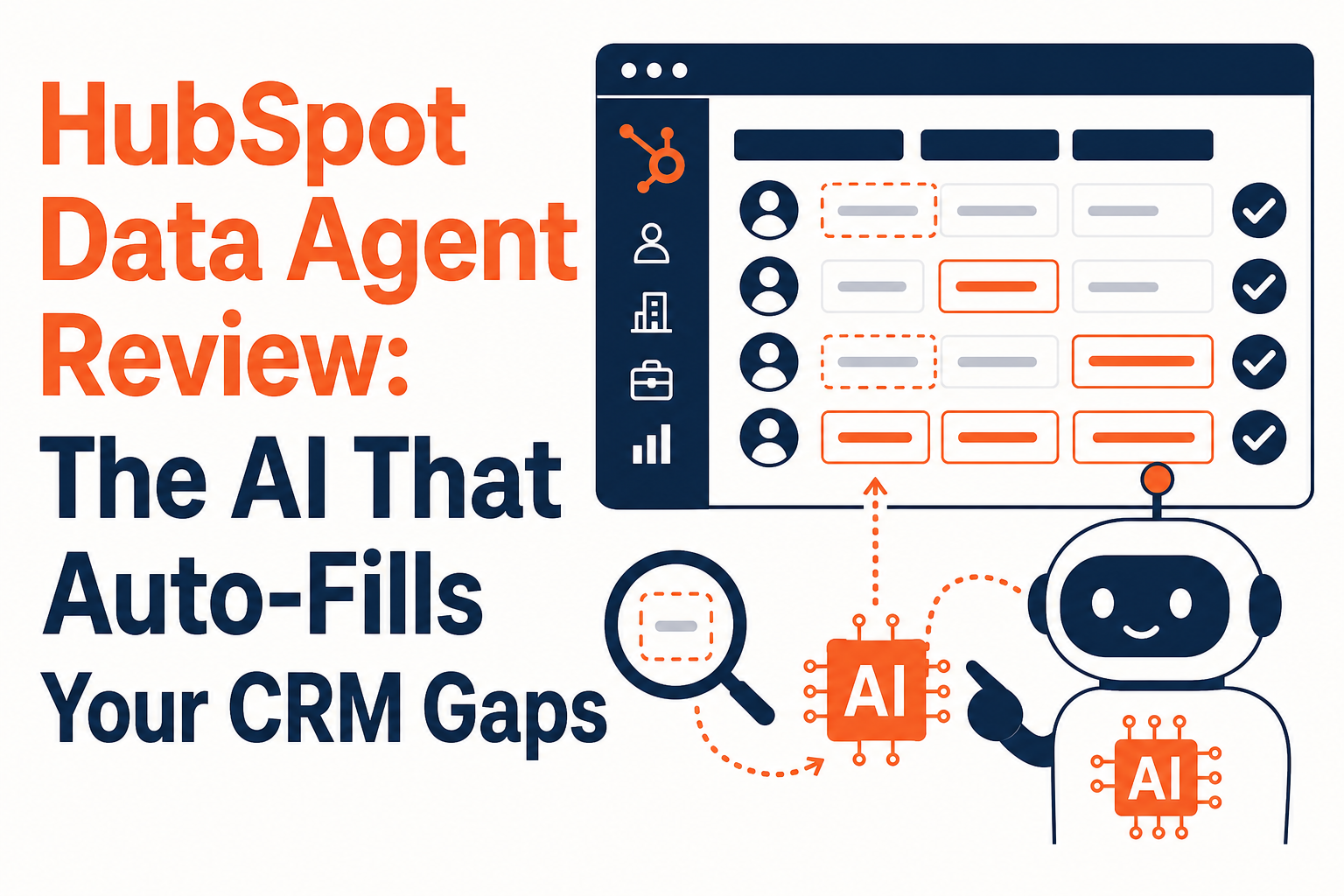
If your HubSpot records are full of blank fields, duplicate companies, and inconsistent formatting, you're not alone. HubSpot's Breeze Data Agent is the native AI agent built to close those gaps automatically, without a manual cleanup project.
This review covers what the Breeze Data Agent actually does, how it's priced, where it fits in a HubSpot-first tech stack, and when your team should pair it with a broader data strategy instead of relying on it alone.
TL;DR
- What it is: A HubSpot Breeze AI Agent that researches and enriches CRM contact and company records using CRM data, call/email transcripts, uploaded documents, and public web sources.
- Why it matters: Reps and marketers waste hours on manual research and cleanup; automated enrichment keeps records usable for segmentation, personalization, and reporting.
- Best for: Teams whose primary customer data already lives in HubSpot and want enrichment and insights without adding a separate tool.
- Decision point: Evaluate whether your data problem is mostly "missing fields" (Breeze Data Agent territory) or "structural" — duplicate objects, bad field mapping, multi-system sync issues — which needs a data migration and integration approach first.
- How Vantage Point helps: We scope HubSpot data cleanup and system integration and data migration work so AI enrichment tools like Breeze Data Agent are working with a clean, well-structured CRM instead of masking deeper data problems.
What Is the HubSpot Breeze Data Agent?
The Breeze Data Agent is a native AI agent inside HubSpot's Breeze suite that researches, enriches, and answers specific business questions about contacts and companies in your CRM. It's installed from the Breeze Agents section of the HubSpot Marketplace, where the listing shows strong adoption — the app has been installed by thousands of HubSpot portals, reflecting broad demand for automated data enrichment inside the CRM.
Rather than just appending generic firmographic data like industry or employee count, the agent is designed to answer more specific questions such as whether a company has a European headquarters, whether it shows active buying signals, or whether its leadership has been in recent news. It pulls from your existing HubSpot CRM data, call and email transcripts, uploaded documents, and the open web, then surfaces the results directly on the contact or company record.
For teams whose primary complaint is "our records have blank fields and stale information," this is squarely the use case the agent addresses: formatting inconsistent entries, flagging duplicates for review, and filling gaps in company and contact properties without a manual research project.
Why This Matters for HubSpot Teams in 2026
Clean, complete CRM data is the foundation for segmentation, lead scoring, personalization, and accurate reporting. When company and contact records are incomplete, marketing automation misfires, sales reps waste time on research instead of selling, and forecasting becomes unreliable.
As HubSpot has expanded its Breeze AI Agent suite (including agents for prospecting and customer service alongside the Data Agent), native data enrichment has become a bigger part of how HubSpot customers are expected to keep records usable at scale. For teams already invested in HubSpot as their system of record, using a native agent instead of layering on a third-party enrichment tool can simplify vendor management and keep enrichment logic inside the same workflows and permissions structure your team already uses.
How the Breeze Data Agent Works
- Install from the HubSpot Marketplace. The Data Agent is available to portals on Starter plans and above; it is not a separate purchased product but a Breeze Agent enabled inside your existing subscription.
- Connect to CRM objects. The agent reads existing contact and company properties, along with logged call and email activity and uploaded documents.
- Enrich and format records. It fills empty fields, standardizes formatting on properties like company name or industry, and flags likely duplicate records for review.
- Surface insights, not just data. Beyond enrichment, it can answer specific questions (buying intent, recent news, headcount trends) directly on the record or inside workflows.
- Consume HubSpot Credits. Usage is metered through HubSpot's credit-based pricing model shared across Breeze AI features; some subscription tiers include monthly credits, with additional usage purchased as needed.
Breeze Data Agent vs. a Broader Data Cleanup Project
| Criteria | Breeze Data Agent (native) | Full Data Migration & Integration Project |
|---|---|---|
| Best for | Filling gaps and formatting issues in an otherwise healthy CRM | Duplicate objects across systems, broken field mapping, multi-platform sync problems |
| Setup effort | Low — install and configure from the Marketplace | Higher — requires data audit, mapping, and migration planning |
| Data sources | HubSpot CRM, call/email transcripts, uploaded docs, public web | Any connected system: ERP, legacy CRM, marketing tools, data warehouses |
| Pricing model | HubSpot Credits (usage-based) | Project-based or managed services engagement |
| Ongoing maintenance | Runs continuously inside HubSpot workflows | One-time project, followed by governance rules |
| When to choose | Your core data structure is sound; you just need enrichment and dedup flags | You're consolidating systems, migrating platforms, or fixing structural data issues |
If your CRM problems go beyond missing fields — think duplicate company hierarchies, conflicting records between HubSpot and Salesforce, or a messy legacy import — enrichment alone won't fix it. That's a system integration and data migration conversation, not just an AI agent install.
What Businesses Should Do Next
- Audit before you automate. Run a quick sample audit of contact and company records to understand whether your issue is missing data (Breeze Data Agent territory) or structural (migration/integration territory).
- Set enrichment rules deliberately. Decide which fields the agent should update automatically versus which should route to a human for review, especially for fields tied to compliance or reporting.
- Watch credit consumption. Because the Data Agent runs on HubSpot Credits, monitor usage against your plan's included allotment so enrichment costs stay predictable.
- Pair enrichment with process design. Data enrichment only pays off if the records feed working automation — lead routing, scoring, and campaigns — through your broader CRM and marketing automation setup.
- Plan for dual-platform teams. If your organization runs HubSpot alongside Salesforce, make sure enriched HubSpot data is actually reaching Salesforce records through a proper HubSpot–Salesforce integration rather than staying siloed.
How Vantage Point Helps
Vantage Point is a senior-led Salesforce and HubSpot consulting partner. For HubSpot customers evaluating the Breeze Data Agent, we help with:
- Configuring HubSpot Breeze Agents correctly so enrichment rules match your data governance and reporting needs.
- Running a data audit to determine whether native enrichment is sufficient or whether a broader system integration and data migration project is needed first.
- Connecting enriched HubSpot records into working CRM and marketing automation so cleaner data actually improves segmentation and lead routing.
- Bridging HubSpot and Salesforce data through HubSpot–Salesforce integration for organizations running both platforms.
If your team is evaluating how AI-driven data enrichment fits into your broader HubSpot or Salesforce strategy, Vantage Point can help assess the right next step and build a practical implementation plan.
View on HubSpot Marketplace to see current listing details, reviews, and installation steps.
FAQ
What does the HubSpot Breeze Data Agent actually do?
It's a native HubSpot AI agent that enriches contact and company records by filling in missing fields, standardizing formatting, flagging likely duplicates, and answering specific research questions using CRM data, call/email transcripts, and public web sources.
Is the Breeze Data Agent a separate purchase from HubSpot?
No. It's installed from the HubSpot Marketplace as part of the Breeze AI Agent suite and is available to portals on Starter plans and above. Usage is metered through HubSpot Credits rather than a standalone subscription fee.
Will the Breeze Data Agent fix duplicate records across multiple systems?
It can flag likely duplicates within HubSpot for review, but it isn't designed to resolve structural data problems that span multiple systems, such as conflicting records between HubSpot and Salesforce. Those situations typically need a dedicated data migration and integration project.
Does the Breeze Data Agent work with data outside HubSpot?
It's optimized for the HubSpot ecosystem, pulling from HubSpot CRM data, logged call and email activity, and uploaded documents, plus public web sources. Organizations needing to unify data from outside platforms like ERPs or a separate legacy CRM should plan for a broader integration approach.
How is the Breeze Data Agent priced?
It uses HubSpot's credit-based pricing model shared across Breeze AI features. Some subscription tiers include a monthly allotment of free credits, with additional credits purchased as usage grows.
Which teams benefit most from the Breeze Data Agent?
Teams whose primary customer data already lives in HubSpot and whose main data problem is incomplete or inconsistently formatted records benefit most, since the agent is built to enrich and clean up records already inside the CRM.
Should we install the Breeze Data Agent before or after a CRM cleanup project?
If your CRM has significant structural issues — like widespread duplicate objects or broken sync with another platform — address those first. Enrichment tools work best on a CRM that's already reasonably well structured, so sequencing a cleanup or migration project ahead of enrichment usually produces better results.
Can the Breeze Data Agent replace a dedicated data enrichment vendor?
For HubSpot-centric teams, it can reduce or replace the need for a separate enrichment tool for many use cases. Organizations that need to unify knowledge across many non-HubSpot systems may still want a complementary tool or a broader integration strategy alongside it.