CRM implementations require discovery, configuration, testing, training, and documentation. At Vantage Point, Claude AI helps senior consultants prepare and refine that work more efficiently, while people remain accountable for decisions, delivery, and final review.
This is an AI-assisted operating model, not an “AI does the implementation” story. We use AI to organize, draft, analyze, and challenge work; experienced consultants validate it against each client’s goals, CRM architecture, data, governance, and workflow.
Quick Answer
What it is: Vantage Point uses Claude AI as an AI-assisted workbench across CRM consulting, from research and documentation to testing, training materials, and internal project operations.
Who it matters for: Business leaders evaluating a Salesforce, HubSpot, integration, or AI initiative and looking for a consulting partner that uses AI responsibly in delivery.
What action this helps with: It explains what AI-assisted consulting can improve, what still requires human judgment, and the questions to ask before bringing AI into customer-data and implementation work.
Why Vantage Point is relevant: Vantage Point is a senior-led Salesforce and HubSpot consulting partner and a Claude Partner Network Member. We use an AI-first, human-reviewed approach to help turn CRM strategy into usable, governed delivery.
TL;DR
- What it is: Claude AI supports Vantage Point’s CRM implementation work by accelerating research, drafting, analysis, documentation, testing support, training development, and internal coordination.
- What it does not do: Claude does not replace discovery, architecture decisions, client approval, security review, configuration expertise, or accountable human quality control.
- Why it matters: AI can remove friction from repeatable knowledge work so senior consultants can spend more time on process design, data decisions, adoption, and delivery judgment.
- Client benefit: The goal is faster preparation, clearer and more consistent materials, and innovative options grounded in the client’s actual CRM environment.
- How Vantage Point helps: We connect AI use to AI-driven personalization and analytics, CRM implementation, data governance, integrations, and user adoption: not isolated prompts.
What Does AI-First CRM Consulting Mean at Vantage Point?
AI-first CRM consulting means Vantage Point looks for responsible ways to use AI before defaulting to manual, repetitive work. It does not mean that AI makes decisions without experienced people. A CRM implementation still succeeds or fails on fundamentals: a clear business problem, reliable data, usable process design, sound platform configuration, change management, and governance.
Claude is useful because much of implementation delivery begins with information that needs to be understood, compared, structured, and turned into an actionable artifact. A consultant may need to synthesize discovery inputs, turn a process discussion into a first-pass workflow, identify questions in a requirements document, outline test scenarios, or adapt training concepts for a role. These are places where AI can create a useful starting point.
The starting point is not the finish line. Our consultants review the output, correct it, add the context only people on the engagement possess, and make the final recommendation. That distinction matters most when work touches CRM data, customer communications, automation rules, or business decisions.
Anthropic describes the Claude Partner Network as a program for organizations helping enterprises adopt Claude. As a Claude Partner Network Member, Vantage Point brings that AI perspective into the Salesforce and HubSpot work clients already need: not as a separate experiment detached from operations.
How Claude Supports Our CRM Delivery Methodology
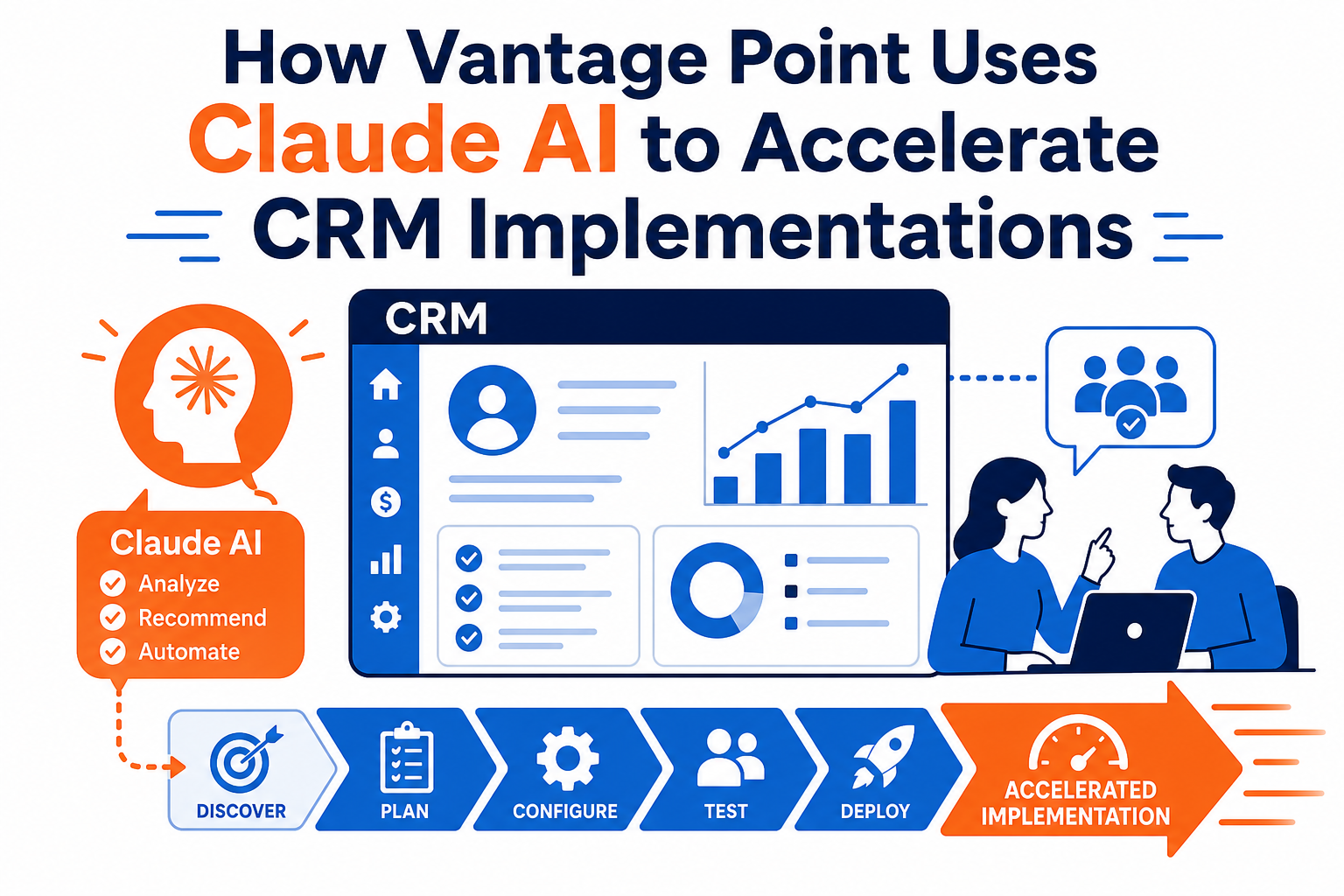
Claude can assist at several points in a CRM implementation, but its role changes by phase. The table below shows the practical division of labor.
| Delivery phase | How Claude can assist | What Vantage Point’s consultants own |
|---|---|---|
| Discovery and planning | Organize notes, surface follow-up questions, summarize documented processes, and outline decision logs | Facilitation, requirements validation, prioritization, scope, stakeholder alignment, and recommendations |
| CRM design and configuration | Produce first-pass field, workflow, user-story, or acceptance-criteria drafts | Architecture, data model decisions, security, configuration, platform best practices, and client approval |
| Build and testing | Suggest test scenarios, organize defect notes, and turn outcomes into readable documentation | Testing strategy, execution, defect triage, remediation, deployment readiness, and sign-off |
| Enablement and launch | Draft role-based job aids, FAQs, release notes, and training outlines | Change management, final training materials, live enablement, adoption planning, and governance |
| Optimization | Help synthesize feedback and identify themes for review | Backlog management, prioritization, measurement, roadmap decisions, and ongoing support |
Discovery: Turning Inputs Into Better Questions
Discovery finds the decisions that shape the CRM: which process should change, which data is trustworthy, who owns the work, and what should not be automated.
Claude can organize workshop inputs, surface themes and open questions, and create a first-pass requirements outline. Consultants then challenge those materials with stakeholders and decide what belongs in the implementation. A polished summary of a flawed process is still flawed; human discovery and business judgment remain non-negotiable.
Design, Documentation, and Testing: Making Work Easier to Review
Claude can accelerate first drafts of user stories, test cases, data-mapping descriptions, meeting summaries, release notes, and configuration documentation. It can also translate technical language into a version business users can evaluate.
Unreviewed output is never ready for a build. Vantage Point consultants check meaningful artifacts against requirements, platform behavior, the data model, and security expectations. Claude may propose edge cases or clarify a defect report, but it cannot certify automation in a client environment. This lets teams focus on correctness, exceptions, usability, and decisions: work connected to our Salesforce implementation and advisory services and HubSpot consulting and optimization services.
How We Use Claude for Content Production
Vantage Point uses Claude to support content research, drafting, editing, and optimization: organizing source material, finding outline gaps, creating a first draft, tightening language, and checking whether a piece answers likely buyer or user questions.
The process is deliberately layered:
- Research begins with authoritative sources. For platform capabilities, policies, and product behavior, we start with official documentation and primary sources rather than relying on AI output as evidence.
- Claude helps structure the draft. It can turn a brief and sourced notes into a clear outline, draft alternative explanations, and suggest useful question-and-answer sections.
- A human editor verifies the work. We check facts, remove unsupported claims, confirm links, preserve Vantage Point’s point of view, and make sure advice is practical for a broad business audience.
- Optimization serves the reader. We use plain-language definitions, answer-first sections, descriptive headings, and FAQs so people can find and use the information quickly.
For customer-facing CRM content, AI can accelerate a draft but never replace source verification, brand judgment, or editorial responsibility. Anthropic’s Claude for Work guidance describes workplace use cases; our job is to apply them with consulting-grade review.
How Claude Supports Client Delivery
In a CRM engagement, documentation is a delivery asset: it supports decisions, user adoption, and ongoing administration.
Vantage Point uses Claude to accelerate preparation of materials such as:
- implementation plans, decision logs, and milestone summaries;
- process descriptions and draft standard operating procedures;
- user-story, acceptance-criteria, and test-case starting points;
- data-mapping narratives and integration documentation;
- role-based training outlines, job aids, and frequently asked questions; and
- release notes and change summaries that make new functionality easier to understand.
Every artifact is tailored and reviewed; a generic training guide cannot account for a client’s fields, approvals, integrations, security model, or language, and a generated test case must still be executed in the right environment.
For integration-heavy work, AI assistance sits alongside system integration and data migration services focused on data ownership, mappings, interfaces, error handling, and operational readiness: not “more AI” for its own sake.
Internal Operations: Knowledge, Proposals, and Project Management
Inside Vantage Point, Claude supports knowledge management, proposal development, and project coordination by helping structure information, draft first-pass materials, and prepare for decisions. It can turn notes into a reusable checklist, summarize project status, or identify assumptions that need to be resolved.
We do not treat fluent output as a source of truth. Internal use follows the same rule as client delivery: verify important facts, use approved information, and keep the accountable person in control, especially where sensitivity, access controls, or contractual commitments require a different approach.
The Quality Advantage: AI-Assisted, Human-Reviewed
The quality advantage is not automatic correctness. AI can make a first useful version available sooner, so experienced people can devote more time to the work only they can do well.
Our quality controls focus on five questions:
- Is the input appropriate? We consider the information’s sensitivity, the approved environment, and the client’s governance expectations before using AI.
- Is the output accurate? A consultant verifies claims against source material, platform behavior, and engagement context.
- Is it complete? We check for exceptions, dependencies, missing stakeholders, and impacts on downstream teams.
- Is it usable? We edit for clear language, role relevance, and an action a client can actually take.
- Is a human accountable? A Vantage Point consultant owns the recommendation, final artifact, and client conversation.
This reflects the human-oversight principle in Claude’s Constitution: AI output contributes to the work; it is not an unreviewed authority over a client’s CRM, data, or process.
What This Means for Clients Working With Vantage Point
Clients working with Vantage Point should expect an implementation team that uses modern tools to prepare thoroughly and deliver clear, useful artifacts. They should also expect direct conversations about where AI is appropriate, what information should be used, how output will be reviewed, and who makes the final call.
The benefits are practical:
- Faster delivery preparation: Teams can move more quickly from raw inputs to a structured draft for review.
- More consistent materials: Reusable patterns help make plans, documentation, test cases, and training materials easier to follow.
- More time for judgment: Senior consultants can focus on the architecture, workflow, data, adoption, and change decisions that determine whether a CRM is actually useful.
- Innovative options with guardrails: AI is considered alongside CRM workflow, data quality, security, governance, and integration: not bolted on after the fact.
AI does not fix a weak process, unreliable data, or an unclear operating model. It can, however, help a prepared team identify those problems sooner and spend more energy resolving them. That is why AI readiness belongs in the implementation conversation from the beginning.
How Vantage Point Helps
Vantage Point helps organizations apply AI in the context of the CRM work that already matters: Salesforce and HubSpot implementation, workflow design, data quality, integrations, adoption, and governance. We can help assess where AI adds value, map the data and process prerequisites, design a sensible pilot, and build a roadmap that people can operate responsibly.
That work often includes advisory and change management so teams understand not just what the new technology can do, but how roles, controls, training, and day-to-day habits need to change. For organizations comparing AI approaches across the CRM stack, our Agentforce vs. Claude architecture guide offers additional context.
If you are evaluating how AI applies to Salesforce, HubSpot, integrations, or CRM governance, Talk to Vantage Point about AI-powered consulting. We will help you identify a practical next step, not simply add another tool to the stack.
Frequently Asked Questions
Does Vantage Point let Claude make CRM implementation decisions?
No. Vantage Point consultants make the implementation decisions and remain accountable for their recommendations. Claude can help organize information, draft materials, and surface questions, but people validate requirements, architecture, security, configuration, testing, and client-facing deliverables.
How does Vantage Point use Claude during CRM discovery?
Vantage Point can use Claude to structure notes, identify themes, prepare follow-up questions, and create a first-pass requirements outline. Senior consultants then validate those materials with stakeholders and determine what belongs in the CRM design and project scope.
Can Claude help with Salesforce and HubSpot documentation?
Yes. Claude can support first drafts of user stories, process descriptions, test cases, data-mapping narratives, release notes, and training materials. Vantage Point reviews and tailors each artifact to the client’s configured platform, data model, processes, and users before delivery.
How does Vantage Point protect quality when using AI?
Vantage Point uses a human-reviewed process: appropriate inputs are selected, outputs are checked against authoritative sources and project context, gaps and exceptions are assessed, and a consultant owns the final deliverable. AI assistance never replaces accountable professional judgment.
What client information should be used with AI tools?
The answer depends on the organization’s data classification, approved AI environment, contractual commitments, access controls, and governance policies. Vantage Point works with clients to define appropriate inputs and review practices before AI is used in a delivery workflow.
Is Vantage Point a Claude Partner Network Member?
Yes. Vantage Point is a Claude Partner Network Member. That membership supports our ability to bring Claude knowledge into CRM consulting, while our delivery approach remains grounded in human review, client context, and Salesforce and HubSpot expertise.
Can Vantage Point help us decide where AI fits in our CRM roadmap?
Yes. Vantage Point can assess candidate workflows, data quality, integrations, governance requirements, user adoption needs, and platform fit to identify a practical AI starting point. The outcome is a prioritized plan that connects AI opportunities to measurable CRM work rather than an isolated experiment.
Official Anthropic Sources
About Vantage Point
Vantage Point is an employee-owned, senior-led consulting firm that helps organizations improve CRM strategy, Salesforce, HubSpot, integrations, data, automation, and AI adoption. We combine practical delivery experience with a focus on clear governance, usable processes, and long-term team capability. Visit Vantage Point to explore our services.