
SEO title: Usage Isn't Value: How to Measure Real ROI From AI Meta description: Learn why login counts and prompt volume don't prove AI ROI, and which CRM and RevOps metrics actually show business value. Recommended slug: blog/ai/usage-isnt-value-measuring-ai-roi
Source note: This article is a Vantage Point strategic brief for RevOps, sales, and operations leaders evaluating AI adoption. It uses anonymized patterns from general industry observation and does not identify any client, individual, vendor, or account team.
Key Takeaways
| Question | Answer |
|---|---|
| What is it? | A framework for measuring AI's actual business impact instead of relying on usage metrics like logins or prompts sent. |
| Key benefit | Leaders can tell the difference between AI that people merely touch and AI that changes an outcome: pipeline velocity, case resolution, forecast accuracy. |
| What you need | Baseline process metrics before rollout, a short list of outcome metrics tied to CRM data, and a review cadence that looks past adoption dashboards. |
| Biggest risk | Reporting "80% weekly active users" as proof of ROI while the underlying business metric (cycle time, close rate, cost to serve) hasn't moved. |
| Best for | Any team on Salesforce, HubSpot, or both that has rolled out Claude or another AI assistant and needs to justify or expand the investment. |
| Bottom line | Usage is a leading indicator, not a result. Measure the outcome the AI was supposed to change, not just whether people opened it. |
Quick Answer
Usage metrics (logins, prompts sent, seats activated) tell you whether people are touching an AI tool, not whether it created business value. Real ROI measurement ties AI use back to a specific CRM or RevOps outcome that existed before the tool did: shorter sales cycles, faster case resolution, cleaner data, or fewer manual hours on a defined task. If you cannot name the metric that was supposed to move, and show it moved, you have adoption data, not ROI data.
The fix is straightforward but frequently skipped: pick the outcome metric before rollout, capture a baseline, and review the outcome, not the login count, on a fixed cadence. This applies whether the AI in question is Claude, a native CRM AI feature, or anything else, and it is the same discipline Vantage Point applies when validating value from any technology investment.
TL;DR
- Usage is a leading indicator, not a result. High adoption can coexist with zero measurable business impact.
- Pick the outcome metric first. Decide what the AI is supposed to change (cycle time, resolution time, error rate) before rollout, not after.
- Baseline before you launch. Without a "before" number, you cannot credibly claim an "after" improvement.
- Tie metrics to CRM data you already trust. Pipeline velocity, case aging, and forecast accuracy live in Salesforce and HubSpot already: use them.
- Review outcomes on a cadence, not just adoption dashboards. Usage reporting is easy and often substitutes for the harder outcome review.
What Does "Usage Isn't Value" Actually Mean?
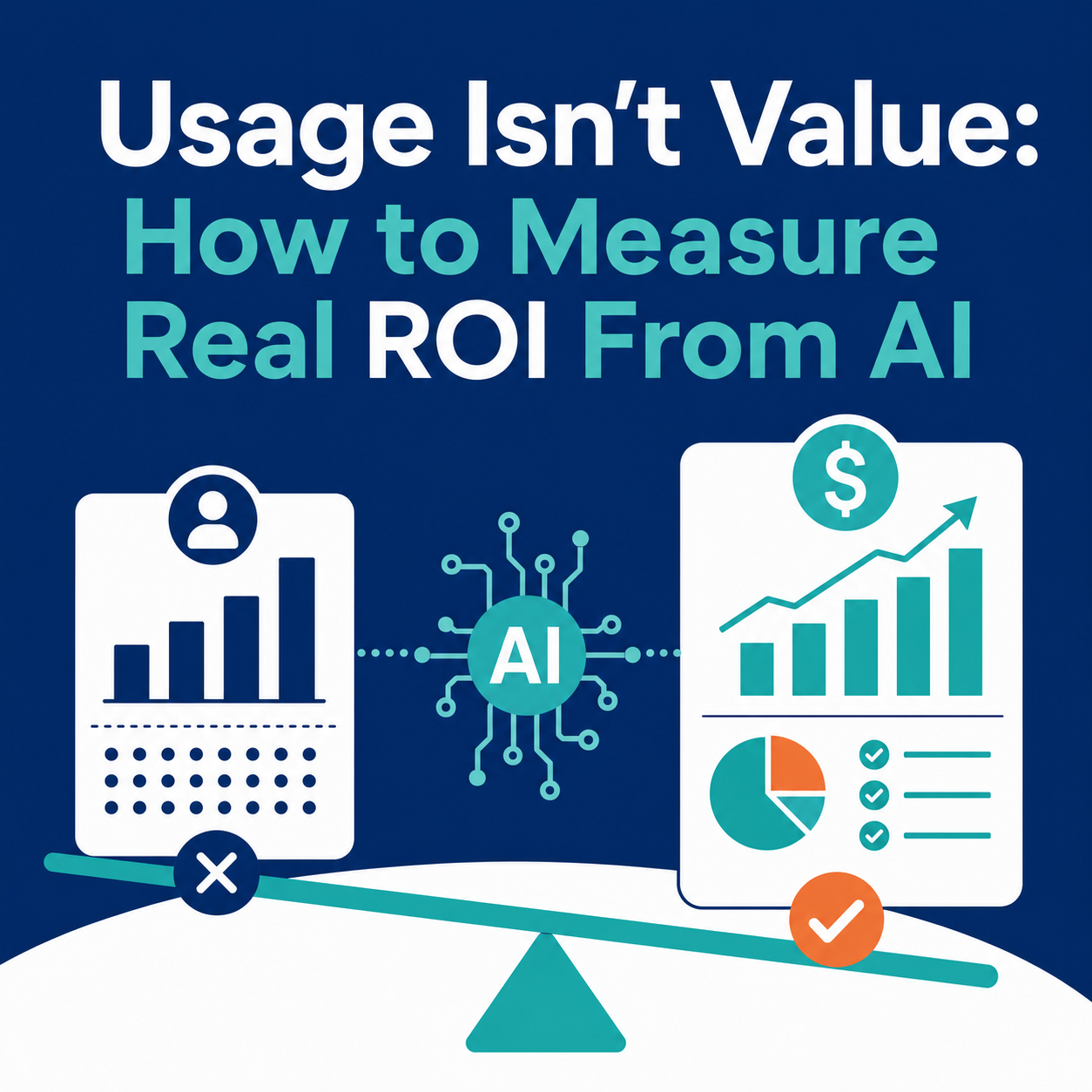
It means that a high adoption number (daily active users, prompts sent, seats provisioned) describes behavior, not results. Those numbers answer "are people using it," which is a real and useful question, but it is a different question from "did it make anything better." A sales team can log into an AI assistant every day and still close deals at the same rate, resolve cases in the same time, and enter the same volume of dirty data into the CRM. Usage confirms the tool is being touched. It says nothing about whether the business is better off.
This gap shows up most often in AI rollout reporting, where teams reach for the metric that is easiest to pull (login counts, license utilization, prompt volume) because it is available immediately and looks good in a dashboard. Outcome metrics take longer to move and require someone to have defined them in advance. Skipping that step is how organizations end up celebrating adoption while the business case for the AI investment quietly goes unproven.
Why This Matters for CRM and RevOps Leaders in 2026
As more teams put Claude or similar AI tools into daily sales, service, and marketing workflows, budget owners will increasingly ask for proof of value, not proof of usage. Renewal conversations for AI licenses are starting to mirror the CRM license conversations of a decade ago: "we're paying for seats: what did we get?" Teams that can only answer with adoption percentages will struggle to defend or expand the investment.
The reason this is a CRM and RevOps problem specifically, not a generic IT problem, is that most of the outcome metrics that matter already live in Salesforce and HubSpot. Pipeline velocity, win rate, case aging, first-response time, and forecast accuracy are all fields and reports your CRM already tracks. The work is connecting AI usage to changes in those existing numbers, not inventing a new AI-specific scorecard that lives in isolation from the systems of record everyone already trusts.
How to Build an Outcome Metric, Step by Step
Building a credible outcome metric follows the same discipline as any other process improvement measurement: define, baseline, attribute, and review.
- Name the workflow the AI is meant to change. Be specific: "faster case triage," not "better customer service." A vague workflow produces a vague, unmeasurable metric.
- Identify the CRM field or report that already measures it. Case age, time-to-first-response, opportunity stage duration, and forecast variance are typically already tracked in Salesforce or HubSpot reporting.
- Capture a baseline before rollout. Pull 60-90 days of the metric before anyone starts using the AI tool for that workflow. Without this, any "improvement" claim is unverifiable.
- Roll out to a defined group. A pilot team or single workflow makes it possible to compare AI-assisted outcomes against a control group still working the old way.
- Review the outcome metric on a fixed cadence. Monthly or quarterly, alongside, not instead of, usage reporting.
- Separate correlation from attribution where you can. If other changes happened at the same time (new comp plan, headcount change, seasonal shift), note that plainly rather than crediting the AI tool alone.
Usage Metrics vs. Outcome Metrics: A Working Comparison
| Category | Usage metric (what it tells you) | Outcome metric (what it actually proves) |
|---|---|---|
| Sales | Prompts sent per rep per week | Change in average sales cycle length or stage duration |
| Service | Logins to the AI assistant | Change in case resolution time or first-response time |
| Marketing | Content pieces generated | Change in campaign turnaround time or content output quality reviewed by a human |
| Data quality | AI-suggested field completions accepted | Change in record completeness or duplicate rate over time |
| Forecasting | AI-generated forecast commentary viewed | Change in forecast accuracy versus actuals |
| Adoption overall | Percentage of licensed seats active weekly | Percentage of targeted workflows showing a measurable outcome improvement |
Usage metrics are still worth tracking: a tool nobody opens cannot produce an outcome either. The mistake is treating the left column as if it were the right column in a board update or renewal justification.
What Can Go Wrong When Teams Measure the Wrong Thing?
The most common failure is not measuring nothing. It is measuring the easy thing instead of the right thing, and then treating that as proof.
| Failure | What it looks like | How to avoid it |
|---|---|---|
| Vanity adoption reporting | "90% weekly active users" presented as the ROI case | Pair every usage stat with the outcome metric it was supposed to move |
| No baseline | Claiming improvement with no pre-rollout number to compare against | Capture 60-90 days of baseline data before launch |
| Metric drift | The outcome metric changes definition mid-measurement, making before/after comparisons meaningless | Lock the metric definition and source report before rollout |
| Attribution overreach | Crediting the AI tool for gains driven by an unrelated process or comp change | Note concurrent changes explicitly; use a control group where possible |
| Measuring too broadly | Tracking "overall productivity" instead of a specific workflow | Scope the outcome metric to one workflow at a time |
| No review cadence | Metrics defined once and never revisited | Put outcome review on the same calendar as usage review |
Each of these is a measurement-discipline problem, not an AI capability problem. The tool can be working exactly as intended and still get evaluated on the wrong evidence.
What Should Businesses Do Next?
Start with one workflow, not an enterprise-wide scorecard. Pick the single AI-assisted workflow with the clearest existing metric (case resolution time is a common starting point because it is already tracked and reviewed) and build the baseline-to-outcome measurement around it before expanding to others. This mirrors sound workflow automation and process optimization practice: prove value on a bounded process before scaling the change.
If your data quality is the limiting factor (inconsistent stages, missing timestamps, duplicate records) the outcome metric will be noisy regardless of what the AI does. That is a signal to prioritize data quality and integration work alongside, or even ahead of, AI expansion.
How Vantage Point Helps
Vantage Point is a vendor-agnostic consulting firm that helps organizations evaluate technology investments across both Salesforce and HubSpot, with senior consultants who have built and reviewed measurement frameworks in regulated and high-growth environments. When a client asks us to validate AI ROI, we do not start with a usage dashboard. We start with the workflow, the CRM field or report that already measures it, and a baseline captured before anyone touches the tool.
That approach works whether the AI in question is Claude, a native platform AI feature, or a third-party assistant, because we are not selling a single vendor's AI product. We are helping you prove or disprove value using the systems of record you already trust. If your team has rolled out AI and needs a credible way to show whether it worked, Vantage Point can help define the outcome metrics, build the baseline, and run the review. Ask about a complimentary AI Discovery session. This work connects directly to our AI-driven personalization and analytics practice.
FAQ
Why isn't login activity or prompt volume a good ROI metric?
Because it measures behavior, not results. People can use an AI tool consistently without any change in the business outcome it was meant to improve: sales cycle length, case resolution time, or data quality. Usage is a necessary precondition for value, not proof of it.
What's a simple first outcome metric to track?
Case resolution time or first-response time is a common starting point for service teams, and average sales-cycle or stage duration is a common starting point for sales teams. Both are usually already tracked in Salesforce or HubSpot reporting, which makes the baseline easy to pull.
How long should we baseline before rolling out AI?
60 to 90 days of pre-rollout data is a reasonable floor for most CRM-based metrics, long enough to smooth out weekly noise and seasonal variation without delaying the rollout indefinitely.
Can we credit an outcome improvement entirely to the AI tool?
Only if nothing else material changed at the same time. Note any concurrent changes (comp plan updates, headcount shifts, process changes) explicitly, and use a control group or phased rollout where possible to isolate the AI's effect.
Do we still need to track usage at all?
Yes. Usage is still a useful leading indicator: a tool nobody opens cannot produce an outcome. The mistake is stopping at usage and reporting it as if it were the outcome.
What if our data is too messy to measure a clean baseline?
Then the immediate priority is data quality, not more AI. A noisy or incomplete baseline makes any outcome claim unverifiable regardless of how well the AI performs, so remediating the specific fields and records behind your chosen metric should come first.
How often should outcome metrics be reviewed?
Monthly or quarterly, on a fixed calendar alongside, not instead of, usage reporting. A one-time measurement at rollout and never again is as unreliable as never measuring at all.
How does Vantage Point help teams measure AI ROI?
Vantage Point is vendor-agnostic and works across both Salesforce and HubSpot, so we build outcome measurement around the CRM data and reports you already trust rather than a new AI-specific scorecard. We help name the right outcome metric, capture the baseline, and set up the review cadence needed to make an ROI claim defensible.