
Choosing a partner to help you deploy Claude across your business is now a core operations decision. The right partner accelerates safe, governed adoption; the wrong one leaves you with shadow AI, data exposure, and pilots that never reach production.
This guide explains what a Claude implementation partner actually does, the criteria that separate strong partners from weak ones, and a practical scorecard you can use to evaluate any vendor.
Quick Answer
Evaluate a Claude implementation partner on five things: real deployment experience (not just demos), data governance and security rigor, CRM and systems integration depth, change management and adoption capability, and vendor-agnostic honesty about when Claude is — and isn't — the right tool. The best partners connect Claude to your actual workflows in Salesforce, HubSpot, and your data stack, with governance built in from day one rather than bolted on later.
TL;DR
- A Claude implementation partner helps you scope use cases, govern data, integrate Claude with your CRM and systems, and drive adoption.
- Weigh partners on deployment experience, governance, integration depth, change management, and vendor-agnostic advice.
- Watch for red flags: demo-only experience, no governance plan, no integration strategy, and one-size-fits-all recommendations.
- Use the scorecard below to compare partners on equal footing before you commit.
- Vantage Point delivers senior-led, governance-forward AI deployment connected to Salesforce and HubSpot workflows.
Evaluating Claude partners right now?
Vantage Point is a Claude Partner Network member specializing in Salesforce and HubSpot environments. See exactly what working with us looks like — services, approach, and team.
See our Claude AI services →
What Is a Claude Implementation Partner?
A Claude implementation partner is a consulting or services firm that helps your organization deploy Anthropic's Claude models safely and productively inside real business workflows. The work goes well beyond turning on a chatbot.
A strong partner helps you identify high-value use cases, design governance and data-handling policies, integrate Claude with systems like Salesforce and HubSpot, and roll the capability out to teams in a way that actually gets used. The goal is measurable workflow improvement, not a science experiment.
Why Choosing the Right Claude Partner Matters in 2026
AI adoption has moved from curiosity to operating expectation, but most stalled projects fail for the same reasons: unclear use cases, poor data foundations, weak governance, and low adoption. A partner's job is to remove those failure points.
The cost of choosing poorly is real. A demo-driven partner can leave you with tools nobody trusts, sensitive data flowing through ungoverned channels, and integrations that break under production load. A governance-forward partner builds the guardrails first, so adoption scales without surprises.
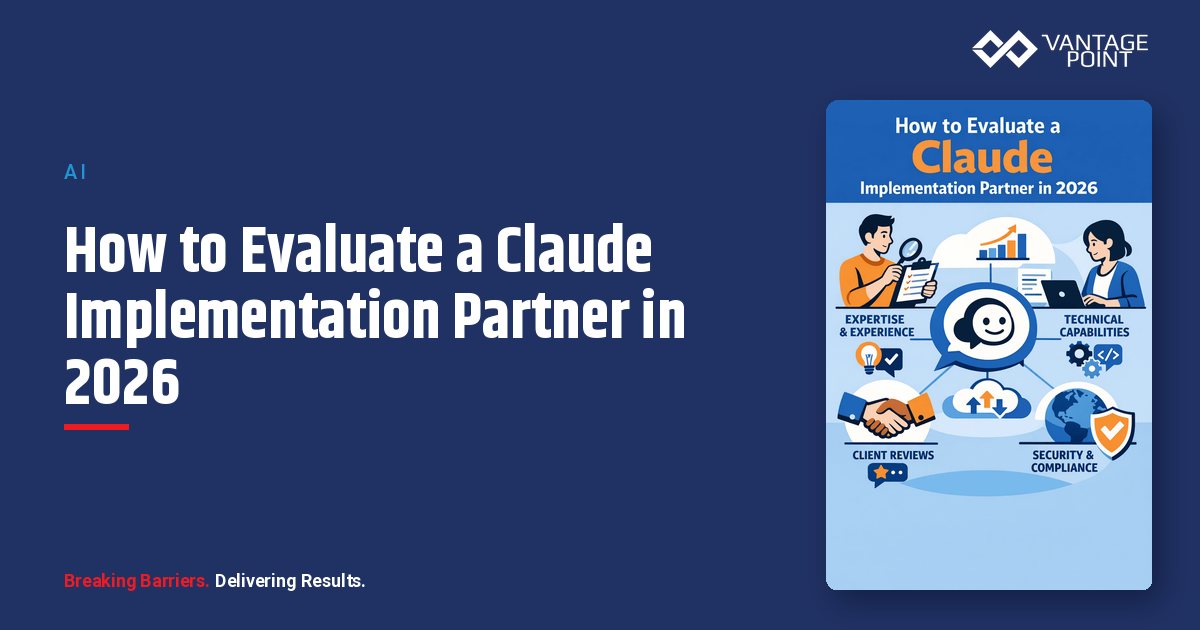
How to Evaluate a Claude Partner
Use these five criteria. Each maps to a real failure mode we see when AI projects stall.
1. Deployment Experience, Not Demo Experience
Ask for examples of Claude moved into production, not slideware. Probe how they handled data access, fallback behavior on sensitive queries, cost modeling, and what they did when something went wrong.
2. Data Governance and Security Rigor
A serious partner leads with governance: what data Claude can access, retention policies, audit trails, and role-based controls. If governance is an afterthought in the conversation, it will be an afterthought in your deployment.
3. CRM and Systems Integration Depth
Claude delivers business value when it is wired into the systems your teams already use. Look for genuine depth in Salesforce, HubSpot, and middleware — and a clear plan for moving data cleanly between them.
4. Change Management and Adoption
Technology that nobody adopts returns nothing. Strong partners plan training, internal champions, and workflow redesign so the capability sticks.
5. Vendor-Agnostic Honesty
The best partners tell you when Claude is the right tool and when it isn't. Beware anyone who recommends the same model and architecture for every problem regardless of cost, data sensitivity, or workflow fit.
Claude Partner Evaluation Scorecard
| Criteria | Strong Partner | Weak Partner |
|---|---|---|
| Deployment experience | Production deployments with measurable outcomes | Demos and proofs-of-concept only |
| Governance | Data access, retention, and audit designed up front | Governance treated as a later phase |
| Integration | Deep Salesforce/HubSpot and middleware capability | Standalone chatbot, no systems plan |
| Adoption | Training, champions, workflow redesign | "We'll hand it over and you take it from here" |
| Advice | Vendor-agnostic; right tool for the job | One model and architecture for everything |
| Team | Senior practitioners on your account | Junior staff after the sales call |
What Businesses Should Do Next
- Define two or three concrete use cases tied to revenue, cost, or service quality — not "use AI."
- Audit the data those use cases depend on, and be honest about its quality and sensitivity.
- Ask every prospective partner for a governance plan before you discuss build work.
- Score partners with the table above and weight governance and integration heavily.
- Start with a focused, governed pilot that has a clear path to production — not an open-ended experiment.
- Finally, review each candidate's actual Claude service offering — not just their marketing claims. A credible partner publishes what they do, how they integrate with your CRM, and who does the work. Here's ours, as a benchmark.
How Vantage Point Helps
Vantage Point helps organizations evaluate, deploy, and govern Claude inside the systems they already run. Our approach is senior-led and vendor-agnostic: we recommend the right model and architecture for your workflows, data sensitivity, and budget — not a one-size-fits-all build.
We connect AI to real business value through AI-driven personalization and analytics, wire it into your CRM with Salesforce implementation and advisory and HubSpot expertise, move data cleanly with system integration and data migration, and keep it safe with compliance and security solutions. Adoption is built in through advisory and change management.
If your team is evaluating how AI applies to Salesforce, HubSpot, integrations, or CRM governance, Vantage Point can help assess the right next step and build a practical implementation plan. You can see the full picture — services, implementation program, and team — on our Claude AI services page.
FAQ
What does a Claude implementation partner do?
A Claude implementation partner helps you identify use cases, govern data, integrate Claude with your CRM and systems, and drive team adoption. The work centers on safe, measurable workflow improvement rather than standing up a standalone chatbot. Strong partners build governance in from the start.
How do I know if a Claude partner is qualified?
Ask for production deployments with measurable outcomes, not just demos. Probe how they handle data access, retention, sensitive-query behavior, and integration with Salesforce or HubSpot. A qualified partner leads with governance and staffs senior practitioners on your account.
What is the biggest risk when deploying Claude in a business?
The biggest risks are ungoverned data access and low adoption. Without clear policies on what Claude can access and how outputs are reviewed, you expose sensitive information; without change management, teams never use the tool. A good partner addresses both before building.
Should a Claude partner integrate with Salesforce and HubSpot?
Yes. Claude creates the most value when it is connected to the systems your teams already use, like Salesforce and HubSpot. Look for partners with genuine integration depth and a clear plan for moving data cleanly between systems. Standalone deployments rarely deliver lasting value.
Why does vendor-agnostic advice matter for AI deployment?
Vendor-agnostic advice means a partner recommends the right model and architecture for each problem rather than defaulting to one approach. This protects you from overpaying for capability you don't need or under-provisioning for hard tasks. Vantage Point evaluates fit based on workflow, data sensitivity, and budget.
How long does a Claude deployment take?
Timelines vary by scope, but a focused, governed pilot with a clear path to production typically moves faster than an open-ended experiment. The key is starting with two or three concrete use cases and solid data foundations. A good partner sets realistic milestones and measures outcomes.
How does Vantage Point approach Claude deployments?
Vantage Point delivers senior-led, vendor-agnostic AI deployment with governance built in from day one. We connect Claude to real workflows in Salesforce, HubSpot, and your data stack, and plan for adoption so the capability sticks. The goal is measurable business value, not a pilot that stalls after the demo.