
Most AI agent pilots fail for a boring reason: someone hands a user an empty prompt box and calls it an agent. No context, no starting point, no idea what "good" looks like. The user stares at a blinking cursor, types something vague, gets a mediocre answer, and never comes back.
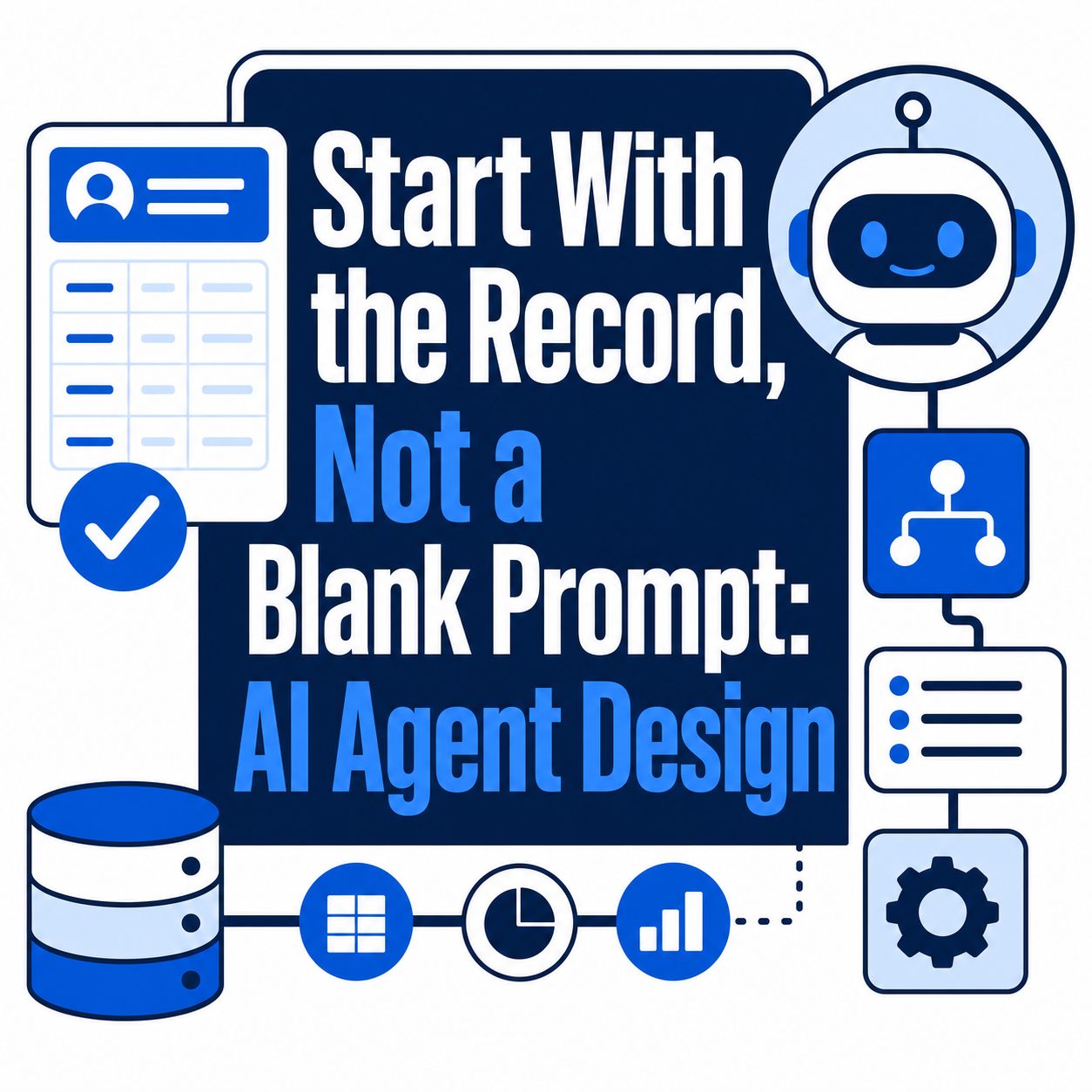
The fix is not a smarter model. It's a design choice: anchor the agent to a record. When an AI agent opens already knowing which account, case, or opportunity it's working on, the entire interaction changes. The user doesn't have to explain who they are talking about. The agent already knows, and it can act on that record instead of guessing.
This matters right now because most organizations are moving from AI chat experiments to embedded agents inside Salesforce and HubSpot. The design pattern you choose in the first few pilots determines whether adoption sticks or quietly dies.
Quick Answer
What it is: Record-anchored AI agent design means an AI assistant launches already scoped to a specific CRM record (a contact, case, deal, or account) instead of starting from a blank prompt box with no context.
Who it matters for: RevOps leaders, Salesforce and HubSpot admins, and anyone piloting Agentforce, Copilot, Breeze, or a custom AI assistant inside a CRM workflow.
What it helps you decide: Whether your next AI agent pilot should be built around an open-ended chat interface or a scoped, record-anchored entry point, and how to handle the edge cases that a scoped design will not automatically cover.
Why Vantage Point is relevant: Vantage Point designs and implements AI agent workflows inside Salesforce and HubSpot, including scoping, guardrails, and adoption planning through our AI-driven personalization and analytics and Salesforce implementation and advisory services.
TL;DR
- A blank prompt box is the single biggest reason new AI agents go unused. Users don't know what to ask or what the agent can actually do.
- Anchoring an agent to a record (account, case, deal, contact) removes the guesswork and turns the agent into a tool that acts on data the user is already looking at.
- Design for the 80% common case first, but explicitly plan for the 20% edge cases (unscoped questions, missing data, and multi-record requests) or users will lose trust fast.
- A demo that works in a controlled walkthrough is not the same as a product that survives real users with real data. Test with messy records before rolling out broadly.
- Vantage Point builds record-scoped AI agent proofs of concept for Salesforce and HubSpot so the first release earns trust instead of losing it.
What Does "Start With the Record, Not a Blank Prompt" Mean?
It means the entry point into an AI agent should be a specific piece of CRM data, not an open text field. Instead of a generic chat window that asks "What can I help you with?", the agent opens from a case, an opportunity, or a contact record, and its first action already reflects what it can see on that record.
Practically, this looks like an "Ask AI" button on a case page that already knows the case history, the customer's tier, and open action items. Instead of a separate chat tab where the user has to type "pull up case 4021 and summarize it" before getting anything useful.
Why Does the Blank Prompt Box Kill Adoption?
Three things happen when users are handed an unscoped prompt box:
- They don't know what's possible. Without a starting point, most users default to the simplest, least valuable question they can think of, then judge the whole tool by that one weak interaction.
- They have to do translation work. Typing out which record, which customer, which time period just to get the agent oriented is friction most users won't tolerate more than once or twice.
- Trust erodes on the first miss. If the agent's first real answer is wrong or generic because it lacked context, users conclude the tool doesn't work and stop trying.
McKinsey's research on AI adoption points to the same pattern across functions: the barriers are rarely about model quality and mostly about workflow fit, trust, and whether the tool shows up where people already work. An agent that requires users to leave their workflow and re-explain context every time fails that test immediately.
How Does Record-Anchored Design Work in Practice?
| Design element | Blank prompt approach | Record-anchored approach |
|---|---|---|
| Entry point | Separate chat window or tab | Button or panel on the record itself |
| Context | User must describe the situation | Agent already has record data loaded |
| First interaction | Open-ended, unpredictable | Pre-scoped suggested actions (e.g., "Summarize this case") |
| Common failure | Vague or generic first answer | Fewer surprises since scope is defined |
| Trust curve | One bad answer often ends usage | Early wins build habit before edge cases appear |
The pattern shows up across CRM AI features already shipping in the market: Salesforce Agentforce actions attached to a record, HubSpot Breeze Assistant suggestions inside a contact or deal, and Copilot panels scoped to the document or thread you're viewing. None of these start with a blank box by default. They start with "you're looking at this thing, here's what I can do with it."
What About the Edge Cases the Agent Wasn't Designed For?
Record-anchored design solves the common case, not every case. Plan explicitly for the roughly 20% of requests that fall outside the scoped design:
- Cross-record questions. "Compare this account to our top five renewals this quarter" needs data the single-record scope doesn't have. Decide in advance whether the agent attempts this, hands off to a report, or says it can't help.
- Missing or incomplete data. If the record is missing key fields, the agent should say so plainly rather than guessing or hallucinating detail. This ties directly to data quality work. An agent is only as good as the record it's anchored to.
- Multi-step or ambiguous requests. Build a clear fallback (a human handoff, a link to a broader tool, or an honest "I don't have enough information") instead of forcing the agent to answer something it wasn't scoped for.
Design the edge-case behavior before launch, not after the first embarrassing miss. A short, honest "I can't help with that from this view" builds more trust than a confident wrong answer.
Why Does "Demo-Grade" Fail to Become "Product-Grade"?
A controlled demo uses clean data, a rehearsed question, and a presenter who already knows what to type. Real usage involves incomplete records, typos, ambiguous requests, and users who have never seen the tool before. The gap between the two is where most AI agent pilots quietly stall after a strong initial demo.
Before a broader rollout, test the agent against:
- Records with missing or outdated fields, not just your cleanest accounts.
- Users who were never in the design sessions, not just the internal champions.
- Questions phrased the way real customers or reps actually phrase them, not the demo script.
If the agent only performs well on curated examples, it isn't ready for the floor. It's ready for another round of scoping and guardrail work.
Decision Checklist: Is Your Next AI Agent Pilot Ready?
- [ ] The agent launches from a specific record, not a blank chat window.
- [ ] The first 2-3 suggested actions are pre-defined and tested against real data.
- [ ] Edge-case behavior (missing data, cross-record questions) is defined, not left to chance.
- [ ] The pilot has been tested by someone outside the build team, on messy records.
- [ ] There's a clear, honest fallback message for requests the agent can't handle.
- [ ] Adoption will be measured by repeat usage, not just first-week logins.
What Should Teams Do Next?
Start small and scoped. Pick one high-volume record type (a support case, a renewal opportunity, a lead) and design the agent around the two or three questions users ask most often about that record. Ship that first, measure whether people come back to it, and only then expand scope to adjacent use cases.
Resist the temptation to launch a general-purpose assistant on day one. A narrow, record-anchored agent that reliably handles the common case builds the trust needed to expand into harder, less-scoped territory later.
How Vantage Point Helps
Vantage Point designs and implements AI agent workflows for Salesforce and HubSpot with a record-first, adoption-focused approach. We help teams scope the first use case, define guardrails for edge cases, and connect agent design to the underlying data quality work that makes agents trustworthy in the first place. This work runs through our AI-driven personalization and analytics practice and pairs naturally with Salesforce implementation and advisory or HubSpot engagements, along with workflow automation and process optimization when agents need to trigger downstream actions.
If your team is evaluating how this applies to Salesforce, HubSpot, or your next AI agent pilot, Vantage Point can help scope a record-anchored proof of concept and a practical rollout plan.
Frequently Asked Questions
What does "record-anchored" mean for an AI agent?
It means the agent launches already scoped to a specific CRM record (a case, contact, deal, or account) instead of opening as a blank chat window. The agent can immediately reference the data on that record rather than requiring the user to describe the situation first.
Why do blank prompt boxes hurt AI agent adoption?
Without a starting point, users don't know what to ask, must do extra work to give the agent context, and often judge the entire tool based on one vague first interaction. This friction is a common reason promising AI pilots see strong initial interest but low repeat usage.
Does record-anchored design work for both Salesforce and HubSpot?
Yes. Salesforce Agentforce actions can be attached to a record, and HubSpot Breeze Assistant surfaces suggestions inside contact and deal views. The same design principle (start from the data the user is already looking at) applies across both platforms.
What are common edge cases a record-anchored agent will not handle?
Cross-record questions (comparing multiple accounts), requests that depend on missing or incomplete data, and multi-step ambiguous asks typically fall outside a single-record scope. Plan an honest fallback message for these instead of letting the agent guess.
How is a demo-grade AI agent different from a product-grade one?
A demo-grade agent is tested on clean data with a rehearsed question. A product-grade agent has been tested against messy, real-world records and phrasing from users who were not part of the build process. Many pilots look strong in a demo and then stall once real usage begins.
What should the first AI agent pilot focus on?
Pick one high-volume record type and the two or three questions users ask most often about it. Ship a narrow, well-scoped version first, measure repeat usage, and expand only after the common case is solid.
How does data quality affect AI agent design?
An agent anchored to a record is only as useful as the data on that record. Missing fields, outdated information, or duplicate records will produce weak or misleading agent answers even with good design. Data quality work is a prerequisite, not an afterthought, for reliable agent behavior.
Can Vantage Point help design an AI agent pilot for our CRM?
Yes. Vantage Point scopes and builds record-anchored AI agent pilots for Salesforce and HubSpot, including guardrails for edge cases and a rollout plan focused on adoption, not just a working demo.