
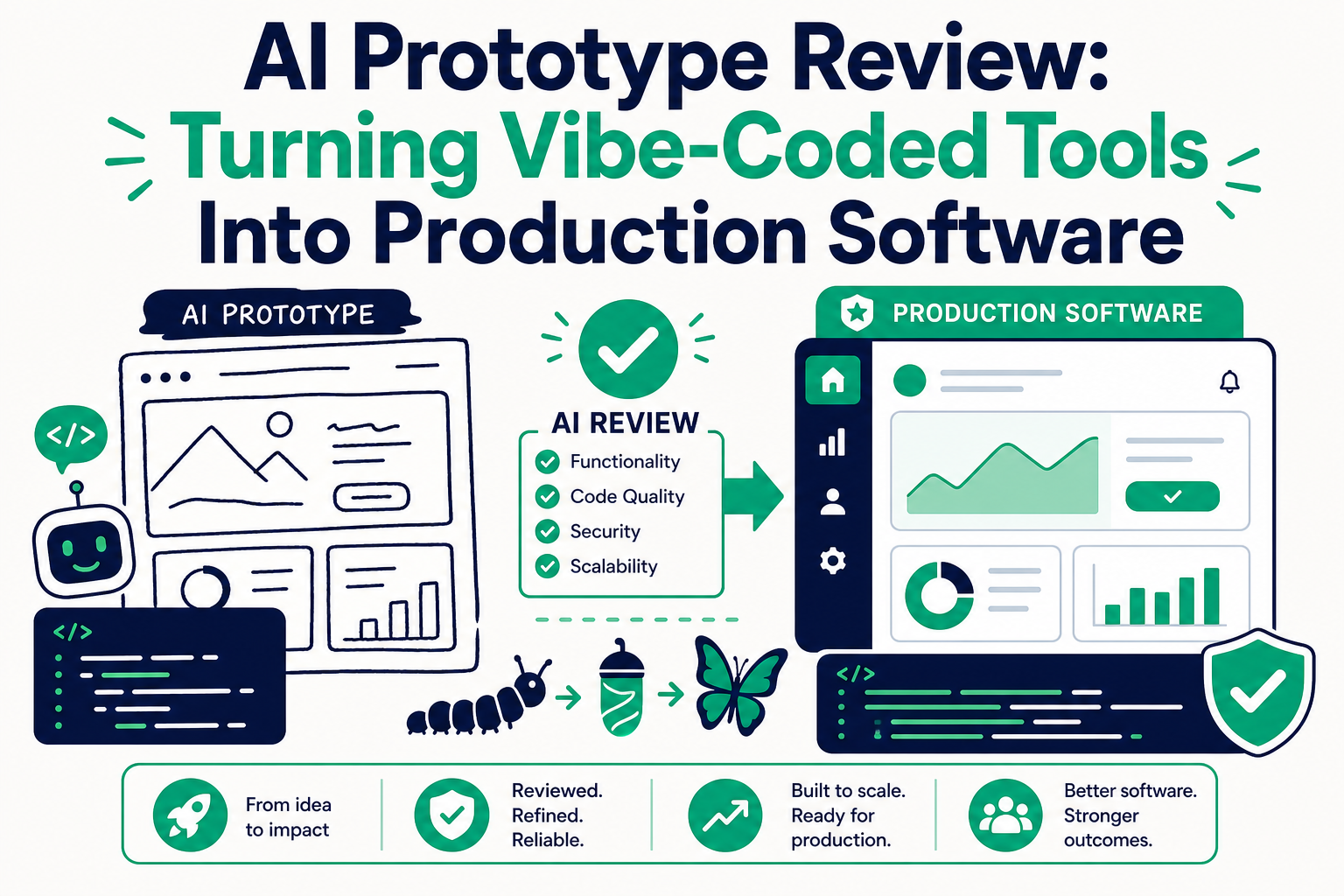
Most AI-generated prototypes never reach production, and the ones that do often get there without a real review. A business user "vibe codes" an internal tool with Claude or another AI coding assistant, it works well enough in testing, and someone decides to just start using it. Six months later IT discovers it, and nobody can answer basic questions about what data it touches, who can access it, or what happens if it breaks.
This is not an argument against AI-assisted prototyping. It is one of the fastest ways to validate an idea. The problem is treating a working prototype as a finished decision instead of a starting point that still needs a structured review before it touches real business data or real customers.
Quick Answer
AI prototype review and remediation is the structured process of assessing an AI-generated or AI-assisted application, often built through "vibe coding", for security, data governance, reliability, and maintainability before it is allowed to run on production data or in front of customers. It matters because AI coding tools make it easy to produce something that looks finished while skipping the access controls, error handling, and audit trails that production software requires. Vantage Point reviews AI-generated prototypes against a structured checklist, remediates the gaps, and connects the surviving logic into your Salesforce or HubSpot environment as supportable, governed software.
TL;DR
- What it is: A formal review and remediation process for AI-generated ("vibe-coded") prototypes before they run on real data.
- Why it matters: AI coding tools produce plausible-looking software fast, but skip security, governance, and reliability work by default.
- Best for: Businesses where a department, ops team, or individual has already built and started relying on an AI-generated tool.
- Data needed: An inventory of what the prototype touches: data sources, credentials, integrations, and who currently uses it.
- What can go wrong: Unreviewed prototypes can leak or corrupt customer data, run on hardcoded credentials, and create a shadow system no one owns.
- How Vantage Point helps: We assess AI-generated prototypes against a governance checklist, remediate what's salvageable, and integrate the result properly with Salesforce and HubSpot: see our system integration and data migration services.
What Is AI Prototype Review and Remediation?
AI prototype review is a structured assessment of software that was built quickly with the help of an AI coding assistant (Claude, another large language model, or a "vibe coding" platform) to determine whether it is safe, secure, and maintainable enough to keep running, and remediation is the work of closing the gaps the review finds.
The term "vibe coding" describes a real and useful pattern: someone describes what they want in plain language, the AI generates working code, and the person iterates by testing and re-prompting rather than reading every line. It is an excellent way to validate an idea in hours instead of weeks. The risk is not the technique. It is skipping the step where someone with security and architecture judgment reviews the result before it becomes a permanent fixture that other people depend on.
Why This Matters Now
AI coding assistants have made it dramatically easier for non-engineers to produce working software. That is a genuine gain in speed, but it has created a growing category of tools running inside businesses that were never reviewed by anyone with security, data governance, or architecture responsibility. Industry research on AI-generated code has repeatedly found meaningful rates of security vulnerabilities in AI-written snippets, and a prototype built through iterative prompting, without a formal code review step, carries that same risk by default.
The tools themselves are not the problem. The gap is procedural: most organizations have a change-management process for software that IT builds, but no equivalent process yet exists for software a business user built with an AI assistant over a weekend. Until that gap closes, these prototypes accumulate as unmanaged risk. Often already touching customer records, financial data, or internal systems by the time anyone in IT or security finds out.
The Review Checklist: What to Check Before Production
Every AI-generated prototype should pass through the same structured review before it is allowed to run on real data or serve real users.
- Data access and scope: What data can this tool read or write? Is it scoped to only what it needs, or does it have broad access because that was easier to configure?
- Credential handling: Are API keys, tokens, and passwords stored securely, or hardcoded into the application in plain text (a common vibe-coding shortcut)?
- Authentication and authorization: Does the tool verify who is using it, and does it enforce who is allowed to see or change what?
- Error handling: Does the tool fail safely when it hits bad input or an unavailable system, or does it silently return wrong results or crash without warning?
- Audit trail: Is there a record of what the tool did, when, and for whom, sufficient to investigate a problem after the fact?
- Dependency and version hygiene: Are the libraries and integrations it relies on current and maintained, or frozen at whatever version the AI assistant happened to generate?
- Ownership: Is there a named person or team accountable for this tool going forward, or does it belong to whoever happened to build it?
Decision Table: What to Do With Each Finding
| Finding | Risk Level | Typical Action |
|---|---|---|
| Hardcoded credentials or API keys | High | Remediate before any further use: rotate credentials, move to secure storage |
| Overly broad data access | High | Re-scope access to least privilege before production use |
| No audit trail | Medium-High | Add logging before scaling usage beyond original builder |
| Missing error handling on external calls | Medium | Remediate before exposing to more users or customer-facing data |
| No named owner | Medium | Assign ownership immediately regardless of other findings |
| Outdated or unmaintained dependencies | Medium | Schedule remediation; not always urgent, but should not be ignored |
| Clean logic, no data or access issues | Low | Candidate for supported integration into Salesforce or HubSpot workflows |
Governance: Who Should Own This Process
Reviewing AI-generated prototypes should not fall entirely on the person who built one, and it should not require every business user to become a security expert before they are allowed to experiment. The workable model most organizations land on has three parts: a lightweight intake process so IT or security knows a prototype exists before it becomes load-bearing, a standard checklist (like the one above) that a technical reviewer applies consistently, and a clear decision (remediate, retire, or formally adopt) rather than letting reviewed and unreviewed tools sit in the same undifferentiated pile.
This does not need to be bureaucratic. The goal is a fast, predictable path from "someone built something useful" to "this is either safely retired or safely running," not a review board that discourages experimentation in the first place.
What Can Go Wrong Without a Review
- Data exposure. A prototype with broad, unreviewed data access can expose customer records, financial data, or internal communications to people who should never have seen them.
- Silent data corruption. Poor error handling can let a tool write incorrect data into a CRM or database without anyone noticing until reports stop matching reality.
- Credential leakage. Hardcoded API keys and tokens, if the prototype's code is ever shared, copied, or exposed, can grant access far beyond the original tool.
- Shadow dependency. Teams build real workflows around an unreviewed prototype, and it becomes business-critical infrastructure that nobody budgeted, secured, or planned to maintain.
- Compliance exposure. In regulated environments, an unreviewed tool touching customer or financial data can create audit findings that are expensive and disruptive to unwind after the fact.
How to Start
- Inventory first. Before reviewing anything, find out what AI-generated tools are already running informally across your business. Ask department leads directly. Most of these tools exist because they solved a real problem quickly, not because anyone tried to hide them.
- Triage by data sensitivity. A prototype touching customer PII or financial data needs review before a prototype that only reformats internal notes. Prioritize accordingly.
- Apply the checklist consistently. Use the same review criteria for every prototype so decisions are defensible and comparable across teams.
- Decide: remediate, retire, or adopt. Not every prototype is worth saving. Some solved a one-time problem and can simply be retired once the review is done.
- Build the intake habit going forward. The bigger win is catching the next prototype before it becomes load-bearing, not just cleaning up the current backlog.
How Vantage Point Helps
Vantage Point works with mid-market businesses running Salesforce, HubSpot, or both to review AI-generated prototypes and turn the ones worth keeping into properly governed software. Our system integration and data migration services address the highest-risk findings directly. Re-scoping data access, replacing hardcoded credentials with secure integration patterns, and connecting salvageable logic into your CRM environment the right way instead of leaving it as a standalone script. Our compliance and security solutions help regulated businesses formalize the review and audit-trail requirements that unreviewed AI prototypes typically skip.
For the organizational side of this problem, our advisory and change management services help businesses build the lightweight intake and ownership process described above, so the next AI-generated prototype gets reviewed before it becomes business-critical rather than after. We are vendor-agnostic across Salesforce and HubSpot, work only with senior consultants on every engagement, and can integrate whatever the remediated tool needs to talk to. No throwing away the parts of the prototype that were actually good.
FAQ
Is vibe coding itself the problem? No. AI-assisted prototyping is a genuinely useful way to validate ideas quickly. The risk comes from skipping a structured review before the result runs on real data or serves real users, the same discipline any hand-written prototype would need before going into production.
How do we find AI-generated prototypes we don't already know about? Ask department leads directly rather than relying on IT to discover them organically. Most of these tools exist in the open within their team; they simply haven't been reported upward because there was no clear process to report them to.
What is the single highest-priority thing to check first? Credential handling and data access scope. Hardcoded credentials and overly broad data access are the two findings most likely to cause serious harm if left unaddressed, and both are usually fixable quickly once identified.
Can a remediated prototype become a permanent tool? Yes, and it often should. A prototype with clean logic and no unresolved data or access issues is a strong candidate for integration into a supported workflow inside Salesforce or HubSpot, where it gains proper access controls, monitoring, and ownership.
Does every AI-generated tool need a full security audit? No: triage by data sensitivity and blast radius. A tool that only reformats internal notes needs a lighter review than one touching customer PII or financial records. Applying the same checklist to both, at different depths, keeps the process fast without ignoring real risk.
Who should own the review process internally? A named technical reviewer, typically in IT or security, should apply a consistent checklist, but business users should not be blocked from experimenting while that process is being built. The goal is a fast, predictable path to a decision, not a gate that discourages the prototyping in the first place.
What's the difference between remediation and a full rebuild? Remediation fixes the specific gaps a review finds (access scope, credential handling, error handling, audit logging) while keeping the original logic. A full rebuild is only necessary when the underlying architecture can't support proper access controls or integration, which is the exception rather than the rule for most business-tool prototypes.
How does this connect to broader AI governance work? Prototype review is one piece of a larger AI governance program that should also cover acceptable-use policy, data access rules, and role-based training. Businesses building a full framework should treat prototype review as the checkpoint that catches issues other governance policies won't, since prototypes are often built and adopted before any policy applies to them.