
A mortgage CRM ties your entire lending operation together, from the moment a lead enters your funnel to the day you close the loan and beyond. Without a well-implemented system, you're likely re-entering borrower data across multiple platforms, chasing document status in disconnected tools, and hoping nothing falls through the cracks on compliance. Vantage Point helps mortgage lenders build CRM foundations that support both growth and regulatory requirements.
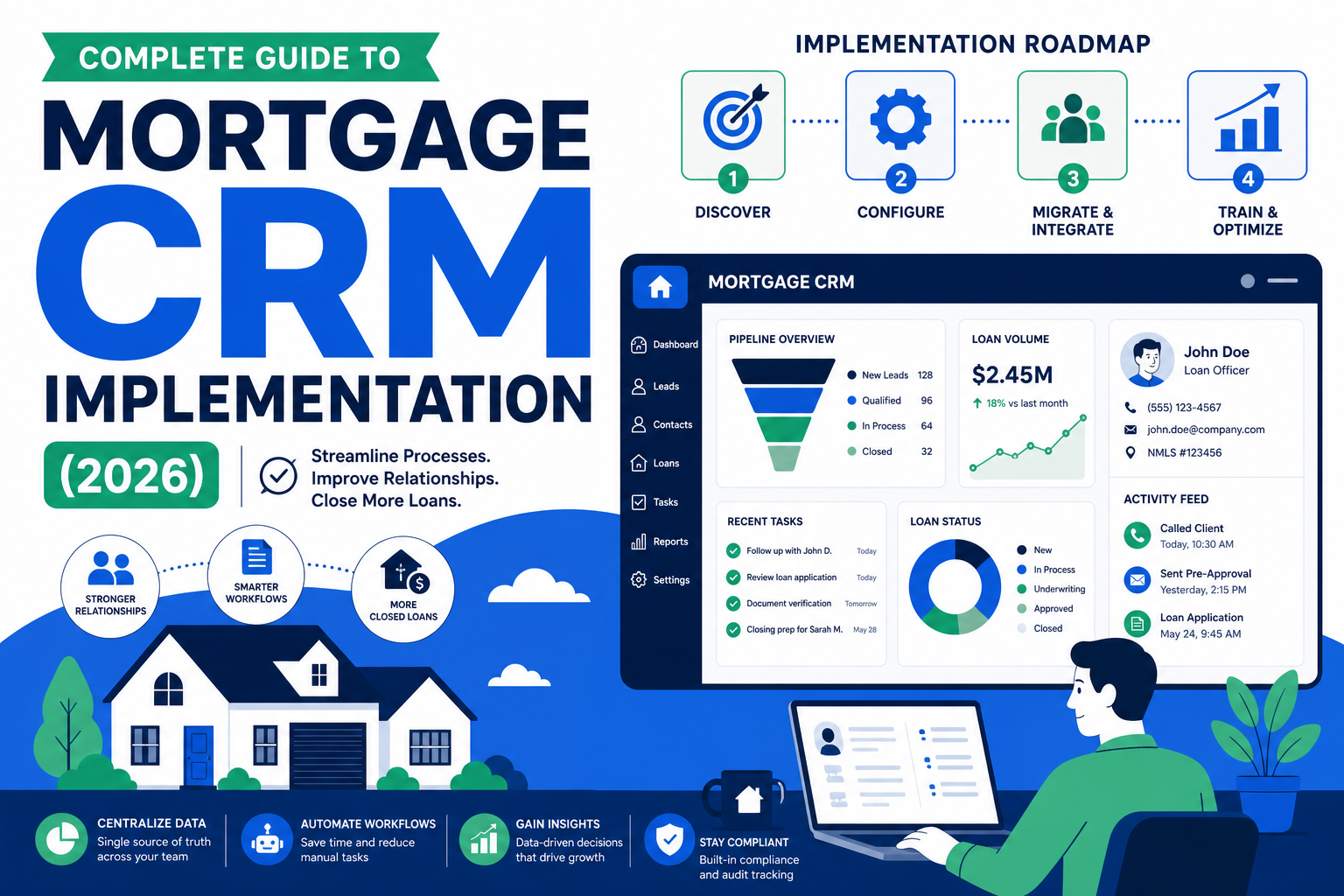
This guide walks you through the key phases of a mortgage CRM implementation: gathering requirements, integrating with your loan origination system (LOS), migrating your data, and training your team. By the end, you'll have a clear roadmap for moving from planning to production.
Key Takeaways: Complete Guide to Mortgage CRM Implementation
- A successful mortgage CRM implementation requires mapping your unique loan origination and servicing workflows before selecting features.
- Integration with your LOS, core banking systems, and document platforms eliminates duplicate data entry and reduces errors.
- Vantage Point brings compliance-first CRM implementation with deep experience in nCino, Encompass, and Salesforce Financial Services Cloud.
- Data migration planning should include field mapping, deduplication, and validation rules to protect borrower information accuracy.
- Post-launch training and ongoing support determine whether your team adopts the new CRM or reverts to spreadsheets.
Why Mortgage Lenders Need a Purpose-Built CRM Strategy
Generic CRM platforms require heavy customization before they can handle mortgage-specific needs. You'll need fields for loan types, property addresses, income verification documents, and regulatory disclosures that don't exist out of the box.
Mortgage CRM implementation also demands integration with your LOS from day one. If your CRM and origination platform don't communicate, your loan officers spend their time copying data between systems instead of closing loans.
A purpose-built strategy accounts for TRID timelines, HMDA reporting requirements, and BSA/AML compliance checks. These aren't optional add-ons: they're core to how your CRM should function.
How Do You Gather Requirements for Mortgage CRM Implementation?
Start by documenting your current loan origination process from first contact through funding. Identify every handoff between team members, every system that touches borrower data, and every manual step that creates delays.
Interview your loan officers, processors, underwriters, and compliance staff. Each role interacts with borrower data differently, and your CRM needs to support all of them. Pay attention to pain points: Where does data get lost? Where do bottlenecks form?
Create a prioritized list of must-have features versus nice-to-haves. Compliance automation, LOS integration, and document tracking typically top the list for mortgage lenders. Marketing automation and referral partner management often follow.
What Systems Should Your Mortgage CRM Integrate With?
Your CRM needs to connect with your loan origination system first. Platforms like nCino, Encompass, and Byte sync borrower profiles, loan status updates, and milestone completions. This bidirectional data flow keeps everyone working from the same information.
Document management systems come next. Your CRM should track which documents have been requested, received, and verified without requiring your team to check a separate platform.
Core banking and custodial platforms round out the integration picture. When your CRM connects to backend financial systems, you eliminate the risk of mismatched data between client-facing and operational records.
How Long Does a Mortgage CRM Implementation Take?
A typical mortgage CRM implementation runs 8 to 16 weeks, depending on scope and complexity. The timeline breaks down into phases: discovery and requirements (2-3 weeks), configuration and integration (4-8 weeks), testing and training (2-4 weeks), and go-live support (1-2 weeks).
Factors that extend timelines include multiple branch locations, complex integration requirements with legacy systems, and large data migration volumes. Organizations with clear documentation of existing processes move faster through discovery.
Vantage Point's structured implementation methodology has been refined, with a focus on helping mortgage lenders see value soon after launch.
What Does Mortgage CRM Data Migration Involve?
Data migration is often the most underestimated phase of CRM implementation. You'll need to extract borrower records, loan history, and document metadata from your existing systems and map each field to the new CRM structure.
Deduplication runs before import. Mortgage lenders commonly have the same borrower appearing multiple times across different loan files. Cleaning this up before migration prevents conflicting client communications and reporting errors.
Validation rules catch data quality issues during import. Phone number formats, email addresses, and property addresses all need standardization. Running test imports on a subset of records helps identify problems before full migration.
How Do You Handle Compliance During CRM Implementation?
Compliance isn't an afterthought in mortgage CRM implementation: it shapes every configuration decision. Your CRM needs built-in audit trails that track who accessed or modified borrower data and when.
TRID disclosure timing requires automated alerts. Your CRM should flag loans approaching disclosure deadlines and prevent progression until requirements are met. HMDA reporting fields need to capture demographic data at the right points in the application process.
Vantage Point builds compliance controls and security measures into every mortgage CRM implementation, including SEC/FINRA, BSA/AML, and TRID/HMDA requirements with full audit trail capabilities.
Training Your Team to Adopt the New Mortgage CRM
The most powerful CRM fails if your team doesn't use it. Training should be role-specific: loan officers need to see how the CRM helps them close more loans, while processors need to understand document tracking features.
Schedule training close to go-live so information stays fresh. Provide quick reference guides for common tasks and establish a clear escalation path for questions. Identify CRM champions in each department who can support their colleagues.
Monitor adoption metrics in the first 30, 60, and 90 days. If usage drops, investigate why. Often, a small configuration change or additional training session resolves the issue before teams revert to old habits.
In Conclusion: Building a Mortgage CRM That Drives Results
A well-executed mortgage CRM implementation connects your teams, automates compliance tasks, and gives you visibility into every loan in your pipeline. The investment pays off in reduced operational costs, faster loan processing, and better borrower experiences.
The key is starting with clear requirements, prioritizing LOS integration, and planning for thorough data migration. Post-launch training and ongoing support ensure your team gets the full value from the new system.
If your current CRM doesn't match how your mortgage operation works, or you're still running on spreadsheets, it's time to build something better. The lenders who modernize their CRM infrastructure now position themselves to compete effectively as the market evolves.
FAQs about Complete Guide to Mortgage CRM Implementation
How much does a mortgage CRM implementation cost?
Implementation costs vary based on scope, integration complexity, and data migration volume. Most mortgage lenders should budget for configuration, integration development, data migration services, and training. Vantage Point structures implementations with clear deliverables so you understand exactly what you're investing in.
Can I implement a mortgage CRM without disrupting my current loan pipeline?
Yes, with proper planning. Phased rollouts allow you to migrate historical data and test integrations while your team continues processing loans in the existing system. Vantage Point's implementation methodology includes parallel operation periods to minimize risk to active loans.
What's the difference between a generic CRM and a mortgage-specific CRM?
Generic CRMs lack fields for loan types, property data, and regulatory tracking. You'd need extensive customization to handle mortgage workflows. Purpose-built mortgage CRMs or platforms like Salesforce Financial Services Cloud come with lending-specific data models that reduce implementation time.
How do I know if my team is ready for a new CRM?
Signs of readiness include documented frustration with current tools, leadership commitment to change management, and willingness to invest in training. Vantage Point helps mortgage lenders assess readiness and build adoption strategies that stick.
What happens after the CRM goes live?
Post-launch support includes monitoring system performance, resolving user questions, and making configuration adjustments based on real-world usage. Vantage Point offers managed services that keep your CRM optimized long after implementation.