
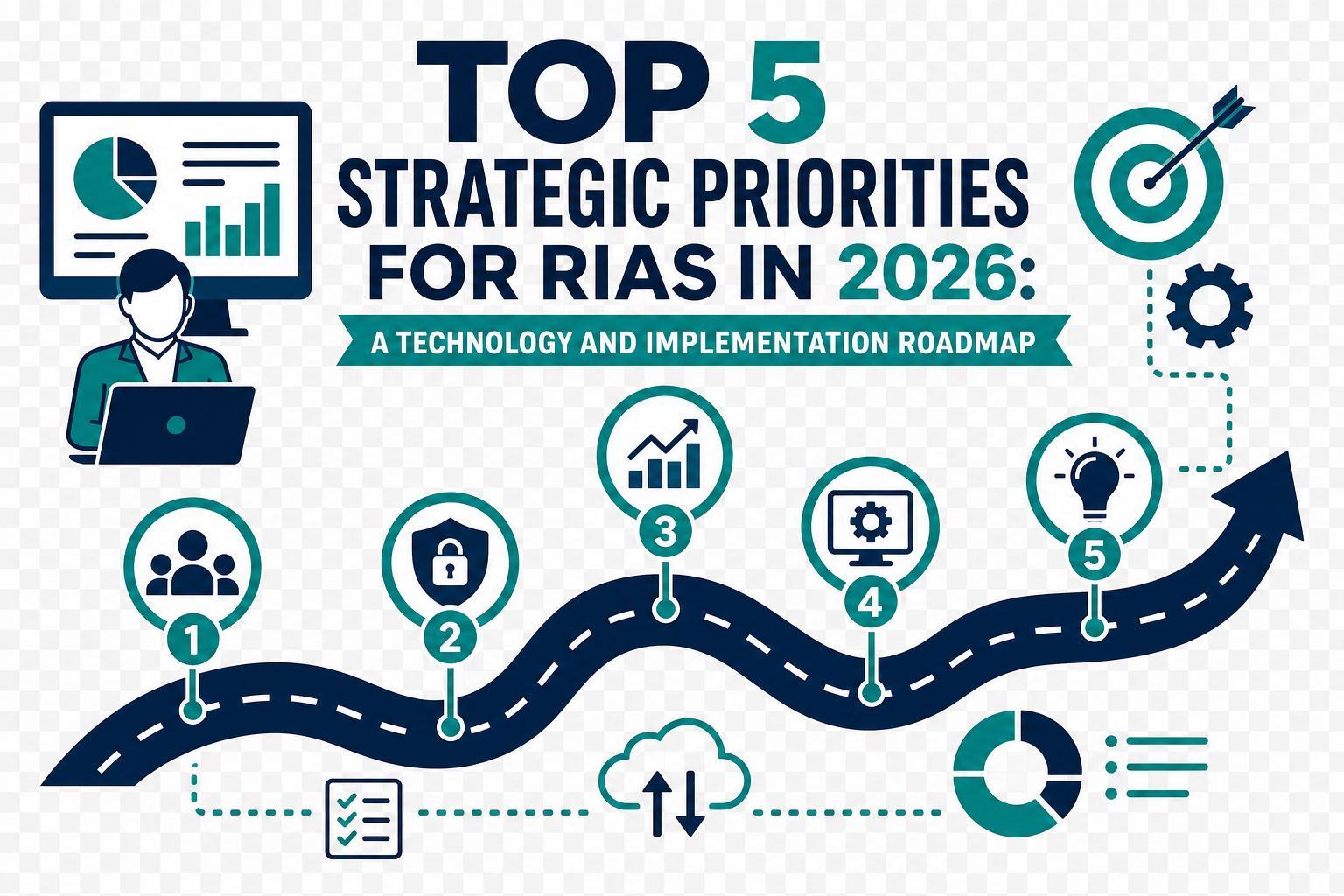
Top 5 Strategic Priorities for RIAs in 2026: A Technology and Implementation Roadmap
TL;DR: Quick Reference - What: A comprehensive analysis of the five strategic priorities reshaping RIA firms in 2026 (AI integration, next-gen client experience, succession planning, cybersecurity & compliance, and niche specialization) with the technology strategies powering each one. - Key Benefit: Actionable technology roadmap backed by current industry data (68% AI adoption, $84T wealth transfer, 110K advisor retirements) to help firms prioritize investments. - For: RIA owners, COOs, technology leaders, and operations teams planning their 2026-2027 strategy. - Bottom Line: Firms that treat CRM, AI, and integration as a unified strategy will outperform those making piecemeal investments: start with data unification, then build outward.
The RIA landscape in 2026 is defined by convergence. Five forces (artificial intelligence, generational wealth transfer, advisor demographics, cyber threats, and competitive specialization) are hitting simultaneously. None of them can be addressed in isolation, and all of them demand technology infrastructure that most firms don't yet have.
We work with wealth management firms every day on the technology implementations that power these strategic priorities. Here's what we're seeing across the industry. The data behind each priority, the technology strategies that enable them, and the practical steps firms can take right now.
1. AI Integration and Operational Efficiency: From "If" to "How Fast"
The Data
The AI adoption curve for RIAs has been remarkably steep. A 2025 Deloitte survey of over 500 U.S. RIAs found that 68% have adopted AI tools, up from 42% just one year earlier. Cerulli Associates' Q4 2025 report shows 55% of financial advisors are using generative AI daily or weekly, with 82% planning increased investment in 2026.
The efficiency gains are no longer theoretical:
- 25-30% average time savings on routine tasks like research, reporting, and client communication (McKinsey 2025 Global Wealth Management Report)
- 72% of early adopters report saving 20+ hours per advisor per month
- 28% efficiency gains in compliance workflows specifically (Fidelity 2025 RIA study)
- 35% faster client query resolution for firms using Salesforce Agentforce (Envestnet 2026 Technology Outlook)
What's Actually Working
The firms gaining the most from AI aren't just bolting ChatGPT onto existing workflows. They're redesigning processes around AI capabilities:
Meeting Preparation Agents: Salesforce Agentforce can automatically compile a complete client briefing before every meeting, pulling portfolio performance, recent interactions, life events, market commentary relevant to their holdings, and compliance notes. What used to take 30-45 minutes of an advisor's morning now happens automatically overnight.
Compliance Monitoring: AI-powered compliance agents continuously scan client communications, trading activity, and documentation for regulatory issues. Instead of quarterly manual reviews, firms get real-time alerts. For RIAs operating under SEC or state examination priorities that increasingly focus on communication surveillance, this shifts compliance from reactive to proactive.
Client Communication at Scale: HubSpot's AI tools combined with Salesforce's client data enable personalized market commentary, birthday messages, portfolio milestone celebrations, and proactive outreach: all automated but deeply personal. One advisor's voice, multiplied across hundreds of relationships.
Administrative Automation: Account opening, transfer paperwork, beneficiary updates, and RMD processing (the administrative tasks that consume 40-60% of support staff time) are increasingly handled by AI workflows that pull data from custodial platforms, pre-fill forms, and route for approval.
The Technology Foundation
AI doesn't work without clean, unified data. This is where most RIAs hit their first wall. If client data lives in separate silos (Schwab for custody, MoneyGuidePro for planning, Outlook for communication, and a CRM that's half-populated) AI has nothing meaningful to work with.
The firms succeeding with AI have invested in:
- Salesforce Financial Services Cloud (FSC) as the central client record
- Data Cloud to unify data across custodial, planning, and communication platforms
- MuleSoft or Workato integrations connecting every data source into a single client view
- Agentforce deployed on top of that unified foundation
The order matters. Data first, AI second. Firms that skip the data unification step end up with AI tools that produce unreliable outputs, which is worse than having no AI at all.
2. Next-Generation Client Experience: The $84 Trillion Question
The Data
The great wealth transfer is no longer a future event: it's happening now. Cerulli Associates projects $84 trillion in total intergenerational wealth transfer by 2045, with $28 trillion moving in the next five years alone. Of that near-term transfer, 68% ($19 trillion) will go to millennials and Gen Z.
The expectations gap is stark:
- 74% of inheriting millennials expect fully digital advisory experiences (BlackRock 2025 HNWI survey)
- 62% of under-40 inheritors will switch advisors if they can't access seamless mobile tools (PwC 2026 NextGen Wealth Report)
- 81% of next-gen clients prioritize ESG integration through digital platforms
- Only 32% of Baby Boomers expect the same digital-first experience
The math is simple: if your firm can't deliver a modern digital experience, you'll lose the inheriting generation, and with them, the assets you spent decades building.
What Leading RIAs Are Building
Client Portals That Actually Get Used: The difference between a client portal that gets 15% adoption and one that gets 80% comes down to integration. When the portal pulls real-time data from every custodian, shows the financial plan, enables document signing, facilitates secure messaging, and surfaces AI-generated insights: clients use it. When it's a static page with quarterly PDFs, they don't.
Mobile-First Communication: Younger clients don't check email weekly for their advisor's market commentary. They want push notifications, in-app messaging, video meeting scheduling, and document approvals from their phone. HubSpot's mobile communication tools combined with Salesforce's client management create a multi-channel engagement layer that meets clients where they are.
Integrated Financial Planning Views: The next generation doesn't think in asset classes: they think in goals. They want to see "Am I on track to buy a house?" not "Your allocation is 60/40." This requires integration between financial planning platforms (MoneyGuidePro, eMoney, RightCapital) and the CRM to present unified, goal-based views.
Proactive, Not Reactive: AI-powered CRM workflows can trigger outreach based on life events, portfolio milestones, and market changes: before the client has to ask. Birthday in two weeks? Automatic personalized note. Portfolio crossed $1M? Celebration message. Market dropped 5%? Proactive reassurance with their specific impact quantified. This is the experience gap between firms retaining inheritors and firms losing them.
The Technology Foundation
- Salesforce Experience Cloud or custom-built client portals connected to FSC
- HubSpot CRM for marketing automation, content delivery, and front-of-funnel engagement
- Integration layer (MuleSoft, Workato, or native APIs) connecting custodial platforms, planning tools, and document management
- Salesforce Mobile SDK or partner mobile solutions for native app experiences
3. Succession Planning and Talent Development: The 110,000-Advisor Cliff
The Data
The demographic reality facing RIAs is stark:
- 69% of financial advisors are 55 or older (InvestmentNews 2025 RIA Industry Report)
- 37% plan to retire by 2030: average exit age is 59
- 110,000 advisors (42% of total) will retire in the next decade (CFP Board 2026 Workforce Study)
- 45% of RIA firms lack a formal succession plan (Schwab 2025 RIA Benchmarking Study)
Meanwhile, M&A activity is surging to fill the gap. DeVoe & Company reported 320 RIA transactions in 2025 (up 18% year-over-year), with Q1 2026 on pace for 350+. Succession-motivated deals now comprise 52% of transactions, representing over $15 billion in AUM transfers.
Why This Is a Technology Problem
Succession planning (whether internal, external, or via M&A) is fundamentally a data and process challenge:
Valuation Depends on Systems: Firms with clean CRM data, documented processes, integrated technology stacks, and automated workflows command higher multiples. DeVoe's data shows firms with mature technology platforms achieving 2.8-3.2x revenue multiples, while firms with manual processes and fragmented data often struggle to find buyers at all.
Knowledge Transfer Requires Documentation: When a founding advisor retires, decades of client relationships, investment philosophy, and institutional knowledge need to transfer to successors. Firms running on Salesforce FSC with complete client interaction histories, documented meeting notes, and AI-generated relationship summaries can facilitate this transfer. Firms running on spreadsheets and memory cannot.
Client Retention Through Transition: The biggest risk in any advisor transition is client attrition. Firms with automated client communication workflows, detailed engagement histories, and proactive outreach programs retain 90%+ of clients through transitions. Without these systems, attrition can exceed 30%.
Junior Talent Development: Younger advisors expect modern technology. Firms still running on legacy tools and manual processes can't compete for talent against firms offering Agentforce-powered workflows, integrated planning tools, and mobile-first client engagement platforms.
Practical Steps
- Document everything in your CRM: every client interaction, every investment decision rationale, every planning conversation. Salesforce FSC's activity timeline is purpose-built for this.
- Automate workflows so they're not dependent on one person's knowledge. If your best advisor left tomorrow, could anyone else serve their clients at the same level?
- Build a technology stack that scales: fragmented point solutions become liabilities during transitions. A unified Salesforce + HubSpot + integration platform becomes an asset.
- Get a formal valuation that accounts for technology maturity. If your systems are a weakness, you have time to fix them before they impact your exit.
4. Cybersecurity and Regulatory Compliance: The $4.9 Million Wake-Up Call
The Data
The cybersecurity threat landscape for RIAs has never been more dangerous:
- Average cost of a data breach: $4.9 million for RIAs (Ponemon Institute 2025)
- 1,200+ incidents targeting wealth management firms in 2025, 28% involving ransomware (IBM 2026 X-Force Threat Report)
- Phishing attacks up 32% year-over-year targeting financial advisory firms
- Average SEC cyber violation fine: $2.1 million
- RIAs represent 15% of all financial sector cyber victims
The regulatory pressure is matching the threat level. The SEC's 2025-2026 examination priorities make cybersecurity the top focus area for RIA examinations:
- 65% of 2025 RIA examinations included Reg S-P (privacy) audits
- SEC is specifically targeting AI-driven threats and multi-factor authentication gaps
- 22% of examined RIAs were cited for cybersecurity deficiencies in 2025 sweeps
The Zero Trust Imperative
Only 29% of RIAs have fully implemented zero trust architecture, though 67% plan adoption by 2027. Early adopters report 40% fewer security incidents (CrowdStrike 2025 data). For RIAs, zero trust means:
- No implicit trust: every user, device, and application must be verified before accessing client data
- Micro-segmentation: even if an attacker breaches one system, they can't move laterally to others
- Continuous monitoring: AI-powered security tools that detect anomalous behavior in real-time
How CRM Strategy Impacts Security Posture
Your CRM platform choice directly affects your cybersecurity profile:
Salesforce Shield provides event monitoring, field-level encryption, and platform encryption that satisfy most SEC examination requirements. For RIAs handling sensitive financial data, Shield's audit trail capabilities provide the compliance documentation that examiners are specifically asking for.
Salesforce's SOC 2 Type II, ISO 27001, and FedRAMP certifications provide a security foundation that no RIA could build independently. When examiners ask "How do you protect client data?", running on Salesforce with Shield gives you a comprehensive answer.
Integration security matters too. Every connection between your CRM, custodial platform, planning tools, and client portal is a potential attack surface. MuleSoft and Workato provide API management, encryption in transit, and access controls that secure these connections, far more robust than flat files, CSV exports, or manual data transfers.
HubSpot's security infrastructure: SOC 2 Type II certified with SSO, encryption, and role-based access: provides similar protection for marketing and client communication workflows.
Action Items for 2026
- Conduct a security assessment specifically focused on CRM and integration points
- Implement MFA everywhere: the SEC is specifically examining this
- Evaluate Salesforce Shield if you handle sensitive financial data
- Document your incident response plan: examiners are asking for it
- Encrypt data at rest and in transit across all integration points
- Allocate 10-15% of technology budget to cybersecurity (industry recommendation)
5. Specialization and Niche Positioning: The 22% Growth Advantage
The Data
The era of the generalist RIA is ending. Data from Fidelity's 2025 RIA Benchmark Study tells a compelling story:
- Specialized RIAs grew AUM 22% year-over-year vs. 12% for generalist firms
- Niche firms captured 41% of new high-net-worth client flows in 2025
- Client retention: 92% for specialized firms vs. 74% for generalists (Coalition Greenwich 2026)
- Specialized RIAs acquire clients 30% faster through targeted marketing (McKinsey)
- Niche firms now represent 35% of total RIA AUM ($2.1T of $6T), up from 25% in 2023
The specialization premium is real: better growth, better retention, faster acquisition, and increasingly, higher firm valuations.
How Technology Enables Niche Positioning
Specialization without technology support creates bottlenecks. Technology enables it to scale:
Targeted Marketing with HubSpot: Niche positioning is a marketing strategy as much as a service delivery one. HubSpot's marketing automation enables specialized content (blog posts, newsletters, webinars, social media) targeted to your specific niche. A firm specializing in tech executives can automate content about RSU planning, IPO wealth management, and concentrated stock positions. A firm focused on medical professionals can deliver content about practice valuation, disability insurance, and student loan strategies.
Industry-Specific Data Models in FSC: Salesforce Financial Services Cloud's data model supports specialization with custom fields and objects that capture niche-relevant data. A firm serving business owners can track entity structures, buy-sell agreements, and succession timelines. A firm serving retirees can model income streams, healthcare costs, and legacy goals.
Niche-Specific Integrations: Specialized firms need specialized integrations. Tech executive specialists need equity compensation platform connections (Fidelity Stock Plan, E*Trade). Medical professional specialists need practice management integrations. Real estate investor specialists need property management and 1031 exchange tracking. MuleSoft and Workato make these specialized integrations feasible without custom development.
AI That Understands Your Niche: When Agentforce is trained on niche-specific data and workflows, it becomes dramatically more useful than generic AI. An Agentforce agent configured for a tech executive practice knows to flag stock vesting dates, monitor insider trading windows, and prepare concentration risk analyses. That level of specificity is only possible when the underlying data and processes are structured for the niche.
Finding Your Niche
Not every firm needs to hyper-specialize, but every firm needs to answer: "Why should this specific type of client choose us over the firm down the street?" If the answer is just "We're experienced and care about our clients," that's not differentiation: it's the minimum expectation.
The strongest niches emerge from authentic expertise. Look at: - Your existing client base: where are you already concentrated? - Your advisors' backgrounds (former CPAs serve business owners well; former insurance professionals understand risk planning - Your geographic market) local specializations can be powerful - Emerging demographics: first-generation wealth from tech, crypto, and creator economy
The Unified Technology Strategy
These five priorities aren't five separate initiatives: they're five faces of one transformation. The RIA that deploys AI (Priority 1) on top of a unified data platform also delivers better client experiences (Priority 2), builds transferable institutional knowledge for succession (Priority 3), maintains security and compliance (Priority 4), and can scale niche-specific service delivery (Priority 5).
The common denominator is a connected technology foundation:
| Layer | Purpose | Tools |
|---|---|---|
| CRM | Central client record, relationship management | Salesforce FSC, HubSpot CRM |
| Data | Unified client view across all sources | Data Cloud, Data 360 |
| Integration | Connect custodians, planning tools, portals | MuleSoft, Workato, APIs |
| AI | Automate workflows, generate insights, scale advice | Agentforce, HubSpot AI |
| Security | Protect data, satisfy regulators | Salesforce Shield, zero trust architecture |
| Marketing | Attract and nurture niche-specific prospects | HubSpot Marketing Hub |
Firms that build this foundation address all five priorities simultaneously. Firms that treat each priority as a separate project end up with fragmented technology, duplicated data, and integration headaches that compound over time.
How Vantage Point Can Help
At Vantage Point, we help RIAs and wealth management firms build the technology foundation that powers all five of these strategic priorities. Our team is senior-only and employee-owned, with deep expertise in:
- Salesforce Financial Services Cloud implementation and optimization
- Agentforce deployment for advisor efficiency and client experience automation
- Data Cloud and integration architecture connecting custodial platforms, planning tools, and client portals
- HubSpot CRM for marketing automation and client engagement
- MuleSoft and Workato for enterprise integration
- Compliance-first implementation with Salesforce Shield and security best practices
Whether you're planning your first CRM implementation, preparing for a technology-driven succession, or looking to deploy AI across your advisory practice, we bring the regulated industry expertise to make it work.
Research data sourced from Deloitte (2025 RIA Survey), Cerulli Associates (Q4 2025 Report, Great Wealth Transfer Study), McKinsey (2025 Global Wealth Management Report), Fidelity (2025 RIA Benchmark Study), Envestnet (2026 Technology Outlook), PwC (2026 NextGen Wealth Report), BlackRock (2025 HNWI Survey), InvestmentNews (2025 RIA Industry Report), CFP Board (2026 Workforce Study), DeVoe & Company (Q1 2026 M&A Update), Schwab (2025 RIA Benchmarking), Ponemon Institute (2025), IBM (2026 X-Force), CrowdStrike (2025 Falcon OverWatch), Coalition Greenwich (2026 RIA Market Sizing), and Salesforce FY2026 Earnings.
Frequently Asked Questions
What are the top strategic priorities for RIAs in 2026? The five priorities reshaping RIA firms in 2026 are: AI integration and operational efficiency, next-generation client experience for the wealth transfer generation, succession planning and talent development, cybersecurity and regulatory compliance, and niche specialization. Each requires a connected technology foundation to execute effectively.
How are RIAs using AI in 2026? 68% of U.S. RIAs have adopted AI tools as of 2025, up from 42% the prior year. Leading use cases include automated meeting preparation, compliance monitoring, client communication at scale, and administrative workflow automation. Early adopters report 25-30% time savings on routine tasks. Salesforce Agentforce is seeing 15% penetration in wealth management firms, with users reporting 35% faster client query resolution.
How much wealth is transferring to younger generations? Cerulli Associates projects $84 trillion in total intergenerational wealth transfer by 2045, with $28 trillion moving in the next five years (2026-2030). 68% of near-term transfers ($19 trillion) will go to millennials and Gen Z, who overwhelmingly expect digital-first advisory experiences. 62% of under-40 inheritors say they'll switch advisors without seamless mobile tools.
What percentage of financial advisors are near retirement? 69% of financial advisors are 55 or older, and 37% plan to retire by 2030. The CFP Board estimates 110,000 advisors (42% of total) will retire in the next decade, creating a significant talent gap. 45% of RIA firms still lack a formal succession plan, despite surging M&A activity (320 deals in 2025, up 18% year-over-year).
What are the biggest cybersecurity threats facing RIAs? RIAs face an average breach cost of $4.9 million, with phishing attacks up 32% year-over-year and ransomware involved in 28% of wealth management incidents. The SEC has made cybersecurity its top examination priority, with 65% of 2025 RIA exams including Reg S-P audits. Only 29% of RIAs have fully implemented zero trust architecture, though 67% plan adoption by 2027.
Do specialized RIAs grow faster than generalist firms? Yes: significantly. Fidelity's 2025 data shows specialized RIAs growing AUM at 22% annually versus 12% for generalists. Niche firms captured 41% of new high-net-worth client flows, acquire clients 30% faster through targeted marketing, and retain 92% of clients versus 74% for generalists. Specialized firms now represent 35% of total RIA AUM ($2.1 trillion).