
Quick Answer
At its UNBOUND 2026 event, HubSpot announced an expanded OpenAI partnership: the first CRM integration with ChatGPT Ads, an updated HubSpot connector for ChatGPT, and an AI Growth Bundle (discounted HubSpot Starter, buy-one-get-one ChatGPT Business seats, and a $750 ChatGPT Ads spend match for new accounts opened by September 30, 2026). The operator question for a regulated firm is not the bundle. It is that a foundation model from a specific vendor now touches your CRM data through platform defaults, and defaults rarely get re-reviewed. Run the same vendor due-diligence pass on the model embedded in your CRM that you would run on any other subprocessor touching client data.
Key Takeaways (TL;DR)
- What happened: On September 16, 2026, HubSpot announced an expanded OpenAI partnership, the first CRM integration with ChatGPT Ads, an updated HubSpot connector for ChatGPT, and an AI Growth Bundle for new customers.
- Adoption signal: HubSpot reports 250% growth in weekly active users of its ChatGPT connector; Stifel raised its HubSpot price target to $225 from $200, citing UNBOUND's AI agents and Smart CRM strategy (per analyst coverage).
- Why it matters for regulated firms: "which foundation model is inside your system of record" is now a vendor-risk-review line item, not a marketing footnote.
- What to do: apply your standard third-party diligence checklist (data retention, training use, audit logging, subprocessor disclosure, opt-out mechanics) to the AI features already live in your HubSpot portal.
- Time-sensitive: the AI Growth Bundle's $750 ad-spend match requires a new account opened by September 30, 2026: a decision window, not a reason to skip diligence.
- Best for: HubSpot admins, compliance officers, and RevOps leads at RIAs, insurers, and lenders.
- Bottom line: this is not an argument for or against any model vendor. It is an argument that the vendor embedded in your CRM by default deserves the same paperwork as the one you chose deliberately.
What Did HubSpot Actually Announce at UNBOUND 2026?
Set the marketing headline aside and look at what changed operationally. According to HubSpot's September 16, 2026 announcement, three things shipped or expanded:
- ChatGPT Ads integration. HubSpot is the first CRM to integrate with ChatGPT Ads, build campaigns, set budgets, and trace closed deals back to ChatGPT ad spend from inside HubSpot.
- An updated HubSpot connector for ChatGPT. Already the most popular CRM connector for ChatGPT, it now supports running email campaigns, creating landing pages, and analyzing closed-won deals from inside ChatGPT. HubSpot reports 250% growth in weekly active users of the connector since launch.
- The AI Growth Bundle. For new HubSpot customers: HubSpot Starter and credits at up to 65% off for a year, buy-one-get-one-free ChatGPT Business seats for a year, and a $750 match on ChatGPT Ads spend for new accounts opened by September 30, 2026 (per the AI Growth Bundle offer page, the match is structured as up to $750 in ad credit after $750 in qualifying spend, for eligible new U.S. advertisers).
Wall Street noticed: Stifel raised its HubSpot price target to $225 from $200 and held it after reviewing the UNBOUND announcements around AI agents and Smart CRM, per coverage of the analyst reaction. Read one layer down, though, and the announcement does something more consequential for customers: it tells you, by name, which AI vendor's models and ad network are now wired into your system of record by default.
Why Is "Which Model Is Inside Your CRM" a Vendor-Review Question?
Regulated firms already run a real third-party risk process: a due-diligence questionnaire, a data-flow map, a subprocessor review, security attestations, contract language on retention and breach notification. We covered the latest regulatory expectations in our post on third-party risk guidance for AI vendor contracts.
Now apply that process honestly to the AI features already switched on in your HubSpot portal. When a rep uses the ChatGPT connector to analyze pipeline, CRM data leaves HubSpot's environment and is processed by OpenAI. When marketing builds a ChatGPT Ads audience from CRM context, customer data shapes targeting on a third-party ad network. None of that is alarming. It is simply a vendor data flow, and vendor data flows are exactly what your review process exists to document.
The uncomfortable part is how it got enabled. Nobody signed a new MSA. Nobody routed a DDQ. A platform-level default set at a conference keynote became production behavior, and platform defaults are the least-reviewed category of change in most firms' vendor inventory. For a bank, RIA, insurer, or lender, "the CRM vendor added an AI integration" is not a product update. It is a change to your subprocessor map, and your examiners will eventually treat it that way. Our earlier piece on EU data residency and HubSpot subprocessors covers the adjacent data-location dimension of the same file.
What Belongs on the Due-Diligence Checklist?
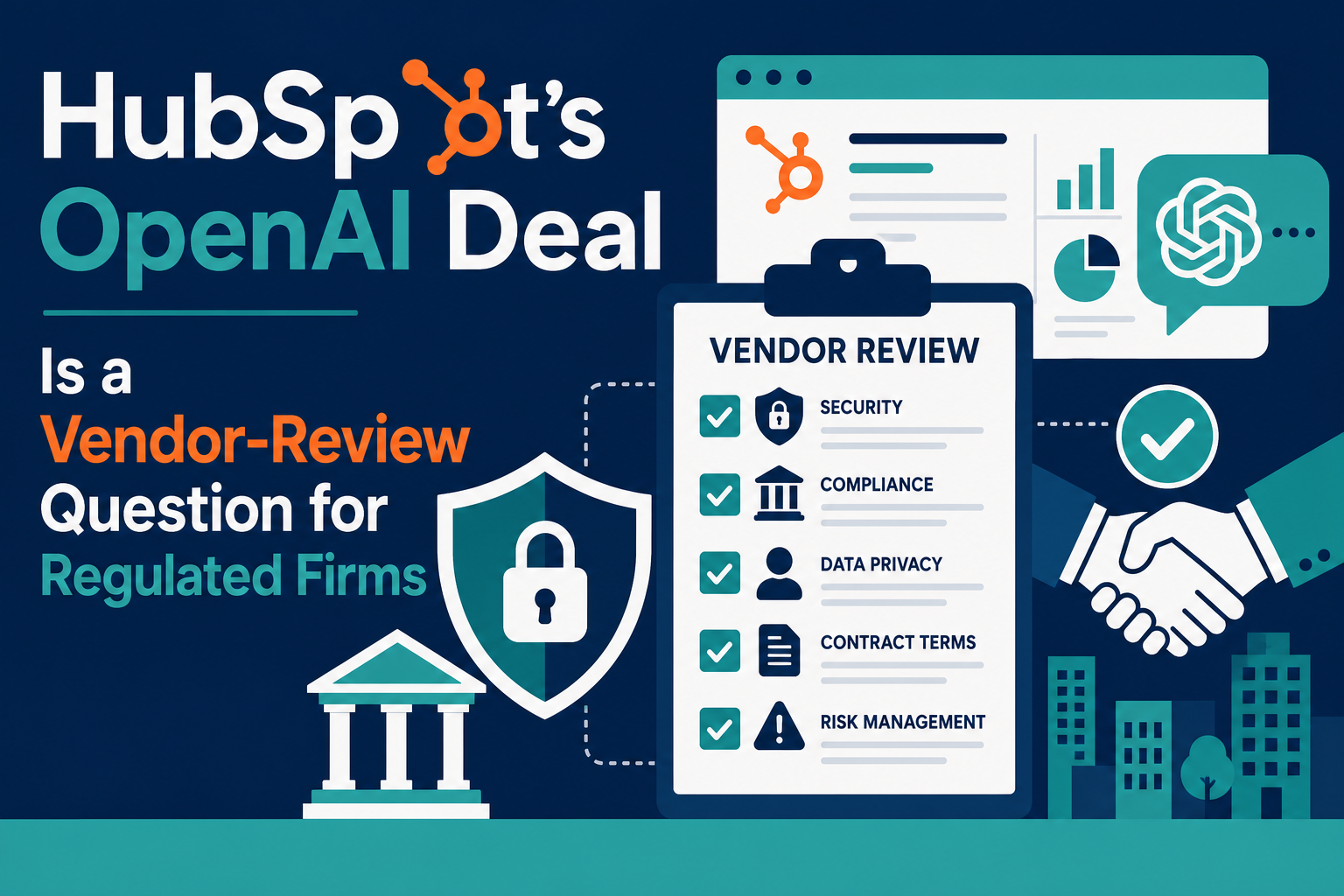
The checklist below is deliberately ordinary. That is the point: the AI embedded in your CRM should clear the same bar as any vendor you deliberately selected. Six questions, all answerable from vendor documentation plus your own contract:
| Review item | What to ask | Where the answer lives |
|---|---|---|
| Data retention | How long are prompts, CRM context, and outputs retained by the model vendor? Is retention different for business vs. consumer tiers? | The model vendor's data-usage and retention terms for the specific tier in use: get them in writing, not from a sales deck |
| Training use | Is CRM-derived data used to train foundation models? Under what opt-out or contractual exclusion? | Vendor data-usage policy plus your HubSpot agreement; confirm the answer for your exact plan, not the default marketing claim |
| Audit logging | Can you reconstruct who sent what CRM data to the model, when, and what came back? Are connector actions logged in HubSpot's audit trail? | HubSpot audit logs and enterprise logging settings; the connector's own activity records |
| Subprocessor disclosure | Is the AI vendor listed in HubSpot's subprocessor documentation, and does your contract's notice provision cover additions? | HubSpot's subprocessor list and your MSA's change-notice clause |
| Opt-out mechanics | Can you disable the connector or ads integration portal-wide? Per user? What happens to historical data after opt-out? | HubSpot admin settings; document the actual clicks, not the assumption |
| Access scoping | Which objects and properties can the connector read? Does it respect HubSpot permission sets, or does the integration user see everything? | Connector permissions in the HubSpot app listing plus a sandbox test against your real permission model |
If your team wants a broader frame for evaluating AI vendors beyond the CRM, our guide to HubSpot AI connectors maps what each connector actually touches.
Why Do Platform Defaults Get Skipped?
Three reasons, none of them good. First, the enablement path is invisible to procurement: no new contract, no invoice line, no onboarding meeting: nothing to trigger review. Second, ownership is ambiguous: marketing assumes RevOps reviewed it, RevOps assumes IT did, IT assumes compliance signed off because it shipped from an approved vendor. Third, the risk feels hypothetical until an examiner or client DDQ asks which third parties process client data, and the honest answer requires a scramble.
The fix is procedural, not technical: treat platform-level AI feature releases as change events in your vendor inventory. When HubSpot (or Salesforce, or any system of record) announces a new embedded AI capability, that announcement should open a review ticket the same way a new subprocessor notice does.
What Does the September 30 Window Actually Change?
Very little, for most regulated firms, and that is worth saying plainly. The AI Growth Bundle is explicitly aimed at new HubSpot customers, and the $750 ad-spend match applies to eligible new U.S. advertisers who open an account by September 30, 2026, then have 14 days to complete the qualifying spend. If your firm already runs HubSpot, the bundle is not for you, and no deadline should compress your diligence timeline.
If you are evaluating a new HubSpot Starter purchase for a business unit or subsidiary, the window is real, but treat it as pricing context, not urgency. A $750 ad credit does not change the answer to any question on the checklist above, and a vendor decision made to beat a promotional deadline is exactly the kind of decision a vendor-risk committee exists to slow down.
What Does Good Look Like in Practice?
A digital asset investment firm (a sector where vendor diligence is a weekly conversation, not an annual one) engaged Vantage Point to rebuild its revenue operations across both Salesforce and HubSpot. The governance work was not separate from the rebuild; it was the rebuild. Every integration, including AI-assisted workflows, got a documented data flow, an owner, and a logging standard before it went live. The measurable outcome: the firm's Marketing Hub health score moved from 40 to 100, and it achieved 100% closed-loop attribution from campaign to closed deal. Audit-ready reporting that answers an examiner's "where did this lead come from?" in one query instead of one quarter.
That is the standard to hold embedded AI to: not "is the model good?" but "could we produce the paperwork on this data flow tomorrow if someone asked?"
How Vantage Point Helps
Vantage Point works with RIAs, insurers, lenders, and other regulated firms on exactly this intersection. HubSpot architecture, integration governance, and the documentation that makes AI features approvable rather than alarming. As a member of the OpenAI Partner Network, we also govern the ChatGPT side of the connection; see our OpenAI consulting. Through our HubSpot implementation, compliance and security solutions, and managed services work, senior consultants map the data flows, run the vendor-review checklist, and configure audit logging alongside your compliance team. Senior consultants only. No junior handoffs; the experts you meet are the experts who deliver.
Is Your CRM's AI Reviewed, or Just Enabled?
The UNBOUND announcements make this a good week to find out. Vantage Point's senior consultants can run the checklist above against your live HubSpot portal and hand your compliance team the documentation to match. Contact Vantage Point to schedule a HubSpot AI governance review, or explore our HubSpot services.
Frequently Asked Questions
What did HubSpot announce with OpenAI at UNBOUND 2026?
On September 16, 2026, HubSpot announced an expanded OpenAI partnership: the first CRM integration with ChatGPT Ads, an updated HubSpot connector for ChatGPT (with 250% growth in weekly active users, per HubSpot), and an AI Growth Bundle for new customers, discounted HubSpot Starter, buy-one-get-one ChatGPT Business seats, and a $750 ChatGPT Ads spend match tied to a September 30, 2026 sign-up deadline.
Is the AI inside HubSpot a vendor-risk issue for regulated firms?
Yes. When CRM data flows to a model vendor through a connector or an ads integration, that vendor is processing your client data. The same fact pattern that triggers third-party risk review for any other subprocessor. The only difference is the enablement path: platform defaults don't generate a contract signature or an invoice, so they rarely trigger the review they deserve.
Does OpenAI train its models on our HubSpot CRM data?
Treat this as a contract question, not a marketing question. Model-vendor training and retention policies differ by product tier and change over time, so confirm the data-usage terms that apply to your specific plan in writing (through your HubSpot agreement and the model vendor's current business-tier data policies) before enabling connector or ads workflows on client data.
What is the AI Growth Bundle and who qualifies?
Per HubSpot's offer page, the bundle is for new HubSpot customers only: HubSpot Starter and credits at up to 65% off for a year, buy-one-get-one-free ChatGPT Business standard seats for 12 months with annual subscription, and up to $750 in ChatGPT ad credit after $750 in qualifying spend for eligible new U.S. advertisers who sign up before September 30, 2026. Existing HubSpot customers do not qualify.
Should we disable the HubSpot connector for ChatGPT until review is complete?
That is a decision for your compliance function, but the general principle holds: enable embedded AI features after the vendor-review questions are answered, not before. If the connector is already live, document the current data flows now (which users, which objects, what logging exists) and remediate any gaps the review surfaces.
Is this an argument for choosing a different AI vendor?
No. This is not a case for or against OpenAI, Anthropic, or any other model provider. It is a case for applying one consistent diligence standard: the AI vendor embedded in your CRM by default should clear the same review bar as an AI vendor you selected deliberately. Firms that run Claude, ChatGPT, or Gemini connectors all face the identical checklist.
What did analysts say about the HubSpot: OpenAI news?
Stifel raised its HubSpot price target to $225 from $200 around UNBOUND and maintained a Hold rating, with coverage citing the conference announcements around AI agents and HubSpot's Smart CRM platform as validation of the company's AI strategy. Analyst views on the stock are a market signal, not a diligence substitute: your vendor review still owns the risk question.
Sources
- HubSpot and OpenAI deepen partnership to bring AI transformation to every SMB: HubSpot, September 16, 2026
- AI Growth Bundle offer terms: HubSpot (accessed September 18, 2026)
- HubSpot stock holds above Stifel's target as UNBOUND puts AI strategy in focus: ad-hoc-news, September 2026
Vantage Point is an employee-owned boutique CRM consulting firm helping businesses transform with Salesforce, HubSpot, and AI. It is a member of the OpenAI Partner Network, an official Claude partner, and a HubSpot Gold Partner. Learn more at vantagepoint.io.