
Treating HubSpot as ‘just a CRM’ instead of a revenue system
A successful first HubSpot implementation starts with a clear definition of how the platform will support your full revenue process, not just contact storage. CEOs should treat HubSpot as the core system of record for marketing, sales, and service, with defined outcomes, data structures, and reporting before any configuration begins.
For a 50-200 person B2B firm, the first mistake is buying HubSpot to “get a CRM in place” instead of designing a revenue system. This shows up as simple contact lists, a basic deal pipeline, and a few campaigns, but no shared definition of a qualified lead, no clear lifecycle stages, and no visibility from first touch to closed revenue. When this happens, leadership quickly concludes that “HubSpot is not giving us insight,” when the real issue is the implementation scope.
Practically, this means you should start with process and data design, not page layouts. Map how a lead becomes an opportunity, how an opportunity becomes a client, and how post-sale teams manage renewals or expansions. A widely cited implementation guide notes that teams who invest in process mapping before configuration see significantly higher adoption and reporting quality compared to those who start by importing lists and building pipelines (Growth London). That planning step is what turns HubSpot from “address book” into an operating system.
A helpful way to ground this is to define three or four business questions HubSpot must answer within six months. Examples include: Which campaigns generate the most sales-qualified leads? Where do opportunities most often stall in the pipeline? Which client segments have the highest retention rate? Once those questions are explicit, you can work backwards to design properties, objects, and reports needed to answer them consistently.
Many mid-sized teams also overlook how flexible HubSpot’s data model is: standard objects like contacts, companies, deals, and tickets, plus custom objects if needed. Instead of forcing everything into contacts and deals, start by documenting the real entities in your business (for example, accounts, contracts, projects, or funds) and how they relate. An article on common HubSpot onboarding mistakes points out that poor initial data modelling is one of the main reasons organisations later need expensive rework (Federation Design).
Finally, remember that a first implementation sets expectations for every later initiative. If HubSpot is positioned as a tactical email and deal tracker, it will be funded and staffed as such. If it is positioned as the revenue platform that leadership uses for forecasting and strategy, it will attract better ownership, better data, and better outcomes. The technology is the same; the difference is the level of intent and design you bring to the first build.
Rushing implementation without clear ownership, processes, or data standards
The second major mistake is aiming to “go live fast” without assigning accountable owners, defining core processes, or setting data standards. A rapid but under-designed rollout produces cluttered properties, unreliable reports, and low trust, which are significantly harder and more costly to correct later.
In many B2B firms, HubSpot is purchased during a period of change, new go-to-market strategy, a funding event, or rapid hiring. Under pressure, leaders often approve an aggressive timeline: migrate data, spin up a pipeline, and switch teams across in a few weeks. The intent is good; the impact is often the opposite. Without strong ownership and design, teams import legacy spreadsheets as-is, create one-off fields to solve immediate problems, and replicate old habits in a new system.
A practitioner with experience across dozens of implementations observed that underestimating the time and focus required is the single most common pitfall (Growth London). The pattern is familiar: the implementation is added on top of full-time roles, workshops are rushed, and decisions are made in small side conversations. Six months later, leadership is told that cleaning up the data model and workflow logic will itself require a new project.
A more disciplined approach starts with clear roles. Appoint a business owner for HubSpot (often the head of revenue operations or head of operations) who is accountable for outcomes and decision-making. Pair this person with a technical owner who can manage configuration and integration work. Define a small steering group that meets weekly during implementation to approve key design decisions, such as lifecycle definitions, pipeline stages, and core properties.
Equally important are data standards. Before you import a single record, agree on naming conventions, required fields, picklist values, and rules for duplicates and record ownership. For example, you might decide that every company must have a defined segment, region, and ideal client profile fit rating, and that deals cannot be created without a primary company association. These standards are what later enable reliable reports and automation.
Standard operating procedures turn these standards into behaviour. Document how teams should create records, update stages, log activities, and close deals. Even a basic set of process documents hosted in a shared workspace dramatically reduces ambiguity and inconsistency. When new colleagues join, they can learn the “right way” from day one instead of copying the most convenient habits they see around them.
If you are already partway through a rushed implementation, you can still course-correct. Pause net-new configuration for a short period, form the ownership group, and run a structured review of your current data model, pipelines, and workflows. Identify a small set of high-value cleanup tasks that can be completed in weeks, not months, and clearly communicate to leadership how this stabilisation will unlock better reporting and automation.
Ignoring change management, training, and ongoing optimisation
The third mistake is treating HubSpot go-live as the finish line instead of the beginning. Without structured change management, role-specific training, and a clear optimisation roadmap, usage plateaus quickly and the platform never delivers the expected revenue impact.
Even in mid-sized firms, a CRM or revenue platform changes how people work every day. Yet many implementations allocate most of the budget to technical setup and almost none to behaviour change. The result: teams keep working from spreadsheets or personal tools, data quality stays low, and leadership doubts the value of the investment.
Effective change management starts by explaining the “why” in concrete terms. Instead of presenting HubSpot as a technology upgrade, link it to outcomes each team member cares about: fewer manual tasks, better visibility into their pipeline, or faster access to client history. Research on platform adoption repeatedly shows that when individuals can see personal benefits, they are significantly more likely to change established habits (Zooma).
Training should be designed around roles, not generic feature tours. Sales teams need to learn how to manage their day in HubSpot: prioritising tasks, updating deals, and logging meetings. Marketing teams need to understand segmentation, campaign setup, and attribution. Leadership needs focused sessions on dashboards, forecasting, and how to read behaviour signals. Short, scenario-based sessions tend to be more effective than long one-time workshops.
Another overlooked element is how new colleagues will be onboarded into HubSpot over time. Without a defined onboarding path, training quality decays as the organisation grows. A simple checklist, a short library of internal videos, and updated process documentation ensure that each new team member learns consistent practices and understands why they matter. This is especially important in organisations where sales and marketing teams are expanding.
Finally, treat optimisation as an ongoing program, not an ad-hoc activity. Set a quarterly review cadence where the HubSpot owner and key stakeholders examine adoption metrics, pipeline health, and data quality indicators. Use those reviews to decide on a small number of improvements: adjusting lifecycle stages, refining scoring models, improving integrations, or adding automation where manual work is still heavy. External research notes that organisations which treat CRM as a continuous improvement program realise higher long-term return on investment than those that see it as a one-off project (Federation Design).
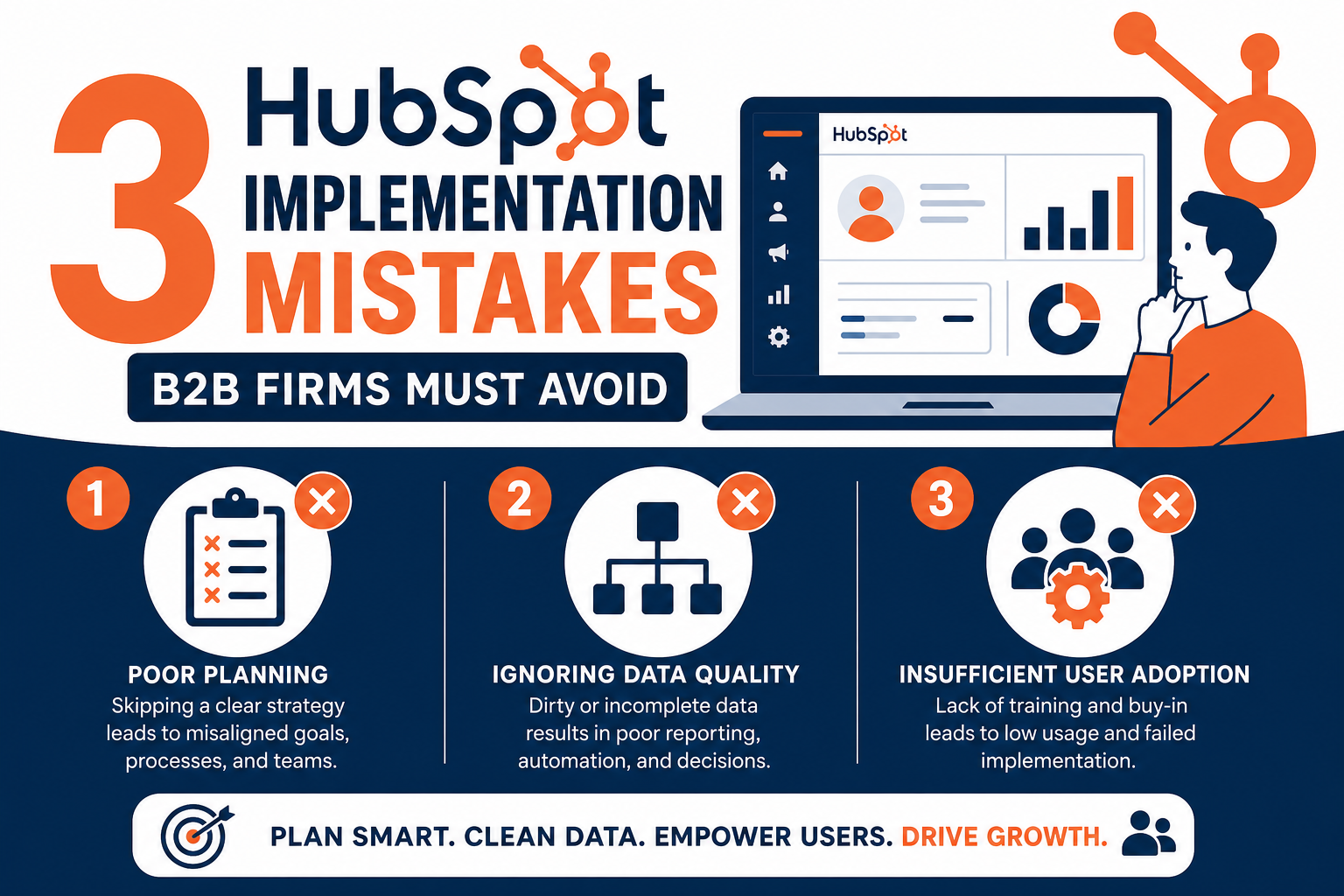
For CEOs and heads of operations, the message is straightforward: the technology will do what you design and lead it to do. Avoid these three mistakes (narrow scope, rushed rollout, and weak change management) and your first HubSpot implementation can become a durable foundation for reliable insight, efficient operations, and stronger client relationships.