
Somewhere in your organization, a finance or operations person spends hours every pay period doing commission math in a spreadsheet: exporting payment data, applying tiered rates, adjusting for returned payments, reconciling disputes, and hand-keying the result into payroll. It works — until a rep crosses a tier mid-stream, a payment bounces, or the spreadsheet's owner goes on vacation.
If your sales data already lives in Salesforce, the raw material for commission automation is already there. What's usually missing is the system design: the rules engine, the approval flow, and the audit trail that turn "a sales manager spends two days reconciling spreadsheets" into "a sales manager reviews a report for twenty minutes."
This guide covers what a Salesforce commission tracking setup needs to handle, how the data model typically works, and where the edge cases — tier crossings, split payments, NSFs, disputes — break naive implementations.
Quick Answer
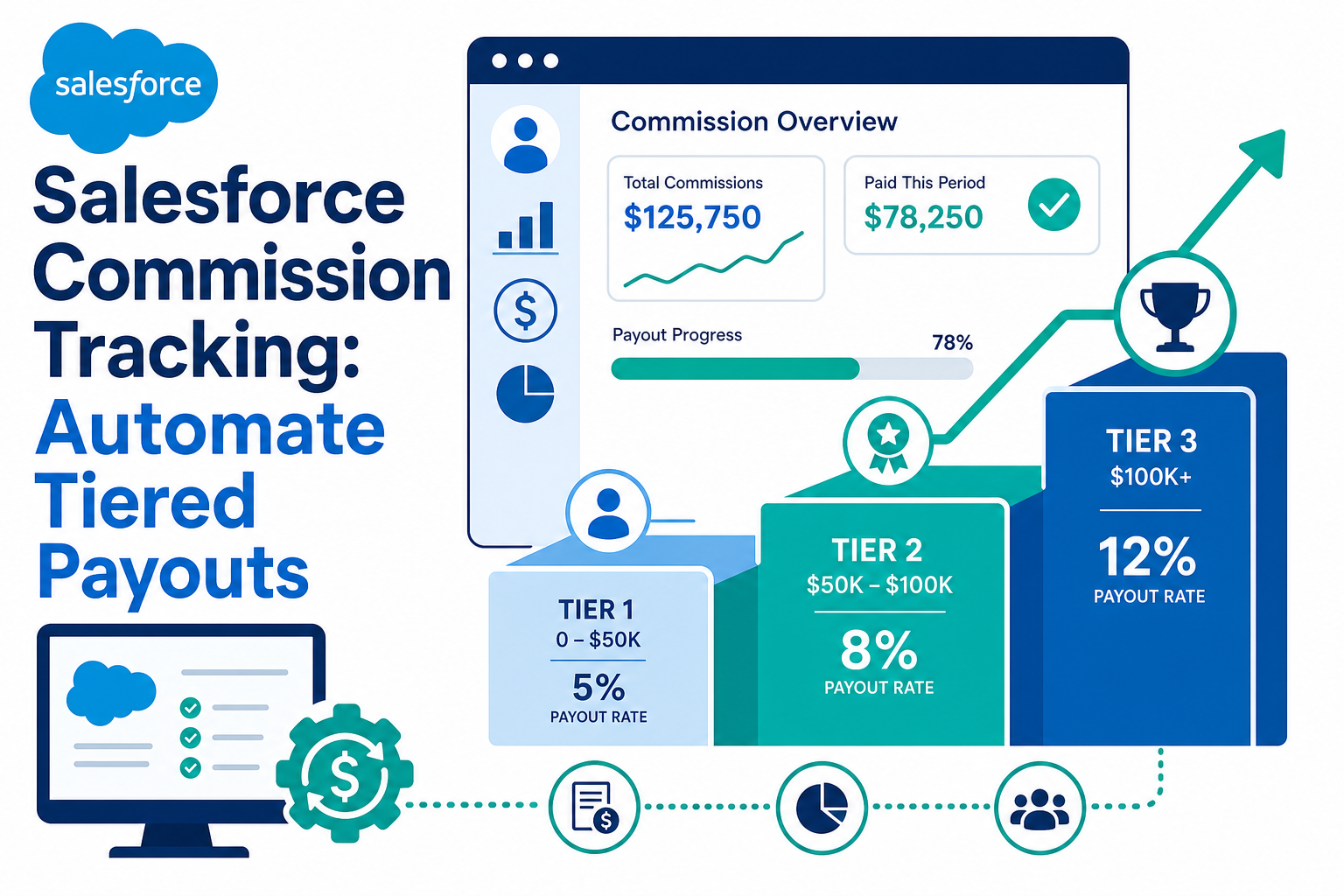
Salesforce commission tracking replaces manual spreadsheet reconciliation with a rules-driven engine inside your CRM: commission plans define rates and tiers, payment or revenue records feed the calculation, and flows or Apex apply the logic to produce per-rep payout statements. A production-grade setup handles the hard parts — catch-up adjustments when a rep crosses a tier after earlier payments, split payments spread across months, returned payments (NSFs) excluded from cleared totals, rep attestation before processing, dispute handling via adjustments instead of rollbacks, and an auditable snapshot of every pay period. Done well, it connects to payroll as a reviewed report or an automated handoff. Vantage Point designs and builds commission engines as part of its Salesforce consulting practice.
Key Takeaways (TL;DR)
- What it is: commission calculation, approval, and payout reporting built on your Salesforce data instead of spreadsheets.
- Why it matters: manual reconciliation burns hours per pay period and every error erodes rep trust.
- Hard parts: tier crossings, split payments, returned payments, disputes, and auditability — plan for them up front.
- Best for: teams with multi-tier or multi-payment commission plans and recurring payroll cycles.
- How Vantage Point helps: design and build of commission automation through our Salesforce services.
Why Do Spreadsheet Commissions Break Down?
Spreadsheets survive simple plans: one rate, paid once, on one record type. Real commission plans are rarely simple. Rates tier by volume. Payouts spread across a customer's first several payments. Payments bounce and must be excluded retroactively. Reps dispute amounts and corrections land in a later cycle. Each rule is manageable in isolation; composed together in a spreadsheet, they produce exactly the reconciliation marathon most operations teams know too well.
The deeper problem is trust. When reps can't see how a number was produced, every paycheck generates questions. A commission system inside Salesforce makes the calculation inspectable: every payout line traces back to source records and an explicit rule.
What Must a Salesforce Commission Engine Handle?
Before picking tools, enumerate the rules your plan actually has. The requirements that separate a demo from a production system:
- Tiered rates: the rate changes as a rep's period total crosses thresholds — including the case where later payments push them across a tier after earlier payments were already paid at the lower rate, requiring catch-up adjustments.
- Payment sequencing: plans that pay on "the first three cleared payments" need durable ordering — and returned payments (NSFs) must not count as cleared, or the whole sequence shifts.
- Reversals and clawbacks: when a payment is reversed, the commission effect must link to the original payout line so netting is correct — reversals as offsetting entries, never silent deletion.
- Manual overrides: spiffs, contests, and corrections need a sanctioned entry point with its own audit trail, not a shadow spreadsheet.
- Approval and attestation: reps review their statement, affirm or dispute within a window, and only then does the batch go to payroll. Processed items are flagged so they never reappear in a later batch.
- Dispute handling: disagreements resolve as compensating adjustments in a subsequent payroll — finalized pay periods are immutable.
- Snapshots: a frozen record of what was processed, when, and under which plan version — the artifact that makes audits short.
What Does the Salesforce Data Model Look Like?
A typical build uses a small set of custom objects around your existing records:
| Object | Purpose | Key fields |
|---|---|---|
| Commission Plan | The rules: tiers, rates, effective dates, eligible products | Rate table, plan version, active dates |
| Source records | Payments, opportunities, or invoices that trigger commission | Amount, cleared date/status, sequence number, rep owner |
| Commission Entry | One row per payout event, linked to its source record | Rep, amount, tier applied, period, status (pending/approved/processed) |
| Adjustment | Overrides, clawbacks, catch-ups — always linked to an original entry | Type, reason, approver, net effect |
| Pay Period Batch | The frozen snapshot for payroll | Period dates, totals, approval status, export timestamp |
Flows handle most event logic (new cleared payment → create commission entry under the rep's active plan). Apex earns its keep in the batch engine: tier evaluation across a period, catch-up calculation, and snapshot creation — logic you want unit-tested, not clicked together.
How Do You Handle Tier Crossings and Catch-Up Adjustments?
The classic failure: a plan pays a lower rate below a volume threshold and a higher rate above it. A rep's first payments of the month are paid at the lower rate; a late-month payment pushes them over. Does the higher rate apply only to new payments, or retroactively to all of them?
Both designs exist — the mistake is not deciding. If retroactive, the engine must compute a true-up: recalculate the period at the achieved tier, subtract what was already paid, and emit a catch-up adjustment line. That's straightforward in a batch process and painful in real-time triggers, which is why mature implementations calculate in batch at period milestones rather than on every payment save.
Should Approvals and Disputes Live in Salesforce Too?
Yes — this is where commission projects earn their keep. A practical pattern:
- Entries generate as pending when source payments clear.
- Reps see a personal dashboard and affirm their statement (a checkbox or auto-affirm after a review window).
- A dispute creates a case-like record routed to operations; resolutions become adjustments in the next batch.
- On payroll day, affirmed entries freeze into a batch snapshot; processed flags prevent reprocessing.
Every step leaves a record. When finance asks "why was this paid?" six months later, the answer is a report, not an archaeology project.
How Does Payroll Integration Work?
Two patterns, in increasing order of sophistication:
- Report-first: the frozen batch exports a formatted payroll report (CSV or PDF) that payroll staff review and enter. Most teams should start here — the approval workflow matters more than the last mile of automation.
- Integrated handoff: once the report has run clean for several cycles, push batches to the payroll system via API or scheduled file transfer. Keep the snapshot as the system of record either way.
A phased approach de-risks the project: dashboards and reporting first, approvals and snapshots second, payroll automation last.
What About Security, Sharing, and AppExchange Alternatives?
Commission data is compensation data — the most sensitive numbers in most orgs. A custom build must get sharing right from day one: commission entries private by default (organization-wide default: Private), reps seeing only their own entries via owner-based sharing, and operations and finance seeing everything through roles or permission sets. Dashboard filters do the rest so a rep's "my payouts" view and leadership's "all payouts" view come from the same governed data.
On build-versus-buy: AppExchange commission applications (SPM/ICM tools) make sense when your plan fits their model — standard tiers, quotas, and payout schedules — and you want vendor maintenance. Custom builds win when the plan is unusual (payment-sequencing rules, complex clawbacks, multi-entity splits), when commissions must embed deeply in existing Salesforce objects and flows, or when per-seat app pricing exceeds the build cost within a year or two. Many teams land hybrid: a custom calculation core with packaged reporting.
How Vantage Point Helps
Vantage Point designs and builds commission engines on Salesforce — data model, calculation logic, approval workflows, and payroll handoff — sized to how your plan actually works rather than a generic template. Our Salesforce consultants have built revenue and payout automation across 400+ engagements for 150+ clients, with a 4.71/5.0 average engagement rating and 95% client retention. Senior consultants only — no junior handoffs; the experts you meet are the experts who deliver. For teams that want the engine tuned as plans evolve, our managed services provide ongoing administration.
Still Reconciling Commissions by Hand?
Vantage Point can map your commission plan to a Salesforce design — tiers, approvals, snapshots, and payroll handoff — and show you what the automated version looks like. Talk to Vantage Point about commission automation.
Frequently Asked Questions
Can Salesforce calculate commissions natively?
Salesforce has no out-of-the-box commission engine, but its platform primitives — custom objects, roll-up summaries, flows, Apex, and approval processes — support a fully custom build. AppExchange commission applications are the alternative for teams that prefer a packaged product.
How do you handle a rep crossing a commission tier mid-period?
Decide whether the higher tier applies to new payments only or retroactively to the whole period. If retroactive, the system recalculates the period at the achieved tier and issues a catch-up adjustment for the difference — easiest to compute in a batch process at period milestones.
Should a returned payment (NSF) count toward commissions?
No — commission plans typically pay on cleared payments only. The system should exclude returned payments from cleared totals and, if a payout already occurred, record a linked reversal or clawback adjustment rather than deleting history.
How should commission disputes be handled?
In-system, as adjustments to a future payroll — never by editing a finalized batch. Give reps a review-and-affirm window with a visible dispute path, and resolve disputes as compensating entries so every pay period remains an immutable, auditable snapshot.
Build a custom commission engine or buy an AppExchange app?
Buy when your plan matches a packaged app's model (standard tiers, common payout schedules). Build custom when your rules are unusual — payment-sequencing plans, complex clawbacks, multi-entity splits — or when you need the commission logic deeply embedded in existing Salesforce objects and flows.
What should the first phase of a commission automation project include?
Dashboards and payout reporting, an override entry point, correct payment sequencing, and returned-payment notifications. Add approvals and snapshots next; automate the payroll push last, after the reports have reconciled clean for several cycles.