
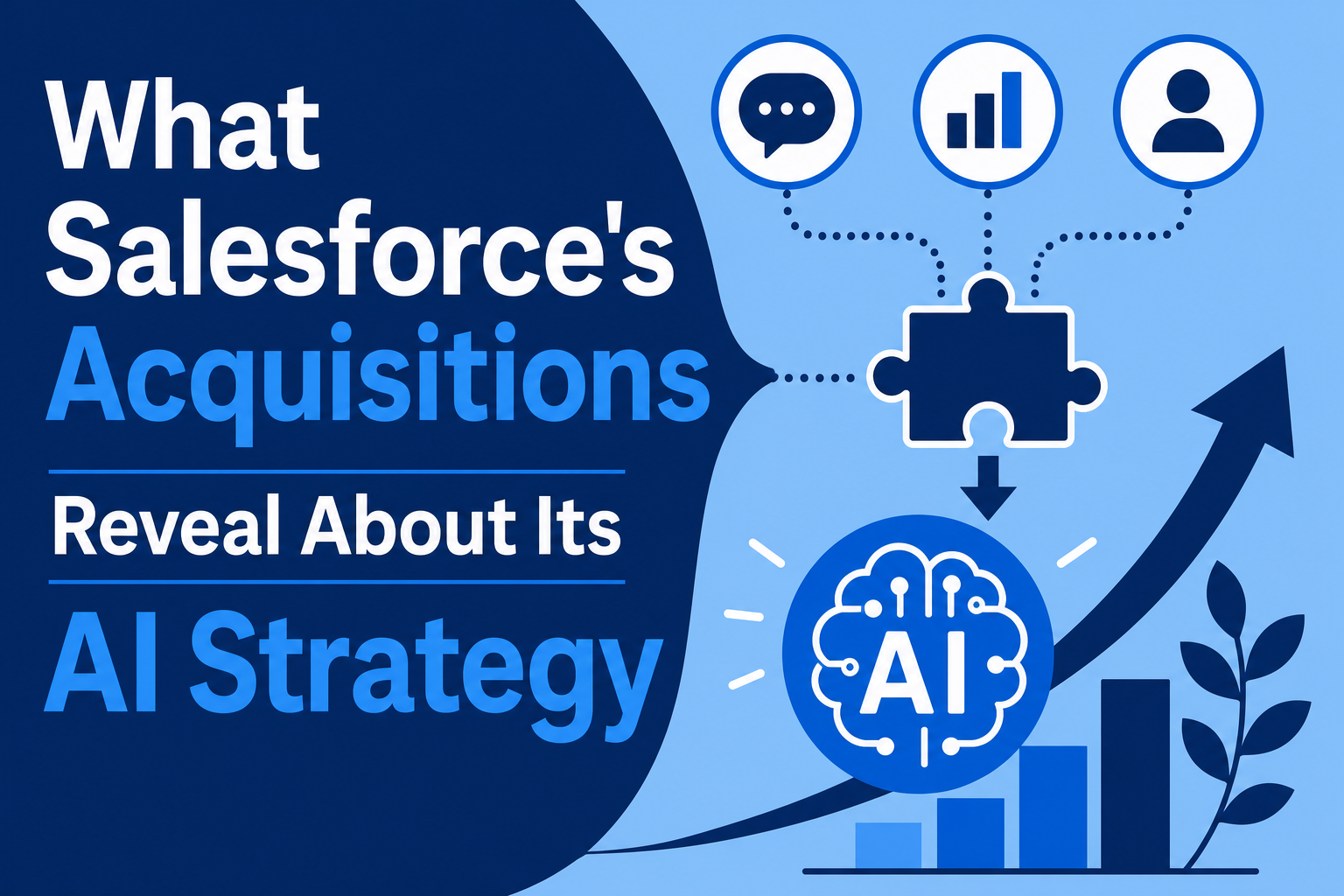
Salesforce has spent the last year buying companies at a pace that is easy to read as opportunism. Look at the deals individually and you see a data tool here, a content system there, a customer-service agent, a billing engine. Look at them together and a different picture appears: a deliberate plan to assemble an end-to-end enterprise-AI operating system on one platform.
That distinction matters for mid-market and SMB Salesforce customers. The headline is not "Salesforce bought a lot of companies." It is that competitive advantage is shifting away from owning the single best tool and toward orchestrating a connected stack: where data, content, conversations, applications, and AI agents work together. And the hard part of that shift is integration and data governance, which is exactly the work most mid-market teams underestimate.
This is Vantage Point's read of the strategy, based on Salesforce's public announcements and investor disclosures. We are not claiming insider knowledge. We are connecting the dots the way a buyer should before planning their own AI roadmap.
Quick Answer
Salesforce's recent acquisitions, viewed as a group, reveal a strategy to build a single connected enterprise-AI platform (from trusted data at the foundation to AI agents that take action) rather than a collection of standalone products. This matters for mid-market and SMB Salesforce customers planning AI and CRM investments. The practical takeaway: value will come from how well you integrate and govern a connected stack, not from buying more point tools. Vantage Point is a senior-only, mid-market Salesforce specialist that helps clients sequence and integrate this stack (Data Cloud, MuleSoft integration, Agentforce, and Service Cloud) with the governance autonomous agents require.
TL;DR
- What it is: Salesforce's acquisition pattern points to one layered platform (data, context, content, action, monetization, and a shared workspace) not separate features.
- Why it matters: The real moat is integration across the stack, not any single AI model. That is where mid-market value is realized or lost.
- Foundation first: Agents are only as good as the trusted, connected, governed data underneath them. You do not need perfect data to start, but governance still matters: especially for agents that take action.
- What to do now: Audit your data foundation, map where context and content live today, and avoid buying more tools before you can integrate what you have.
- How Vantage Point helps: We sequence and integrate Salesforce's connected stack with governance using our VALUE Methodology: see our Salesforce implementation and advisory services.
What Is Salesforce's Acquisition Strategy?
Salesforce's acquisition strategy is the assembly of a connected enterprise-AI platform where each acquired capability fills a specific layer of one system. Instead of selling AI as a bolt-on, Salesforce is building a path that runs from raw data to a completed business outcome, and trying to keep every step of that path inside one ecosystem.
The clearest way to understand it is to stop looking at the deals as a shopping list and start mapping them to functions. When you do, the acquisitions line up into a recognizable stack.
The Salesforce AI Platform Stack: Six Layers
Here is how the recent moves map to the layers of an enterprise-AI platform. This framing is Vantage Point's analysis, not an official Salesforce diagram.
| Layer | Job to be done | Salesforce building blocks | Status |
|---|---|---|---|
| Foundation | Trusted, connected, governed data | Data Cloud, Informatica, MuleSoft | Informatica announced 2025 (~$8B); Data Cloud and MuleSoft are core platform |
| Context | Understand what was actually said across meetings and customer conversations | Momentum | Acquisition completed March 2, 2026 |
| Content | Give agents approved, enterprise-grade content on demand | Contentful | Acquisition completed |
| Action | Move from insight to executing work and resolving issues | Agentforce, Fin, Qualified | Qualified completed April 1, 2026; Fin signed June 15, 2026 (~$3.6B) but not yet closed |
| Revenue / Monetization | Usage-based and outcome-based pricing for AI consumption | m3ter | Definitive agreement signed, not yet closed |
| Front door / Workspace | One surface where humans and AI agents collaborate | Slack | Core platform |
A few accuracy points worth keeping straight, because they change how you should plan:
- Completed acquisitions: Momentum, Qualified, Contentful, and Informatica.
- Signed but not yet closed: Fin (formerly Intercom, ~$3.6B, announced June 15, 2026, targeted to close in Q4 FY27 pending regulatory clearance) and m3ter (metering and rating for consumption-based billing). Do not assume these are finished or generally available.
The flow across these layers is straightforward: data → context → content → action → outcome, all inside one connected ecosystem, with Slack as the place people and agents meet.
Why the layers reinforce each other
Each layer is more valuable because of the others. Context (Momentum) is only useful if it draws on trusted data (the foundation). Action (Agentforce, Fin) only earns trust if the content it serves (Contentful) is approved and current. Monetization (m3ter) exists because the action layer creates usage worth metering. And Slack is the front door that makes the whole thing feel like one product rather than seven.
Agentforce gives this a commercial backbone: Salesforce reported Agentforce reached $1.2 billion in annual recurring revenue in Q1 FY27, up 205% year over year. That is the layer Salesforce is betting will turn the rest of the stack into recurring revenue.
Why the Real Moat Is Integration, Not the Model
The most common misread of this strategy is that Salesforce is competing on AI models. It is not, and neither should you when you plan your own roadmap.
Foundation models are increasingly available to everyone. What is hard to copy is the combination: governed data, real workflows, approved content, recorded conversations, line-of-business applications, and agents that can act, all wired together and trusted enough to run a business process end to end. That integration is the moat.
This is also the part mid-market teams underestimate. Buying Agentforce, or any agent platform, does not produce outcomes on its own. The agent needs clean, connected data to reason over, approved content to draw from, and clear boundaries on what it is allowed to do. Get the integration and governance right and the platform compounds. Skip it and you get expensive demos that never reach production.
If you want a deeper look at the foundation layer specifically, see our analysis of why your data foundation is now your competitive moat and how Data 360, Informatica, and MuleSoft fit together.
What This Means for Mid-Market and SMB Salesforce Customers
Mid-market and SMB teams do not have enterprise integration budgets or large internal platform teams. That is precisely why the connected-stack shift is both an opportunity and a risk for them.
- Opportunity: You can buy a coherent stack from one vendor instead of stitching together a dozen niche tools. Done well, that lowers integration overhead.
- Risk: Vendor consolidation does not automatically mean integration. You still have to model your data, connect your systems, govern your agents, and adopt the workflows. The platform makes this possible; it does not make it free.
The teams that win will treat AI agents as the last step of a sequence, not the first purchase. The teams that struggle will buy more agents before they can feed them trusted data.
What to Do Now: A Staged Mid-Market Roadmap
You do not need a perfect data estate to begin. You do need a sequence. Here is a practical, staged approach.
Stage 1: Audit your data foundation
Inventory where your customer data lives, how clean it is, and which systems are not yet connected. Identify the few data domains that matter most for your priority use cases. Perfect is not the bar; trusted enough to act on is.
Stage 2: Map context, content, and action
Document where your real signals live today: call recordings, meeting notes, support tickets, marketing content, knowledge bases. This is your version of the Momentum and Contentful layers. You likely already have these assets; they are just not connected.
Stage 3: Tighten governance before autonomy
Decide what an agent is allowed to read, say, and do. Define approval paths, escalation rules, and audit requirements. Governance is light when AI only suggests; it becomes essential the moment AI acts on a customer's behalf.
Stage 4: Integrate before you expand
Connect what you have (Salesforce, your telephony, your billing, your content) before buying another tool. Most mid-market AI value is unlocked by integration, not by additional licenses.
Stage 5: Roll out agents in stages
Start with bounded, low-risk use cases (service deflection, lead routing, internal Q&A), measure outcomes, then expand. Tie each agent to a workflow and a data source you trust.
A practical CTA: If your team is mapping how this connected stack applies to your Salesforce environment (data foundation, integration, Agentforce readiness, or governance) Vantage Point can help assess the right next step and build a staged implementation plan.
How This Connects to Other Salesforce Moves
This big-picture synthesis sits alongside the individual deals we have analyzed:
- The Salesforce acquisition of Fin (formerly Intercom): the action layer for AI customer service.
- The Salesforce acquisition of Contentful: the content layer for approved, enterprise-grade material.
- The Salesforce Q1 FY27 earnings breakdown: the financial signal behind the agentic bet.
Read together, they tell one story: a platform being assembled layer by layer.
How Vantage Point Helps
Vantage Point is a senior-only consultancy focused on mid-market Salesforce and HubSpot work. We help clients turn this connected-stack strategy into something they can actually run.
- Data foundation and integration: We connect and govern your data across systems with system integration and data migration services, including MuleSoft and Data Cloud work.
- Salesforce strategy and Agentforce readiness: We sequence platform investments through Salesforce implementation and advisory so agents have the data and workflows they need.
- AI strategy and governance: We design practical, governed AI use cases through AI-driven personalization and analytics, with guardrails for agents that take action.
- Service and omnichannel: Where customer conversations matter, we connect telephony and service workflows, including Service Cloud Voice and Aircall.
We use our VALUE Methodology to keep the work staged, senior-led, and tied to measurable business outcomes: not technology for its own sake.
FAQ
What is Salesforce's acquisition strategy in 2026?
Salesforce's acquisition strategy is to assemble a single connected enterprise-AI platform rather than a set of standalone products. Each deal fills a layer (data, context, content, action, monetization, or workspace) so that AI agents can move from raw data to a completed business outcome inside one ecosystem.
Which Salesforce acquisitions have actually closed?
Momentum (completed March 2, 2026), Qualified (completed April 1, 2026), Contentful (completed), and Informatica (announced 2025) are completed or core to the platform. Fin (formerly Intercom, ~$3.6B, announced June 15, 2026) and m3ter are signed but not yet closed, so they should not be treated as generally available.
Why does Salesforce's strategy matter for mid-market companies?
It matters because competitive advantage is shifting from owning the best single tool to orchestrating a connected stack. For mid-market teams, the value comes from integrating and governing data, content, and agents together. Work that is easy to underestimate and where most AI initiatives stall.
Is the moat the AI model or the integration?
The moat is the integration. Foundation models are widely available, but the combination of governed data, workflows, approved content, conversations, applications, and agents working together on one platform is hard to copy. That combination, not any single model, is where durable advantage and real business value live.
Do we need perfect data before adopting Salesforce AI agents?
No. You do not need perfect data to start, but you do need data that is trusted enough to act on, plus clear governance. Governance is light when AI only suggests answers and becomes essential the moment an agent takes action on a customer's behalf.
What should a mid-market team do first?
Audit your data foundation and map where context, content, and action already live in your business before buying more tools. Integrate what you have, tighten governance, then roll out AI agents in bounded, low-risk stages tied to trusted data sources.
How does Agentforce fit into the platform stack?
Agentforce is the action layer that executes work and resolves issues, and it is the commercial engine of the strategy: Salesforce reported it reached $1.2 billion in ARR in Q1 FY27, up 205% year over year. It depends on the foundation, context, and content layers to produce reliable outcomes.
How can Vantage Point help us plan for this?
Vantage Point is a senior-only, mid-market Salesforce specialist that helps clients sequence and integrate this stack (Data Cloud, MuleSoft integration, Agentforce, and Service Cloud) with the governance autonomous agents require. We build staged roadmaps that prioritize data foundation and integration before agent expansion.
Sources and Resources
- Salesforce Investor Relations: Salesforce Signs Definitive Agreement to Acquire Fin
- Salesforce Investor Relations: Salesforce Delivers Record First Quarter Fiscal 2027 Results
- Vantage Point: Salesforce implementation and advisory and system integration and data migration