
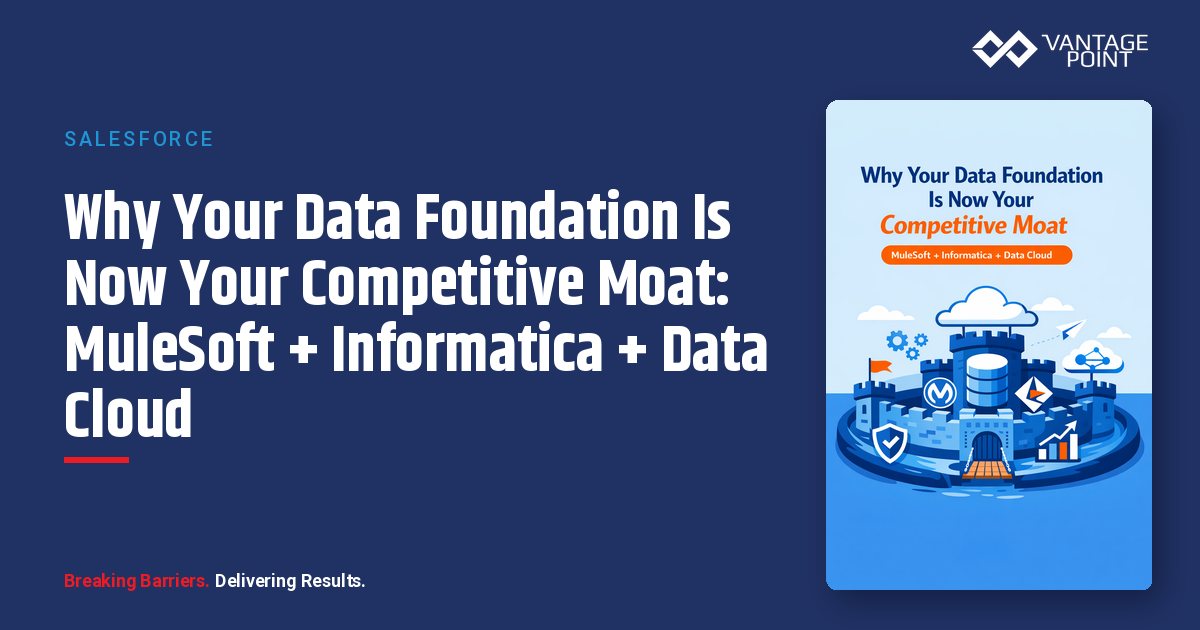
Key Takeaways (TL;DR)
- What is a data foundation? The unified layer of integration, governance, and metadata that connects all enterprise systems into a single source of truth — enabling AI, automation, and analytics to operate on trusted data
- Key Benefit: Organizations with a strong data foundation are 3× more likely to achieve ROI from AI initiatives vs. those building on fragmented data
- Cost: $75K–$500K+ depending on system complexity, data volume, and organizational scale
- Timeline: 3–9 months for a phased implementation across core systems
- Best For: Any organization investing in AI, automation, or digital transformation that needs to unify siloed data across CRM, ERP, marketing, and operations
- Bottom Line: AI models are only as good as the data beneath them — companies that invest in their data layer first will outpace competitors still stuck stitching together fragmented systems
Introduction: The Hidden Bottleneck Behind Every Failed AI Project
Every enterprise is racing to deploy AI. Agentic AI, predictive analytics, real-time personalization — the promises are everywhere. But here's the uncomfortable truth most vendors won't tell you: more than 80% of AI projects fail, and the number-one reason isn't the model. It's the data.
AI models are remarkably intelligent, but they're "corporate-stupid." They know almost everything about the world, but almost nothing about your business. Without a unified, governed, and connected data foundation, your AI agents are forced to guess. A customer ID is just a string of numbers. A shipment status is just a phrase. Fragments exist everywhere — a deal in your CRM, a ticket in your service desk, an order in your commerce platform — but nothing connects those fragments into a meaningful, trustworthy story.
This is why your data foundation — not your AI model — is now your most important competitive moat. And it's why the convergence of MuleSoft, Informatica, and Salesforce Data Cloud into a unified platform represents a seismic shift for every organization investing in AI and automation.
In this guide, we'll break down what a data foundation actually is, why it matters more than ever, how MuleSoft + Informatica + Data Cloud compare to hyperscaler alternatives, and how to build a data foundation strategy that turns your enterprise data into a durable competitive advantage.
What Is a Data Foundation and Why Does It Matter?
A data foundation is the unified infrastructure that connects, governs, and activates all of your enterprise data. It's not a single product — it's an architectural approach that combines three critical capabilities:
- Integration: Connecting siloed systems (CRM, ERP, marketing, operations, legacy databases) into a coherent data fabric
- Governance: Ensuring data quality, lineage, access controls, and compliance across every touchpoint
- Activation: Making trusted data available in real time for AI agents, dashboards, automation workflows, and business applications
Think of it as the operating system beneath your AI. Without it, every AI initiative sits on shaky ground.
Why the Data Foundation Has Become a Competitive Moat
Historically, competitive moats in technology came from proprietary software, scale, or brand. Today, that moat is shifting to data and the infrastructure that makes it usable.
Consider these trends:
- Gartner named Agentic AI the #1 strategic technology trend for enterprises, and identified AI-ready data foundations as one of the fastest-advancing capabilities
- Only 26% of AI initiatives achieved enterprise-wide scale in 2025, largely because organizations lacked the data infrastructure to move beyond pilots
- Enterprise AI adoption surged to 72% in 2026, but the gap between organizations that achieve ROI and those that don't correlates directly with data maturity
- Forrester and IDC predict that by 2027, organizations with unified data foundations will outperform peers by 40% in time-to-insight and operational efficiency
The message is clear: everyone can access the same AI models. The difference-maker is the quality, connectivity, and governance of the data you feed them.
How Do MuleSoft, Informatica, and Data Cloud Work Together?
With Salesforce's acquisition of Informatica (completed November 2025 for approximately $8 billion), the enterprise data landscape underwent a fundamental restructuring. MuleSoft, Informatica, and Salesforce Data Cloud now operate as a unified stack under the Data 360 umbrella — creating the most complete pathway yet for AI that acts with context, trust, and accountability.
Here's how each component contributes:
MuleSoft: The Connectivity and Action Layer
MuleSoft provides the real-time integration backbone that connects every system in your enterprise. Using an API-led connectivity approach, MuleSoft:
- Connects siloed systems across CRM, ERP, HR, marketing, commerce, and legacy infrastructure
- Surfaces operational signals such as inventory changes, order exceptions, shipment delays, and customer interactions
- Enables secure actions so AI agents can trigger workflows, update records, and execute business processes across any connected system
- Supports 1,700+ pre-built connectors for rapid integration without custom code
MuleSoft eliminates the brittle point-to-point integrations that most enterprises have accumulated over decades and replaces them with a reusable, governed integration foundation.
Informatica: The Governance and Trust Layer
Informatica brings enterprise-wide data governance at a depth and scale that no other platform matches. Its capabilities include:
- Master Data Management (MDM): Creates golden records not just for customers, but for products, suppliers, assets, locations, and every other business entity — ensuring your AI understands that "Part A" in the warehouse is the same as "SKU-123" in the catalog
- Data Catalog: Provides a single map of every data asset across on-premises systems, cloud platforms, data lakes, and legacy infrastructure
- Data Lineage: Traces the full journey of every data element from origin to consumption, showing every transformation — so AI agents know where data came from, how it was produced, and whether it's trustworthy
- Data Quality Scoring: Continuously monitors and scores data quality, flagging issues before they compromise AI outputs
- Privacy and Access Controls: Enforces attribute-based access control, data masking, and compliance policies across the enterprise
Informatica's engine processes more than 140 trillion metadata transactions per month, making it the backbone for enterprise-scale data governance.
Data Cloud: The Activation and Memory Layer
Salesforce Data Cloud is where everything comes together. It synthesizes the rich business context from Informatica with the operational signals from MuleSoft into a single, harmonized context interface. Key capabilities include:
- Zero-Copy Architecture: Access any enterprise data without physically moving or duplicating it — reducing storage costs while maintaining real-time freshness
- Unified Customer Profiles: Harmonize data from every source into a 360-degree view that AI agents, dashboards, and automation workflows can all access
- Real-Time Data Activation: Push trusted data into AI agents, marketing campaigns, service workflows, and analytics in sub-second timeframes
- Native AI Integration: Feed governed data directly into predictive models, agentic AI (like Salesforce Agentforce), and custom AI applications
Together, these three layers create what Salesforce calls "trusted context" — the enterprise memory that transforms AI from guessing to reasoning.
How Does This Compare to Hyperscalers and Data Platforms?
One of the most critical questions enterprises face is: should we build our data foundation on a hyperscaler (AWS, Azure, GCP) or a specialized platform like Databricks or Snowflake?
Hyperscalers (AWS, Azure, GCP)
Strengths: Raw compute power, storage scalability, broad service catalogs, deep infrastructure control
Limitations:
- Assembly required: You must stitch together dozens of individual services (data lakes, ETL tools, governance layers, API management) yourself
- No built-in business context: Hyperscalers provide infrastructure, not business intelligence — you need to build the semantic layer, MDM, and data quality scoring on top
- Integration fragmentation: Each cloud has its own integration approach, creating complexity in multi-cloud environments
- Governance as an afterthought: Data governance tools exist but require significant custom implementation and ongoing maintenance
Specialized Data Platforms (Databricks, Snowflake)
Strengths: Excellent for analytics workloads, SQL querying, data lakehouse architecture, ML model training
Limitations:
- Analytics-first, not action-first: These platforms excel at querying and analyzing data, but aren't designed to trigger actions across operational systems
- No native integration layer: You still need a separate integration platform to connect CRM, ERP, and operational systems
- Limited MDM and governance: Data quality and master data management capabilities are basic compared to dedicated platforms
- Disconnected from business processes: Data sits in a warehouse but isn't natively connected to the workflows and AI agents that need it
MuleSoft + Informatica + Data Cloud
Strengths:
- End-to-end by design: Integration, governance, and activation are purpose-built to work together — not bolted on after the fact
- Business context as a first-class citizen: MDM, data lineage, quality scoring, and semantic metadata are built in, not added as optional layers
- Action-oriented: Data isn't just stored and analyzed — it's activated into AI agents, automation workflows, and business processes
- Multi-cloud and vendor-neutral: MuleSoft connects across any cloud, SaaS application, or on-premises system; Informatica's governance extends across the entire technology estate
- AI-native architecture: Designed from the ground up to power agentic AI with trusted context
The bottom line: Hyperscalers give you the building blocks. Specialized platforms give you the analytics engine. MuleSoft + Informatica + Data Cloud give you the trusted data layer — the complete foundation that connects building blocks, enriches analytics, and powers AI that can actually act on your data.
Why Must Companies Solve Their Data Layer Before Investing in AI?
The rush to deploy AI has created a dangerous pattern: organizations invest millions in AI models and agent frameworks while neglecting the data infrastructure beneath them. This is like building a skyscraper on sand.
The Data-First Imperative
Here's why solving the data layer must come first:
- AI predictions are only as accurate as the data they consume. If your customer data is fragmented across six systems with no deduplication, your AI's "personalized recommendations" will be embarrassingly wrong.
- Automation breaks without data quality. An automated workflow that triggers on incorrect data doesn't save time — it creates costly errors that require manual intervention to fix.
- Compliance requires lineage and governance. AI-driven decisions must be explainable and auditable. Without data lineage, you can't trace how a decision was made.
- Agentic AI demands trusted context. AI agents that can autonomously execute tasks — updating records, triggering transactions, orchestrating multi-step processes — need to trust the data they're acting on.
- Siloed data creates siloed AI. Without a unified data foundation, you end up with department-specific AI tools that can't share context, creating the same fragmentation problems you were trying to solve.
Real-World Impact
Salesforce reported that by applying Informatica's MDM capabilities with Data 360 and MuleSoft to its own internal data, the company achieved:
- 98% reduction in tax adjustments caused by duplicate or inconsistent account data
- 20% fewer duplicate accounts across its global systems
These aren't theoretical benefits — they're measurable outcomes from unifying fragmented data into a trusted foundation.
How Does a Unified Data Foundation Enable Agentic AI?
Agentic AI represents a fundamental shift from AI that informs to AI that acts. Unlike traditional AI copilots that suggest actions for humans to approve, agentic AI can autonomously:
- Update systems with governed access
- Trigger or complete transactions
- Enforce business rules and policies
- Orchestrate processes across multiple applications
- Reason with full enterprise context
But this level of autonomy is only safe and effective when built on a trusted data foundation.
Context Is the Missing Ingredient
When an AI agent receives a service ticket, it needs more than the ticket text. It needs to understand:
- Who is this customer? (Unified profile from Data Cloud)
- What's their purchase and interaction history? (Connected via MuleSoft from CRM, commerce, and support systems)
- Is this data trustworthy? (Lineage and quality scoring from Informatica)
- What business rules apply? (Governance policies enforced across the stack)
- What actions am I authorized to take? (Access controls from Informatica + Data Cloud)
Without this layered context, the agent guesses. With it, the agent reasons — and takes action with the full weight of enterprise truth behind it.
From Pilots to Production
Most organizations have AI pilot programs. Far fewer have AI operating at enterprise scale. The data foundation is the bridge between the two. When your data is:
- Connected (via MuleSoft across all systems)
- Governed (via Informatica's MDM, lineage, and quality scoring)
- Activated (via Data Cloud's real-time context)
...you can deploy AI agents confidently, knowing they'll produce consistent, trustworthy, and auditable results across every department and use case.
What Are the Practical Steps for Building a Data Foundation Strategy?
Building a data foundation doesn't have to be a multi-year, monolithic project. Here's a phased approach that delivers value at every stage:
Phase 1: Assess and Map (Weeks 1–4)
- Audit your current systems: Catalog every data source — CRM, ERP, marketing automation, service platforms, legacy databases, spreadsheets
- Identify integration gaps: Map data flows between systems and flag where manual processes, duplicate data entry, or data inconsistencies exist
- Define business priorities: Which AI, automation, or analytics use cases will deliver the most value? Start there.
- Establish governance baseline: Document current data quality, ownership, and access control policies
Phase 2: Connect Core Systems (Months 2–4)
- Deploy MuleSoft integration: Start with your highest-priority system connections using API-led connectivity
- Build reusable integration assets: Create APIs and connectors that other teams can leverage — avoiding point-to-point spaghetti
- Implement real-time data flows: Move from batch processing to event-driven integration for time-sensitive use cases
- Connect to Data Cloud: Begin harmonizing data from connected systems into unified profiles
Phase 3: Govern and Enrich (Months 3–6)
- Implement MDM: Deploy Informatica master data management for your core business entities (customers, products, suppliers, assets)
- Enable data lineage: Set up end-to-end data lineage tracking so every data element can be traced from source to consumption
- Establish quality scoring: Configure automated data quality monitoring with thresholds and alerting
- Build the data catalog: Create a single searchable map of all enterprise data assets
Phase 4: Activate and Scale (Months 4–9)
- Deploy AI on trusted data: Launch AI agents, predictive models, and automation workflows that consume governed, unified data
- Measure and iterate: Track data quality scores, integration performance, AI accuracy, and business outcomes
- Expand system connections: Add secondary and tertiary system integrations as value is proven
- Scale governance: Extend MDM, lineage, and quality scoring to additional data domains
Key Success Factors
- Executive sponsorship: Data foundation initiatives cross departmental boundaries and require C-suite alignment
- Start with high-impact use cases: Don't try to boil the ocean — pick the use cases where trusted data will deliver the most measurable value
- Invest in reusability: Every integration, API, and governance rule should be designed for reuse by other teams and future projects
- Treat data as a product: Assign data owners, define SLAs for data quality, and treat your data foundation like a product with users and stakeholders
How Does Vantage Point Help Organizations Build Their Data Foundation?
At Vantage Point, we specialize in helping organizations design, implement, and optimize data foundations that power AI, automation, and digital transformation. As experts in MuleSoft, Salesforce Data Cloud, and the broader Salesforce ecosystem, we bring:
- Deep MuleSoft expertise for connecting any system in your enterprise — cloud, on-premises, SaaS, or legacy
- Data Cloud implementation that harmonizes data from every source into a unified, real-time view
- Integration architecture design that follows API-led connectivity best practices for scalability and reusability
- Multi-platform experience across Salesforce, HubSpot, and partner technologies like Anthropic (Claude AI), Aircall, and Workato
- Proven methodology for phased implementations that deliver value at every stage — not year-long projects that delay ROI
Whether you're just starting to explore integration and data unification, or you're ready to power agentic AI with a trusted data foundation, our team can guide you from strategy to execution.
Frequently Asked Questions (FAQ)
What is a data foundation?
A data foundation is the unified infrastructure that connects, governs, and activates all of an organization's data. It combines integration (connecting systems), governance (ensuring quality, lineage, and compliance), and activation (making data available for AI, automation, and business applications).
Why is a data foundation considered a competitive moat?
Because every organization can access the same AI models and tools, but the quality, connectivity, and governance of your data determines whether those tools produce real business value. Organizations with strong data foundations achieve significantly higher ROI from AI and automation investments.
How do MuleSoft, Informatica, and Data Cloud differ from each other?
MuleSoft handles integration — connecting systems and enabling real-time data flows. Informatica handles governance — MDM, data quality, lineage, and cataloging. Data Cloud handles activation — synthesizing context from both into a unified layer that powers AI and business applications. Together, they form a complete data foundation.
How does this compare to building on AWS, Azure, or GCP?
Hyperscalers provide raw infrastructure — compute, storage, and individual services. You must assemble your own data foundation by stitching together dozens of tools. MuleSoft + Informatica + Data Cloud provide a purpose-built, end-to-end data foundation with integration, governance, and activation designed to work together.
What about Databricks or Snowflake?
These platforms excel at analytics and data warehousing but aren't designed for real-time integration, enterprise MDM, or triggering actions across operational systems. They complement a data foundation but don't replace the integration and governance layers.
How long does it take to build a data foundation?
A phased approach can deliver initial value in 3–4 months, with a comprehensive foundation across core systems in 6–9 months. The key is starting with high-impact use cases and expanding iteratively.
Do we need a data foundation before deploying AI?
Yes. AI models are only as good as the data they consume. Deploying AI on fragmented, ungoverned data leads to inaccurate predictions, broken automation, and compliance risks. A data foundation ensures your AI operates on trusted, complete, and real-time data.
Conclusion: Your Data Layer Is Your AI Strategy
The AI revolution isn't won by who has the best model. It's won by who has the best data — connected, governed, and activated at enterprise scale.
The convergence of MuleSoft, Informatica, and Salesforce Data Cloud into a unified platform has fundamentally changed the calculus for every organization investing in AI. For the first time, enterprises have a purpose-built stack that connects every system, governs every data element, and activates trusted context for AI agents that can reason and act — not just suggest.
Your data foundation isn't just infrastructure. It's your competitive moat.
Ready to build yours? Contact Vantage Point to start designing a data foundation that powers your AI strategy and delivers measurable business outcomes.
About Vantage Point
Vantage Point is a technology consulting firm specializing in CRM, integration, data, and AI solutions. As experts in Salesforce (Sales Cloud, Service Cloud, Experience Cloud, Data Cloud), HubSpot, MuleSoft, and AI technologies, we help organizations across every industry connect their systems, unify their data, and unlock the full potential of automation and artificial intelligence. Learn more at vantagepoint.io.