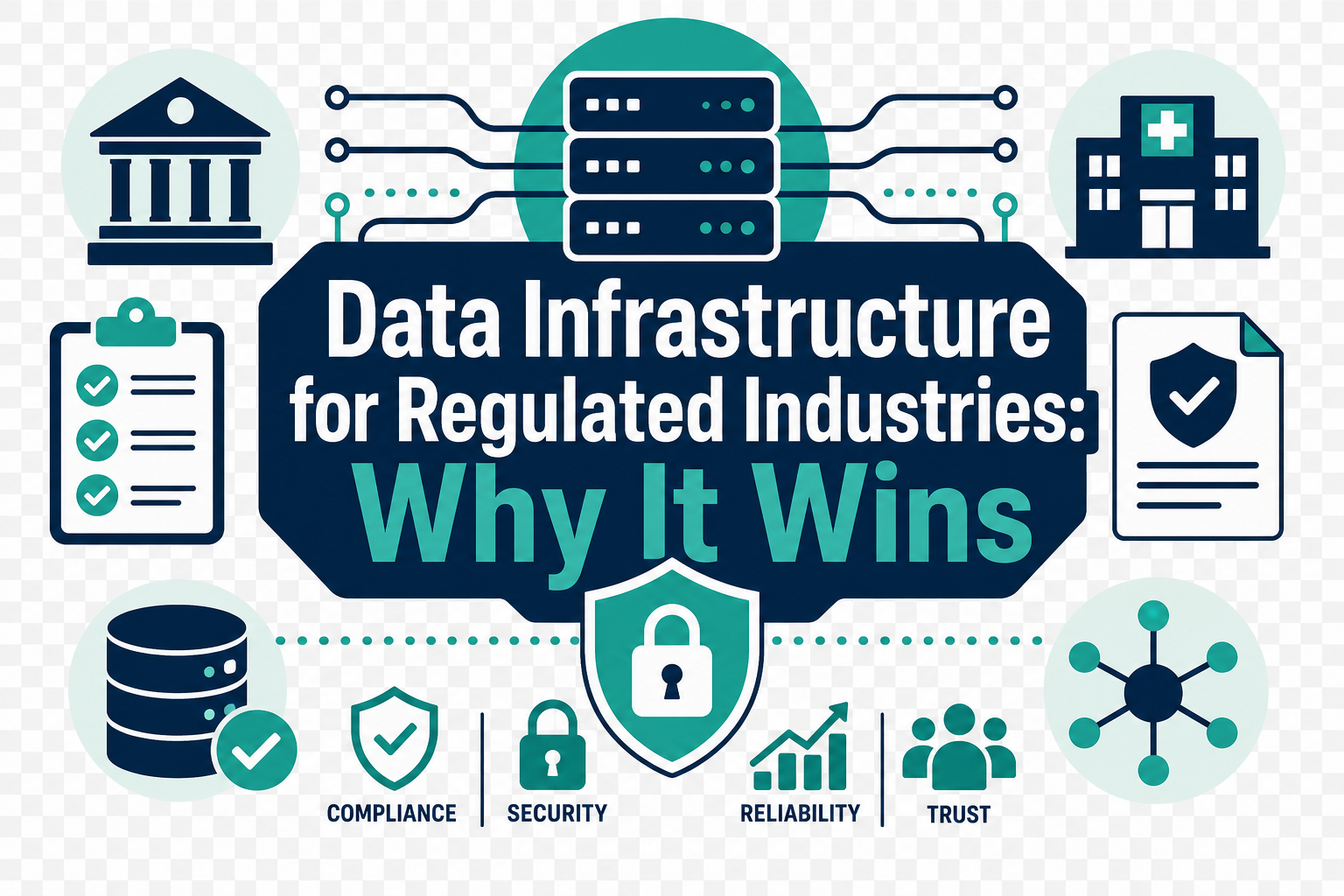
Regulated businesses are under pressure from every direction at once. Regulators are tightening identity, privacy, and reporting requirements. Tax and margin pressure is forcing operational efficiency. Customers and policymakers expect genuine duty of care, not checkbox compliance. And every executive team is being told to move fast on AI.
These pressures look different on the surface, but they share a single root cause: fragmented, siloed data. Customer records scattered across dozens of systems. Compliance workflows held together by manual processes. AI initiatives built on data nobody trusts.
This post breaks down the four defining data challenges facing regulated industries — financial services, insurance, healthcare, gaming, and beyond — and makes the case for why master data management, API-led integration, and AI governance have become the most strategic investments a regulated business can make.
Quick Answer
Data infrastructure — the combination of master data management (MDM), API-led integration, and AI governance — is the foundation that lets regulated organizations know their customers completely, comply with confidence, operate efficiently, and adopt AI safely. It matters most for compliance, risk, and technology leaders in regulated industries who are deciding where to invest next. This guide explains the four pressures making data infrastructure urgent, the technologies that solve them (Informatica MDM and MuleSoft API-led connectivity), and how Vantage Point implements these platforms alongside Salesforce and HubSpot.
TL;DR
- What it is: Data infrastructure is the unified layer of master data management, integration, and governance that connects every system into a trusted, auditable view of the customer.
- Why it matters: Regulators now expect a single customer view, automated GDPR erasure, and proactive duty of care — none of which fragmented systems can deliver.
- The technology answer: Informatica MDM for a single source of truth, MuleSoft for API-led connectivity, and MuleSoft Agent Fabric with Omni Gateway for AI governance and LLM cost control.
- The ROI case: Forrester research shows a 426% three-year ROI from API-led connectivity, while industry research shows poor data quality is the top barrier to AI returns.
- How Vantage Point helps: We design and implement integration and data migration architectures and compliance solutions for regulated organizations on Salesforce and HubSpot.
What Is Data Infrastructure in Regulated Industries?
Data infrastructure is the connected layer of systems, APIs, and governance that gives an organization one accurate, real-time, auditable view of its customers and operations. In a regulated industry, it is what turns compliance from a manual scramble into an automated, provable process.
For a bank, insurer, healthcare provider, or gaming operator, customer data rarely lives in one place. It is spread across CRM platforms, core systems, payment processors, marketing tools, data warehouses, and legacy databases. Data infrastructure is what makes those systems behave like one.
Why Data Infrastructure Matters in 2026
Three forces have converged to make data infrastructure a board-level issue:
- Regulators have raised the bar. Supervisory bodies now expect organizations to identify duplicate customer accounts, honor erasure requests across every system, and demonstrate proactive — not reactive — customer protection.
- Margins are under structural pressure. Rising tax burdens and compliance costs mean regulated businesses must do more with less, which is impossible when teams manually reconcile data across disconnected systems.
- AI has raised the stakes. AI models querying fragmented, duplicate-riddled data produce unreliable — sometimes harmful — outputs. Without trusted data foundations, AI investment is "garbage in, garbage out."
The Four Data Challenges Facing Regulated Industries
1. Regulatory Tightening: KYC, AML, and the Single Customer View
Know Your Customer (KYC) and Anti-Money Laundering (AML) enforcement is intensifying across regulated sectors, with individual enforcement actions routinely reaching into the millions. A critical and often underappreciated requirement: organizations must identify and link separate accounts held by the same individual.
This is harder than it sounds. Customers register across multiple product lines and channels, creating duplicate records that legacy systems treat as distinct people. The consequences are serious — in gaming, a self-excluded customer can simply re-register on another product line; in financial services, AML risk gets assessed at the account level instead of the entity level. Compliance looks good on paper and fails in practice.
2. GDPR and the Right to Erasure: A Technical Minefield
GDPR Article 17 — the right to be forgotten — obligates organizations to erase a customer's personal data on request, notify third parties who received it, and do so within a one-month window. Regulators have ruled that device data combined with personal identifiers counts as personal data, so an erasure request can legitimately extend to IP logs, device fingerprints, and behavioral tracking across every system.
Without an automated map of where customer data lives, organizations face two bad options: manual hunts that risk missing data, or blanket deletion that destroys records they are legally required to retain for AML and other obligations. European regulators have already levied fines of €600,000 in landmark right-to-erasure cases.
3. Margin Pressure: The Operational Efficiency Mandate
Regulated industries are absorbing structural cost shocks. The UK gaming sector is a vivid example: Remote Gaming Duty rose from 21% to 40% in April 2026, with General Betting Duty rising from 15% to 25% in April 2027. Financial services, insurance, and healthcare face their own versions — rising compliance costs, capital requirements, and reimbursement pressure.
The only viable response is doing more with less: rationalizing legacy systems, eliminating duplicated processes and manual compliance workflows, lowering the cost of data management and reporting, and reducing time-to-market for new products. That requires infrastructure agile enough to absorb the next regulatory change without a bespoke development program every time.
4. Duty of Care: From Tick-Box Compliance to Proactive Protection
Regulators increasingly expect proactive, data-driven harm prevention. In gaming, that means detecting escalating session lengths and loss-chasing patterns in real time. In financial services, it means suitability and vulnerability checks. In healthcare, it means complete patient context at the point of care.
Effective duty of care requires exactly what KYC, AML, and GDPR compliance require: a complete, real-time, cross-system view of the customer. Without it, exclusion flags set in one system are invisible to others, limits don't carry across products, and behavioral triggers never reach safeguarding teams.
| Challenge | Data requirement | Enabling technology |
|---|---|---|
| KYC/AML and duplicate accounts | Single, authoritative customer record across all systems | Informatica MDM |
| GDPR right to erasure | Complete data catalog and automated erasure workflows | Informatica Data Privacy Management |
| Margin and tax pressure | Reusable APIs replacing point-to-point integrations | MuleSoft Anypoint Platform |
| Duty of care | Real-time, cross-system behavioral data | MuleSoft event-driven integration + MDM |
| AI adoption | Governed, cost-controlled, observable AI traffic | MuleSoft Agent Fabric + Omni Gateway |
The Technology Answer: MDM, API-Led Integration, and AI Governance
Three disciplines solve these challenges simultaneously: Master Data Management creates the single source of truth, API-led integration connects every system to it in real time, and AI governance ensures the AI built on top is controlled, observable, and cost-effective. None is a silver bullet — but together they are the foundation everything else depends on.
Informatica: Building the Single Source of Truth
Informatica's Intelligent Data Management Cloud (IDMC) is purpose-built for complex, multi-system data environments.
Single customer view and duplicate detection. Informatica MDM creates one authoritative master record per customer by ingesting data from every system of record and applying probabilistic matching — identifying the same person through combinations of device fingerprints, address history, payment methods, and behavioral patterns rather than easily defeated exact-match checks. The result: exclusion lists and limits enforced consistently, AML red flags triggered at the entity level, and a genuine 360-degree customer view that supports both compliance and personalization.
Automated GDPR data discovery and erasure. Informatica's data privacy capabilities build a comprehensive catalog of where every piece of customer data lives. When an erasure request arrives, an automated workflow identifies every instance across connected systems, applies retention rules to separate what must be kept from what must be erased, executes deletion or anonymization, and generates a complete audit trail. A labor-intensive, high-risk manual process becomes governed, repeatable, and auditable. See Informatica's master data governance framework for the underlying methodology.
Data quality for regulatory reporting. Informatica Data Quality ensures data flowing into regulatory reports meets defined thresholds before it is used — automated profiling, cleansing, and validation catch errors at the source rather than downstream.
MuleSoft: The Integration Layer That Connects Everything
Informatica solves the data problem. MuleSoft solves the connectivity problem — because even the best data platform is only as good as its ability to reach the systems where data lives.
API-led connectivity for compliance automation. MuleSoft's Anypoint Platform builds a reusable API layer that abstracts underlying system complexity. When a customer registers, a single real-time API call can simultaneously query the MDM platform for existing matches, third-party identity verification services, exclusion registers, and internal fraud databases — instead of overnight batch processes that leave windows of exposure.
Legacy modernization without the "big bang." MuleSoft's approach to legacy modernization connects legacy systems to modern platforms incrementally, without replacing mission-critical systems in one high-risk program. Replacing bespoke point-to-point integrations with reusable APIs reduces IT operating expense over time — directly answering the margin-pressure challenge. We cover this pattern in depth in our guide to connecting Salesforce with legacy platforms via MuleSoft.
Real-time data for proactive interventions. With every customer touchpoint connected in real time, organizations can build event-driven architectures that trigger interventions automatically — alerting a safeguarding or compliance team the moment behavior crosses a defined threshold, regardless of which product or channel the customer is using.
The AI Governance Layer: Agent Fabric and Omni Gateway
AI adoption without data foundations fails — but even organizations with good data face a second problem: uncontrolled AI spend and ungoverned agents. Industry research shows enterprise LLM spend hit $8.4 billion by mid-2025, more than doubling in six months even as per-token costs fell. When teams negotiate their own model contracts and manage token budgets locally, the result is a fragmented, unobservable AI estate with no central cost control.
MuleSoft Agent Fabric and Omni Gateway place a single governed control plane over every AI interaction — LLM traffic, MCP tool access, and agent-to-agent communication:
- Centralized LLM cost governance — token usage, costs, and data flows across all models visible in one place, with budgets and limits enforced before runaway spend hits the invoice.
- Policy-bound agent access — existing APIs exposed to AI agents as governed tools, with scoped access instead of unrestricted keys.
- Identity propagation — user and agent identity continuously verified through every interaction via enterprise identity providers like Okta or Entra ID, supporting AI agent governance end to end.
- Full observability — security, compliance, and audit trails enforced at every step of every agent interaction.
For a deeper look at this control plane, see our post on MuleSoft Agent Fabric for enterprise AI agents.
The ROI Case for Data Infrastructure
Industry research makes the financial case clear:
- Forrester research shows a 426% ROI over three years from MuleSoft's API-led connectivity, driven by reduced development costs, faster time-to-market, and elimination of manual integration work.
- 95% of IT leaders cite difficulties connecting AI and data tools to existing systems as a top challenge, according to MuleSoft's Connectivity Benchmark Report.
- 82% of data leaders cite poor data quality as the top barrier to ROI from AI investments, per Informatica's research.
- The average organization manages 897 applications with poor integration between them — complexity that compounds cost across every team.
- Regulatory fines dwarf prevention costs. KYC/AML enforcement actions routinely run into the millions, and GDPR erasure failures have produced six-figure fines in Europe.
Framed against rising tax and compliance burdens, every dollar saved through operational efficiency and every fine avoided through better compliance has an outsized impact on the bottom line. These are not discretionary investments — they are strategic necessities. For more on this framing, read why your data foundation is now your competitive moat.
What Businesses Should Do Next
- Map your customer data. Build a catalog of where customer data lives across every system — you cannot govern what you cannot see.
- Assess duplicate exposure. Quantify how many customers exist as multiple records across product lines and channels.
- Automate one compliance workflow. Start with GDPR erasure or KYC verification — prove the model, then scale.
- Replace point-to-point integrations with reusable APIs. Prioritize the integrations that compliance workflows depend on.
- Govern AI before it governs you. Put LLM cost controls, identity propagation, and observability in place before agent deployments scale.
How Vantage Point Helps
Vantage Point is a senior-led consulting partner for Salesforce, HubSpot, MuleSoft, and the broader data ecosystem. We help regulated organizations design and implement the data infrastructure this post describes — from MDM strategy and single customer view design to API-led integration architecture and AI governance.
Our system integration and data migration services connect legacy and modern systems without big-bang risk. Our compliance and security solutions turn regulatory requirements into automated, auditable workflows. And our Salesforce implementation and advisory services ensure your CRM becomes the activation layer on top of trusted data.
If your team is evaluating how this applies to your environment, Vantage Point can help assess your data readiness and build a practical, phased implementation plan.
FAQ
What is data infrastructure in a regulated industry?
Data infrastructure is the connected layer of master data management, APIs, and governance that gives a regulated organization one accurate, real-time, auditable view of its customers. It is what allows compliance obligations — KYC, AML, GDPR, duty of care — to be met automatically rather than through manual processes.
Why do regulators require a single customer view?
Regulators require organizations to identify and link separate accounts held by the same individual so that controls like self-exclusion, AML monitoring, and affordability checks apply to the person, not just one account. Without master data management, duplicate records across product lines make this impossible to enforce consistently.
How does master data management help with GDPR erasure requests?
MDM and data privacy tools build a complete catalog of where each customer's data lives across every system. When an erasure request arrives, automated workflows locate every instance, apply legal retention rules, execute deletion or anonymization, and generate an audit trail — replacing error-prone manual searches.
What is API-led connectivity?
API-led connectivity is an integration approach, pioneered by MuleSoft, that exposes data and processes from any system through reusable, governed APIs instead of bespoke point-to-point integrations. Compliance workflows can then query any system in real time, and new regulatory requirements can be met by composing existing APIs rather than building new integrations.
How do you control enterprise LLM and AI agent costs?
Centralize AI traffic through a governed gateway such as MuleSoft Omni Gateway. This makes token usage and costs visible across all models in one place, enforces budgets and token limits, and gives agents policy-bound, identity-verified access to enterprise systems — preventing the fragmented, unobservable AI spend that industry research shows is compounding across enterprises.
Is data infrastructure only relevant to gaming and betting companies?
No. Gaming is a sharp example because of its recent tax and regulatory shocks, but the same four pressures — KYC/AML, data privacy, margin pressure, and duty of care — apply across financial services, insurance, healthcare, and any regulated sector. The technology answer is the same in each case.
How long does it take to build a data infrastructure foundation?
A phased approach typically starts delivering value within months: begin with a data catalog and one automated compliance workflow, then expand MDM matching and API coverage incrementally. Legacy modernization through APIs avoids the risk and timeline of a big-bang platform replacement. Vantage Point builds these programs in phases so compliance wins land early.
Ready to make data infrastructure your competitive advantage? Talk to Vantage Point about a data readiness assessment covering master data, integration architecture, and AI governance.
Resources
- Informatica: Master Data Governance Framework
- MuleSoft: API-Led Integration
- MuleSoft: Legacy Modernization
- MuleSoft: AI Gateway and Agent Governance
- MuleSoft: Connectivity Benchmark Report
- Informatica: Scale AI With Data You Can Trust
- Vantage Point: Why Your Data Foundation Is Now Your Competitive Moat
- Vantage Point: MuleSoft Agent Fabric — The Control Plane for Enterprise AI Agents
Vantage Point is a boutique CRM consulting firm helping businesses transform with Salesforce, HubSpot, and AI. Our senior-only, US-based team has delivered 400+ engagements for 150+ clients with an average rating of 4.71/5.0. Learn more at vantagepoint.io.