Key Takeaways (TL;DR)
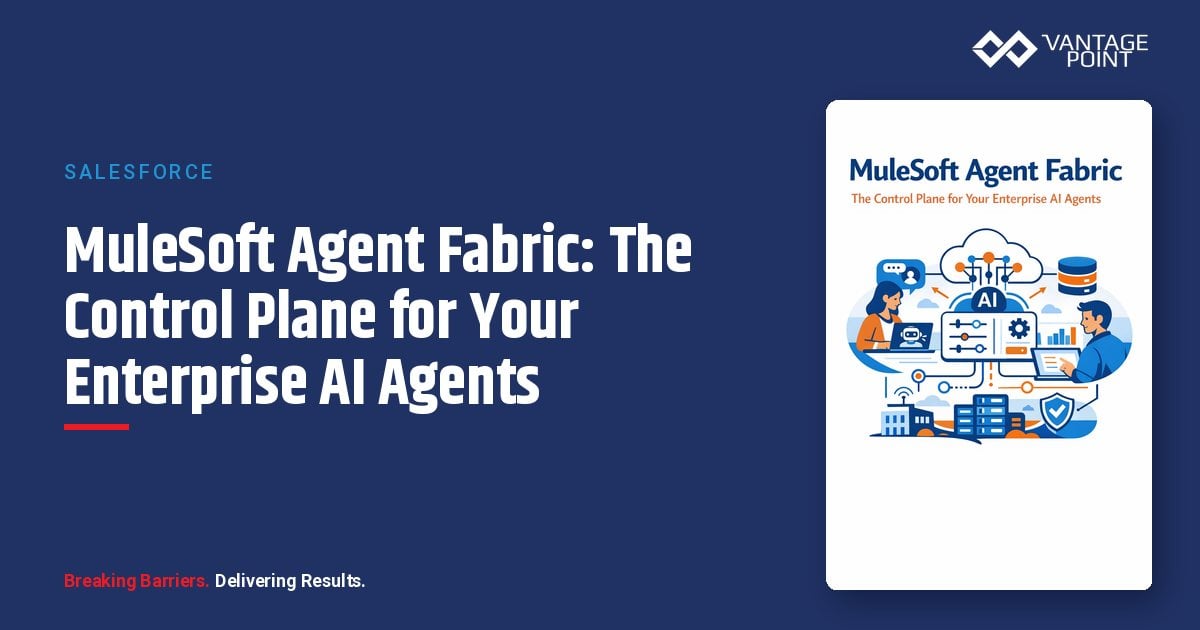
- What is MuleSoft Agent Fabric? A Salesforce and MuleSoft approach for discovering, orchestrating, governing, and observing AI agents and agent-ready services across the enterprise.
- Key Benefit: Teams gain a control plane for reducing agent sprawl, securing access, and coordinating AI actions across systems.
- Requirements: API strategy, identity and access controls, integration governance, observability, and clear agent ownership.
- Timeline: A readiness assessment and first governed agent workflow can often be scoped in 4-8 weeks, with broader rollout phased by business domain.
- Best For: Organizations building multiple AI agents across CRM, service, operations, data, and internal productivity workflows.
- Bottom Line: As AI agents multiply, the winning architecture is not more isolated bots; it is governed orchestration.
Meta Description: MuleSoft Agent Fabric helps organizations discover, orchestrate, govern, and observe enterprise AI agents across systems and workflows.
Why enterprises need an AI-agent control plane
AI agents are moving from demos into real business workflows. Teams are experimenting with agents for service resolution, sales support, knowledge search, onboarding, operations, analytics, and employee productivity. That momentum is useful, but it creates a new problem: agent sprawl.
If every team builds agents independently, organizations can quickly lose track of what agents exist, what systems they access, what actions they can perform, how they are monitored, and who owns the outcome. MuleSoft Agent Fabric is designed to address that challenge by creating a governed way to discover, orchestrate, secure, and observe agents and agent-ready capabilities.
For business and IT leaders, the strategic question is clear: how do we let teams innovate with AI while maintaining control over enterprise data, workflows, and risk?
What is MuleSoft Agent Fabric?
MuleSoft Agent Fabric is a control-plane concept for the agentic enterprise. It helps organizations coordinate AI agents, APIs, tools, and workflows so agent activity can be governed rather than scattered. Public Salesforce and MuleSoft materials describe capabilities around agent discovery, orchestration, governance, observability, and support for patterns such as Model Context Protocol (MCP) and agent-to-agent coordination.
In practical terms, Agent Fabric can help answer:
- What agents exist across the organization?
- Which tools, APIs, and data sources can they access?
- Which agent should handle a task?
- How are agent actions authenticated and governed?
- How can teams monitor performance, errors, and usage?
- How do we expose existing APIs and workflows to agents safely?
The value is not just technical. It gives leaders a way to manage AI adoption responsibly.
What problems does Agent Fabric solve?
| Enterprise challenge | How an agent control plane helps |
|---|---|
| Agent sprawl | Creates a registry and ownership model for agents and tools |
| Unclear access | Applies identity, permission, and policy controls |
| Duplicated work | Enables reuse of APIs, actions, and agent capabilities |
| Inconsistent orchestration | Routes tasks to appropriate agents and workflows |
| Limited visibility | Provides observability into usage, failures, and outcomes |
| Risky integrations | Uses governed APIs and MCP-enabled services instead of ad hoc connections |
| Scaling pilots | Moves agent work from experimentation to enterprise operations |
The control plane becomes more important as agents move from answering questions to taking actions.
How does MCP fit with MuleSoft Agent Fabric?
Model Context Protocol (MCP) is an open standard for connecting AI applications to tools and data sources. MuleSoft's role in the architecture is to help expose enterprise capabilities in a governed way. Instead of hard-coding every agent to every system, organizations can make APIs, workflows, and data access available through controlled interfaces.
That matters because AI agents need context and tools. A service agent may need to look up customer history, create a case, check an entitlement, and trigger a follow-up. A sales agent may need to summarize account activity, update an opportunity, and recommend next steps. MCP-style patterns can help standardize how those agents connect, while MuleSoft governance helps keep access secure and observable.
What does a reference architecture look like?
A practical Agent Fabric architecture includes:
- Agent registry: Inventory of approved agents, owners, purposes, environments, and risk levels.
- Tool and API registry: Governed catalog of APIs, workflows, prompts, and MCP-enabled tools.
- Identity and policy layer: Authentication, authorization, consent, data boundaries, and audit rules.
- Orchestration layer: Routing logic that determines which agent or workflow handles a task.
- Observability layer: Logs, usage metrics, failures, latency, cost, quality signals, and exception handling.
- Human oversight: Review queues, approval workflows, escalation paths, and operating procedures.
- CRM and data context: Salesforce, HubSpot, Data Cloud, knowledge bases, and operational data sources.
The architecture should start small, but it should be designed to scale.
What should leaders do before adopting Agent Fabric?
Before implementing an agent control plane, complete a readiness assessment:
- Inventory current AI experiments and agent pilots.
- Identify systems agents are already accessing or requesting access to.
- Define agent ownership and support responsibilities.
- Review API maturity and integration governance.
- Classify use cases by risk: recommend, draft, update, transact, or escalate.
- Define approval requirements for agent actions.
- Establish logging and monitoring expectations.
- Choose one business workflow where governed agent orchestration would create measurable value.
Readiness work prevents the control plane from becoming another unused platform layer.
Best practices for MuleSoft Agent Fabric programs
- Treat agents as enterprise assets. Give each one an owner, purpose, scope, and lifecycle.
- Use governed APIs. Avoid one-off credentials and direct database access.
- Start with low-risk actions. Recommendations and drafts are easier to govern than transactions.
- Build observability early. You cannot govern what you cannot see.
- Create reusable tools. Design APIs and MCP servers for reuse across agents.
- Align business and IT. Agent orchestration affects customer experience, operations, security, and data governance.
- Plan for exception handling. Every agent workflow needs a human fallback.
How Vantage Point helps
Vantage Point helps organizations plan and implement governed AI-agent architectures across Salesforce, MuleSoft, Data Cloud, HubSpot, Claude AI, and workflow automation platforms. We can help assess agent readiness, design an API and MCP strategy, define governance, configure CRM workflows, and launch a controlled first agent use case.
FAQ
Is MuleSoft Agent Fabric only for Salesforce environments?
No. The value of MuleSoft Agent Fabric is strongest when agents need to coordinate across multiple systems, including Salesforce, HubSpot, data platforms, communication tools, and operational applications.
What is agent sprawl?
Agent sprawl happens when teams create many AI agents without shared governance, ownership, monitoring, or integration standards. It increases risk and reduces reuse.
Does Agent Fabric replace APIs?
No. APIs remain essential. Agent Fabric helps make APIs and tools discoverable, governable, and usable by agents in a more coordinated way.
How is MCP related to Agent Fabric?
MCP helps standardize how AI applications connect to tools and data. Agent Fabric can govern, register, expose, orchestrate, and observe those agent-ready capabilities.
What is a good first use case?
Choose a workflow that is valuable, bounded, and observable, such as service case triage, account research, onboarding task coordination, or internal knowledge assistance.
What governance roles are needed?
Most programs need business owners, integration architects, security stakeholders, CRM administrators, data stewards, and support owners for each agent workflow.
Conclusion
MuleSoft Agent Fabric points to a practical future for enterprise AI: many agents, many tools, but one governed approach to discovery, orchestration, access, and observability.
If your organization is moving from AI pilots to production agent workflows, Vantage Point can help you design the control plane, integration foundation, and governance model needed to scale safely.
About Vantage Point
Vantage Point helps organizations modernize CRM, automation, integration, analytics, and AI across Salesforce, HubSpot, MuleSoft, Data Cloud, Anthropic Claude, Aircall, and Workato. We design practical systems that improve visibility, reduce manual work, and help teams serve clients more effectively.