
Quick answer: Lifecycle stages describe where a contact or company sits in their overall journey with your business — from subscriber to customer and beyond. Deal stages describe where a single sales opportunity sits in one pipeline, from first meeting to closed-won or closed-lost. They are related but not interchangeable: a company has one lifecycle stage at a time, but can have many deals in different stages at once. Most HubSpot reporting confusion comes from teams treating these two properties as the same thing.
If your funnel reports never match your pipeline reports, or a "customer" keeps showing up in lead-nurture emails, the root cause is usually a muddled relationship between these two properties. Here's how to configure both so your revenue reporting holds together.
What are lifecycle stages in HubSpot?
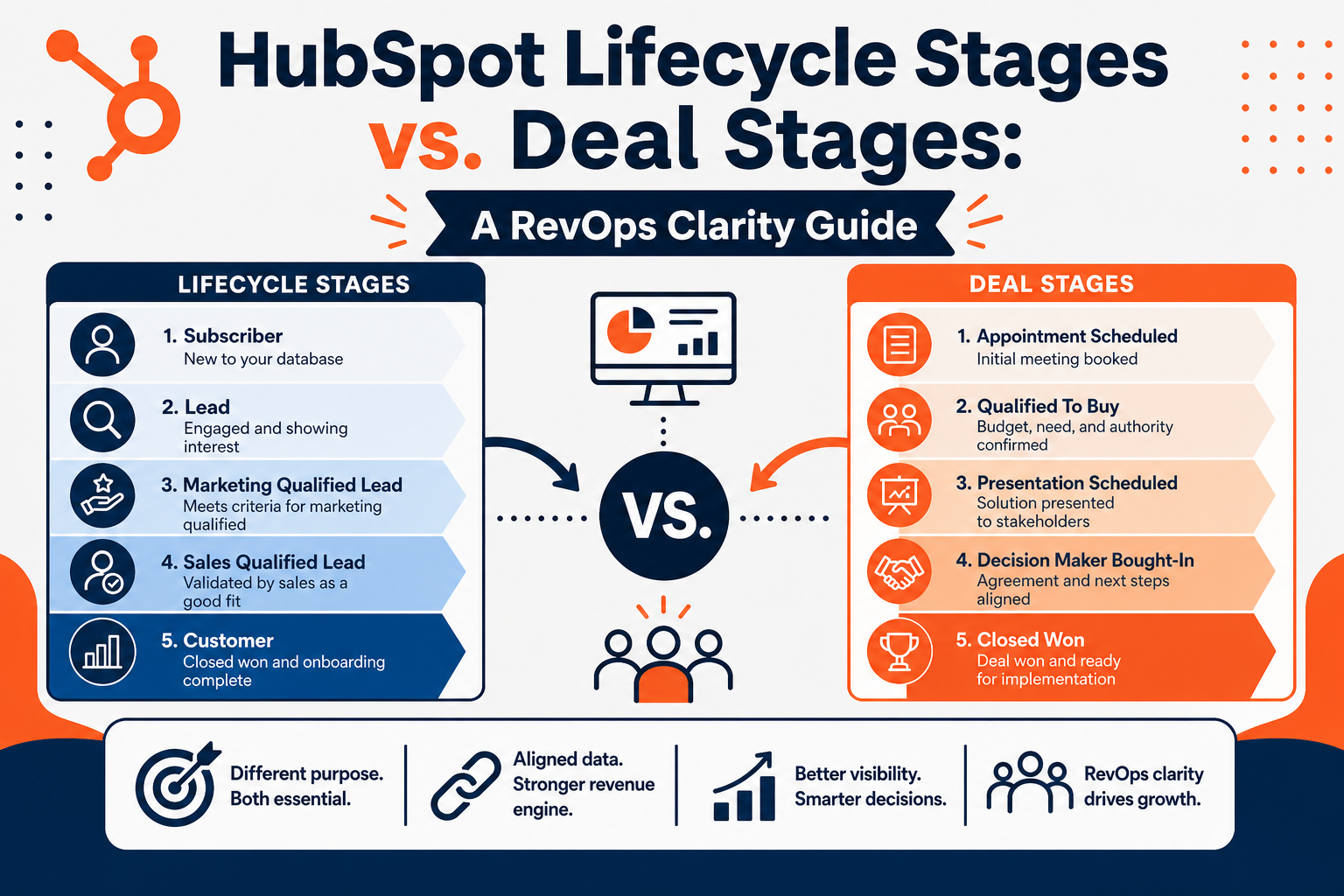
Lifecycle stage is a default property on both contact and company records. It answers a single question: how far has this person or organization progressed in their relationship with us? Per HubSpot's knowledge base, the default stages are:
- Subscriber — opted in to hear from you (blog, newsletter)
- Lead — converted beyond a simple subscription
- Marketing Qualified Lead (MQL) — marketing has qualified them as sales-ready
- Sales Qualified Lead (SQL) — sales has qualified them as a potential customer
- Opportunity — associated with an open deal
- Customer — has at least one closed-won deal
- Evangelist — a customer who advocates for you
- Other — doesn't fit the model (partners, vendors, competitors)
Two things matter for RevOps. First, lifecycle stage moves forward — it represents the furthest point reached in the relationship. Second, HubSpot can automate key transitions: deal association can advance the stage to Opportunity, and a closed-won deal can advance it to Customer.
What are deal stages in HubSpot?
Deal stages live on deal records and describe the progress of one specific sale inside a pipeline. HubSpot's default sales pipeline ships with seven stages, each with a win probability: Appointment scheduled (20%), Qualified to buy (40%), Presentation scheduled (60%), Decision maker bought-in (80%), Contract sent (90%), Closed won (100%), and Closed lost (0%), per HubSpot's pipeline documentation.
Nearly every team customizes these. Good deal stages share three traits:
- They reflect verifiable buyer actions ("proposal reviewed with decision maker"), not seller hopes ("looking good").
- Each stage has clear entry and exit criteria any rep could apply consistently.
- The stage probabilities roughly match your historical conversion rates, so weighted forecasts mean something.
What is the real difference between the two?
The cleanest way to think about it: lifecycle stage tracks the relationship, deal stage tracks the transaction. One is about a person or company; the other is about a discrete revenue event.
| Lifecycle stage | Deal stage | |
|---|---|---|
| Lives on | Contacts and companies | Deals |
| Describes | Overall journey with your business | Progress of one specific sale |
| How many at once | One per record | One per deal — but a company can have many deals |
| Typical owner | Marketing + RevOps (definitions), automation (movement) | Sales reps and sales management |
| Direction | Generally forward-only | Forward, or straight to closed-lost |
| Powers | Funnel conversion and segmentation reporting | Pipeline, forecast, and velocity reporting |
How do lifecycle stages and deal stages interact?
They touch at exactly two points, and understanding those keeps the model clean:
- Deal creation. When a contact or company is associated with a deal, HubSpot can automatically set the lifecycle stage to Opportunity. This is a one-way nudge — the deal tells the lifecycle "a sale is in motion."
- Deal closed-won. When any associated deal is marked won, the lifecycle stage can automatically advance to Customer.
Notice what is not on that list: intermediate deal movement. A deal advancing from "Qualified to buy" to "Contract sent" should not change anyone's lifecycle stage — the relationship status hasn't changed, only the transaction's progress. Likewise, a closed-lost deal does not demote a Customer back to Lead; if they've bought before, they're still a customer.
The complementary case matters too: when an existing Customer opens an expansion deal, their lifecycle stage stays Customer — it doesn't regress to Opportunity — while the new deal moves through its own stages. This is why cross-sell reporting should be built on deals, not lifecycle stage.
Which misconfigurations cause the most damage?
After enough HubSpot audits, the same patterns show up repeatedly:
- Syncing lifecycle stage to every deal movement. Workflows that map each deal stage to a lifecycle value destroy funnel reporting — lifecycle dates get overwritten and conversion metrics become meaningless.
- Custom lifecycle sprawl. HubSpot allows custom lifecycle stages, and some teams add eight or ten. Every added stage needs a definition, an owner, and automation; most portals are better served by lead status for sales-process granularity.
- Skipped-stage blindness. If a contact jumps from Lead straight to Customer, the "became an MQL/SQL" date properties never populate, and stage-to-stage conversion reports quietly undercount. Decide deliberately whether records should pass through every stage.
- Using deal stages as a to-do list. Stages like "Send follow-up email" describe rep tasks, not buyer progress. Tasks belong in tasks; stages belong to the buying process.
- Nobody owns closed-lost hygiene. Deals parked in an active stage for 200 days inflate pipeline and erode forecast trust.
What reporting does each property enable?
Get the separation right and two distinct, trustworthy reporting layers emerge.
Lifecycle stage reporting answers demand questions: How many MQLs did we create this quarter? What's our MQL-to-SQL conversion rate? How long does it take a lead to become a customer? Which channels produce contacts who actually close? It also drives segmentation — suppressing customers from acquisition campaigns, targeting evangelists for referrals.
Deal stage reporting answers revenue questions: How much weighted pipeline do we have? Where do deals stall? What's our stage-by-stage win rate and average sales cycle? Structuring pipelines well is its own discipline — our guide to deal and ticket pipeline best practices covers stage design in depth, and our post on tracking revenue from pipeline through closed-won and recurring shows how deal data feeds full revenue reporting.
How should you set both up? A worked example
Consider one company, Acme Logistics, with two concurrent deals: a new-business deal for its distribution division and a smaller services deal for its fleet group.
- Acme's operations director downloads a whitepaper → lifecycle stage Lead.
- Lead scoring threshold crossed → workflow sets MQL; sales accepts and qualifies → SQL.
- The rep creates Deal 1 → lifecycle stage advances to Opportunity. Deal 1 sits at "Qualified to buy."
- A second rep opens Deal 2 for the fleet group. Lifecycle stage stays Opportunity — it's already there. Deal 2 progresses independently.
- Deal 2 closes won → lifecycle stage advances to Customer. Deal 1 is still open at "Contract sent."
- Deal 1 later closes lost. Lifecycle stage remains Customer — Acme still bought something.
Every question stays answerable: funnel reports show one company converting Lead → Customer once; pipeline reports show two deals with different outcomes. Nothing double-counts.
Setup best practices: document a one-line definition and owner for each lifecycle stage; use HubSpot's automatic Opportunity/Customer transitions rather than rebuilding them in workflows; use lead status for sales-process substates; and review deal stage definitions with the sales team quarterly.
Frequently asked questions
Can a contact have a lifecycle stage without any deal?
Yes — and most do. Subscriber, Lead, MQL, and SQL all describe pre-deal relationship states; deals typically enter at the Opportunity stage. That's precisely why you need both properties: lifecycle stage covers the long stretch of the journey where no deal exists yet.
Should lifecycle stage ever move backward?
HubSpot's model treats lifecycle stage as forward-moving. Some teams deliberately reset stages — for example, moving a disqualified MQL back to Lead for re-nurturing. If you do, use a documented workflow, and remember that clearing a stage can affect the date properties your conversion reports depend on. Many teams prefer marking disqualification in lead status instead.
What is the difference between lead status and lifecycle stage?
Lead status is a sub-state that adds working detail inside the MQL/SQL portion of the journey — values like "attempting contact," "connected," or "unqualified." Lifecycle stage is the macro journey; lead status is the sales team's working view within it. Teams that cram sales-process detail into custom lifecycle stages usually should have used lead status.
Do deal stage probabilities affect anything besides labels?
Yes. Each stage's win probability drives weighted pipeline and forecast calculations in HubSpot's forecasting and reporting tools. If your "Qualified to buy" stage is set at 40% but historically only 15% of those deals close, your weighted forecast will consistently overstate revenue. Calibrate probabilities against your actual conversion data at least once a year.
Should companies and contacts share the same lifecycle stage?
HubSpot can sync lifecycle stage between contacts and their associated company, and for most B2B teams that's the right default — the company's stage reflects the furthest-progressed contact. Review the sync settings carefully if you sell to multiple independent buying groups within one large organization, where a single company-level stage can obscure what's happening in each group.
How Vantage Point helps
Lifecycle and deal stage architecture sounds simple until three teams, two migrations, and five years of workflows have layered assumptions on top of it. Vantage Point's CRM and marketing automation practice helps mid-market teams audit their lifecycle model, redesign pipelines around verifiable buyer actions, and rebuild the reporting layer executives actually trust. Senior consultants only — no junior handoffs; the experts you meet are the experts who deliver. If your funnel and pipeline numbers tell two different stories, a short diagnostic usually finds the disconnect quickly.