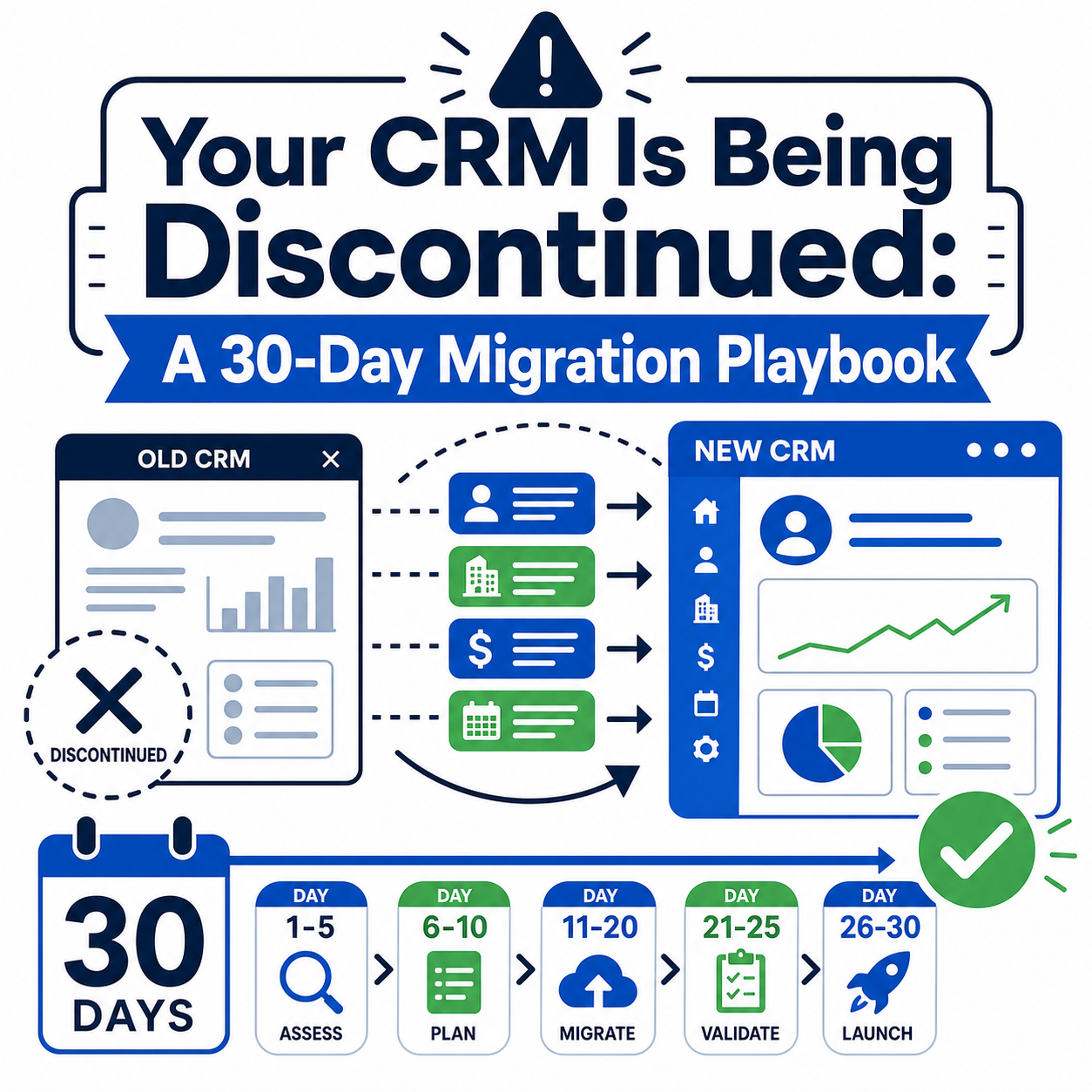
Most growing companies don't decide to fragment the customer journey. It happens one tool at a time. You buy a CRM for sales, a support desk for tickets, a dedicated customer success platform for health scores and renewals, a survey tool for CSAT, a project tool for onboarding, and a BI tool to make sense of all of it. Each one solves a real problem on the day you buy it.
A few years later, the customer lifecycle lives in five or six systems, each with its own data model, integrations, licensing, admins, and security reviews. Simple questions get hard to answer: Which accounts are at renewal risk? Which implementations are running late? Which low-CSAT customers have a renewal in the next 90 days?
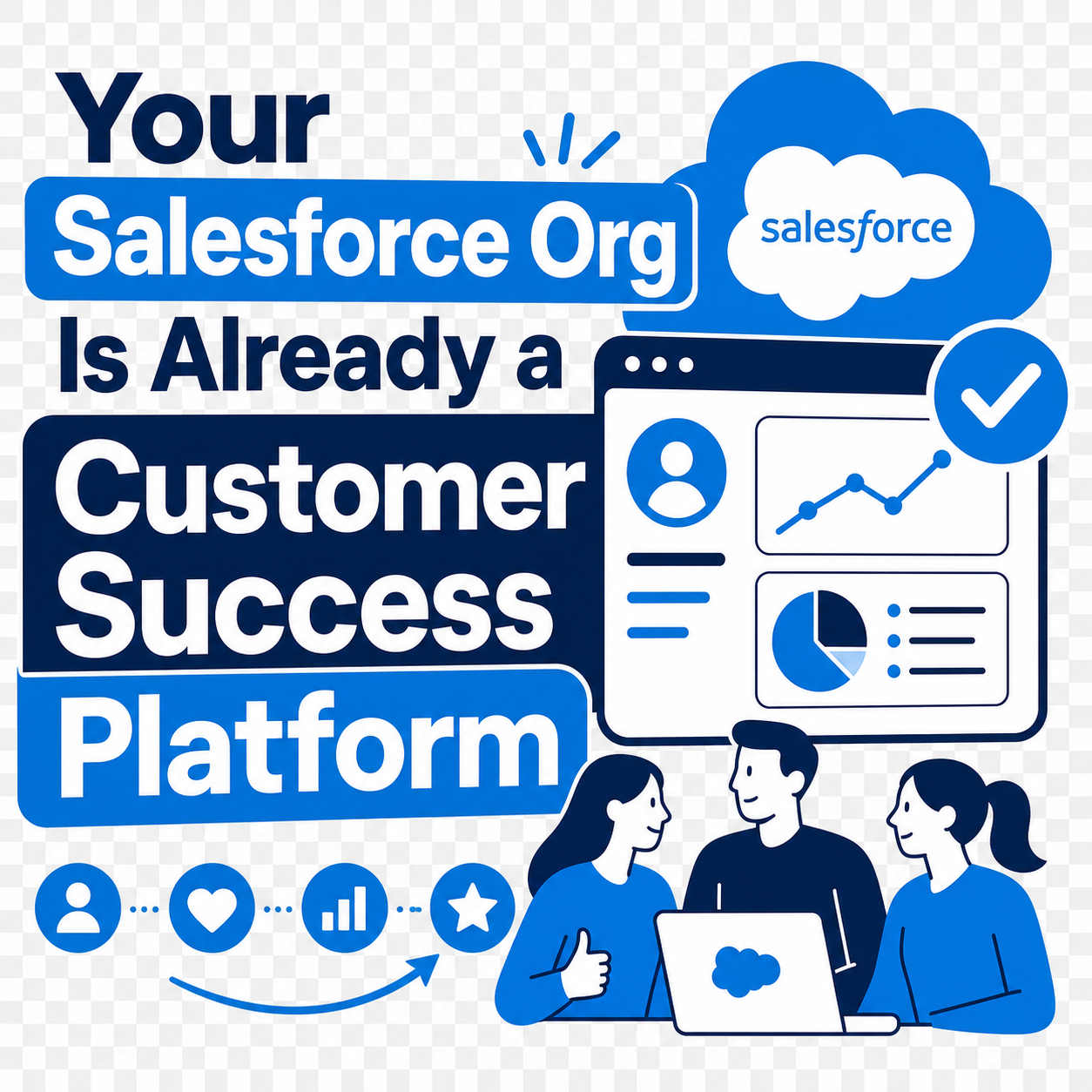
Here's the part most teams miss. Salesforce, the system you almost certainly already own, is already the system of record for the customer relationship. Leads, opportunities, accounts, contacts, contracts, and renewals already live there. Many customer success capabilities can run on that same platform with thoughtful configuration. Before you buy another platform, it's worth mapping what your Salesforce org can already do.
Quick Answer
Salesforce can serve as your customer success platform because the customer relationship (accounts, contacts, contracts, and renewals) already lives there. Health scoring, success plans, onboarding, renewal management, CSAT, executive dashboards, customer analytics, and customer portals can be delivered natively with custom objects, Flow, Service Cloud, Salesforce Surveys, CRM Analytics, and Experience Cloud. This matters for mid-market and growing tech companies whose customer data is fragmented across too many tools. It supports one specific decision: whether to buy another platform or configure the one you already own. Vantage Point helps teams map existing Salesforce capabilities and design the data model, automation, and governance to consolidate well: not just consolidate fast.
TL;DR
- What it is: Running customer success (health, onboarding, renewals, CSAT, and reporting) inside the Salesforce platform you already own, instead of a separate CS tool.
- Why it matters: Every extra platform adds licensing, integrations, duplicate records, sync issues, training, and vendor overhead that can quietly exceed the subscription itself.
- Best for: Mid-market and growing tech companies with a fragmented stack and hard-to-answer renewal and risk questions.
- Decision point: Don't ask "is this CS tool good?" Ask "does it duplicate something we already own in Salesforce?"
- How Vantage Point helps: Our senior consultants run a Salesforce implementation and advisory assessment to map native capabilities before you sign another contract.
What Does "Salesforce as a Customer Success Platform" Mean?
It means delivering customer success workflows on the Salesforce platform rather than in a standalone CS tool. Salesforce already holds the relationship data: accounts, contacts, opportunities, contracts, and renewal dates. Customer success is mostly about acting on that data: tracking health, driving onboarding, managing renewals, capturing satisfaction, and giving leaders visibility.
The point is not "never buy software." Specialized tools earn their place when they do something the platform genuinely can't. The point is narrower and more practical: don't buy software that duplicates capabilities you already own.
Why Stack Fragmentation Quietly Gets Expensive
The subscription price on the order form is the smallest part of the cost. The real cost shows up over the following years.
- Integration projects. Every new platform needs to sync with Salesforce. That's a build, then ongoing maintenance every time either side changes.
- Duplicate records and sync drift. The same account exists in three systems with three slightly different versions of the truth.
- Fragmented reporting. Renewal data here, health scores there, support trends somewhere else, so leadership can't answer cross-cutting questions without a manual export.
- Admin and licensing overhead. More seats, more admins, more configuration to keep in step.
- Training and adoption. Every tool is one more login, one more workflow, and one more reason a CSM updates the wrong system.
- Security and vendor management. Each platform is another security review, data processing agreement, and renewal negotiation.
Stacked over a few years, that overhead can exceed the original subscription. Worst of all, fragmenting customer success data away from the CRM makes the simplest questions, who is at renewal risk?: the hardest to answer.
What Salesforce Can Already Do for Customer Success
These are realistic native capabilities. None of them are automatic, each takes deliberate design, but they don't require a separate platform.
| Customer Success need | How Salesforce can deliver it natively |
|---|---|
| Onboarding & implementation | Cases, custom objects, Flow, and task management to run repeatable onboarding plans tied to the account |
| Health scoring & risk | Custom objects, formula fields, and automation to roll usage, support, and engagement signals into a health indicator |
| Success plans & adoption reviews | Custom objects and activities to track goals, milestones, QBRs, and adoption checkpoints against each account |
| Renewal management | Opportunities, contracts, and renewal activities so renewals live next to the rest of the relationship |
| Support & escalation | Service Cloud for case management, knowledge, SLAs, and escalation |
| CSAT & surveys | Salesforce Surveys tied to records, so feedback attaches to the account and contact |
| Executive dashboards | Reports and dashboards for onboarding status, health, support trends, renewal forecasts, expansion, and satisfaction |
| Customer analytics | Reports, dashboards, and CRM Analytics for deeper trend and cohort analysis |
| Customer & partner portals | Experience Cloud for self-service portals, onboarding hubs, and partner communities |
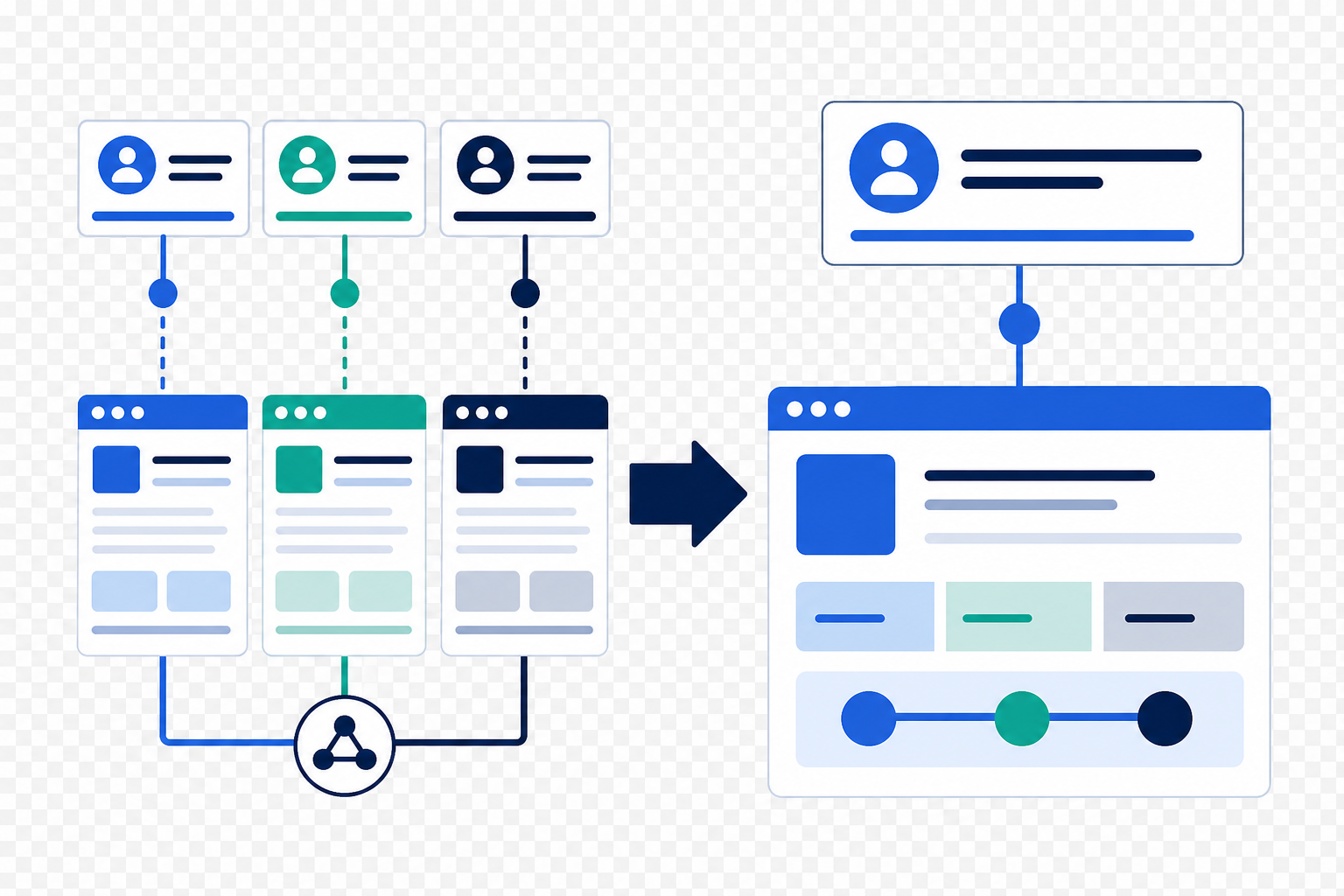
Because all of this sits on one data model, a single dashboard can finally answer the cross-cutting questions: which low-CSAT accounts have a renewal this quarter, and which of those also have an open escalation?
A Better Way to Evaluate "Should We Buy This?"
When a new CS tool lands on your desk, run it through four questions before the demo.
- What business problem are we actually solving? Name the specific gap: not the feature list.
- What already exists in Salesforce? Can custom objects, Flow, Service Cloud, Surveys, CRM Analytics, or Experience Cloud cover it with configuration?
- What is the true total cost of each path? Compare the cost to configure Salesforce against the long-term integration and maintenance cost of another platform: not just year-one license fees.
- Will leadership have better visibility with one system or many? One source of truth almost always wins for cross-functional reporting.
Build on Salesforce vs. Buy a Separate Platform
| Factor | Configure in Salesforce | Add a separate CS platform |
|---|---|---|
| Data location | Lives with accounts, renewals, and cases | Separate system; needs sync |
| Reporting | One unified model and dashboard | Cross-system joins or manual exports |
| Integration cost | None for native; some for external data | New build plus ongoing maintenance |
| Time to value | Slower if your data model needs design first | Fast demo, slower true integration |
| Best when | Capability overlaps what you already own | Tool does something the platform truly can't |
This is exactly the kind of trade-off our advisory and change management team helps leaders weigh before a purchase, not after.
The Catch: Consolidation Isn't Automatic
Consolidating customer success onto Salesforce is the right move for many teams, but "it's all in Salesforce" is not a strategy by itself. Done poorly, you simply move the mess into one system. Done well, it requires senior-led design across four areas:
- Data model. The objects, relationships, and fields that make health, renewals, and onboarding reportable rather than just storable.
- Automation. Flows and rules that keep records current without piling manual work on CSMs.
- Governance. Clear ownership, definitions, and data standards. You don't need perfect data to start, but you do need a governance plan so quality improves instead of decaying.
- Adoption. CSMs have to actually live in the system, which means designing for their workflow and managing the change.
This is the RevOps principle of a single source of truth applied to customer success, and it's where senior design separates a clean consolidation from an expensive one.
What Businesses Should Do Next
- Inventory your stack. List every tool touching the customer lifecycle and what each one actually does.
- Map overlap. Mark which of those capabilities already exist, or could exist, in Salesforce.
- Pressure-test the next purchase. Run any new CS tool through the four evaluation questions above.
- Fix the foundation first. Prioritize the Salesforce data model and governance before adding more systems on top.
- Sequence the consolidation. Move workflows over in deliberate phases, not all at once.
How Vantage Point Helps
Vantage Point is an employee-owned, mid-market Salesforce and HubSpot consultancy staffed by senior-only consultants. "Maximize what you already own" is core to how we work. We help teams get more out of their existing platform before they add another one.
Our Salesforce implementation and advisory team runs a Customer Success and RevOps consolidation assessment that maps your current stack against native Salesforce capabilities, models the true cost of build-vs-buy, and designs the data model, automation, and governance to consolidate well. When external data genuinely needs to come together, our system integration and data migration practice connects it cleanly, and our advisory and change management team drives the adoption that makes consolidation stick.
If your customer journey is spread across five or six systems, the most valuable first step is simple: before you buy another platform, let's map what your Salesforce org can already do. Talk to Vantage Point about a Salesforce Customer Success consolidation assessment.
For related reading, see how a mid-market SaaS company unified sales and customer success in Salesforce, why platform consolidation accelerated in 2026, and how a single source of truth underpins RevOps.
FAQ
Can Salesforce really replace a dedicated customer success platform?
For many mid-market teams, yes. Health scoring, success plans, onboarding, renewal management, CSAT, dashboards, and portals can all run natively using custom objects, Flow, Service Cloud, Salesforce Surveys, CRM Analytics, and Experience Cloud. A separate platform is justified only when it does something the Salesforce platform genuinely cannot.
What customer success workflows are native to Salesforce?
Onboarding via Cases and Flow, health and risk tracking via custom objects and automation, success plans and adoption reviews via custom objects and activities, renewals via opportunities and contracts, support via Service Cloud, CSAT via Salesforce Surveys, and executive reporting via dashboards and CRM Analytics. Customer and partner portals are delivered with Experience Cloud.
Won't building on Salesforce cost more than buying a tool?
Not usually, once you account for total cost. A separate platform adds integration builds, ongoing sync maintenance, duplicate records, extra licensing, training, and vendor management. Configuring capabilities you already own avoids most of that recurring overhead, though it does require upfront design.
When is buying a separate customer success platform the right call?
When the tool delivers a capability Salesforce genuinely can't, and that capability is core to your business. The test is whether it duplicates something you already own. If it does, configure Salesforce; if it truly extends the platform, a focused integration can make sense.
Do we need perfect data before consolidating customer success into Salesforce?
No. You don't need perfect data to start, but you do need a governance plan so data quality improves over time instead of decaying. Clear ownership, consistent definitions, and data standards matter more than waiting for a flawless dataset.
How does consolidating onto Salesforce improve executive visibility?
When health, onboarding, support, renewals, and satisfaction share one data model, a single dashboard can answer cross-cutting questions, like which low-CSAT accounts have an upcoming renewal and an open escalation. Fragmented systems force manual exports to answer the same question.
What's the first step to consolidating customer success onto Salesforce?
Inventory every tool in the customer lifecycle, map which capabilities already exist or could exist in Salesforce, and pressure-test any planned purchase against your existing platform. Vantage Point runs this as a structured Customer Success and RevOps consolidation assessment.