
Key Takeaways (TL;DR)
- The Challenge: A growing B2B SaaS company with ~200 employees and $30M ARR had three disconnected systems (a legacy CRM, spreadsheets for customer success, and a siloed support platform) driving churn to 15% annually.
- The Solution: Vantage Point implemented a unified Salesforce ecosystem (Sales Cloud, Service Cloud, Experience Cloud) with Einstein AI churn prediction and MuleSoft-powered billing integration: all in a phased 4-month migration.
- Key Results: 35% reduction in customer churn, 42% faster deal cycles, NPS improved from 45 to 72, and $2.1M in estimated annual savings.
- Timeline: Full deployment in 4 months with zero operational downtime.
- ROI: Achieved in 14 months, with cross-sell/upsell revenue up 28%.
Why Do Growing SaaS Companies Struggle with Disconnected Tech Stacks?
It's one of the most common, and costly, patterns in fast-growing B2B SaaS organizations. As companies scale past the startup phase, each department selects its own best-of-breed tool. Sales adopts a CRM. Customer success leans on spreadsheets or a standalone platform. Support picks a ticketing system. Finance wires up its own billing engine.
On paper, every team has what it needs. In practice, no one has the full picture.
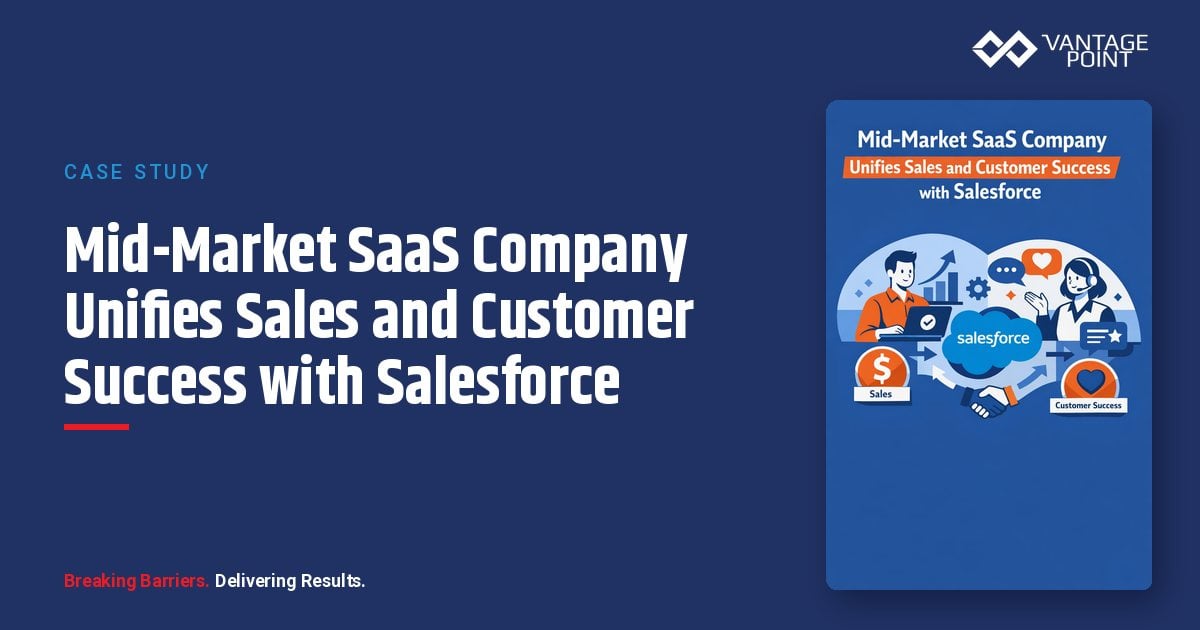
This is the story of a mid-market B2B SaaS company that found itself trapped in exactly that cycle, and how a unified Salesforce implementation orchestrated by Vantage Point transformed their revenue operations, slashed customer churn by 35%, and delivered $2.1M in estimated annual savings.
What Was the Business Challenge?
The company (approximately 200 employees with $30M in annual recurring revenue) was experiencing the symptoms that plague many organizations in high-growth mode:
- Sales relied on a legacy CRM with poor reporting and limited pipeline visibility. Forecasting was largely guesswork.
- Customer Success managed accounts through a combination of spreadsheets and a standalone customer success platform (similar to Gainsight) that had no meaningful integration with the CRM.
- Support operated on a separate ticketing platform, completely siloed from both sales and customer success data.
- Finance and billing data lived in yet another system, disconnected from all customer-facing teams.
The consequences were severe and accelerating:
| Metric | Before Engagement |
|---|---|
| Annual customer churn | 15% |
| Average sales cycle | 68 days |
| Net Promoter Score (NPS) | 45 |
| Customer health visibility | None (no unified view) |
| Cross-sell/upsell identification | Ad hoc, manual |
Net revenue retention was declining quarter over quarter. Support agents couldn't see a customer's billing status or renewal date. Sales reps had no idea whether a prospect's company was already a customer through another product line. Customer success managers were blindsided by churn because the warning signs lived in systems they couldn't access.
The company didn't have a technology problem: they had a connectivity problem. Every team had capable tools, but none of those tools talked to each other.
How Did Vantage Point Approach the Engagement?
Vantage Point's senior consultants began with a discovery phase using the firm's proprietary VALUE methodology: a structured assessment framework that maps business processes, data flows, and system interdependencies before recommending solutions.
What Did the VALUE Assessment Reveal?
The assessment uncovered six critical disconnects across the organization:
- Sales-to-Customer-Success Handoff: No automated transfer of account context, deal history, or customer expectations when deals closed.
- Support-to-Success Visibility: Support ticket volume and sentiment were invisible to customer success managers, masking early churn indicators.
- Billing-to-CRM Sync: Revenue data (MRR, expansion, contraction, payment failures) was trapped in the billing platform with no real-time CRM integration.
- Product Usage Data: Product adoption metrics, the strongest predictor of churn, weren't connected to any customer-facing system.
- Customer Self-Service: Clients had no portal for support tickets, billing inquiries, or product documentation, driving up inbound call volume.
- Reporting Fragmentation: Leadership relied on manually compiled reports from four separate systems, always days or weeks behind reality.
These findings shaped the solution architecture and the phased implementation plan that followed.
What Solution Did Vantage Point Build?
Rather than a disruptive rip-and-replace, Vantage Point designed a unified Salesforce ecosystem with a phased migration strategy that maintained full business operations throughout the 4-month deployment.
Core Platform Components
- Salesforce Sales Cloud: Replaced the legacy CRM as the central system of record for pipeline, opportunities, accounts, and contacts. Custom objects captured SaaS-specific data including product lines, subscription tiers, and contract terms.
- Salesforce Service Cloud: Replaced the siloed ticketing platform. All support cases, knowledge base articles, and SLA tracking moved into Service Cloud, giving agents full customer context (including billing status, product usage, and open sales opportunities) on every interaction.
- Salesforce Experience Cloud: A branded customer portal where clients could submit and track support tickets, view billing history, access product documentation, and manage their account.
How Was Einstein AI Used for Churn Prediction?
One of the most impactful components was the deployment of Salesforce Einstein AI to build predictive churn models. The models ingested three data streams:
- Product usage telemetry: login frequency, feature adoption, session duration
- Support ticket data: volume, severity, sentiment analysis, resolution time
- Billing signals: payment failures, downgrades, contract length remaining
Einstein generated a Churn Risk Score for every account, updated daily. When an account's risk score crossed a configurable threshold, automated alerts notified the assigned customer success manager: often 60 days before renewal: giving them a meaningful window to intervene.
How Did MuleSoft Connect the Billing Platform?
The company's billing platform (a SaaS-based subscription billing system comparable to Stripe Billing or Zuora) contained critical revenue data: MRR, expansion revenue, contraction, failed payments, and invoice history.
Vantage Point used MuleSoft to build a real-time, bidirectional integration between the billing platform and Salesforce. This meant:
- Revenue data flowed into Salesforce in real time, visible on account records, dashboards, and customer health scores.
- Subscription changes in Salesforce (upgrades, add-ons) could trigger billing platform updates.
- Failed payment alerts appeared instantly in both Service Cloud (for support follow-up) and the customer success manager's dashboard.
What Is the Custom Health Score Dashboard?
Vantage Point built a Customer Health Score: a composite metric aggregating signals from across the entire ecosystem:
| Health Score Component | Data Source | Weight |
|---|---|---|
| Product adoption rate | Usage telemetry via MuleSoft | 30% |
| Support sentiment | Service Cloud case analysis | 20% |
| Billing health | Billing platform via MuleSoft | 20% |
| Engagement recency | Sales Cloud activity tracking | 15% |
| NPS / survey responses | Experience Cloud feedback forms | 15% |
The Health Score was visualized on a centralized dashboard accessible to sales, customer success, support, and executive leadership: providing the single source of truth the organization had been missing.
How Was the Migration Executed Without Disrupting Operations?
Vantage Point implemented a four-phase migration over four months, running new systems in parallel with legacy tools during each phase to ensure zero operational downtime:
Phase 1: Foundation (Weeks 1-4): Sales Cloud deployment, data migration from the legacy CRM, user training for the sales team. Legacy CRM remained read-only as a reference during the transition.
Phase 2: Service Unification (Weeks 3-6): Service Cloud deployment with full historical ticket migration. Support agents trained on the new platform while the legacy ticketing system remained available for in-flight tickets.
Phase 3: Integration Layer (Weeks 5-10): MuleSoft integration with the billing platform. Einstein AI model training and validation using historical data. Customer Health Score dashboard development and testing.
Phase 4: Customer Portal & Optimization (Weeks 8-16): Experience Cloud portal launch. Einstein churn prediction models went live. Final legacy system decommissioning. Executive dashboard rollout and leadership training.
Each phase included dedicated change management support (role-based training, documentation, and feedback loops) because Vantage Point understands that even the best technology fails without user adoption.
What Results Did the Unified Salesforce Ecosystem Deliver?
The results were measurable within the first two quarters and continued to compound:
Customer Retention and Churn
| Metric | Before | After | Improvement |
|---|---|---|---|
| Annual churn rate | 15% | 9.7% | 35% reduction |
| Churn prediction lead time | Reactive | 60 days pre-renewal | Proactive intervention |
| NPS | 45 | 72 | +27 points |
Sales Performance
| Metric | Before | After | Improvement |
|---|---|---|---|
| Average deal cycle | 68 days | 39 days | 42% faster |
| Cross-sell/upsell revenue | Baseline | +28% | Better opportunity identification |
Operational Efficiency
| Metric | Before | After | Improvement |
|---|---|---|---|
| Accounts managed per CSM | Baseline | +40% | Higher productivity |
| Support ticket resolution | Baseline | 55% faster | Full customer context |
| Tool consolidation savings | Multiple vendors | Unified platform | Significant cost reduction |
Bottom Line Impact
- $2.1M estimated annual savings from consolidated tool licensing, reduced churn revenue loss, and operational efficiencies.
- ROI achieved in 14 months: well within the typical 18-24 month benchmark for enterprise CRM transformations.
What Best Practices Can Other Organizations Apply?
This engagement highlights several principles that apply far beyond B2B SaaS. Any organization with disconnected customer-facing systems can benefit from these lessons:
1. Diagnose Before You Prescribe
The VALUE methodology assessment identified six specific disconnects before any technology decisions were made. Too many CRM implementations start with the platform and work backward to the problem. Start with the business process gaps.
2. Phase the Migration, Don't Rip and Replace
Running legacy and new systems in parallel during each phase eliminated operational risk and gave teams time to adapt. The result: zero downtime, zero data loss, and higher user adoption rates.
3. Connect Revenue Data to Customer-Facing Teams
Billing data shouldn't live in a silo. When customer success managers can see MRR trends, payment failures, and expansion signals in real time, they can act: not react.
4. Use AI Where It Creates Asymmetric Value
Einstein AI didn't replace human judgment. It gave customer success managers a 60-day head start on churn risk. That asymmetric advantage (catching problems months before they become cancellations) is where AI delivers the highest ROI in customer operations.
5. Build a Single Customer Health Metric
A composite Health Score forces the organization to agree on what "healthy" looks like. It aligns sales, success, support, and leadership around a shared definition, and shared accountability.
6. Invest in Change Management as Much as Technology
Vantage Point's phased training, documentation, and feedback loops ensured the sales, support, and customer success teams actually used the new tools: not just had access to them.
Why Did Vantage Point's Approach Succeed Where Others Might Fail?
Three factors distinguished this engagement:
- Senior-only consultants. Every member of the Vantage Point
team brought deep expertise in both the technical platform
(Salesforce, MuleSoft, Einstein AI) and the business strategy of
customer lifecycle management. There were no junior resources
learning on the job. - Cross-platform integration expertise. Connecting Sales Cloud,
Service Cloud, Experience Cloud, MuleSoft, and Einstein AI into a
cohesive ecosystem requires architectural thinking: not just
configuration skills. Vantage Point's integration practice made the
billing platform connection seamless. - Compliance-aware design. Even though this engagement
wasn't in a regulated industry, Vantage Point applied the same
data governance principles (field-level security, audit trails, role-
based access controls) that they bring to healthcare, financial
services, and insurance clients. The result is a system built to
scale securely.
Frequently Asked Questions
How long does a unified Salesforce implementation typically take?
For a mid-market organization with 3-5 legacy systems, a phased implementation typically takes 3-6 months. This engagement was completed in 4 months, including data migration, integrations, AI model training, and a customer-facing portal.
Can we migrate from a legacy CRM to Salesforce without losing historical data?
Yes. Vantage Point's migration methodology includes full historical data mapping, transformation, and validation. In this engagement, all legacy CRM records, support ticket history, and billing data were preserved and accessible in the new platform.
What is Einstein AI churn prediction and how accurate is it?
Einstein AI uses machine learning models trained on your historical data (product usage, support interactions, billing patterns) to predict which accounts are at risk of churning. In this engagement, the model provided actionable predictions 60 days before renewal, giving customer success managers time to intervene effectively.
How does MuleSoft integrate billing data with Salesforce?
MuleSoft creates a real-time, bidirectional API connection between your billing platform and Salesforce. Revenue data (MRR, payment status, subscription changes) flows into Salesforce automatically, and subscription updates in Salesforce can trigger billing platform actions: all without custom code or manual data entry.
What is a Customer Health Score and why does it matter?
A Customer Health Score is a composite metric that aggregates signals from multiple sources (product usage, support sentiment, billing health, engagement recency, and survey feedback) into a single score. It provides a unified view of account health that aligns all customer-facing teams around shared data.
Is Salesforce Experience Cloud worth implementing for customer self-service?
For organizations with meaningful support volume, yes. Experience Cloud provides a branded portal where customers can submit tickets, view billing, access documentation, and manage their accounts. This engagement saw significant reductions in inbound support requests after portal launch, while simultaneously improving customer satisfaction.
How do you measure ROI on a CRM transformation?
ROI should include both hard savings (tool consolidation, reduced churn revenue loss, operational efficiencies) and revenue gains (faster deal cycles, increased cross-sell/upsell, higher retention). This engagement achieved ROI in 14 months, driven primarily by the 35% churn reduction and 42% faster deal cycles.
Vantage Point helps organizations unify their customer operations with Salesforce, HubSpot, MuleSoft, and AI: delivering measurable results across every industry. Our senior consultants bring the expertise to transform disconnected systems into growth engines.
Ready to eliminate the disconnected stack problem in your organization? Contact Vantage Point to schedule a VALUE methodology assessment and discover what a unified customer platform can do for your business.