
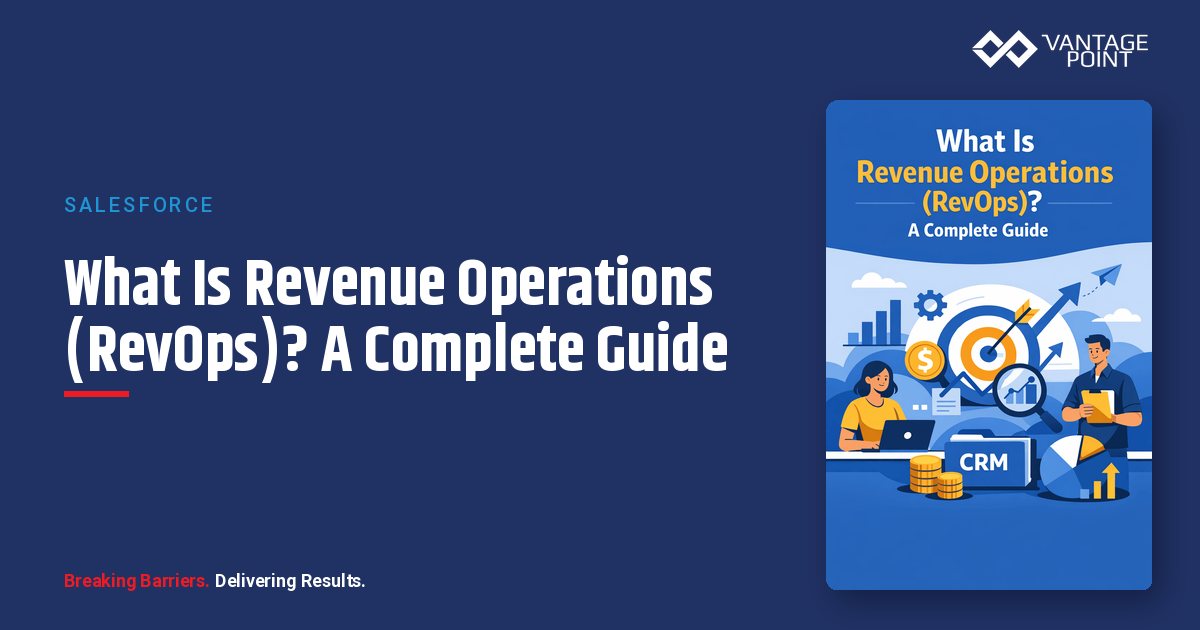
Revenue Operations, or RevOps, has become the operating model behind predictable growth. Instead of running sales, marketing, and customer success as separate silos with separate tools, RevOps aligns them around shared data, processes, and goals. This guide explains what RevOps is, how it is structured, what technology it uses, and how to start.
Quick Answer
Revenue Operations (RevOps) is a business function that aligns sales, marketing, and customer success around shared data, processes, technology, and metrics to drive predictable revenue. It matters for growing companies where disconnected teams and tools create friction, blind spots, and missed forecasts. RevOps unifies the CRM, automation, and reporting that revenue teams depend on. Vantage Point helps companies build the CRM and data foundation that makes RevOps work.
TL;DR
- What it is: RevOps aligns sales, marketing, and customer success around shared data and processes.
- Why it matters: It replaces silos with one revenue engine, improving forecasting and efficiency.
- Best for: Growing companies with disconnected teams, tools, or data.
- Decision point: Evaluate whether your revenue teams share data, processes, and metrics today.
- How Vantage Point helps: We unify your CRM and marketing automation into one RevOps foundation.
What Is Revenue Operations?
Revenue Operations is the practice of aligning the people, processes, data, and technology across sales, marketing, and customer success so the entire revenue cycle runs as one system. Rather than each team optimizing its own metrics, RevOps optimizes the full customer journey from first touch to renewal.
RevOps rests on four pillars:
- People: A team or function responsible for cross-departmental alignment.
- Process: Standardized, documented workflows across the revenue lifecycle.
- Data: A single source of truth for customer and revenue data.
- Technology: An integrated tech stack centered on the CRM.
Why RevOps Matters for Growing Companies in 2026
As companies grow, sales, marketing, and customer success tend to drift apart: each with its own tools, definitions, and reporting. That fragmentation creates handoff friction, conflicting data, and unreliable forecasts. RevOps fixes the structural problem rather than patching symptoms.
In 2026, RevOps is especially important because:
- AI and automation need unified data. Disconnected revenue data undermines AI forecasting and automation.
- Buyers expect a seamless journey. Customers do not see departments; they see one company.
- Efficient growth is the priority. RevOps reduces waste by aligning effort across the funnel.
How RevOps Is Structured
Most RevOps functions cover four areas:
- Operations management: Owning the CRM, tools, and workflows across teams.
- Enablement: Equipping teams with training, content, and process.
- Insights and analytics: Building shared dashboards and a single source of truth.
- Tooling and integration: Connecting the tech stack so data flows cleanly.
Common RevOps Tech Stack
| Layer | Purpose | Common tools |
|---|---|---|
| Core CRM | Single source of customer truth | Salesforce, HubSpot |
| Marketing automation | Lead capture and nurture | HubSpot Marketing Hub, Marketing Cloud |
| Sales engagement | Outreach and sequences | HubSpot Sales Hub, Sales Cloud |
| Analytics | Shared reporting and forecasting | CRM analytics, BI tools |
| Integration | Connecting the stack | MuleSoft, Workato |
Key RevOps Metrics to Track
- Pipeline velocity and conversion rates by stage
- Customer acquisition cost (CAC) and lifetime value (LTV)
- Win rate and average deal size
- Net revenue retention and churn
- Forecast accuracy
What Businesses Should Do Next
- Audit whether sales, marketing, and success share one CRM and consistent definitions.
- Standardize the revenue lifecycle stages and handoffs across teams.
- Consolidate reporting into shared dashboards built on a single source of truth.
- Integrate disconnected tools so data flows automatically.
If your team is evaluating how RevOps applies to Salesforce, HubSpot, integrations, or CRM governance, Vantage Point can help assess the right next step and build a practical implementation plan.
How Vantage Point Helps
Vantage Point is a senior-led Salesforce and HubSpot consulting partner. We help growing companies build the operational backbone RevOps requires: a unified CRM, clean data, connected tools, and shared reporting. Our work spans CRM and marketing automation, system integration and data migration, Salesforce implementation and advisory, and HubSpot. We keep platform guidance balanced and focused on your revenue goals.
FAQ
What does RevOps stand for?
RevOps stands for Revenue Operations. It is a function that aligns sales, marketing, and customer success around shared data, processes, technology, and metrics. The goal is predictable, efficient revenue growth.
How is RevOps different from sales operations?
Sales operations supports the sales team specifically, while RevOps spans the entire revenue cycle across sales, marketing, and customer success. RevOps takes a unified view of the customer journey rather than optimizing one department. It is broader in scope and cross-functional by design.
Does my company need a dedicated RevOps team?
Not necessarily at first. Smaller companies often start with RevOps as a shared responsibility or a single owner, then formalize a team as they scale. What matters most is aligning data, process, and tools: the structure can grow over time.
What technology does RevOps require?
RevOps centers on an integrated CRM such as Salesforce or HubSpot, supported by marketing automation, sales engagement, analytics, and integration tools. The key is that systems connect and share a single source of truth. Vantage Point helps design and integrate this stack.
How do I start with RevOps?
Start by unifying your CRM and standardizing how sales, marketing, and success define and hand off revenue stages. Consolidate reporting into shared dashboards, then integrate disconnected tools. Beginning with data and process alignment delivers value before any reorganization.
Can RevOps work with both Salesforce and HubSpot?
Yes. Many companies run HubSpot for marketing and Salesforce for sales or service, integrated into one RevOps data layer. The priority is a single source of truth across the stack. Vantage Point implements and integrates both platforms.
How does RevOps improve forecasting?
RevOps improves forecasting by unifying revenue data and standardizing pipeline stages, so forecasts draw from consistent, trustworthy information. It also enables shared dashboards that surface risks early. Clean, aligned data is what makes AI-assisted forecasting reliable.