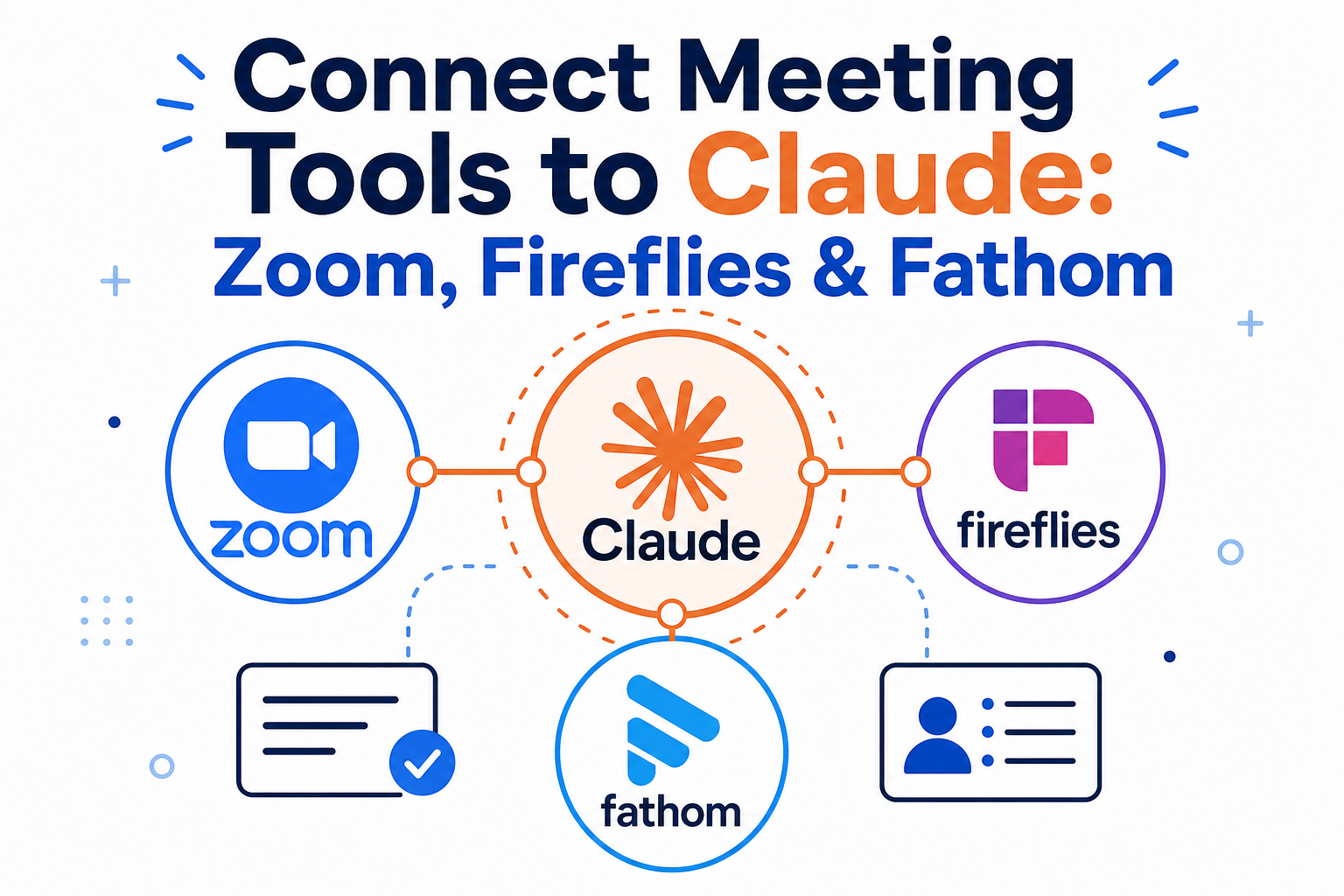
Most of what gets decided in your business happens in meetings, the commitments, the objections, the next steps, the "let's circle back on pricing." And almost all of it now lives inside an AI meeting tool: a Zoom recording, a Fireflies transcript, a Fathom summary, an Otter note. The problem is that the value of those transcripts decays the moment the call ends, because nobody has time to read them, mine them for patterns, or move what matters into the systems where work actually gets done. Connecting Claude to your meeting tools changes that. Instead of asking a person to scrub a recording, you can ask Claude to read the transcript, pull the decisions and action items, draft the follow-up, and tee up a clean CRM update. This guide explains how meeting-intelligence connectors work, which tools already publish them, what data and permissions the connection needs, what can go wrong, and the safe, repeatable way to wire it up.
This is the meeting-intelligence category deep-dive in our connector series. For the full picture of how every category fits together, start with the Claude connector ecosystem map, and pair this with how to connect your CRM to Claude, since meeting insight is only as valuable as where it lands.
Quick Answer
To connect Claude to meeting tools, you add a connector (usually a remote MCP server published by the meeting vendor (Zoom, Fireflies, Otter, Fellow, Read AI, and others)) and authenticate it so Claude can read your recordings, transcripts, summaries, and action items within that account's permissions. The Model Context Protocol (MCP) is the open standard underneath nearly every meeting connector, which is why the setup is consistent across tools: enable the connector in Claude's directory, sign in to the meeting platform, and confirm the access is scoped and logged. Fireflies was the first AI meeting tool listed in Claude's connector directory; Zoom, Otter, Fellow, and Read AI followed with their own connectors. The work that matters is not clicking "connect". It is deciding which meeting account Claude authenticates as, which recordings it can reach, and what governs the highly sensitive conversation data it will now see. Connect through a scoped, least-privilege identity, prove value on one workflow such as recap-to-CRM, and govern the connection like any other production integration.
TL;DR
- What it is: Connecting Claude to meeting tools means adding MCP-based connectors that let Claude read recordings, transcripts, summaries, and action items from platforms like Zoom, Fireflies, Fathom, Otter, Fellow, and Read AI.
- Why it matters: It turns dead transcripts into living workflows. Claude can summarize a call, extract commitments, draft the follow-up email, and prepare a clean CRM update without anyone re-watching the recording.
- Best for: Sales, customer success, and operations teams whose decisions live in calls and whose follow-through depends on what happens after them.
- Decision point: Which meeting account does Claude authenticate as, which calls can it reach, and how is that conversation data classified and logged?
- How Vantage Point helps: We design and govern meeting-tool-to-Claude connections, and the bridge into your CRM, through system integration and data migration and compliance and security solutions.
What Does It Mean to Connect Claude to Meeting Tools?
Claude is Anthropic's AI assistant, and a meeting connector is the bridge that lets it reach into the recordings and transcripts your team already captures. Once connected, Claude can summarize a specific call, search across many meetings for a pattern ("what objections came up most this quarter?"), extract the action items and owners, or assemble a deal brief from the last three conversations. All without anyone exporting a transcript or pasting it into a chat window.
Underneath almost every meeting connector sits one open standard: the Model Context Protocol (MCP). MCP is the common language that lets Claude discover what a meeting tool can do, request specific transcripts or summaries, and take scoped actions without a hand-coded, one-off integration. That shared foundation is why connecting Fireflies looks broadly similar to connecting Zoom or Otter: you enable the connector, authenticate to the meeting platform, and Claude works within that account's access. For the underlying mechanics, see how MCP servers connect Claude to your systems of record.
The important reframe: connecting a meeting tool is not a convenience toggle. It is a data-access decision about some of the most sensitive content your company holds. Recordings capture candid negotiation, personnel discussions, customer complaints, and confidential strategy. The connection inherits the permissions of whatever account authenticates it, so the real question is never "can Claude reach our meetings?" but "which conversations, exactly, should it be allowed to read?"
Why Connect Claude to Meeting Tools in 2026?
The value shows up wherever a person currently re-watches or re-reads a call to get something done:
- Recap-to-CRM without the retyping. Claude reads the transcript, extracts decisions, action items, and next steps, and stages a clean update for the right record: instead of a rep typing notes from memory hours later.
- Deal intelligence across many calls. Ask "what's the status and risk on this account?" and Claude synthesizes the last several conversations into one brief, surfacing commitments, objections, and stalled threads.
- Coaching at scale. Claude can review call patterns (talk ratio, discovery questions, objection handling) and summarize coaching themes without a manager listening to every recording.
- Faster, accurate follow-ups. Claude drafts the follow-up email grounded in what was actually said, so nothing promised on the call gets dropped.
- Voice-of-customer mining. Across support and success calls, Claude can surface recurring feature requests, churn signals, and themes that would otherwise stay buried in transcripts.
These are the same patterns that make connected AI worthwhile for revenue and operations teams, and they compound when meeting insight flows into the CRM, the subject of connecting your CRM to Claude.
How Meeting Connectors Work: The Three Types
"Meeting connector" covers three meaningfully different things. They look similar in Claude's interface but differ in who builds them, who hosts them, and who governs them.
| Connector type | Who builds and hosts it | Typical setup | Governance implication |
|---|---|---|---|
| First-party / vendor connector | The meeting vendor (e.g., Zoom, Fireflies, Otter) | Enable in Claude's connector directory, sign in to the platform | Vendor maintains it; you govern which account and scope are used |
| Partner remote MCP server | A third party or integration platform | Add the remote MCP URL, authenticate to the meeting tool | Vendor hosts; you control users and permissions |
| Local or custom MCP server | Your own team | Run via the desktop app or your infrastructure against the meeting tool's API | You own the code, hosting, credentials, and audit |
A few practical points that apply to every meeting tool:
- The connector inherits account access. A meeting connector acts within the recordings, transcripts, and workspaces the authenticated account can see. A connector tied to a single user's calls is very different from one tied to a workspace-wide admin account: connect with the narrowest access the workflow needs.
- Plan tier matters on both sides. Many meeting connectors require a paid Claude plan (Pro, Max, Team, or Enterprise) on the Claude side, and a qualifying plan on the meeting-tool side. Admin-managed connectors and the ability to restrict which connectors users can enable generally require a business-grade Claude tier. Verify current plan requirements at adoption time, because connector gating changes frequently.
- Read first, act later. Most meeting workflows start as read-and-summarize. Write or push actions (creating tasks, sending follow-ups, updating records) should be added only once the team trusts the output.
- No connector? Build one. If a specific meeting tool has no published connector, a custom MCP server against its API is a supported path, and the one that demands the most governance discipline, because you own the credentials and the blast radius.
Which Meeting Tools Connect to Claude?
The meeting-intelligence category is moving fast, and several major tools now publish connectors that appear in Claude's connector directory. Availability and plan requirements change often, so treat the table below as a snapshot to verify at adoption time rather than a permanent list.
| Meeting tool | What Claude can typically access | Notes on availability |
|---|---|---|
| Zoom | AI meeting summaries, transcripts, and meeting data | MCP connector available through Claude's connector directory; works with Claude Cowork and Claude Code |
| Fireflies.ai | Meeting transcripts, summaries, and user data | First AI meeting tool listed in Claude's connector directory; available to customers with a paid Anthropic plan |
| Otter.ai | Meeting notes and transcripts | Enterprise MCP server published for connecting meeting data |
| Fellow | Meeting notes, transcripts, and action items | Official Anthropic-verified connector |
| Read AI | Transcripts and summaries across Zoom, Meet, and Teams | Listed among Claude meeting connectors |
| Others (Fathom, Granola, Grain, tl;dv, MeetGeek, Webex, and more) | Recordings, transcripts, summaries (varies by tool) | Some publish connectors or APIs; verify current availability and whether a custom MCP server is needed |
The pattern is what matters more than any single row: the meeting-intelligence space is consolidating around MCP, so even tools without a first-party connector today can usually be reached through a partner or custom MCP server. Choose the tool your team already records in, confirm its current connector status, and connect that one first.
What Data and Permissions Does the Connection Need?
Before you connect, answer four questions for each meeting tool:
- What can it read? A connector inherits the account's access. Decide whether Claude should see one user's calls, a team's, or the whole workspace, and default to the narrowest scope that makes the workflow work.
- What classification applies? Recordings and transcripts frequently contain personal data, confidential negotiation, and privileged discussion. That classification determines who may enable the connector, for which calls, and under what retention rules.
- Does it respect consent and recording rules? Meeting capture is governed by recording-consent laws and internal policy. The connection should never become a backdoor that exposes calls some participants did not agree to have analyzed.
- Is it logged? Connector activity, sign-ins, and access grants should be reviewable in both the meeting tool's admin console and your own audit trail, and reviewed periodically like any other integration.
These four controls are the foundation of a governed environment. Building that foundation properly is the subject of building a secure Claude environment.
What Can Go Wrong?
- Over-broad meeting access. Connecting a workspace-admin account when the workflow only needs one rep's calls gives Claude reach across every recorded conversation in the company, including HR and executive calls. Scope to the narrowest account that works.
- Consent and privacy gaps. Analyzing recordings of calls where participants did not consent to AI processing creates legal and trust risk. Align the connection with your recording-consent policy before turning it on.
- Hallucinated specifics. Treat Claude's meeting outputs as drafts grounded in the transcript, not gospel. Keep a human in the loop before a summary becomes a contractual commitment or a CRM "source of truth."
- Connector sprawl. Multiple overlapping meeting connections nobody can inventory. Maintain an approved-connector list and a named owner.
- Writing without guardrails. Letting Claude auto-create tasks, send follow-ups, or update records unsupervised before the team trusts its output creates real risk. Start read-only, add scoped write actions once value is proven.
None of these are model failures. They are integration-governance failures, cheap to prevent and expensive to retrofit.
How to Connect Claude to Meeting Tools: Step by Step
- Pick one workflow. Choose a single, frequent, painful task (recap-to-CRM, deal briefs, or follow-up drafting) and connect only the meeting tool that workflow needs.
- Choose a scoped account and confirm plan tiers. Authenticate through a controlled account scoped to the right calls, and verify the connector is available on both your Claude plan and your meeting-tool plan.
- Add the connector. Enable the vendor connector from Claude's connector directory and sign in to the meeting platform, or stand up a custom MCP server against the tool's API if no connector exists.
- Set admin and governance controls. Confirm recording-consent alignment, restrict which connectors users can enable on a business-grade Claude tier, apply your data-classification rules, and verify activity is logged on both sides.
- Start read-only, then expand. Prove value on read-and-summarize before granting scoped write actions like creating tasks or updating records. Once the first workflow earns trust, route meeting insight into the CRM and add the next workflow carrying the same governance forward.
What Businesses Should Do Next
Resist the urge to "connect everything." The fastest path to value is one governed workflow on the meeting tool your team already records in, usually recap-to-CRM or deal briefs, proven before you expand. Decide who owns the connection, which account and scope it uses, how it aligns with your recording-consent policy, and how its activity is reviewed. Then sequence additional workflows deliberately, and route meeting insight into your CRM only once each side is independently governed. If you are weighing the broader build, start with how to connect your CRM to Claude.
How Vantage Point Helps
Vantage Point helps companies connect Claude to their meeting tools safely, with senior consultants on every engagement and no junior staff learning on your project. A typical engagement maps the meeting workflows worth connecting, designs the scoped account and identity architecture, builds the connection from Zoom, Fireflies, Otter, Fellow, or another tool into Claude, and wires the recap-to-CRM path so insight lands where work gets done: all while verifying consent, classification, and audit before usage scales.
The integration and recap-to-CRM work runs through system integration and data migration and CRM and marketing automation; the consent, classification, and audit work runs through compliance and security solutions; and the ongoing health of the connection runs through managed services and ongoing support. Because the practice is vendor-agnostic and dual-platform, the meeting-tool-to-Claude strategy fits whether your customer data lives in Salesforce, HubSpot, or both, and it is built to hand over with documentation and a named internal owner, not to create dependency.
FAQ
How do I connect Claude to a meeting tool like Zoom or Fireflies?
Open Claude's connector directory, enable the connector for your meeting tool, and sign in to that platform with a scoped account. Confirm the connector is available on both your Claude plan and your meeting-tool plan, align the connection with your recording-consent policy, and verify the activity is logged. The setup is similar across Zoom, Fireflies, Otter, Fellow, and Read AI because nearly all meeting connectors are built on the Model Context Protocol.
Which meeting tools have official Claude connectors?
As of this writing, Fireflies.ai was the first AI meeting tool listed in Claude's connector directory, and Zoom, Otter.ai, Fellow, and Read AI have published their own connectors or MCP servers. Other tools such as Fathom, Granola, Grain, and tl;dv can often be reached through a partner or custom MCP server. Connector availability changes frequently, so verify the current status of your specific tool before you build a workflow around it.
Is it safe to let Claude read meeting recordings?
It is safe when the connection is scoped and governed. Connect through an account limited to the right calls, align with your recording-consent policy, classify the conversation data appropriately, keep a human reviewing outputs, and log activity on both the meeting tool and your side. The risk comes from over-broad access and ungoverned connections, not from the connection itself.
Can Claude push meeting notes into my CRM?
Yes: that is one of the highest-value workflows. Claude can read a transcript, extract decisions and action items, and stage a clean update for the right CRM record. Start by having Claude draft the update for human review, then add scoped write actions once the team trusts the output. See how to connect your CRM to Claude for the other half of the workflow.
Do I need a paid Claude plan to connect meeting tools?
Usually, yes. Many meeting connectors require a paid Claude plan such as Pro, Max, Team, or Enterprise, and a qualifying plan on the meeting-tool side. Admin-managed connectors and the ability to restrict which connectors users can enable generally require a business-grade Claude tier. Confirm current plan requirements for your specific tools at adoption time.
How do recording-consent laws affect connecting meeting tools to Claude?
They are central. Meeting capture and analysis are governed by recording-consent laws that vary by jurisdiction and by internal policy. Before connecting, confirm that the calls Claude will analyze were recorded with appropriate consent, and ensure the connection does not expose conversations some participants did not agree to have processed by AI. Treat this as a prerequisite, not an afterthought.
What is the difference between a vendor connector and a custom MCP server for meetings?
A vendor connector is built and hosted by the meeting tool and enabled from Claude's connector directory: fastest to set up and maintained for you. A custom MCP server is one your team builds against the tool's API when no connector exists; it gives you full control but means you own the code, credentials, and audit. Most teams should use a vendor connector where available and reserve custom servers for gaps.