Most integration messes start with a reasonable decision. Two systems need to talk, so someone wires them together directly. Then another pair. Then another. A year later you have a tangle of point-to-point connections that only one or two people understand, that break every time a vendor changes an API, and that nobody can fully inventory.
Replacing those brittle, one-to-one connections with an integration platform as a service (iPaaS) like Workato moves your business off custom-code "integration spaghetti" and onto a governed, hub-and-spoke model that scales as you add systems. This guide explains what point-to-point integration is, why it breaks down, how Workato's recipe-based approach fixes the root cause, and the practical, low-risk way to migrate without ripping everything out at once.
Quick Answer
Replacing point-to-point integrations with Workato means retiring direct, custom-coded connections between individual systems and routing those data flows through a central automation platform instead. Point-to-point integration links two applications one-to-one, which works for a single connection but becomes unscalable, fragile, and hard to track as your app count grows — the average business now runs well over 100 SaaS apps. Workato, an iPaaS and enterprise automation platform, replaces that sprawl with reusable "recipes," 1,000+ pre-built connectors, and a single dashboard for monitoring every integration. This matters most for operations, RevOps, and IT leaders who are tired of integrations that depend on one engineer and break on every API update. The right move is rarely a big-bang rewrite — it's a phased migration that targets your most fragile and most business-critical connections first. Vantage Point designs and runs these migrations through our system integration and workflow automation services.
TL;DR
- What it is: Replacing direct, custom-coded point-to-point integrations with Workato's centralized, recipe-based iPaaS model.
- Why it matters: Point-to-point integrations don't scale, aren't future-proof, depend on a few key people, and are difficult to monitor — all of which create operational risk.
- Best for: Operations, RevOps, and IT teams with a growing app stack and a backlog of fragile or undocumented integrations.
- Decision point: Which connections are most fragile and most business-critical? Migrate those first; keep simple, stable one-offs where they make sense.
- How Vantage Point helps: We map your integration landscape and rebuild it on Workato through system integration and data migration and workflow automation and process optimization.
What Is Point-to-Point Integration?
Point-to-point integration (also called peer-to-peer or P2P integration) is a direct, one-to-one connection between two applications that lets them exchange data without an intermediary. It is typically built with custom code and APIs, defining exactly how those two specific systems talk to each other.
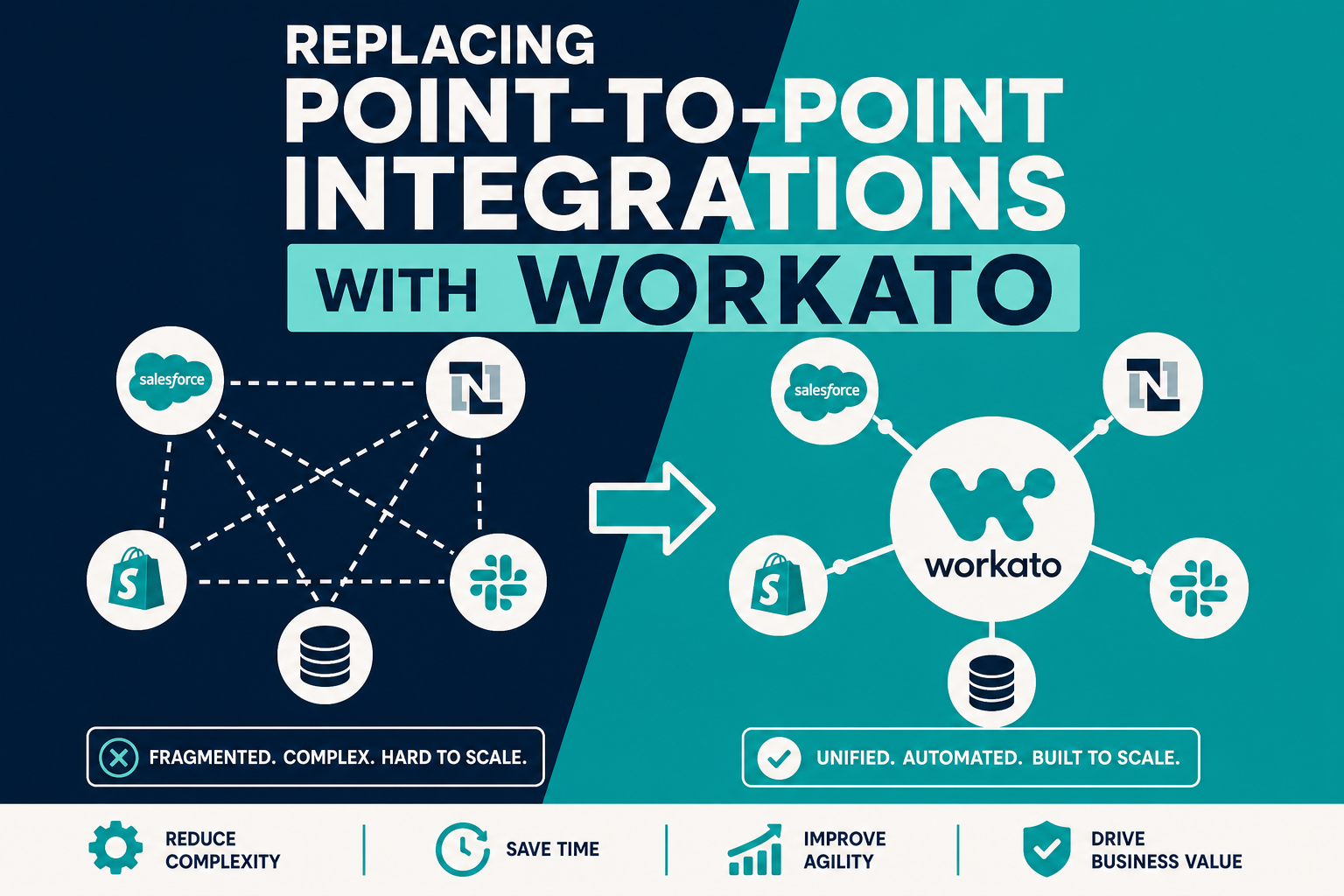
For a single, stable connection, that can be perfectly reasonable. The problem is what happens when you repeat the pattern across dozens of systems. Each new connection is another piece of bespoke code to build, secure, monitor, and maintain — and the number of possible connections grows far faster than the number of apps. That tangle is what architects call "integration spaghetti."
The alternative is a hub-and-spoke model, where every system connects to a central hub instead of to each other. Adding a new application means connecting it once to the hub, not rewiring it to every other system. An iPaaS like Workato is a modern, cloud-based implementation of that hub.
Why Point-to-Point Integrations Break Down in 2026
The case against P2P sprawl is operational, not theoretical. Workato's own analysis of the model highlights five recurring failure modes:
- It's time-consuming to build. Each integration is custom work, which slows your team and creates a backlog. In Workato's customer survey, most respondents said they couldn't build integrations fast enough before adopting an automation platform.
- It doesn't scale. With businesses running 100+ SaaS apps, building and maintaining direct connections across all of them is effectively impossible, which forces teams into data silos.
- It isn't future-proof. When a vendor changes an API or your processes shift, every affected point-to-point link must be reworked by hand.
- It creates key-person risk. The few engineers who wrote the code hold the knowledge. When they leave, the ability to fix or change those integrations leaves with them.
- It's hard to track. Without a central console, no one has a complete, current picture of which integrations exist or whether they're running.
These are exactly the symptoms that push organizations toward an iPaaS — and they compound quietly until an outage or a failed audit makes them visible.
Point-to-Point vs. iPaaS: A Decision Table
| Factor | Point-to-Point Integration | Workato (iPaaS / Hub-and-Spoke) |
|---|---|---|
| Connection model | Direct, one-to-one between each pair of systems | Each system connects once to a central hub |
| Build approach | Custom code per connection | Low-code/no-code recipes and 1,000+ pre-built connectors |
| Scalability | Degrades quickly as apps grow | Add a system once, reuse it everywhere |
| Maintenance | Manual rework on every API or process change | Centralized updates and connector maintenance |
| Visibility | Fragmented; often undocumented | Single dashboard for monitoring jobs and errors |
| Key-person risk | High — knowledge lives with a few coders | Lower — business and IT teams can build and maintain |
| Best fit | A single, shallow, stable connection | A growing, multi-system, business-critical landscape |
Choose point-to-point if you have one shallow, stable integration that rarely changes and is easy to own in-house. Choose Workato if you're connecting many systems, your integrations change often, or you need governance, visibility, and the ability to scale without hiring more developers.
How Workato Replaces Point-to-Point Connections
Workato is an integration and automation platform built on a few core ideas that directly target P2P's weaknesses:
- Recipes instead of custom code. A recipe is a reusable automation — a trigger plus a series of actions — built in a low-code interface. Business and IT users can create and maintain them without writing bespoke integration code.
- Pre-built connectors. With over a thousand connectors, common systems (CRM, ERP, marketing, support, finance, databases) connect to the hub quickly instead of through hand-coded API work each time.
- A central dashboard. One place to see connected apps, running recipes, and job history — so monitoring and troubleshooting stop depending on tribal knowledge.
- End-to-end workflow automation. Beyond moving data, Workato automates whole processes — lead routing, quote-to-cash, employee onboarding — so you're not just replacing plumbing, you're improving the workflow on top of it.
The result is the same data flowing between your systems, but governed centrally, documented by default, and far cheaper to change.
How to Migrate Off Point-to-Point Integrations: A Phased Plan
Migrating from integration spaghetti to a centralized iPaaS is a journey, not an overnight switch. A phased approach keeps the business running while you rebuild.
- Inventory what you have. List every point-to-point connection, what it does, who owns it, and how critical it is. This alone often surfaces integrations no one remembered.
- Score by fragility and importance. Rank each connection on how likely it is to break and how much damage that causes. Your migration order falls out of this scoring.
- Rebuild the highest-risk flows first. Recreate the most fragile, most business-critical connections as Workato recipes, running them in parallel with the old ones until you trust the output.
- Cut over and decommission. Once a recipe is validated, retire the old point-to-point code and remove it from the landscape so it can't break later.
- Standardize and govern. Set recipe naming conventions, error handling, ownership, and monitoring so the new hub doesn't slowly turn into a new mess.
What Businesses Should Do Next
You don't need to migrate everything, and you shouldn't try to do it all at once. Start by making your integration landscape visible — most teams are surprised by how many undocumented connections they find. Then target the connections that are both fragile and important, rebuild those on Workato first, and prove value before expanding. Keep the rare simple, stable one-off where it genuinely makes sense. If you also run both Salesforce and HubSpot, the same hub model is what keeps those platforms in sync cleanly; see our HubSpot and Salesforce integration architecture guide for how those data flows should be structured.
How Vantage Point Helps
Vantage Point helps organizations replace brittle point-to-point integrations with a governed Workato hub — with senior consultants on every engagement, not junior staff learning on your systems. A typical engagement inventories your current connections, scores them by risk and business value, rebuilds the priority flows as Workato recipes, and stands up the monitoring and standards that keep the new platform healthy.
That rebuild runs through our system integration and data migration and workflow automation and process optimization services, and we keep the platform healthy over time through managed services and ongoing support. Because our practice is vendor-agnostic and dual-platform, the same approach fits whether your data lives in Salesforce, HubSpot, an ERP, or all three — and we build to hand over with documentation and a named internal owner, not to create dependency. If you're weighing platforms, our Workato vs. MuleSoft comparison for CRM integration is a useful next read.
FAQ
What is a point-to-point integration?
A point-to-point integration is a direct, one-to-one connection between two software systems that lets them exchange data without an intermediary. It is usually built with custom code and APIs. It works well for a single, stable connection but becomes hard to scale and maintain as you add more systems.
Why are point-to-point integrations considered brittle?
They're brittle because each connection is custom and isolated. When a vendor changes an API, a process shifts, or a key engineer leaves, the affected integration can break with no central way to catch it. There's no shared dashboard, so problems often surface only after something stops working.
How does Workato replace point-to-point integrations?
Workato routes data through a central hub instead of direct system-to-system links. You rebuild each connection as a reusable, low-code "recipe" using pre-built connectors, then monitor everything from one dashboard. This removes per-connection custom code and makes integrations easier to scale, change, and govern.
Do I have to migrate all my integrations at once?
No, and you shouldn't. The lowest-risk approach is phased: inventory your connections, rank them by fragility and business importance, rebuild the highest-risk ones first, run them in parallel until validated, then decommission the old links. This keeps the business running throughout.
When does point-to-point integration still make sense?
Point-to-point can be reasonable for a single, shallow connection that rarely changes and is easy to own in-house. The problems appear when you repeat the pattern across many systems. If you're connecting a growing, business-critical app stack, an iPaaS like Workato is the more sustainable choice.
Is Workato only for large enterprises?
No. While Workato is widely used by enterprises, its value applies to any organization whose app count and integration needs are outgrowing what a few custom-coded connections can support. The deciding factor is integration complexity and growth, not company size alone.
How is this different from native CRM connectors?
Native connectors link two specific products and are great when they cover your exact need. An iPaaS like Workato adds a governed layer across many systems, with reusable recipes, central monitoring, and end-to-end workflow automation — useful when your integrations span more than one vendor or need orchestration beyond a simple sync.