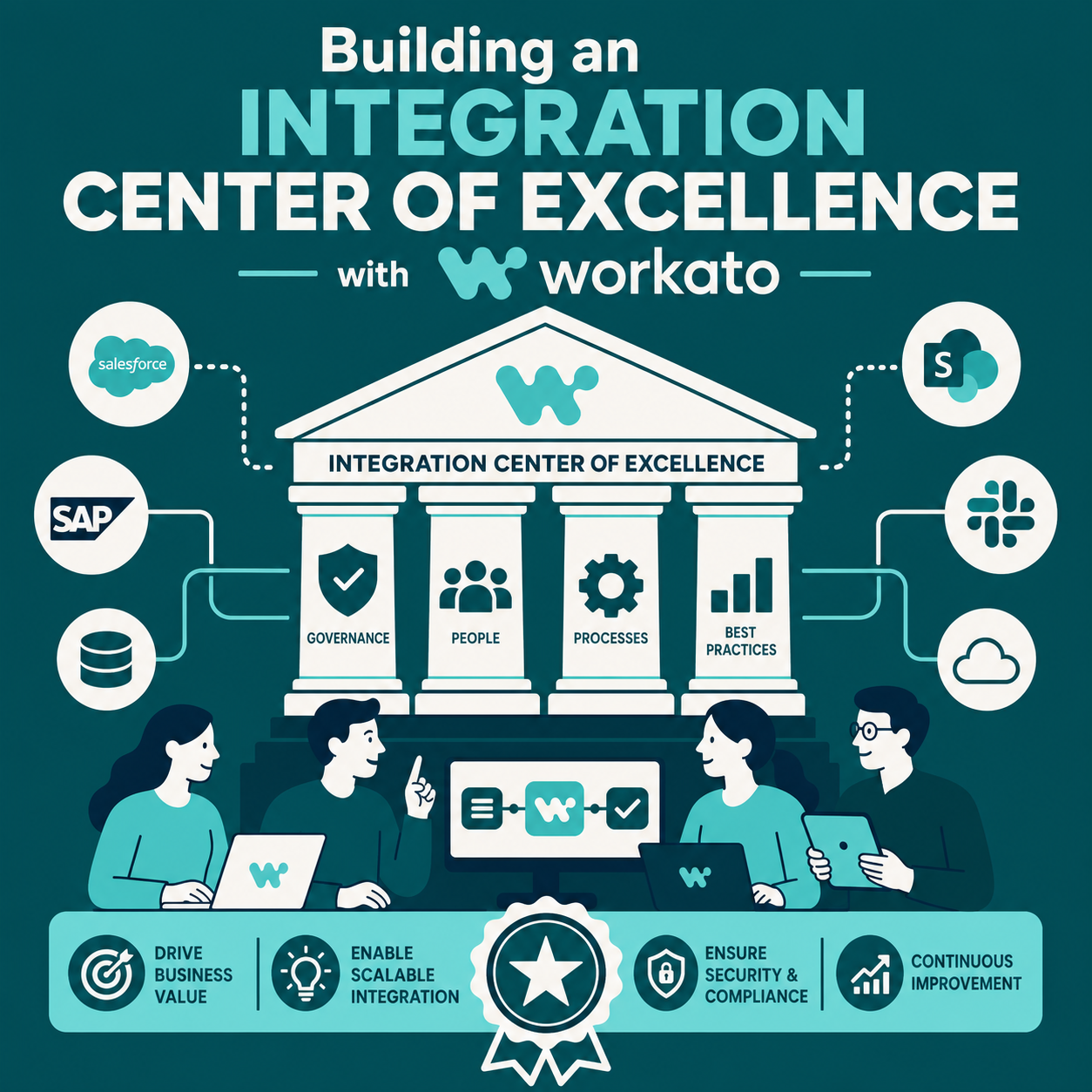
Organizations running dozens of Workato recipes without shared standards often end up with duplicated logic, inconsistent error handling, and no single owner when something breaks. An Integration Center of Excellence (ICoE) solves this by giving automation a governance structure — and Workato provides several native features that make building one practical rather than theoretical.
Quick Answer
An Integration Center of Excellence is a centralized team and set of standards that governs how an organization builds, secures, and maintains automations and integrations. It matters for IT leaders, RevOps teams, and Workato admins managing a growing number of recipes across departments. This article helps readers decide whether they need a formal ICoE and how to structure one using Workato's built-in tools. Vantage Point is relevant because we help organizations design and implement integration governance across Workato, MuleSoft, and native CRM automation.
TL;DR
- What it is: A centralized governance model for building, reviewing, and maintaining Workato automations.
- Why it matters: Without one, integrations sprawl across departments with no consistent security, naming, or error-handling standards.
- Best for: Mid-size and enterprise teams running Workato across multiple business units or departments.
- Decision point: Whether your current automation count and risk profile justify a formal governance function.
- How Vantage Point helps: We help design integration governance and implement it through our system integration and data migration services.
What Is an Integration Center of Excellence?
An Integration Center of Excellence is a defined team, or a defined set of responsibilities, that owns integration strategy, standards, and quality across an organization. Instead of every department building automations independently with no shared conventions, an ICoE sets naming standards, security policies, and review processes that all automation builders follow.
Why an ICoE Matters in 2026
As more departments — sales, finance, HR, customer support — build their own Workato recipes, the risk of duplicated logic, orphaned automations, and inconsistent error handling grows. An ICoE matters now because automation is no longer confined to IT. Business teams are building recipes directly, and without governance, that speed creates technical debt and security gaps just as fast as it creates value.
How an ICoE Works in Practice
A working ICoE typically includes:
- A core governance team that owns standards, security review, and platform administration (often 1-3 people even at mid-size companies).
- A recipe review process so new automations meet naming, logging, and error-handling standards before going live.
- A shared library of reusable connectors and templates so builders aren't recreating the same logic repeatedly.
- Defined escalation paths for when an automation fails, including who gets alerted and how quickly.
- Regular audits of active recipes to retire unused automations and catch permission creep.
Workato supports this model directly through Workato Automation HQ, which gives governance teams visibility into every recipe across the organization, along with role-based access controls, activity logs, and folder-based permissions that map naturally to an ICoE structure.
Single Team vs. Multiple CoEs: A Comparison
| Model | Best For | Trade-Offs |
|---|---|---|
| Single enterprise-wide ICoE | Organizations with centralized IT and moderate automation volume | Can become a bottleneck if under-resourced |
| Federated model (central standards, departmental builders) | Larger organizations with active business-led automation | Requires strong documentation and training to stay consistent |
| No formal governance | Very small teams with a handful of simple recipes | Works short-term; breaks down quickly as recipe count grows |
Most mid-size organizations get the best results from the federated model: a small central team sets standards and reviews high-risk automations, while trained builders in each department handle day-to-day recipe work within those guardrails.
What Businesses Should Do Next
- Inventory every active Workato recipe and identify who owns each one.
- Define minimum standards for naming, logging, and error handling before adding new recipes.
- Use Automation HQ's role-based access controls to formalize who can build, edit, and publish recipes.
- Decide whether a single centralized team or a federated model fits your organization's size and automation maturity.
- Schedule a recurring audit — quarterly is a reasonable starting cadence — to retire unused automations.
How Vantage Point Helps
Vantage Point helps organizations design integration governance that fits their actual team structure, not a generic template. Our system integration and data migration practice works alongside your team to set up Workato Automation HQ, define standards, and train internal builders. For organizations also running Salesforce automation, our workflow automation and process optimization service ensures Workato recipes and native CRM automation don't duplicate effort.
If your team is evaluating how to bring structure to a growing library of integrations, Vantage Point can help assess the right governance model and build a practical implementation plan. For more on how Workato fits into a broader integration strategy, see our guide on what Workato is and how it works.
FAQ
What is an Integration Center of Excellence? An Integration Center of Excellence is a centralized governance function — a team, standards, and review process — that ensures integrations and automations are built consistently, securely, and with clear ownership across an organization.
Do we need a formal ICoE if we only have a few Workato recipes? Not necessarily. Organizations with a handful of simple recipes and a single owner often don't need formal governance yet. An ICoE becomes valuable once multiple departments are building automations independently.
How does Workato Automation HQ support an ICoE? Automation HQ gives governance teams centralized visibility into all recipes, role-based access controls, and activity logs, which map directly to the oversight and security functions an ICoE needs to perform.
Should the ICoE be a single centralized team or spread across departments? It depends on organization size. Smaller organizations typically do best with a single centralized team, while larger organizations benefit from a federated model with central standards and trained builders in each department.
What happens without an ICoE? Without governance, organizations typically see duplicated automation logic, inconsistent error handling, unclear ownership when something breaks, and growing security risk as more people gain build access.
How often should an ICoE audit existing automations? A quarterly audit is a reasonable starting cadence for most organizations, though higher-risk environments handling sensitive data may benefit from more frequent reviews.
Can an ICoE cover both Workato and Salesforce native automation? Yes. Many organizations run both Workato recipes and native Salesforce Flow or Agentforce automations, and a well-designed ICoE should set standards across both to avoid duplicated logic and conflicting triggers.
How do we get started building an ICoE if we don't have one today? Start with an inventory of existing automations and owners, then define minimum standards for new recipes going forward. Formal governance can be layered in gradually rather than requiring a full program on day one.