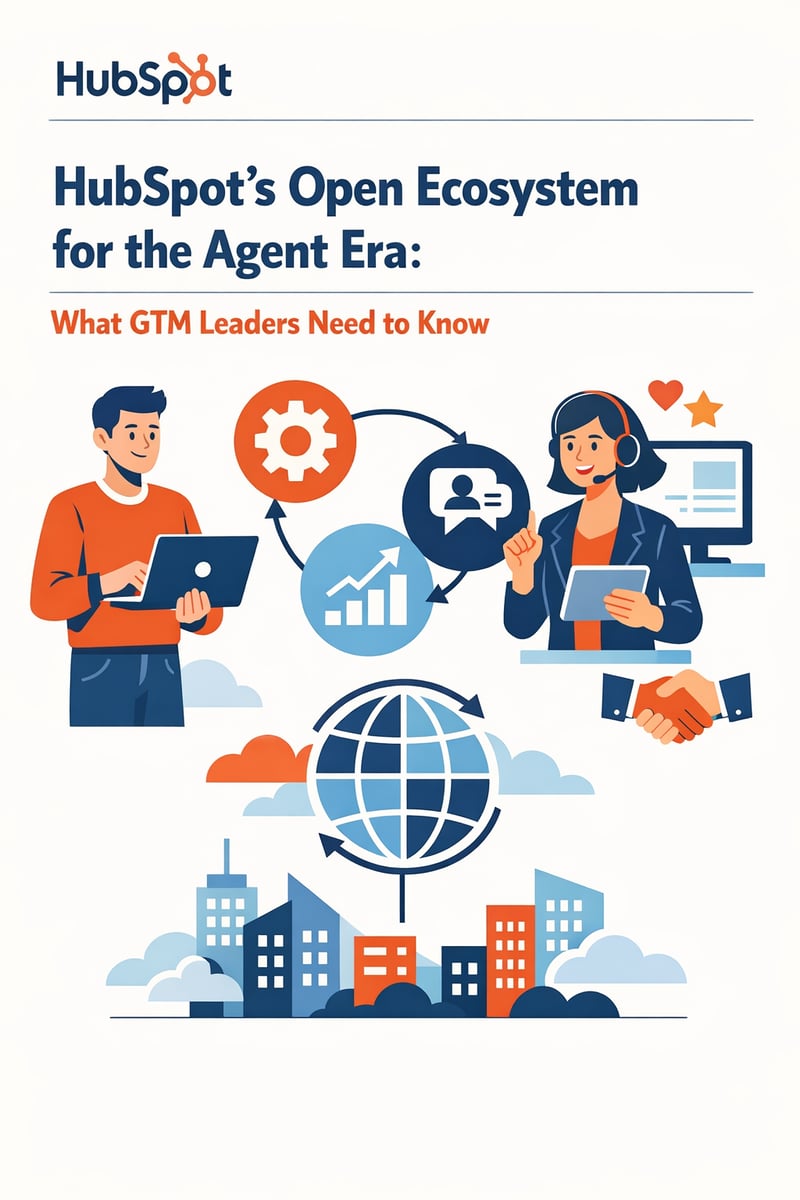
HubSpot’s Open Ecosystem for the Agent Era: What GTM Leaders Need to Know
TL;DR — Key Takeaways
- What is it? HubSpot has outlined a vision for an open, agent-ready customer platform where AI agents can both run on HubSpot and operate HubSpot through APIs, MCP, CLI, and future access methods.
- Key benefit: Go-to-market teams get a clearer path to connect agents, apps, workflows, and customer context without locking every AI use case inside one vendor’s interface.
- Cost/Investment: The near-term investment is not only software. Teams need API readiness, data governance, process cleanup, partner architecture, AI policy, and use-case prioritization.
- Best For: HubSpot customers, RevOps teams, partner-led implementation teams, and leaders evaluating AI agents for sales, marketing, service, support, and customer success.
- Bottom Line: The agent era will reward companies that make CRM data clean, accessible, governed, and actionable. HubSpot’s open ecosystem direction is a strong signal that AI strategy and CRM architecture now belong in the same conversation.
What did HubSpot announce about an open ecosystem for the agent era?
HubSpot’s May 2026 ecosystem update outlines a practical but important shift: the CRM is no longer just a system people log into. It is becoming a platform where AI agents can read context, take action, and coordinate go-to-market work across sales, marketing, service, and operations.
The central idea is simple: agents should be able to run on HubSpot, and agents should be able to run HubSpot.
Running on HubSpot means HubSpot’s data, context, and capabilities become building blocks for first-party and third-party agents. A specialized sales agent, support agent, account research agent, content agent, or workflow automation agent should be able to plug into HubSpot’s customer context and do useful work.
Running HubSpot means agents can operate the platform end to end through technical access layers such as APIs, HubSpot’s MCP server, CLI, and future methods. Instead of forcing AI to click through screens designed for human users, HubSpot is pointing toward a future where agents interact with structured platform capabilities directly.
For business leaders, this is not just a developer announcement. It is a roadmap for how AI-enabled revenue operations will actually function.
Sources: HubSpot’s ecosystem vision and HubSpot Developer Changelog.
Why does HubSpot’s agent-era ecosystem matter for go-to-market teams?
HubSpot’s direction matters because the first wave of AI in GTM has been mostly assistive: summarize this call, write this email, draft this campaign, score this list, or answer this support question. Useful, yes. Transformational, not always.
The next wave is operational. Agents will not simply generate recommendations. They will monitor signals, evaluate context, trigger workflows, update records, route work, escalate risk, and measure outcomes.
That only works when agents have three things:
- Trusted data from contacts, companies, deals, tickets, conversations, campaigns, and activity history.
- Clear permissions that define what an agent can see, suggest, change, or execute.
- Accessible platform actions so the agent can operate through APIs and workflows instead of fragile screen-based workarounds.
This is why HubSpot’s open ecosystem position is meaningful. It signals that CRM platforms are becoming agent infrastructure. The platform is not just where work is recorded; it is where work is orchestrated.
What does “agents can run on HubSpot” mean?
“Agents can run on HubSpot” means HubSpot can serve as the customer-context layer for AI agents built by HubSpot, customers, technology partners, and implementation partners.
In practical terms, an agent could use HubSpot data to answer questions such as:
- Which target accounts are showing buying intent?
- Which open deals have gone quiet?
- Which tickets are likely to miss SLA?
- Which lifecycle-stage definitions are inconsistent?
- Which customer segments need a different nurture path?
- Which reps need a follow-up reminder based on recent activity?
But the more important point is that agents should not be limited to isolated data extracts. HubSpot’s argument is that agents need “growth context”: the dynamic understanding of a company’s customers, processes, teams, activity, and outcomes.
For Vantage Point clients, this is where CRM fundamentals become AI fundamentals. If lifecycle stages are inconsistent, deal stages are subjective, duplicate records are common, or integrations are incomplete, the agent’s output will reflect those weaknesses. The agent era does not eliminate CRM hygiene. It raises the value of doing it correctly.
What does “agents can run HubSpot” mean?
“Agents can run HubSpot” means agents should be able to operate the platform through reliable access methods rather than human-only interfaces.
HubSpot specifically points to APIs, MCP server access, CLI, and future access methods as part of this direction. The broader principle is API parity: anything a user can do inside the platform should increasingly become available to apps and agents built on top of the platform.
For RevOps and IT leaders, this changes the implementation conversation. A modern HubSpot build should not only ask, “Can our users complete this workflow?” It should also ask:
- Can an approved agent safely complete part of this workflow?
- Which steps require human approval?
- Which actions can be automated through APIs or workflows?
- Where do permissions, auditability, and data retention need to be tightened?
- Which systems outside HubSpot need to participate?
The companies that answer these questions early will be better positioned to adopt agentic workflows without redesigning their CRM architecture later.
What is HubSpot’s data layer in the agent era?
HubSpot describes the data layer as the foundation: contacts, companies, deals, conversations, tickets, activity, and the connected records that power sales, marketing, service, and operations.
This layer is already central to thousands of integrations. In the agent era, it becomes even more important because AI systems need structured, current, governed data to produce reliable outcomes.
A practical data-layer readiness checklist includes:
- Standardize required fields for contacts, companies, deals, and tickets.
- Clean duplicate records and define ownership rules.
- Align lifecycle stages and deal stages to the real customer journey.
- Connect core activity sources such as email, meetings, calls, forms, chat, and website behavior.
- Document data sources, sync rules, and field ownership.
- Review permission sets before giving agents broader access.
- Identify sensitive fields that should require additional governance.
In other words, the data layer is not an abstract platform concept. It is the operating foundation for AI that can actually help the business.
What is HubSpot’s intelligence layer?
HubSpot’s intelligence layer is the emerging set of insights and actions that sit on top of CRM data. In HubSpot’s framing, this includes scores, assessments, benchmarks, recommendations, and outcome-oriented actions such as qualifying leads, resolving tickets, or identifying deal risk.
This distinction matters. Raw CRM data can tell you that a deal has been in a stage for 30 days. Intelligence can help interpret whether that is normal, risky, or unusually positive based on context.
For example, a sales leader might ask an AI assistant which deals are at risk. A general model can inspect amounts, close dates, activity counts, and stages. But it may not understand what “normal” looks like for that business, market, buying motion, or customer segment.
The intelligence layer is meant to close that gap by combining business context with platform-level insight. For customers, this points to a future where CRM systems do not only store data; they interpret patterns and recommend action.
That future is powerful, but it also increases the need for implementation discipline. Scoring, routing, next-best-action, and automation logic must be aligned with how the business actually sells and serves customers.
What changed in HubSpot’s Developer Terms and Technology Partner Program Agreement?
Alongside the ecosystem vision, HubSpot updated its Developer Terms and Technology Partner Program Agreement effective May 4, 2026.
The developer changelog highlights several areas:
- Developer scope clarification: HubSpot explicitly recognizes different types of developers, including customers building private integrations, individual developers building for a specific customer, and commercial developers building at scale.
- Agentic use coverage: HubSpot clarified that solutions using agentic features, including MCP-based access, are covered by the same developer terms.
- Customer data ownership: HubSpot clarified that customer data belongs to the customer, not HubSpot and not developers.
- AI/model training restriction: HubSpot added restrictions on using data accessed through APIs to train, fine-tune, or improve AI or machine learning models, with a carve-out for legitimate single-customer use cases. HubSpot also notes that technology partners in good standing are exempted under the updated Technology Partner Program Agreement.
For customers, the practical takeaway is straightforward: AI architecture and legal governance are now linked. If agents, apps, or integrations touch HubSpot data, leaders should review who has access, what the data is used for, whether model training is involved, and whether partner agreements support the intended use case.
Resources: HubSpot Developer Terms and HubSpot Technology Partner Program Agreement.
What should HubSpot customers do now?
HubSpot customers do not need to rebuild everything overnight. But they should begin preparing for agent-enabled operations now.
1. Audit your AI-ready use cases
Start with high-value workflows where agents can reduce manual effort or improve consistency. Common examples include:
- Lead qualification and routing
- Prospect research and enrichment
- Deal risk review
- Ticket summarization and resolution support
- Customer health monitoring
- Renewal preparation
- Campaign performance analysis
- Data cleanup recommendations
Prioritize use cases where the process is already reasonably understood. Agents perform best when the workflow has clear inputs, clear rules, and measurable outcomes.
2. Clean the underlying CRM model
AI agents expose CRM debt quickly. Before giving agents more responsibility, review core objects, field requirements, ownership logic, lifecycle stages, deal stages, pipeline definitions, ticket categories, and integration sync rules.
The goal is not perfection. The goal is enough consistency that an agent can reason from reliable inputs and take action without creating more operational noise.
3. Define agent permissions and approval points
Not every agent should be able to take every action. Create a simple policy that categorizes agent activity:
- Read-only: analyze, summarize, classify, or recommend.
- Draft: create proposed records, tasks, emails, notes, or workflows for human review.
- Execute with guardrails: update approved fields, trigger defined workflows, or route records under controlled rules.
- Escalate: flag exceptions for human decision-making.
This policy should be easy enough for business leaders to understand and specific enough for administrators to enforce.
4. Review partner and app access
An open ecosystem creates value, but only if access is governed. Review connected apps, private apps, marketplace tools, custom integrations, and partner-built automations. Confirm what each system can access, whether the access is still needed, and whether the vendor’s data practices align with your AI policy.
This is especially important for teams experimenting with external AI tools connected to CRM data.
5. Plan for API-first process design
If HubSpot is moving toward broader API parity, companies should design processes that can be operated through structured actions, not only manual user steps. That means clearer workflow definitions, cleaner field logic, better error handling, and more intentional integration design.
A good test is simple: if a process cannot be explained clearly enough for an agent to follow it, the process may need redesign before automation.
How should leaders think about open ecosystem versus walled garden AI?
The market is splitting into two broad approaches. Some platforms will try to keep AI experiences inside tightly controlled product boundaries. Others will open data, context, and actions so customers can combine first-party tools, partner apps, custom agents, and external AI interfaces.
HubSpot is positioning around the second model: customer value above all, open by design, and trusted by default.
For customers, openness should not mean a free-for-all. The best operating model is open and governed:
- Open enough to use the best agent or app for the job.
- Governed enough to protect customer data.
- Flexible enough to support partner innovation.
- Structured enough to avoid fragmented automation.
- Measurable enough to prove business impact.
This is where Vantage Point sees the largest implementation opportunity. The technology matters, but the operating model matters more. Companies need to know which agents belong in which workflows, how decisions get approved, how systems stay synchronized, and how outcomes are measured.
What are the risks if companies adopt agents without CRM governance?
Agentic systems can magnify both strengths and weaknesses. If the CRM foundation is clean, agents can accelerate work. If the foundation is messy, agents can accelerate confusion.
Common risks include:
- Bad recommendations from incomplete data: Missing activity, poor segmentation, or stale records can lead to weak outputs.
- Unauthorized data exposure: Overly broad app scopes or permission sets can give agents access to sensitive information.
- Workflow sprawl: Teams may create overlapping agents, workflows, and integrations without clear ownership.
- Poor user trust: If agents update records incorrectly or create noise, users will stop relying on them.
- Unclear accountability: Leaders need to know who owns agent behavior, monitoring, exceptions, and remediation.
- Compliance gaps: AI model training, data residency, consent, retention, and auditability need policy review before scaling.
The solution is not to avoid agents. The solution is to adopt them with architecture, governance, and change management from the start.
How does this change HubSpot implementation strategy?
HubSpot implementation is expanding from configuration to operating-model design.
A traditional implementation might focus on objects, fields, pipelines, forms, workflows, reports, and integrations. Those still matter. But in the agent era, teams also need to design for:
- Agent-readable data structures
- API-accessible workflows
- Permissioned agent actions
- Human-in-the-loop approval paths
- Cross-system orchestration
- Data usage and AI governance policies
- Business outcome measurement
- Ongoing optimization
This is why partner strategy matters. The right HubSpot partner should understand CRM architecture, GTM operations, integration design, data governance, AI enablement, and change management together.
Vantage Point’s role is to help clients translate platform announcements into practical roadmaps: what to activate now, what to clean first, what to connect, what to govern, and what to measure.
What is the recommended roadmap for HubSpot customers?
A practical 90-day roadmap looks like this:
Days 1-30: Assess and prioritize
- Review HubSpot’s agent-era ecosystem direction with RevOps, sales, marketing, service, IT, and leadership.
- Identify three to five candidate workflows for agent support.
- Audit connected apps, private integrations, permissions, and sensitive data access.
- Review CRM data quality in contacts, companies, deals, tickets, conversations, and activity.
- Define what agents may read, draft, update, and escalate.
Days 31-60: Prepare and pilot
- Clean the highest-impact data gaps tied to the selected use cases.
- Document the workflow rules an agent would need to follow.
- Confirm integration and API requirements.
- Create a small pilot with clear human approval steps.
- Train users on what the agent can and cannot do.
Days 61-90: Measure and scale
- Measure time saved, quality improved, response speed, conversion impact, and user adoption.
- Review agent outputs for accuracy and usefulness.
- Adjust permissions, prompts, workflows, and escalation rules.
- Expand only after the first workflow is stable.
- Build a recurring governance review for AI-enabled operations.
The goal is not to adopt every new agent capability at once. The goal is to build the foundation for repeatable, trusted AI outcomes.
FAQ: HubSpot’s open ecosystem for the agent era
What is HubSpot’s open ecosystem for the agent era?
It is HubSpot’s vision for an agent-ready customer platform where AI agents can use HubSpot’s data, context, APIs, MCP server, CLI, and platform capabilities to deliver business outcomes across go-to-market workflows.
What does “agents can run on HubSpot” mean?
It means HubSpot can serve as a foundation for first-party and third-party agents that use CRM data, customer context, and platform actions to perform useful work.
What does “agents can run HubSpot” mean?
It means agents can operate HubSpot through structured technical access such as APIs, MCP, CLI, and future methods, rather than relying only on user-interface interactions.
Why is API parity important for AI agents?
API parity matters because agents need reliable, governed access to the same actions humans can perform in the platform. If a capability only exists in the user interface, it is harder for agents and integrations to use safely at scale.
What is HubSpot’s MCP server?
HubSpot’s MCP server is part of HubSpot’s agent access strategy, allowing AI systems that support the Model Context Protocol to connect with HubSpot context and capabilities in a more structured way.
Do HubSpot customers need to act immediately?
Customers should not panic, but they should start preparing. The most important near-term steps are reviewing data quality, connected apps, permissions, AI policies, and priority workflows for agent adoption.
Who owns customer data in HubSpot’s updated developer guidance?
HubSpot’s developer changelog states that customer data belongs to the customer, not HubSpot and not developers.
Can developers use HubSpot API data to train AI models?
HubSpot’s updated Developer Terms include restrictions on using data accessed through APIs to train, fine-tune, or improve AI or machine learning models, with specific carve-outs and partner-program considerations. Customers and developers should review the official terms for their use case.
How should companies evaluate partner-built agents or AI integrations?
Evaluate the use case, required data access, permission scopes, model-training practices, auditability, integration design, support model, and business outcome measurement before deployment.
How can Vantage Point help?
Vantage Point helps organizations prepare HubSpot and Salesforce environments for AI-enabled operations through CRM architecture, data hygiene, integration strategy, workflow design, governance, and senior-led implementation support.
Vantage Point perspective: agent readiness starts with CRM readiness
HubSpot’s open ecosystem message is a strong signal for every revenue leader: AI adoption is no longer a side experiment. It is becoming part of the operating system for growth.
But the companies that benefit most will not be the ones that turn on the most tools the fastest. They will be the ones that prepare their data, workflows, integrations, governance, and teams so agents can produce trusted outcomes.
Vantage Point helps organizations build that foundation across HubSpot and Salesforce. If your team is exploring HubSpot AI, agentic GTM workflows, CRM integration, or AI governance, we can help you assess readiness, prioritize use cases, and design the right operating model before automation scales.
Ready to make HubSpot agent-ready? Start with a CRM and AI readiness assessment from Vantage Point.