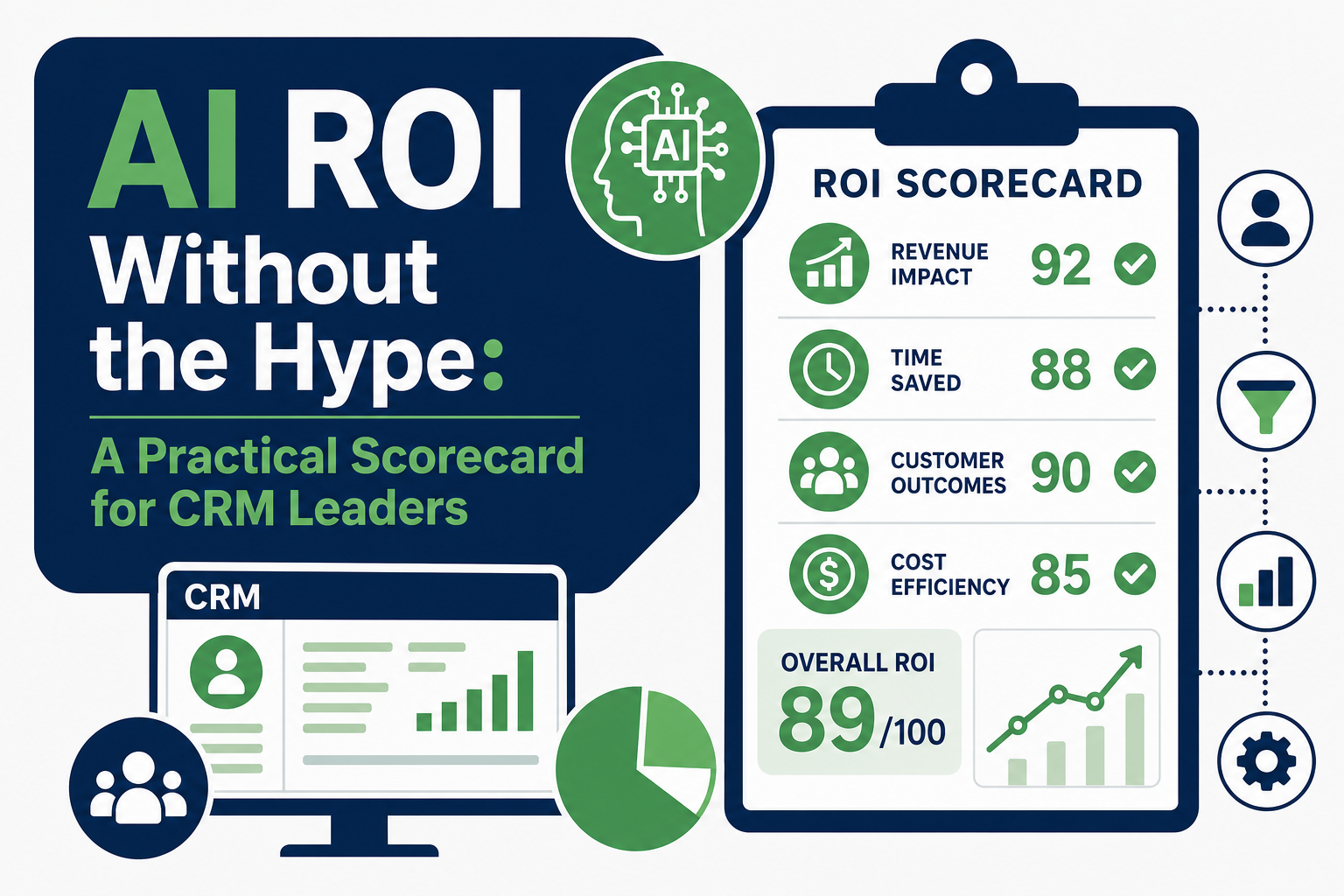
Most AI ROI conversations still lean on vague promises: "transform your business," "unlock productivity," "10x your team." None of that helps a CRM leader decide whether an AI investment is actually working. What businesses need instead is a scorecard — a small set of measurable signals that show whether AI is improving adoption, speed, data quality, service outcomes, and revenue efficiency inside the CRM they already run.
This is not another AI hype piece. It is a practical way to separate AI initiatives that are creating real operational value from ones that are just generating activity. If your team is evaluating Salesforce Einstein, Agentforce, HubSpot Breeze, or a Claude-based workflow, the same scorecard applies regardless of platform.
Quick Answer
AI ROI in CRM is the measurable value an AI feature or workflow delivers against defined operational outcomes — not a single percentage, but a scorecard across adoption, cycle time, data quality, service resolution, revenue efficiency, and governance. It matters for any business evaluating or scaling AI inside Salesforce or HubSpot, because it turns a vague "is AI worth it?" question into a decision leaders can act on with real data. Vantage Point helps CRM leaders build this scorecard, connect it to existing reporting, and design the CRM workflows and data foundation the scorecard depends on.
TL;DR
- What it is: A practical, six-category scorecard for measuring AI ROI in CRM instead of relying on generic productivity claims.
- Why it matters: Leaders need defensible evidence before scaling AI budgets, and vague ROI claims don't hold up in budget reviews.
- Best for: RevOps, IT, and CRM leaders evaluating Salesforce Einstein/Agentforce, HubSpot Breeze, or Claude-based CRM workflows.
- Decision point: Whether your current CRM data and workflows can even produce trustworthy AI ROI numbers.
- How Vantage Point helps: We help teams define the scorecard, clean up the CRM data behind it, and connect AI features to workflows that actually move the numbers — see our AI-driven personalization and analytics services.
What Is AI ROI in CRM?
AI ROI in CRM is the measurable operational and financial return generated by an AI feature, agent, or workflow embedded in your CRM platform. It is not a single ROI percentage pulled from a vendor case study. A defensible AI ROI view combines several categories of evidence: how many people actually use the feature, how much faster work gets done, whether the data feeding the AI is trustworthy, whether service outcomes improve, whether revenue-generating work becomes more efficient, and whether the AI operates inside acceptable governance and risk boundaries.
Treat AI ROI as a scorecard, not a headline number. A single statistic ("40% faster") tells you nothing about whether the underlying process is healthy, whether users trust the output, or whether the gain will hold up over time.
Why AI ROI Matters in 2026
Budget scrutiny on AI spending has increased sharply. Boards and finance leaders are asking CRM and RevOps teams to justify AI licensing costs (Salesforce Agentforce credits, HubSpot Breeze credits, Claude usage) the same way they justify any other software investment. Generic productivity claims no longer satisfy that scrutiny.
At the same time, AI features are becoming default-on inside CRM platforms, which means the real question has shifted from "should we use AI?" to "is the AI we already have paying off, and where should we expand it?" Getting this wrong in either direction is costly: under-measuring means you cut a feature that was actually working, and over-claiming means you scale an AI workflow built on bad data or broken process — which is worse once it is running at scale.
A working AI ROI scorecard also protects CRM leaders in budget conversations. When a CFO asks "what did we get for this," a defensible scorecard beats a vendor-supplied percentage every time. If your team hasn't yet established a baseline CRM ROI framework, start there — see our guide on how to measure CRM ROI before layering AI-specific measurement on top.
How the AI ROI Scorecard Works
Score each AI initiative — a Salesforce Agentforce agent, a HubSpot Breeze workflow, a Claude-powered assistant — against these six categories. You don't need every category for every initiative, but most mature AI ROI reviews touch at least four of them.
- Adoption — What percentage of intended users actually use the AI feature weekly? Low adoption is the single most common reason AI ROI claims collapse under scrutiny.
- Cycle time — Does the AI measurably shorten a defined process (lead response, case resolution, quote turnaround, contract review)? Measure the specific step, not the whole pipeline.
- Data quality impact — Is the AI improving data hygiene (deduplication, field completion, tagging) or quietly making bad data worse by scaling errors faster?
- Service resolution — For service and support use cases, does first-contact resolution or case deflection improve, and does customer satisfaction hold steady or improve alongside it?
- Revenue efficiency — Does the AI reduce the effort required to generate the same revenue outcome (more qualified pipeline per rep-hour, faster proposal cycles), rather than replacing revenue quality with volume?
- Governance and risk — Is the AI operating inside approved data-access boundaries, with audit trails and human review where required? A gain that creates compliance exposure is not a net gain.
Decision Table: Scorecard Categories at a Glance
| Category | Core Question | Good Signal | Warning Sign |
|---|---|---|---|
| Adoption | Who is actually using it? | Steady weekly active use across teams | Spiky use only right after training |
| Cycle time | Is a specific step faster? | Consistent reduction on a defined task | "Faster" claims with no baseline |
| Data quality | Is the data getting better or worse? | Fewer duplicate/incomplete records over time | AI outputs based on stale or dirty fields |
| Service resolution | Are outcomes better, not just faster? | Resolution and satisfaction both improve | Faster closes, flat or falling satisfaction |
| Revenue efficiency | Same result, less effort? | More qualified pipeline per rep-hour | More activity, same or lower close rate |
| Governance | Is it safe to scale? | Clear audit trail and human review points | No visibility into what data the AI touched |
What Businesses Should Do Next
- Start with a focused pilot if you're early. Our 30-day AI ROI quick-wins plan is a useful starting structure for Salesforce and HubSpot teams that haven't yet run a measured AI pilot.
- Baseline before you launch. You cannot prove AI improved cycle time or adoption if you never measured the "before" state. Capture baselines for at least 30–60 days prior to rollout.
- Pick one or two AI use cases to measure well rather than trying to score every AI feature at once. A focused scorecard on your highest-cost workflow (support case handling, lead qualification) produces more credible evidence than a broad, shallow rollout.
- Audit your CRM data first. Every category on this scorecard depends on clean, complete CRM data. If your records are duplicated or your fields are inconsistent, your AI ROI numbers will be unreliable regardless of which AI tool you use.
- Review governance before scaling, not after. Retrofitting audit trails and access controls onto an AI workflow that is already in production is significantly harder than building them in from the start.
- Tie the scorecard to existing reporting, not a separate AI dashboard nobody checks. If adoption and cycle-time metrics don't show up where leaders already look, they won't influence decisions.
How Vantage Point Helps
Vantage Point works with mid-market businesses running Salesforce, HubSpot, or both, to build AI ROI measurement that survives budget scrutiny — not marketing claims. That starts with the CRM data and workflow foundation the scorecard depends on. Our system integration and data migration services address the data quality category directly, cleaning up duplicate records and inconsistent fields before AI features are layered on top. Our workflow automation and process optimization services help teams identify which specific process step an AI feature should target, so cycle-time measurement is tied to a real, well-defined task rather than a vague "productivity" claim.
For teams further along, our AI-driven personalization and analytics services help connect AI-generated signals to revenue and service reporting your leadership already trusts. If your team is evaluating how this applies to Salesforce, HubSpot, integrations, or CRM governance, Vantage Point can help assess the right next step and build a practical implementation plan.
FAQ
What is a good AI ROI benchmark for CRM teams? There is no single universal benchmark, because AI ROI depends on the specific process being measured. Instead of chasing an industry-wide number, set your own baseline before rollout and track improvement against that baseline across adoption, cycle time, and data quality.
How is AI ROI different from regular CRM ROI? Regular CRM ROI typically measures platform-wide value (pipeline visibility, forecasting accuracy, overall adoption), while AI ROI isolates the incremental value of a specific AI feature or agent layered on top of the CRM. AI ROI should be measured as an addition to, not a replacement for, your existing CRM ROI framework.
Why does adoption matter more than the AI feature itself? An AI feature that performs well in testing but is barely used in practice produces no real ROI. Adoption is the gating factor for every other category in the scorecard — you cannot achieve cycle-time or revenue gains from a feature people aren't using.
Can bad CRM data ruin AI ROI even if the AI works correctly? Yes. AI models trained on or referencing duplicate, incomplete, or outdated CRM records will produce unreliable outputs regardless of how well the underlying model performs. Data quality should be addressed before or alongside AI rollout, not after ROI results disappoint.
Should Salesforce and HubSpot teams measure AI ROI differently? The six scorecard categories apply to both platforms. The specific metrics differ by platform feature (Agentforce credit usage and case deflection for Salesforce, Breeze credit usage and email/content workflows for HubSpot), but the measurement discipline is the same.
How long should we wait before measuring AI ROI? Give a new AI workflow at least one full business cycle (typically 60–90 days) before drawing conclusions. Early results are often skewed by novelty use or incomplete adoption, and short measurement windows tend to overstate or understate real impact.
What governance signals should be part of every AI ROI scorecard? At minimum, track what CRM data each AI feature can access, whether there is an audit trail of AI-generated actions, and whether a human reviews AI outputs before they reach a customer in high-stakes scenarios. A gain that creates compliance exposure should be scored as a net negative, not a win.
Do we need a dedicated AI ROI dashboard? No — in most cases, AI ROI metrics should be added to reporting your leadership already reviews (CRM dashboards, service reporting, revenue operations reviews) rather than built as a standalone tool. A separate dashboard nobody checks will not influence decisions.