
Most leaders approve a CRM budget but struggle to prove what it returned. The platform works, adoption looks fine, and yet the finance team still asks: "What did we actually get for this?"
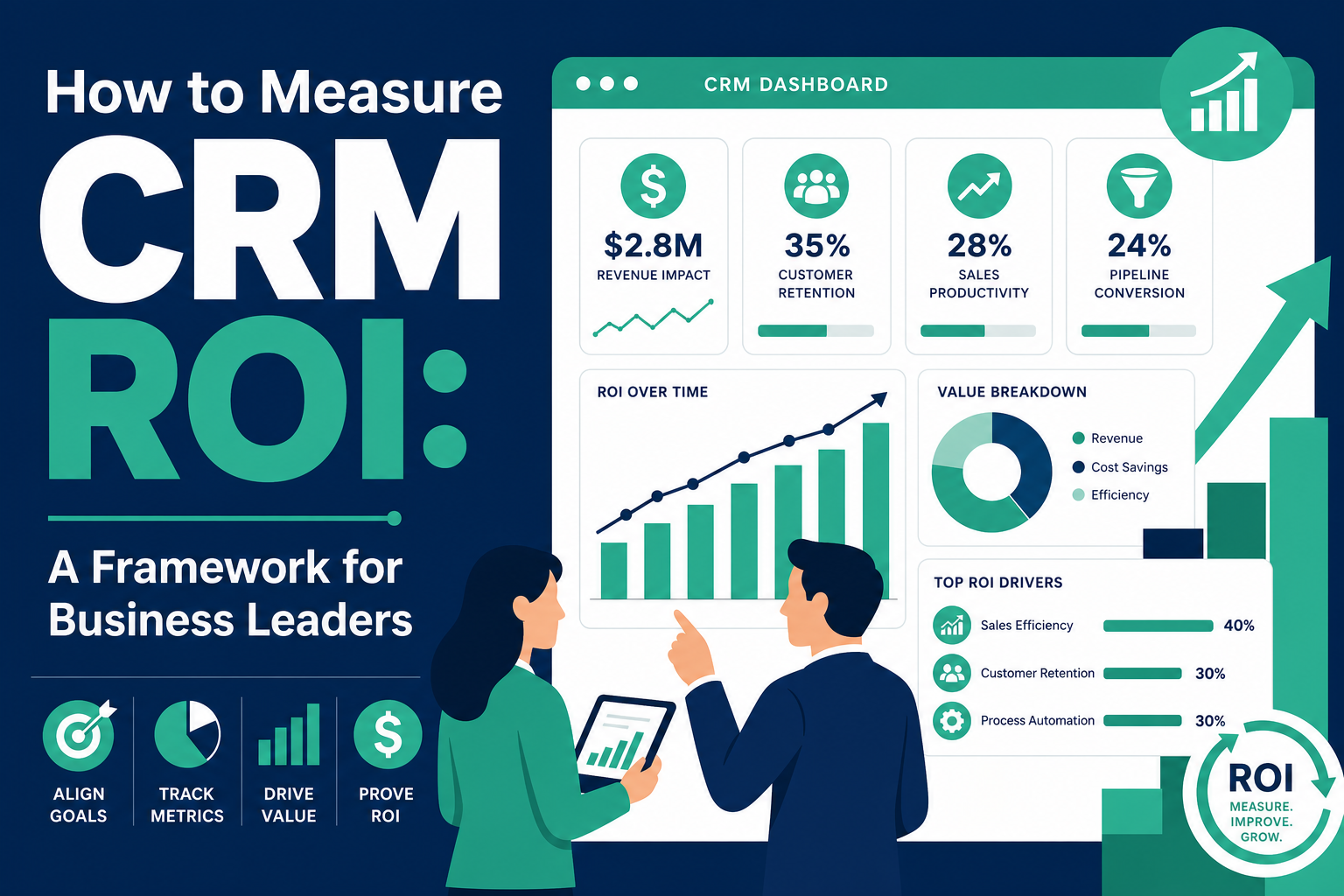
Measuring CRM ROI is not guesswork. It is a structured comparison of the total cost of owning your CRM against the measurable value it creates — faster sales cycles, higher win rates, lower service costs, cleaner data, and reclaimed employee time. The challenge is that most of those gains are spread across teams and easy to overlook.
This guide gives business leaders a practical framework to measure CRM ROI: what to count on the cost side, what to count on the value side, and how to set a baseline so the numbers hold up in a budget review.
Quick Answer
CRM ROI is the net financial value your CRM creates divided by its total cost of ownership, expressed as a percentage or payback period. It matters for executives, RevOps leaders, and finance teams who need to justify CRM spend, prioritize improvements, or decide whether to expand, consolidate, or replace a platform. To measure it credibly, set a pre-CRM baseline, track total cost of ownership (licenses, implementation, admin, and integration), and quantify value across revenue, productivity, retention, and risk. Vantage Point helps organizations build CRM ROI models and tie Salesforce and HubSpot investments to measurable business outcomes.
TL;DR
- What it is: CRM ROI measures the net value your CRM produces against its total cost of ownership, not just license fees.
- Why it matters: Leaders need defensible numbers to justify spend, prioritize fixes, and decide whether to expand or consolidate platforms.
- Best for: Executives, RevOps, finance, and operations leaders who own or fund CRM systems.
- Decision point: Measure value across four buckets — revenue, productivity, retention, and risk — against a real baseline.
- How Vantage Point helps: We build CRM ROI models and connect Salesforce and HubSpot investments to outcomes leaders can defend.
What Is CRM ROI?
CRM ROI is the return on investment generated by your customer relationship management platform, calculated as net value created divided by total cost of ownership. A simple version looks like this:
CRM ROI (%) = (Value Created − Total Cost of Ownership) ÷ Total Cost of Ownership × 100
The hard part is not the formula. It is defining "value created" honestly and capturing every cost. Many CRM business cases overstate value by counting hoped-for revenue, or understate cost by ignoring admin time and integration work. A credible model does both sides carefully and compares them to a baseline measured before the CRM was in place — or before the last major change.
Why CRM ROI Matters in 2026
CRM is now the operational backbone for sales, marketing, and service. Budgets have grown, and so has scrutiny. In 2026, three forces make CRM ROI a board-level question:
- AI investment decisions. Leaders are being asked to fund AI features, agents, and automation layered on top of CRM. You cannot evaluate AI value without a baseline for what the underlying CRM already returns.
- Platform consolidation pressure. Many organizations run overlapping tools. Measuring ROI per platform reveals what to keep, merge, or retire.
- Adoption and data quality. A CRM only returns value when people use it and the data is trustworthy. ROI measurement exposes whether low adoption or dirty data is quietly destroying the return.
Treating CRM as a cost center invites cuts. Treating it as a measurable investment lets you defend and grow it.
How to Measure CRM ROI: The Framework
Use a four-step framework. Do the cost side and value side separately, then compare against a baseline.
Step 1 — Set a Baseline
You cannot prove improvement without a "before" number. Capture baseline metrics for the period before your CRM or before the change you are evaluating:
- Average sales cycle length
- Win rate and average deal size
- Lead-to-opportunity conversion rate
- Customer retention or churn rate
- Average cost to serve a customer
- Hours per week spent on manual data entry and reporting
If you have no clean baseline, use the earliest reliable CRM data or an industry-neutral internal estimate — and label it clearly as an estimate.
Step 2 — Calculate Total Cost of Ownership (TCO)
TCO is more than license fees. Count every recurring and one-time cost:
| Cost Category | What to Include |
|---|---|
| Licenses & subscriptions | Per-seat fees, add-on products, premium AI/feature tiers |
| Implementation | Configuration, customization, data migration, initial setup |
| Integration | Connectors, middleware, API development, ongoing maintenance |
| Administration | Internal admin salaries, external managed services, support |
| Training & adoption | Onboarding, enablement, change management, documentation |
| Opportunity cost | Time lost to downtime, rework, or poor data |
Underestimating TCO is the most common way CRM ROI models become indefensible. Admin time and integration upkeep are real costs.
Step 3 — Quantify Value Across Four Buckets
Spread value across four categories so you do not over-rely on a single hard-to-prove number.
| Value Bucket | Example Measures | How to Quantify |
|---|---|---|
| Revenue impact | Higher win rate, larger deals, shorter cycles, less leakage | Compare conversion and cycle metrics to baseline; apply to pipeline value |
| Productivity gains | Less manual entry, faster reporting, automation | Hours saved × loaded hourly cost |
| Retention & growth | Lower churn, more upsell, better service response | Retained revenue and expansion vs. baseline churn |
| Risk & compliance | Fewer errors, audit readiness, data governance | Cost of avoided errors, penalties, or rework |
Be conservative. It is better to present defensible, slightly understated value than aggressive numbers a CFO can poke holes in.
Step 4 — Calculate ROI and Payback Period
With TCO and value defined, calculate two figures leaders care about:
- ROI % = (Annual Value − Annual TCO) ÷ Annual TCO × 100
- Payback period = Total upfront cost ÷ monthly net value
Payback period often resonates more with executives than a percentage. "This pays for itself in 11 months" is easy to act on.
CRM ROI Metrics That Actually Matter
Skip vanity metrics. These are the measures that connect CRM to financial outcomes:
- Pipeline velocity — how fast deals move from stage to stage
- Win rate change — before vs. after CRM or process improvement
- Cost to serve — service hours and cost per resolved case
- Forecast accuracy — variance between forecast and actuals
- Data quality rate — percentage of complete, deduplicated, valid records
- User adoption rate — active users and key-action completion
- Time-to-value on new features — how quickly investments produce results
If you cannot tie a metric to revenue, cost, or risk, it probably does not belong in your ROI model.
Common CRM ROI Mistakes to Avoid
- Counting only license fees. Implementation, admin, and integration costs are real — include them.
- No baseline. Without a "before" number, every improvement claim is debatable.
- Over-crediting the CRM. Separate CRM impact from market conditions and other initiatives where possible.
- Ignoring adoption. A platform nobody uses returns nothing, no matter how capable it is.
- Skipping data quality. Bad data quietly erodes every downstream value claim.
- One-time measurement. ROI should be tracked over time, not calculated once and forgotten.
What Businesses Should Do Next
- Pick a clear measurement window — typically 12 months — and lock your baseline.
- Build your TCO table with finance, including admin and integration costs.
- Assign owners to each value bucket so measurement is not one person's guess.
- Audit adoption and data quality first; fix obvious gaps before claiming ROI.
- Report ROI and payback in plain financial terms leaders can act on.
- Re-measure each year and after major changes, such as new AI features or integrations.
If your numbers reveal weak adoption, messy data, or heavy admin cost, those are the highest-leverage places to improve return before spending more.
How Vantage Point Helps
Vantage Point helps organizations turn CRM from a line item into a measurable investment. We build practical ROI models, baseline the right metrics, and connect Salesforce and HubSpot programs to outcomes leaders can defend in a budget review.
- Improve return by fixing adoption and process gaps through CRM and marketing automation strategy and advisory and change management.
- Reduce total cost of ownership and admin burden with managed services and ongoing support.
- Protect value by cleaning and unifying records through system integration and data migration.
If your team is evaluating CRM ROI across Salesforce, HubSpot, integrations, or AI investments, Vantage Point can help you build a defensible model and a practical plan to raise the return.
FAQ
What is a good CRM ROI?
A good CRM ROI is a positive net return within a reasonable payback period — often under 18 months for well-adopted platforms. The exact benchmark depends on your industry, deal size, and how heavily you rely on the CRM, so compare results to your own baseline rather than a generic target.
How do you calculate CRM ROI?
Subtract total cost of ownership from the value the CRM creates, divide by total cost of ownership, and multiply by 100. The credibility comes from defining value across revenue, productivity, retention, and risk, and from counting every cost — not just license fees.
What costs should be included in CRM total cost of ownership?
Include licenses and subscriptions, implementation, integration, administration, training and adoption, and opportunity costs like downtime or rework. Leaving out admin time and integration upkeep is the most common reason CRM ROI models fail review.
How long does it take to see ROI from a CRM?
Many organizations see measurable returns within 6 to 18 months, depending on adoption, data quality, and how much process change accompanies the rollout. Quick wins often come from automation and reporting; deeper revenue gains take longer to mature.
Why is adoption important for CRM ROI?
A CRM only returns value when people use it consistently and enter trustworthy data. Low adoption is one of the fastest ways to destroy ROI, which is why measuring adoption and data quality is part of any honest ROI assessment.
Can you measure CRM ROI without a baseline?
It is much harder, but possible with the earliest reliable CRM data or a clearly labeled internal estimate. Without any baseline, improvement claims become debatable, so capturing or reconstructing "before" metrics should be your first step.
How does CRM ROI relate to AI investments?
AI features and agents add cost and potential value on top of your CRM, so you need a CRM baseline before you can measure AI's incremental return. Vantage Point helps organizations evaluate where AI-driven personalization and analytics genuinely improves CRM ROI versus adding cost.