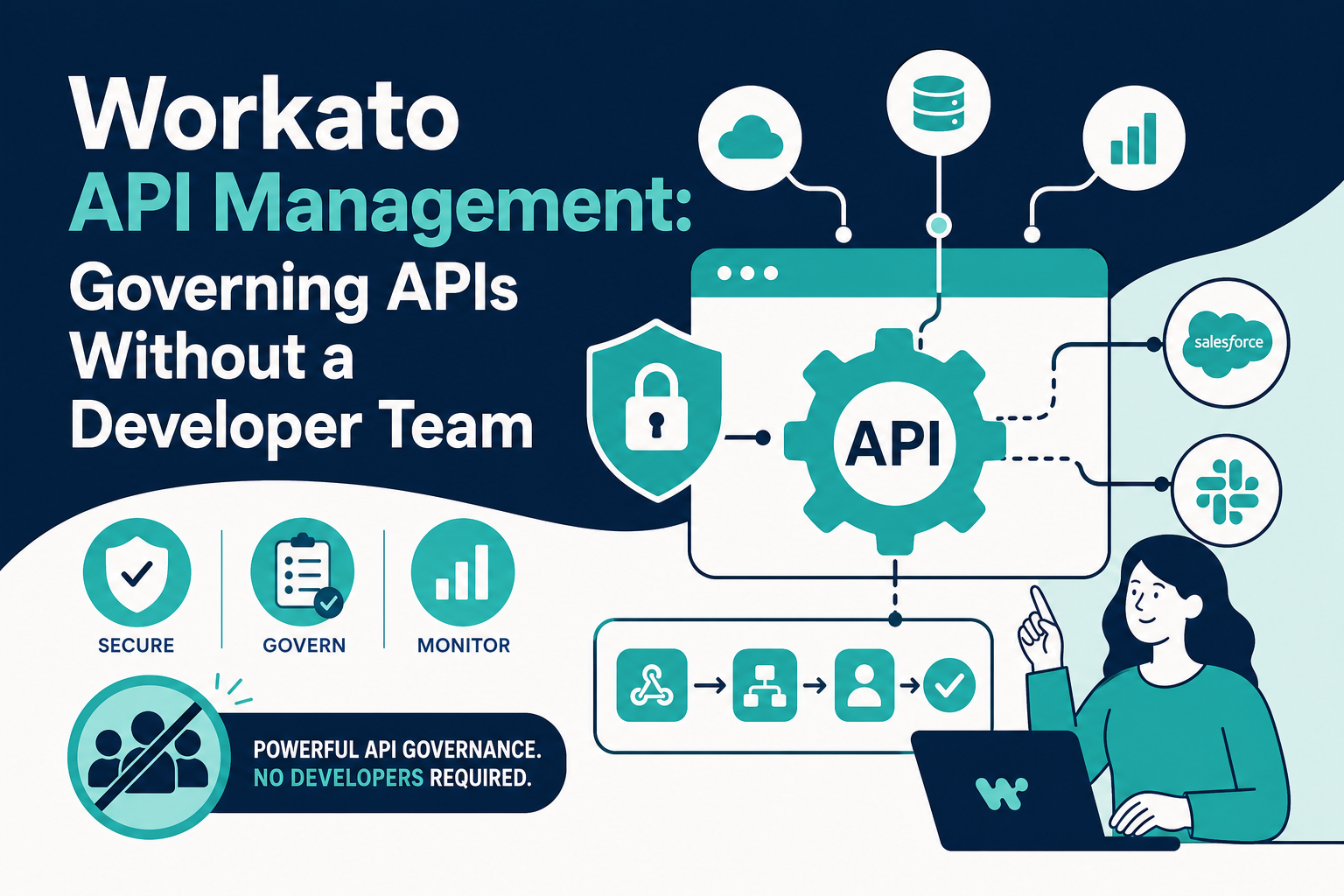
Most mid-size organizations need to expose and consume APIs, but few have a dedicated API development team. Workato's API Management platform lets integration and operations teams build, secure, and govern APIs using the same low-code recipe model they already use for automation — without hand-coding a gateway from scratch.
Quick Answer
Workato API Management is a unified platform for building, securing, and governing APIs using low-code tools instead of custom developer infrastructure. It matters for IT and operations leaders who need API governance but don't have a dedicated development team to build one. This article helps readers decide whether Workato's API Management fits their needs and how to structure governance around it. Vantage Point is relevant because we implement Workato, including API Management, as part of broader integration strategy work.
TL;DR
- What it is: A low-code API gateway and governance layer built into the Workato platform.
- Why it matters: It lets teams without dedicated developers still enforce security, rate limiting, and access controls on the APIs they expose.
- Best for: Mid-size organizations that need governed APIs but lack a full API engineering team.
- Decision point: Whether your current API exposure — internal or external — has any consistent security or monitoring layer today.
- How Vantage Point helps: We design and implement API governance through our system integration and data migration services.
What Is API Management?
API management is the practice of controlling how APIs are published, secured, monitored, and consumed, typically through a gateway that sits between API consumers and the underlying systems. A complete API management setup generally includes an API gateway, a developer portal for documentation, and reporting on usage and errors.
Why API Management Matters in 2026
As more business processes depend on data moving between systems — CRM, ERP, finance, and now AI agents — unmanaged APIs become a real risk. Without governance, teams often don't know which APIs exist, who's calling them, or what happens if a call spikes unexpectedly. This matters more in 2026 because AI agents increasingly call APIs directly and at higher volume than human-driven integrations did, making rate limiting and monitoring more important, not less.
How Workato API Management Works
Workato's approach folds API management into the same low-code environment used for recipes, rather than requiring a separate developer-focused gateway product. Core capabilities include:
- API gateway functionality to publish and expose APIs built from existing Workato recipes.
- Policy enforcement including rate limiting, quotas, and threat protection to keep endpoints stable and secure.
- Role-based access control so only approved users or systems can call sensitive endpoints.
- Activity logging and auditing to track who called what, when, and with what result.
- Versioning so API consumers aren't broken when an underlying recipe changes.
Because it's built on the same platform as Workato's automation recipes, teams that already use Workato for integration work can extend that same skill set to managing APIs, rather than learning a separate developer tool.
Do You Need Dedicated API Governance? A Decision Guide
| Situation | Recommendation |
|---|---|
| A handful of internal APIs, low call volume, no external partners | Basic monitoring may be sufficient for now |
| Multiple departments or partners calling shared APIs | Formal governance with rate limiting and access control is warranted |
| APIs feeding AI agents or automated decision-making | Governance is essential — agent-driven calls can spike volume unpredictably |
| Regulated data flowing through APIs | Full audit logging and access control are required, not optional |
What Businesses Should Do Next
- Inventory every API currently exposed, internally and externally, along with who owns each one.
- Identify which APIs have no rate limiting or access control today — these are the highest-risk starting points.
- Decide whether existing Workato usage makes API Management a natural extension, or whether a dedicated gateway product is a better fit.
- Set logging and audit requirements before exposing any new API that touches sensitive or regulated data.
- Review AI agent integrations specifically, since agent-driven API calls often bypass the assumptions built into older, human-paced governance rules.
How Vantage Point Helps
Vantage Point helps organizations design practical API governance without requiring a dedicated developer team. Our system integration and data migration practice implements Workato API Management alongside broader integration architecture, and our compliance and security solutions team ensures access controls and audit logging meet your regulatory requirements. If you're comparing Workato to other integration platforms, our guide on Workato vs. MuleSoft for CRM integration breaks down where each tool fits.
If your team is evaluating how to govern a growing number of internal and external APIs, Vantage Point can help assess the right approach and build a practical implementation plan.
FAQ
What is Workato API Management? Workato API Management is a low-code platform for building, securing, and governing APIs, using the same recipe-based tools Workato uses for general automation, rather than a separate developer-focused gateway.
Do I need a dedicated developer team to use Workato API Management? No. Workato API Management is specifically designed for teams without dedicated API developers, using low-code tools that integration and operations staff can manage directly.
What is the difference between an API gateway and full API management? An API gateway routes and secures API calls, while full API management adds a developer portal, usage reporting, versioning, and lifecycle management on top of the gateway layer.
Why does API governance matter more with AI agents in the mix? AI agents can call APIs at a much higher and less predictable volume than human-driven processes, making rate limiting, monitoring, and access control more important to prevent outages or unexpected costs.
Can Workato API Management handle external partner APIs, not just internal ones? Yes. It supports policy enforcement, access control, and versioning for both internal and externally exposed APIs, making it suitable for partner integrations as well as internal system connections.
How does role-based access control work in Workato API Management? Role-based access control lets administrators restrict which users, systems, or partner accounts can call specific API endpoints, reducing the risk of unauthorized access to sensitive data.
Is Workato API Management a replacement for MuleSoft? Not necessarily — the two platforms overlap but serve different use cases and organizational maturity levels. Many organizations evaluate both based on existing tooling, team skill sets, and integration complexity.
How do we get started governing APIs if we have none today? Start with an inventory of every exposed API and its current security posture, then prioritize adding governance to the highest-risk endpoints first — particularly any handling regulated data or feeding AI agents.