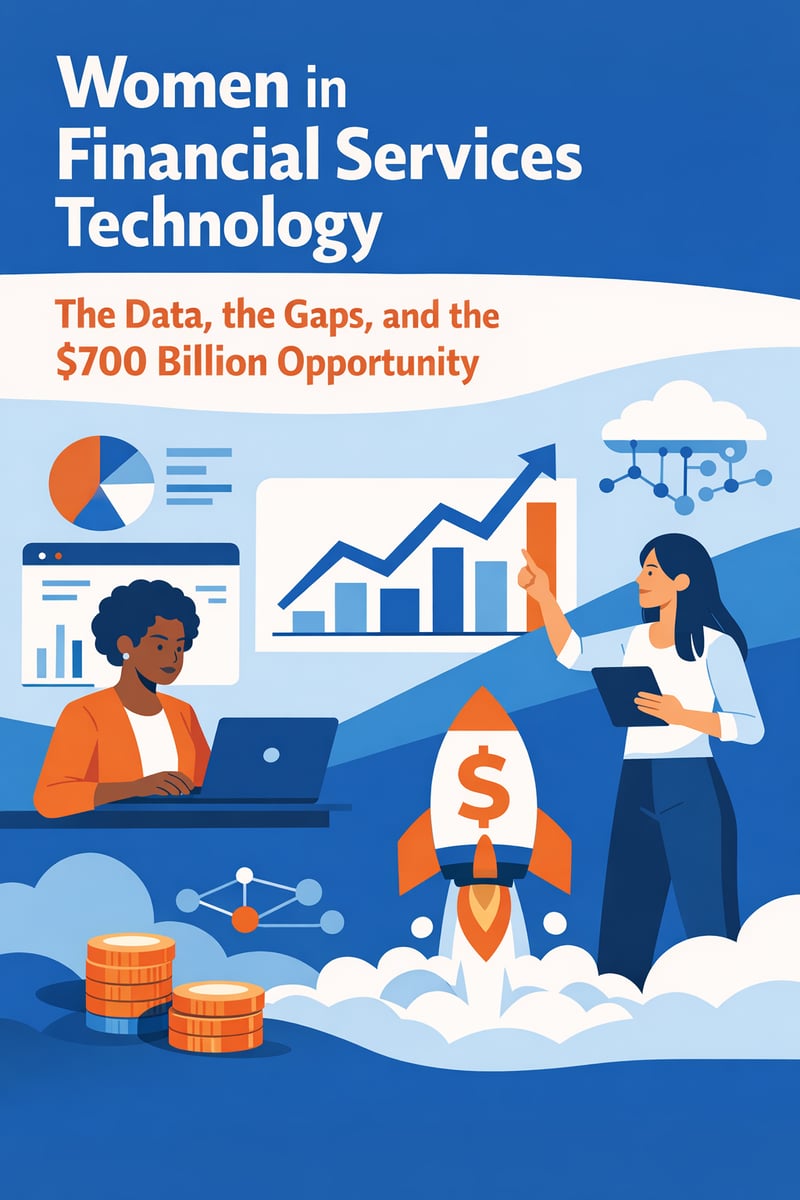
Women in Financial Services Technology: The Data, the Gaps, and the $700 Billion Opportunity
TL;DR / Key Takeaways
What is it? A data-driven analysis of women's representation in financial services technology — and the massive business opportunity firms are missing Key Stat Women hold just 16% of top banking leadership roles and only 26% of revenue-generating positions The Gap $700 billion+ in untapped economic potential from women's financial exclusion globally Best For Financial services firms, RIAs, fintechs, and CRM leaders building inclusive organizations Bottom Line Gender equity isn't just a moral imperative — it's a competitive advantage that drives innovation, client retention, and revenue growth
Part 1 of 4 in our International Women's Day 2026 series | #GiveToGain
The Numbers Don't Lie — But They Do Disappoint
As International Women's Day 2026 approaches, the financial services technology sector finds itself at an inflection point. Progress is real — but painfully slow.
Here's where we stand:
Leadership Representation
| Level | Women's Share | Trend |
|---|---|---|
| Top banking leadership | 16% | All-time high, but barely moving |
| Deputy governors / C-suite | 28% | Slow, steady growth |
| Senior staff | 32% | Modest improvement |
| Commercial bank C-suite | 19% | Recovering from 2024 setback |
| Executive committee seats | 29% | Incremental gains |
| Revenue-generating (P&L) roles | 26% | Critical pipeline bottleneck |
The revenue-generating roles number is the one that should concern every firm. These are the positions that lead to CEO chairs — and with only 26% of women holding them, the leadership pipeline is structurally constrained for the next decade.
The Pay Reality
The controlled gender pay gap — comparing men and women in identical roles with equal qualifications — has narrowed to just one cent. That's genuine progress.
But the uncontrolled gap tells a different story: women globally earn $0.83 for every dollar men earn. The difference isn't about pay discrimination in equivalent roles — it's about which roles women have access to in the first place.
In financial services specifically: - Only 18.6% of UK financial services senior executives are women - Women hold just 12% of STEM C-suite roles despite comprising 47% of the entry-level workforce - The share of women in US corporate leadership actually fell in 2025 amid DEI rollbacks
What Financial Services Professionals Say Matters Most
When surveyed about the most critical themes for women in banking over the next decade, professionals responded:
| Priority | % of Respondents |
|---|---|
| Women in upper management | 45% |
| Work-life balance & benefits | 21% |
| Equal growth opportunities | 18% |
| Upskilling & education access | 16% |
The message is clear: representation in leadership isn't just a talking point — it's the industry's top priority.
The $700 Billion Financial Inclusion Gap
Beyond leadership representation, there's a massive global opportunity hiding in plain sight: approximately 700 million women worldwide still lack access to banking services.
Recent progress has been encouraging: - Women's formal savings in low- and middle-income countries rose from 22% to 36% (2021–2024) - Digital payment usage among women jumped from 50% to 58% - 60% of first-time female account holders opened accounts to receive digital payments from governments or employers
This isn't just a social justice issue — it's a market opportunity. Every woman who gains access to financial services becomes a potential client, investor, and economic contributor. For firms building CRM and technology platforms, this represents an enormous addressable market.
Why This Matters for Financial Services Technology
If you're a financial services firm evaluating your technology stack, the gender equity conversation connects directly to three business imperatives:
1. Client Experience and Retention
Women control or influence an estimated 85% of consumer spending and are the fastest-growing segment of wealth accumulators. With the $84 trillion intergenerational wealth transfer underway, firms that fail to design inclusive client experiences will lose market share to those that do.
CRM platforms like Salesforce Financial Services Cloud and HubSpot enable firms to: - Design personalized onboarding journeys that account for diverse client needs - Track and measure client satisfaction across demographic segments - Automate compliance workflows that ensure equitable treatment - Build reporting dashboards that surface representation gaps in real time
2. Talent Acquisition and Retention
In a market where 40% of financial advisors are approaching retirement, firms can't afford to exclude half the talent pool. Organizations with diverse leadership teams consistently outperform their peers — McKinsey's data shows companies in the top quartile for gender diversity are 25% more likely to have above-average profitability.
Technology enables inclusive workplaces through: - Flexible work arrangements powered by cloud CRM (access client data anywhere) - Transparent performance tracking that reduces bias in promotions - Mentorship matching through internal platforms and communities - AI-assisted recruitment that focuses on skills over demographics
3. Regulatory and Compliance Advantage
Regulatory bodies worldwide are increasing scrutiny on diversity metrics. The EU's Corporate Sustainability Reporting Directive (CSRD) now requires gender pay gap and board diversity disclosures. The SEC has expanded examination priorities around fiduciary duty and equitable client treatment.
Firms with strong CRM infrastructure can: - Generate compliance-ready diversity reports automatically - Track equitable distribution of investment recommendations - Document fair treatment across all client interactions - Demonstrate commitment to regulators during examinations
The Salesforce and HubSpot Ecosystem Response
Both major CRM platforms have made meaningful commitments:
Salesforce has invested heavily in equality: - The Salesforce Women's Network spans 40 hubs worldwide with 25% of employees as members — the largest and first equality group at the company - Salesforce conducts annual pay equity audits and reports that employees in similar jobs are paid on par across genders globally and race in the US - The "Women Who Redefine" initiative highlights women leaders transforming business and technology - Salesforce's equality groups have driven policy changes including expanded parental leave and flexible work arrangements
HubSpot has positioned itself as an inclusive employer: - Named one of the best workplaces for women repeatedly - Published transparency reports on demographic representation - Built inclusive product features like gender-neutral form fields and accessibility compliance tools
For financial services firms evaluating CRM platforms, these ecosystem commitments matter. They signal that the platforms themselves are investing in the communities that will drive innovation and support.
What Forward-Thinking Firms Are Doing Now
The firms pulling ahead aren't waiting for regulation to force their hand. They're:
- Auditing their data — Using CRM analytics to measure representation in client-facing roles, promotion rates, and compensation equity
- Building inclusive client journeys — Designing onboarding, communication, and service flows that work for all clients
- Investing in mentorship technology — Implementing internal matching platforms that connect emerging women leaders with senior sponsors
- Measuring what matters — Creating dashboards that track diversity metrics alongside revenue, retention, and satisfaction
- Choosing partners who share their values — Working with consultancies and technology partners committed to equity
Looking Ahead: The Business Case Is Irrefutable
The data is unambiguous: organizations that invest in gender equity perform better financially, retain talent more effectively, and build stronger client relationships.
As we approach International Women's Day 2026, the question for financial services firms isn't whether to prioritize gender equity — it's how quickly they can embed it into their technology, processes, and culture.
The firms that move fastest will attract the best talent, win the largest share of the wealth transfer, and build the most resilient organizations. The tools exist. The data supports it. The time is now.
This is Part 1 of Vantage Point's International Women's Day 2026 series. Tomorrow: Women Leaders Shaping the Salesforce and HubSpot Ecosystems.
Frequently Asked Questions
What percentage of financial services leadership roles are held by women?
Women hold approximately 16% of top banking leadership positions globally (a record high in 2025), 28% of deputy governor and C-suite roles, and 19% of commercial bank C-suite positions. Only 26% of revenue-generating roles — the primary pathway to CEO — are held by women.
How does the gender pay gap look in financial services in 2026?
The controlled pay gap (same role, same qualifications) has narrowed to about one cent. However, the uncontrolled gap remains significant at $0.83 per dollar, driven primarily by women's underrepresentation in senior and revenue-generating roles rather than direct pay discrimination.
Why should financial services firms care about gender equity from a technology perspective?
CRM and AI platforms enable firms to measure representation gaps, design inclusive client journeys, automate equitable compliance workflows, and track diversity metrics alongside business performance. Women control or influence 85% of consumer spending and are central to the $84T wealth transfer.
What is Salesforce doing to advance gender equity?
Salesforce maintains the Women's Network (40 global hubs, 25% of employees), conducts annual pay equity audits, runs the "Women Who Redefine" initiative, and has implemented policies including expanded parental leave and flexible work arrangements. They report gender pay parity for employees in similar roles globally.
How does the 700 million unbanked women figure translate to a business opportunity?
Every unbanked woman who gains financial access becomes a potential client, saver, and investor. With formal savings among women in developing countries rising from 22% to 36% between 2021-2024, financial services firms and fintechs that build inclusive products for this market have access to one of the largest untapped customer segments globally.
About Vantage Point: We help financial services firms, healthcare organizations, and regulated businesses implement Salesforce and HubSpot CRM solutions that drive growth, ensure compliance, and deliver exceptional client experiences. Learn more at vantagepoint.io