Key Takeaways (TL;DR)
- What is it? A deep dive into how Vantage Point's senior-led, AI-augmented consulting model delivers CRM success in organizations facing heavy compliance, regulatory, and data governance requirements
- Key Benefit: Faster, more secure CRM implementations that meet stringent compliance standards — without sacrificing speed or innovation
- Best For: Organizations in any industry with complex regulatory obligations, data security concerns, or multi-system integration needs
- Differentiator: 100% senior-level team with 400+ engagements and 95% client retention — no junior handoffs, no offshore surprises
- Bottom Line: When compliance isn't optional and failure isn't affordable, Vantage Point's unique model eliminates the risks that derail CRM projects in regulated environments
Introduction: When Compliance Complexity Meets CRM Ambition
Every organization today faces some level of regulatory pressure. Whether it's GDPR, CCPA, SOX, HIPAA, PCI-DSS, or industry-specific mandates, the rules governing how businesses collect, store, process, and share customer data have never been more complex — or more consequential.
According to Capterra's 2026 Sales and Marketing Software Trends Report, 60% of decision-makers now rate security as "critical" when evaluating new CRM software — ranking it above functionality, ease of use, and even price. Meanwhile, 50% of buyers have removed CRM vendors from consideration entirely due to security concerns.
For organizations operating in compliance-heavy environments, CRM implementation isn't just a technology project — it's a risk management exercise. A single misconfigured permission, an unencrypted data flow, or an overlooked audit trail gap can trigger regulatory penalties, reputational damage, and operational disruption.
This is exactly where Vantage Point thrives.
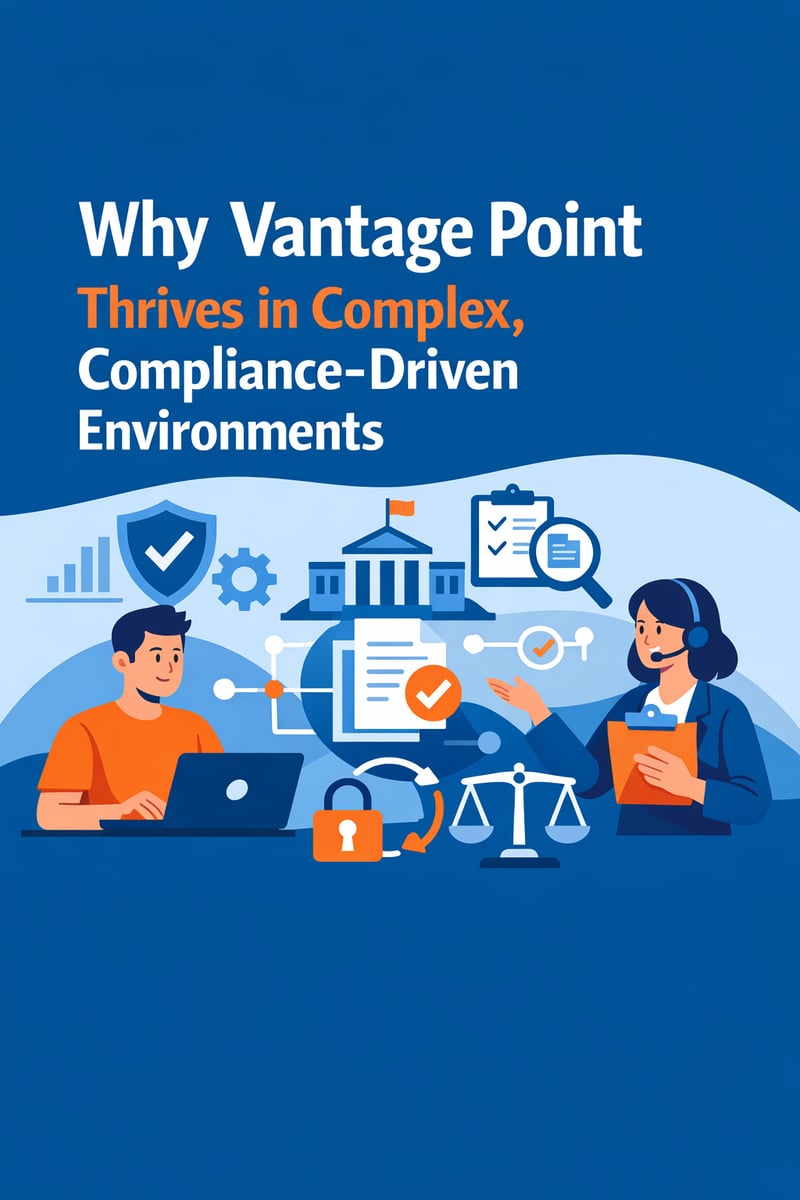
In this article, you'll learn why complex, compliance-driven CRM environments demand a fundamentally different consulting approach — and how Vantage Point's senior-led, AI-augmented model delivers results where traditional firms struggle.
What Makes Compliance-Driven CRM Environments So Challenging?
The Regulatory Landscape Is Expanding
The compliance burden on businesses has grown dramatically. In 2026 alone, organizations must navigate:
- Data privacy regulations — GDPR (EU), CCPA/CPRA (California), and a growing patchwork of state-level privacy laws across the U.S.
- Financial reporting and controls — SOX compliance for public companies, SEC reporting requirements
- Data security standards — PCI-DSS for payment data, ISO 27001 for information security management
- Industry-specific mandates — HIPAA for healthcare data, FINRA/SEC for financial services, FedRAMP for government contractors
- AI governance — Emerging regulations around automated decision-making, algorithmic transparency, and AI-driven customer interactions
Each regulation imposes specific requirements on how CRM systems handle data — and non-compliance can cost millions. GDPR fines alone can reach €20 million or 4% of global annual revenue, whichever is higher.
Why Traditional CRM Consulting Falls Short
Most CRM consulting firms approach implementations with a standard playbook: gather requirements, configure the platform, migrate data, train users, and hand off. This works for straightforward deployments, but compliance-driven environments introduce layers of complexity that break the traditional model:
| Challenge | Traditional Approach | Compliance Reality |
|---|---|---|
| Data Architecture | Standard objects and fields | Field-level encryption, data classification, retention policies |
| Access Controls | Basic role hierarchies | Zero-trust architecture, least-privilege access, conditional permissions |
| Audit Requirements | Minimal logging | Complete audit trails, data lineage tracking, change documentation |
| Integration Security | API connections | Encrypted data flows, consent propagation, cross-system compliance |
| User Training | Feature walkthroughs | Compliance awareness, data handling protocols, security hygiene |
| Change Management | Adoption metrics | Regulatory impact assessments, compliance sign-offs, documentation |
When junior consultants or offshore teams encounter these requirements, projects stall. Requirements get misunderstood. Security gaps appear. Timelines stretch. Costs escalate.
How Vantage Point Is Built for Compliance Complexity
Senior Experts — Every Engagement, Every Time
Vantage Point's most fundamental differentiator is its 100% senior-level team. Unlike traditional consulting firms that sell senior talent in the pitch and deliver junior resources on the project, Vantage Point guarantees that the team you meet is the team that delivers.
This isn't just a staffing philosophy — it's a compliance advantage:
- Senior consultants understand regulatory context. They don't just configure CRM features; they understand why specific data handling, access control, and audit requirements exist.
- Fewer handoffs mean fewer security gaps. Every time a project passes between team members, institutional knowledge is lost and security risks increase. Vantage Point's model eliminates this.
- Faster, more accurate scoping. Senior experts identify compliance requirements during discovery — not halfway through development, when rework is expensive.
With 400+ completed engagements, a 95% client retention rate, and a 4.71/5.0 client satisfaction rating, Vantage Point's model consistently delivers in environments where other firms struggle.
AI-Augmented Delivery — Speed Without Sacrifice
Vantage Point uses AI to do what nearshore teams used to do — accelerating delivery without compromising quality or security. This AI-augmented approach means:
- Faster documentation and configuration — AI tools accelerate the development of compliance documentation, data dictionaries, and configuration specifications
- Automated testing and validation — AI-powered testing ensures that security configurations, permission sets, and data access rules work as intended before go-live
- Accelerated code review — AI assists senior developers in reviewing Apex, Flows, and integration code for security vulnerabilities and compliance gaps
- Cost efficiency — AI augmentation keeps project costs competitive with offshore models while maintaining the quality and security rigor of a senior-led team
Zero-Trust CRM Architecture
In 2026, zero-trust architecture is no longer optional for compliance-driven organizations. Vantage Point implements zero-trust principles across every CRM deployment:
Identity Verification
- Multi-factor authentication (MFA) enforcement
- Single sign-on (SSO) integration with enterprise identity providers
- Conditional access policies based on device, location, and risk score
Least-Privilege Access
- Granular permission sets aligned to job functions
- Field-level security for sensitive data elements
- Time-based and context-aware access controls
Continuous Monitoring
- Real-time event monitoring and anomaly detection
- Login history tracking and session management
- Automated alerts for suspicious access patterns
Data Protection
- Platform encryption for data at rest
- TLS 1.3 for data in transit
- Shield Platform Encryption for organizations requiring BYOK (Bring Your Own Key) capabilities
What Does a Compliance-First CRM Implementation Look Like?
Phase 1: Compliance-Aware Discovery
Before a single line of configuration is written, Vantage Point conducts a compliance-aware discovery process:
- Regulatory mapping — Identify all applicable regulations and their specific CRM implications
- Data classification — Categorize every data element by sensitivity level (public, internal, confidential, restricted)
- Access modeling — Design role hierarchies, permission sets, and sharing rules that enforce least-privilege access
- Integration audit — Assess every connected system for data flow security and compliance alignment
- Risk assessment — Identify potential compliance gaps and develop mitigation strategies
Phase 2: Secure Architecture Design
Vantage Point designs CRM architectures that embed compliance into the platform's DNA:
- Data residency controls — Ensure data is stored in compliant geographic locations
- Encryption strategy — Implement field-level encryption for sensitive data with proper key management
- Audit trail architecture — Configure comprehensive logging for all data access, modifications, and exports
- Consent management — Build consent collection, storage, and propagation into every customer touchpoint
- Retention and deletion — Automate data retention policies and right-to-erasure workflows
Phase 3: Secure Build and Test
During implementation, security and compliance are verified at every stage:
- Code security reviews — All custom code is reviewed for OWASP vulnerabilities, injection risks, and data exposure
- Permission validation — Automated testing confirms that every user role can access only what they should
- Integration testing — Data flows between systems are validated for encryption, consent propagation, and error handling
- Penetration testing — For high-security environments, Vantage Point coordinates with third-party security firms for independent validation
Phase 4: Compliance Documentation and Training
Go-live includes comprehensive compliance deliverables:
- System security documentation — Complete documentation of all security configurations, access controls, and data handling procedures
- Compliance mapping — Documentation showing how the CRM implementation satisfies specific regulatory requirements
- User training — Role-specific training that covers not just how to use the CRM, but how to handle data compliantly
- Incident response procedures — Documented procedures for data breaches, unauthorized access, and compliance violations
The Technology Stack: Salesforce, HubSpot, and Beyond
Salesforce for Complex Compliance
Vantage Point is a certified Salesforce consulting partner with deep expertise across the Salesforce ecosystem:
- Sales Cloud & Service Cloud — Core CRM with enterprise-grade security, configurable to meet virtually any compliance requirement
- Salesforce Shield — Event Monitoring, Field Audit Trail, and Platform Encryption for organizations needing the highest security levels
- Data Cloud — Unified customer data platform with built-in consent management and data governance
- Experience Cloud — Secure portals for customers, partners, and employees with fine-grained access controls
- Agentforce — AI-powered automation that operates within defined compliance boundaries
HubSpot for Growing Organizations
For organizations that need powerful CRM with simpler compliance requirements, Vantage Point implements HubSpot with full security rigor:
- Role-based access controls — Configured to enforce organizational data access policies
- Data privacy tools — GDPR and CCPA compliance features including consent management, data deletion, and communication preferences
- Audit logging — Complete activity tracking for compliance documentation
- SSO integration — Enterprise identity management for secure access
Integration Excellence with MuleSoft
Most compliance-driven organizations have complex, multi-system environments. Vantage Point leverages MuleSoft to build secure, governed integrations:
- API-led connectivity — Structured integration architecture with security at every layer
- Data encryption in transit — All integration data flows are encrypted end-to-end
- Error handling and logging — Complete audit trails for all data movement between systems
- Governance and monitoring — Centralized API management with real-time monitoring and alerting
AI That Respects Boundaries
Through its partnership with Anthropic, Vantage Point brings Claude AI capabilities into CRM environments with a safety-first approach:
- Data boundaries — AI interactions are configured to respect data classification and access controls
- Audit trails — All AI-initiated actions are logged and traceable
- Human oversight — AI recommendations are surfaced for human review before execution in compliance-sensitive workflows
- Model Context Protocol (MCP) — Structured AI-to-CRM communication that maintains security and governance
Best Practices for CRM Compliance Success
Whether you're planning a new CRM implementation or optimizing an existing platform, these best practices will help ensure compliance success:
1. Start with Compliance, Not Features
Don't bolt compliance onto a finished implementation. Begin every CRM project with a regulatory assessment and build compliance into the architecture from day one.
2. Implement Zero-Trust from the Start
Configure least-privilege access, multi-factor authentication, and conditional access policies before opening the platform to users. Retrofitting security is always more expensive and less effective.
3. Classify Your Data Before You Migrate
Every data element should be classified by sensitivity level before migration. This classification drives encryption requirements, access controls, and retention policies.
4. Automate Audit Trails
Don't rely on manual documentation. Configure automated logging for all data access, modifications, exports, and deletions. This creates the continuous compliance record that regulators expect.
5. Test Security as Rigorously as Functionality
Include security testing in every sprint and every release. Validate permission sets, test sharing rules, and verify encryption configurations alongside functional testing.
6. Train for Compliance, Not Just Features
User training should cover data handling protocols, security hygiene, and compliance responsibilities — not just how to create records and run reports.
7. Plan for Regulatory Change
Build flexibility into your CRM architecture. Regulations evolve, and your platform needs to adapt without a complete rebuild. Design modular security configurations that can be updated as requirements change.
8. Choose a Consulting Partner Who Understands Risk
The cheapest CRM implementation isn't the most cost-effective if it fails a compliance audit. Choose a partner with demonstrated expertise in regulated environments and a track record of successful compliance-first implementations.
Frequently Asked Questions (FAQ)
What does "compliance-driven CRM" mean?
A compliance-driven CRM implementation is designed from the ground up to meet specific regulatory requirements — including data privacy, access controls, audit trails, encryption, and data governance. Unlike standard CRM deployments, every configuration decision is evaluated for its compliance impact.
How does Vantage Point handle data privacy in CRM implementations?
Vantage Point implements comprehensive data privacy controls including field-level encryption, role-based access, consent management workflows, automated data retention policies, and right-to-erasure capabilities. Every implementation includes a data classification exercise and privacy impact assessment.
What regulations affect CRM implementations?
Common regulations include GDPR (EU data protection), CCPA/CPRA (California privacy), SOX (financial reporting), HIPAA (healthcare data), PCI-DSS (payment data), FINRA/SEC (financial services), and emerging AI governance regulations. The specific requirements depend on your industry, geography, and the types of data you process.
Why does a senior-led team matter for compliance CRM projects?
Compliance requirements are nuanced and context-dependent. Senior consultants understand not just how to configure CRM features, but why specific security and compliance measures are necessary. This understanding prevents costly rework and ensures implementations meet regulatory scrutiny from day one.
How long does a compliance-first CRM implementation take?
Timelines vary based on complexity, but a typical compliance-first CRM implementation for a mid-size organization takes 3–6 months. More complex environments with multiple regulatory requirements, extensive integrations, or data migration from legacy systems may require 6–12 months.
Can existing CRM implementations be made compliance-ready?
Yes. Vantage Point offers compliance assessments and remediation services for existing Salesforce and HubSpot implementations. This includes security audits, permission optimization, encryption implementation, audit trail configuration, and compliance documentation.
What is zero-trust CRM architecture?
Zero-trust CRM architecture operates on the principle of "never trust, always verify." Every access request is authenticated and authorized based on user identity, device, location, and context — regardless of whether the request comes from inside or outside the organization's network. This approach minimizes the risk of unauthorized data access and reduces the blast radius of security incidents.
Conclusion: Compliance Complexity Is a Competitive Advantage — with the Right Partner
For many organizations, compliance requirements feel like a burden — an obstacle to the fast, agile CRM implementations they see competitors achieving. But with the right consulting partner, compliance complexity becomes a competitive advantage.
Organizations that invest in compliance-first CRM implementations build stronger data foundations, earn greater customer trust, reduce regulatory risk, and create platforms that can scale without security debt.
Vantage Point was built for exactly this challenge. With a 100% senior-level team, AI-augmented delivery, and deep expertise across Salesforce, HubSpot, MuleSoft, and Anthropic's Claude AI, Vantage Point delivers CRM implementations that meet the most stringent compliance standards — on time, on budget, and without the junior-consultant roulette that plagues the industry.
Ready to implement CRM with compliance confidence? Contact Vantage Point for a free CRM assessment and discover how our senior-led approach can transform your compliance-driven CRM environment.
About Vantage Point
Vantage Point is a senior-led, AI-augmented Salesforce and HubSpot consulting firm specializing in complex, compliance-driven environments. Founded by David Cockrum — a former COO with 13 years on the client side of CRM — Vantage Point has completed 400+ engagements with a 95% client retention rate and a 4.71/5.0 satisfaction rating. Our key partnerships include Salesforce, HubSpot, Anthropic (Claude AI), Aircall, and Workato. Learn more at vantagepoint.io.