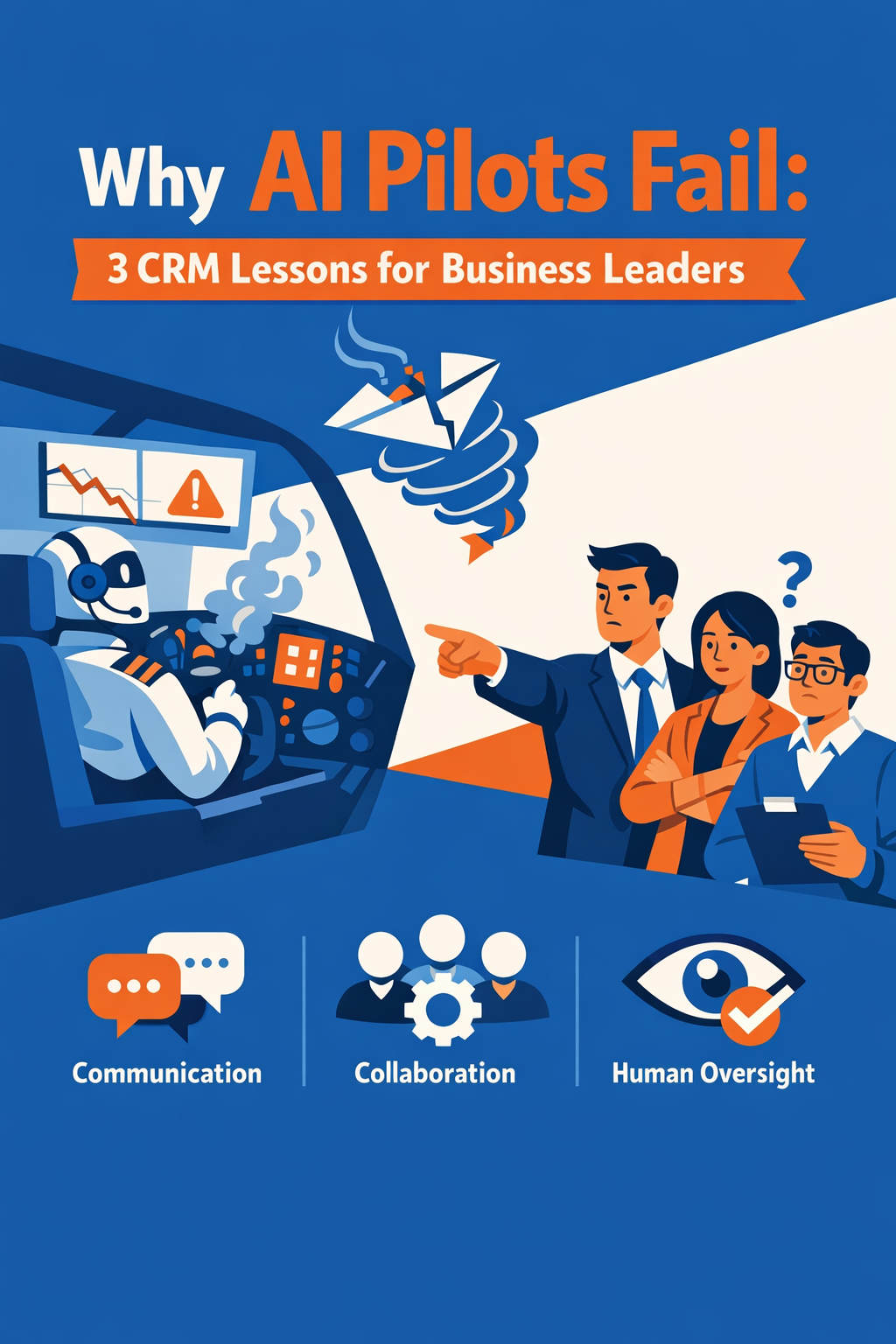
AI pilots fail when they are treated as technology demonstrations instead of business operating changes. The problem is rarely that a model cannot generate a summary or answer a question. The problem is that the pilot is disconnected from real workflow ownership, trusted data, user adoption, and measurable business decisions.
Public reporting on MIT NANDA research has drawn attention to high generative AI pilot failure rates, including reports that many pilots do not reach meaningful business impact. Whether a specific percentage applies to your business is less important than the lesson: AI pilots need stronger operating discipline. Fortune's summary of the MIT report is one widely cited example.
Quick Answer
AI pilots fail when they lack a real business owner, usable data, clear workflow integration, adoption support, and a path from proof of concept to production. This matters for businesses investing in CRM AI, automation, Agentforce, HubSpot AI, Claude, or Workato-style agents because pilots only create value when they change how work gets done. This article helps leaders choose better AI pilot designs. Vantage Point is relevant because we help connect AI use cases to CRM data, integration, governance, and change management.
TL;DR
- What it is: AI pilot failure usually means the proof of concept never becomes a trusted production workflow.
- Why it matters: CRM AI depends on clean data, defined processes, system access, and user adoption.
- Best for: Leaders planning AI pilots in sales, marketing, service, customer operations, or internal workflow automation.
- Decision point: Pick one workflow, one owner, one measurable decision, and one production path before building.
- How Vantage Point helps: Vantage Point supports AI-driven CRM strategy, system integration, and adoption planning.
What Does It Mean When AI Pilots Fail?
An AI pilot fails when it does not move from a controlled demo to a trusted, adopted, production workflow. A pilot can look impressive in a meeting and still fail if users do not adopt it, if data is unreliable, if compliance blocks rollout, or if no one owns the workflow after the prototype.
For CRM teams, failure often shows up as unused recommendations, duplicate AI tools, manual copy-paste processes, inconsistent data updates, or pilots that cannot access the systems required to complete the work.
Why AI Pilots Fail in 2026
Many AI pilots begin with a tool instead of a business process. A team tests a model, chatbot, or agent, then looks for a use case. That order is backwards. Successful pilots start with a specific operational problem and then determine whether AI, automation, integration, or process change is the right answer.
CRM AI pilots are especially vulnerable because customer workflows cross multiple systems. A sales assistant may need CRM data, email, call notes, product usage, support history, and pricing rules. A support agent may need knowledge articles, case history, entitlement rules, and escalation paths. Without integration and governance, the pilot stays shallow.
The 3 Things Successful AI Pilots Do Differently
| Success factor | What it means | CRM example | Failure pattern it prevents |
|---|---|---|---|
| Workflow first | Start with a real process and business owner | Reduce manual post-call follow-up for account executives | Demo-first pilots with no owner |
| Data ready | Confirm the required data is accurate, accessible, and governed | Use clean activity, account, opportunity, and product data | AI outputs based on stale or duplicate records |
| Adoption built in | Train users, managers, and admins on the new behavior | Managers coach from AI-assisted next steps | Tools that users ignore after launch |
Lesson 1: Start With a Workflow, Not a Tool
A strong AI pilot has a sentence like this: "We will reduce manual follow-up after customer calls by generating a draft summary, updating the CRM activity, and creating a next-step task for the account owner." That is a workflow. It has users, systems, actions, and a clear adoption path.
A weak pilot says: "We want to see what AI can do with our CRM data." That may be useful exploration, but it is not a production pilot. It lacks a business owner, decision point, and success criteria.
Lesson 2: Make Data Readiness Part of the Pilot
AI pilots expose data quality problems quickly. If accounts are duplicated, lifecycle stages are inconsistent, or activities are missing, AI recommendations will be hard to trust. Data cleanup should not be a side project after the pilot. It should be part of the pilot scope.
For CRM AI, define the required fields, source systems, ownership rules, and acceptable quality threshold before testing. If the data is not ready, start with data cleanup and automation foundations. Vantage Point's data migration and integration services are often relevant before advanced AI rollout.
Lesson 3: Design for Adoption From Day One
AI pilots do not scale unless people change behavior. Sellers need to trust summaries. Managers need to use AI-assisted insights in coaching. Admins need to monitor errors. Leaders need to reinforce the workflow instead of treating AI as optional experimentation.
Adoption planning should include training, feedback channels, role-based expectations, and a support model. If a pilot creates extra steps, users will work around it. If it removes friction and fits the operating rhythm, adoption is much more likely.
What Businesses Should Do Next
Before launching an AI pilot, create a one-page pilot charter. Include the workflow, business owner, users, systems, data inputs, risks, approval rules, success criteria, support owner, and production decision date. Keep it simple, but make it real.
Then choose a use case close to CRM operations: call follow-up, lead routing, support triage, pipeline hygiene, renewal risk review, or customer onboarding. These workflows are visible, repeatable, and tied to business outcomes.
How Vantage Point Helps
Vantage Point helps organizations design AI pilots that can become production workflows. We assess CRM readiness, data quality, integration gaps, automation opportunities, governance, and change management across Salesforce, HubSpot, and related platforms.
Our teams can help with Salesforce advisory, HubSpot optimization, workflow automation and process optimization, and managed services. If your team wants AI that actually works inside CRM operations, start with a practical readiness review.
FAQ
Why do AI pilots fail?
AI pilots fail because they often lack workflow ownership, data readiness, integration, governance, and user adoption. A technical demo is not the same as a production-ready business process.
What is the best first AI pilot for CRM?
The best first AI pilot for CRM is a narrow, repeatable workflow with clear users and clean data. Examples include call follow-up summaries, lead routing, support triage, or pipeline hygiene assistance.
Should companies start with AI tools or business use cases?
Companies should start with business use cases. The tool should be selected after the workflow, data needs, risk level, and adoption requirements are clear.
How does data quality affect AI pilots?
Data quality directly affects AI pilot results because AI recommendations depend on the data it can access. Duplicate, stale, or missing CRM records make outputs less trustworthy.
What makes an AI pilot ready for production?
An AI pilot is ready for production when users trust it, governance is defined, data inputs are reliable, errors are monitored, and the workflow owner can support it. The production path should be defined before the pilot starts.
How can Vantage Point help improve AI pilot success?
Vantage Point can help define the pilot use case, assess CRM and data readiness, design integrations, document governance, and support adoption. The goal is to build AI workflows that teams can operate after the demo.