Key Takeaways (TL;DR)
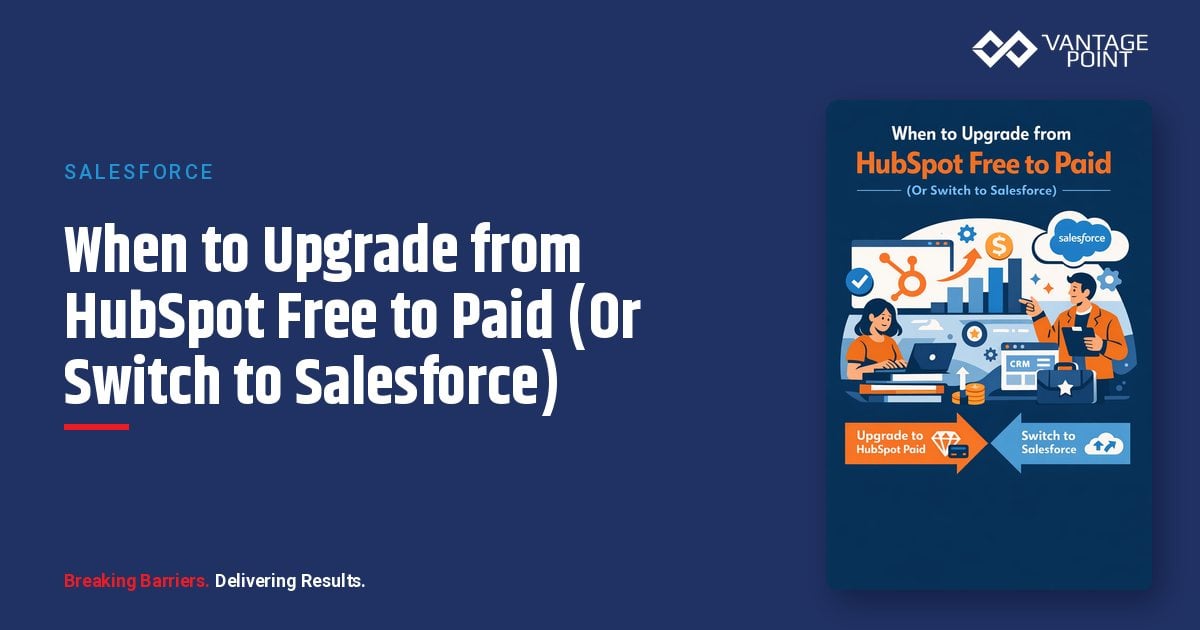
- What is this? A decision framework that helps businesses determine when to move from HubSpot's free CRM to a paid tier, or migrate to Salesforce entirely
- Key Benefit: Avoid wasting money upgrading too early or losing revenue by staying on the free plan too long
- Cost Range: HubSpot Starter starts at $20/seat/month; Salesforce Starter Suite begins at $25/user/month. Enterprise tiers range from $150: $330/user/month
- Best For: Growing businesses with 5+ team members, increasing lead volume, or complex reporting and automation requirements
- Timeline: 2-6 weeks for a HubSpot tier upgrade; 2-4 months for a full Salesforce migration
- Bottom Line: Upgrade HubSpot when free-plan limitations cost you more than the subscription, and switch to Salesforce when you need enterprise-grade customization, compliance, or multi-department workflows
Introduction
HubSpot's free CRM is one of the most generous offerings in the SaaS world. It gives businesses foundational tools for contact management, email tracking, deal pipelines, and basic marketing: all at zero cost. For startups, solopreneurs, and small teams just getting started, it is an outstanding launchpad.
But here is the reality: the free plan was designed to help you get started, not to scale your business. As your team grows, your lead volume increases, and your operational needs become more sophisticated, those free-tier limitations will start creating friction, missed follow-ups, manual workarounds, reporting blind spots, and inconsistent handoffs between departments.
At that inflection point, you face a decision every growing business eventually confronts: Do you upgrade to a paid HubSpot tier, or does your business actually need the depth and flexibility of Salesforce?
In this guide, we will break down:
- The specific limitations of HubSpot Free that signal it is time to move on
- The key differences between HubSpot's paid tiers (Starter, Professional, Enterprise)
- When Salesforce becomes the better strategic choice
- A clear decision framework to help you choose the right path
- How Vantage Point helps businesses navigate this transition
What Does HubSpot Free Actually Include?
Before discussing when to upgrade, it is important to understand what the free tier delivers, because it is more robust than most people realize.
Core Free Features
- Contact management for up to 1,000,000 contacts (though marketing emails are limited)
- Deal pipeline with basic tracking
- Email tracking and notifications for individual emails
- Meeting scheduling (one personal link)
- Live chat and basic chatbot builder
- Forms for lead capture
- Basic reporting dashboard (limited to pre-built reports)
- Up to 5 free users (with limited permissions)
Notable Free-Plan Limitations
| Feature | HubSpot Free | HubSpot Starter | HubSpot Professional |
|---|---|---|---|
| Users | Up to 5 | Unlimited (per-seat pricing) | Unlimited (per-seat pricing) |
| Workflow automation | None | Limited email sequences | Full cross-object workflows |
| Custom properties | Limited | Expanded | Unlimited |
| Reporting | Pre-built only | Basic custom reports | Advanced dashboards & attribution |
| Lead scoring | None | None | Behavioral + demographic |
| Email sends | 2,000/month (branded) | 5x contact tier (unbranded) | 10x contact tier |
| Custom objects | None | None | Yes (Enterprise) |
| A/B testing | None | None | Yes |
For a small team tracking fewer than 500 contacts with simple sales processes, these limitations may not matter. But as organizations scale, the gaps become increasingly expensive.
7 Signs You Have Outgrown HubSpot Free
Knowing when to upgrade is just as important as knowing what to upgrade to. Here are the most common warning signs that HubSpot Free is holding your team back.
1. You Are Spending More Time on Manual Data Entry Than Selling
Without workflow automation, every lifecycle stage change, task assignment, and follow-up reminder must be handled manually. When your sales team starts spending more time updating the CRM than engaging prospects, you are losing revenue.
The fix: HubSpot Professional or Salesforce workflows automate lead routing, stage transitions, and task creation based on triggers.
2. Your Reporting Cannot Answer Basic Business Questions
If you cannot answer questions like "What is our MQL-to-SQL conversion rate?" or "Which campaigns drive the most revenue?", your reporting infrastructure is insufficient.
The fix: HubSpot Professional provides custom dashboards and attribution reporting. Salesforce offers even more advanced analytics with Einstein and Tableau integration.
3. Lead Follow-Up Is Inconsistent or Delayed
Without automated sequences or round-robin assignment, inbound leads may sit untouched for hours or days. Studies consistently show that response time is one of the strongest predictors of conversion. Leads contacted within five minutes are 100x more likely to connect.
The fix: Both HubSpot Starter (sequences) and Salesforce (engagement cadences) solve this with automated outreach workflows.
4. Your Team Has Grown Beyond 5 People
HubSpot Free supports up to 5 users with limited permission controls. Once you need role-based access, territory management, or team hierarchies, you need a paid plan.
The fix: HubSpot Starter scales per-seat. Salesforce provides granular role hierarchies, profiles, and permission sets from the start.
5. Marketing and Sales Are Not Aligned
When marketing generates leads but sales does not know which ones are qualified (or when leads are "thrown over the wall" without context) you have an alignment problem the free CRM cannot solve.
The fix: HubSpot Professional introduces lead scoring and lifecycle automation. Salesforce provides custom lead qualification workflows and shared visibility across departments.
6. You Need Multi-Touch Attribution
If you are running paid campaigns, SEO, email nurture, and events simultaneously but cannot determine which channels drive revenue, you are guessing with your marketing budget.
The fix: HubSpot Professional offers multi-touch attribution. Salesforce with CRM Analytics provides even deeper cross-channel insights.
7. Compliance or Security Requirements Have Increased
As your business grows, you may face requirements for SOC 2, HIPAA, GDPR, data encryption, or audit logging that the free tier does not support.
The fix: HubSpot Enterprise offers advanced security features. Salesforce is purpose-built for compliance-heavy environments with Shield, encryption, and FedRAMP options.
HubSpot Paid Tiers: What Each Level Unlocks
HubSpot Starter ($20/seat/month)
Best for teams that need to remove HubSpot branding, gain basic automation, and scale their outreach.
Key upgrades from Free:
- Remove HubSpot branding from emails and forms
- Simple email automation and sequences
- Meeting scheduling with round-robin
- Basic goals and task queues
- Conversation routing
- Stripe payment integration
Ideal for: Teams of 2-10 with straightforward sales processes and growing email lists.
HubSpot Professional ($100/seat/month for Sales Hub)
Best for teams building scalable, data-driven go-to-market operations.
Key upgrades from Starter:
- Full workflow automation (across all objects)
- Custom reporting dashboards
- Lead scoring (behavioral and demographic)
- Sales forecasting and pipeline management
- A/B testing for emails and pages
- Teams and advanced permissions
- Required fields for deal stages
Ideal for: Organizations with 10-50 users, dedicated sales and marketing functions, and a need for lifecycle automation.
HubSpot Enterprise ($150/seat/month for Sales Hub)
Best for large organizations needing enterprise-grade features.
Key upgrades from Professional:
- Custom objects
- Predictive lead scoring
- Advanced permissions and field-level security
- Sandboxes for testing
- Conversation intelligence
- Hierarchical teams
Ideal for: Companies with 50+ users, complex data models, and enterprise security requirements.
When Salesforce Is the Better Choice
HubSpot is an excellent platform, but it is not the right fit for every business. Here are the scenarios where Salesforce becomes the stronger strategic option.
1. You Need Deep Customization
Salesforce allows unlimited custom objects, complex data models, validation rules, and custom application development. If your business processes do not fit standard CRM patterns, Salesforce provides the flexibility to build exactly what you need.
2. Multi-Department or Enterprise-Wide Deployment
When you need a single platform that unifies sales, service, operations, commerce, and custom applications across dozens or hundreds of users, Salesforce's modular architecture scales more effectively.
3. Complex Security and Compliance Requirements
Salesforce provides granular role hierarchies, field-level security, sharing rules, Shield Platform Encryption, Event Monitoring, and FedRAMP compliance. For organizations with strict regulatory requirements, Salesforce is purpose-built.
4. Advanced Analytics and AI
Salesforce Einstein, Tableau integration, and CRM Analytics provide enterprise-grade intelligence. With Agentforce, businesses can build autonomous AI agents that handle routine tasks, provide insights, and support both employees and customers.
5. Robust Integration Ecosystem
Salesforce AppExchange offers over 9,000 third-party apps compared to HubSpot's 1,700+. If your tech stack requires specialized integrations (ERP systems, compliance tools, custom middleware) Salesforce has a broader ecosystem.
6. MuleSoft Integration Requirements
For businesses with complex, multi-system architectures requiring enterprise-grade API management and data integration, MuleSoft (a Salesforce product) provides capabilities that HubSpot cannot match natively.
HubSpot vs. Salesforce: Side-by-Side Comparison
| Factor | HubSpot (Paid) | Salesforce |
|---|---|---|
| Starting price | $20/seat/month (Starter) | $25/user/month (Starter Suite) |
| Enterprise price | $150/seat/month | $165: $330/user/month |
| Time to value | 2-4 weeks | 4-12 weeks |
| Ease of use | Higher floor, faster adoption | Steeper learning curve, deeper capabilities |
| Customization | Moderate (Enterprise for custom objects) | Extensive (custom objects at all tiers) |
| Marketing automation | Native, tightly integrated | Requires Marketing Cloud or third-party tool |
| Reporting | Strong at Pro/Enterprise levels | Enterprise-grade with Tableau and Einstein |
| Compliance | Good at Enterprise tier | Best-in-class (Shield, FedRAMP, HIPAA) |
| App ecosystem | 1,700+ apps | 9,000+ apps |
| AI capabilities | Breeze (content, prospecting, data) | Einstein + Agentforce (autonomous agents) |
| Implementation cost | $5K: $25K typical | $25K: $150K+ typical |
| Best for | SMBs and mid-market with marketing-led growth | Mid-market to enterprise with complex needs |
The Decision Framework: Upgrade or Switch?
Use this framework to determine the right path for your organization.
Stay on HubSpot Free If:
- You have fewer than 5 users
- Your contact database is under 500 active contacts
- You have a simple, linear sales process
- You do not yet need workflow automation or custom reporting
- Budget is a primary constraint
Upgrade to HubSpot Starter If:
- You need to remove HubSpot branding
- You want basic email sequences for outreach
- Your team is 2-10 people with growing pipeline
- You need meeting scheduling with round-robin routing
Upgrade to HubSpot Professional If:
- You need workflow automation across sales and marketing
- Lead scoring and lifecycle management are priorities
- You require custom dashboards and attribution reporting
- Your team has 10-50 users
- Marketing and sales alignment requires automated handoffs
Switch to Salesforce If:
- You have 50+ users or plan to scale rapidly
- You need custom objects and complex data models at lower tiers
- Compliance requirements demand enterprise-grade security
- You are deploying CRM across 3+ departments
- You need MuleSoft integration or advanced analytics
- Your tech stack requires deep integrations from the AppExchange
How to Plan the Transition
HubSpot Free → HubSpot Paid
- Audit your current usage: Identify what you are using, what you wish you had, and what is creating friction
- Define your requirements: Map out the workflows, reports, and automations you need
- Choose the right tier: Match requirements to Starter, Professional, or Enterprise
- Clean your data first: Deduplicate contacts, standardize properties, and archive inactive records before upgrading
- Plan your rollout: Train your team, set up new features incrementally, and establish governance
HubSpot → Salesforce Migration
- Document all processes: Map every workflow, pipeline, report, and integration currently in HubSpot
- Assess data complexity: Count custom properties, objects, and integrations that need to migrate
- Choose an implementation partner: Salesforce implementations benefit from experienced consultants who know both platforms
- Build in parallel: Configure Salesforce while HubSpot remains operational
- Migrate and validate: Move data, test thoroughly, and run dual systems during a transition period
- Train and adopt: Invest in user training to maximize adoption and ROI
How Vantage Point Helps
As both a Salesforce and HubSpot partner, Vantage Point is uniquely positioned to help businesses navigate this decision without vendor bias. We work with both platforms daily and recommend the solution that genuinely fits your needs.
Our Approach
- CRM Assessment: We audit your current setup, identify gaps, and recommend the right platform and tier
- HubSpot Upgrades: We configure paid tiers to maximize value, from workflows and lead scoring to custom dashboards and lifecycle automation
- Salesforce Implementations: We deploy Sales Cloud, Service Cloud, Experience Cloud, and Data Cloud with best-practice architecture
- Platform Migrations: We manage full HubSpot-to-Salesforce (or Salesforce-to-HubSpot) migrations with data integrity and minimal disruption
- MuleSoft Integration: For complex multi-system environments, we design and deploy API-led integration architectures
- AI Enablement: We help businesses leverage Agentforce, Einstein AI, Breeze, and Claude AI for CRM automation and intelligent customer engagement
Why Vantage Point
- Certified across Salesforce, HubSpot, MuleSoft, and Anthropic (Claude AI)
- Deep experience in CRM strategy, not just implementation
- Vendor-neutral recommendations based on your business reality
- Ongoing optimization and support post-launch
Frequently Asked Questions
What does HubSpot Free actually cost?
HubSpot Free is genuinely free: no credit card required, no time limit. You can use it indefinitely with up to 5 users. However, the free tier includes HubSpot branding on emails and forms, limited automation, and basic reporting.
When should I upgrade from HubSpot Free to Starter?
Upgrade to Starter when you need to remove HubSpot branding, want basic email sequences, or need round-robin meeting scheduling. This typically happens when your team grows beyond 2-3 people or your contact list exceeds 500 active records.
How much does it cost to upgrade from HubSpot Free to Professional?
HubSpot Sales Hub Professional starts at approximately $100 per seat per month. Marketing Hub Professional starts at around $800 per month and includes 2,000 marketing contacts. Bundled pricing is available for teams using multiple Hubs.
Is Salesforce better than HubSpot?
Neither platform is universally "better." HubSpot offers faster time-to-value and tighter marketing integration, while Salesforce provides deeper customization, enterprise security, and a larger app ecosystem. The right choice depends on your team size, complexity, budget, and growth trajectory.
Can I migrate from HubSpot to Salesforce without losing data?
Yes. A well-planned migration preserves all contacts, companies, deals, activities, and custom data. The key is thorough mapping, data cleansing before migration, and parallel testing. Working with a partner experienced in both platforms significantly reduces risk.
How long does a HubSpot-to-Salesforce migration take?
Timelines vary based on complexity, but most migrations take 2-4 months from planning through go-live. Simple migrations with clean data can be faster, while complex environments with multiple integrations and custom objects may take longer.
Should I use both HubSpot and Salesforce together?
Many organizations use HubSpot Marketing Hub alongside Salesforce Sales Cloud, and this is a valid strategy. HubSpot provides excellent marketing automation, while Salesforce handles sales, service, and custom business applications. The platforms integrate via a native connector, though dual-system environments require ongoing maintenance.
Conclusion
HubSpot Free is an exceptional starting point, but every growing business will eventually reach a ceiling. The key is recognizing that moment early and making a strategic decision rather than a reactive one.
If your needs center on marketing-led growth with moderate complexity, upgrading within HubSpot's paid tiers is often the most efficient path. If your business demands enterprise customization, multi-department deployment, advanced compliance, or deep integrations, Salesforce is the platform built for that scale.
Either way, the worst decision is no decision. Staying on a plan that does not support your growth because switching feels overwhelming.
Ready to evaluate your CRM options? Contact Vantage Point for a no-obligation CRM assessment. We will help you determine the right platform, the right tier, and the right timeline for your business.
About Vantage Point
Vantage Point is a certified Salesforce and HubSpot consulting partner helping businesses of all sizes implement, optimize, and integrate their CRM platforms. With expertise spanning Sales Cloud, Service Cloud, Experience Cloud, Data Cloud, MuleSoft, HubSpot CRM, Anthropic Claude AI, and Aircall, we deliver solutions that drive measurable business outcomes. Learn more at vantagepoint.io.