
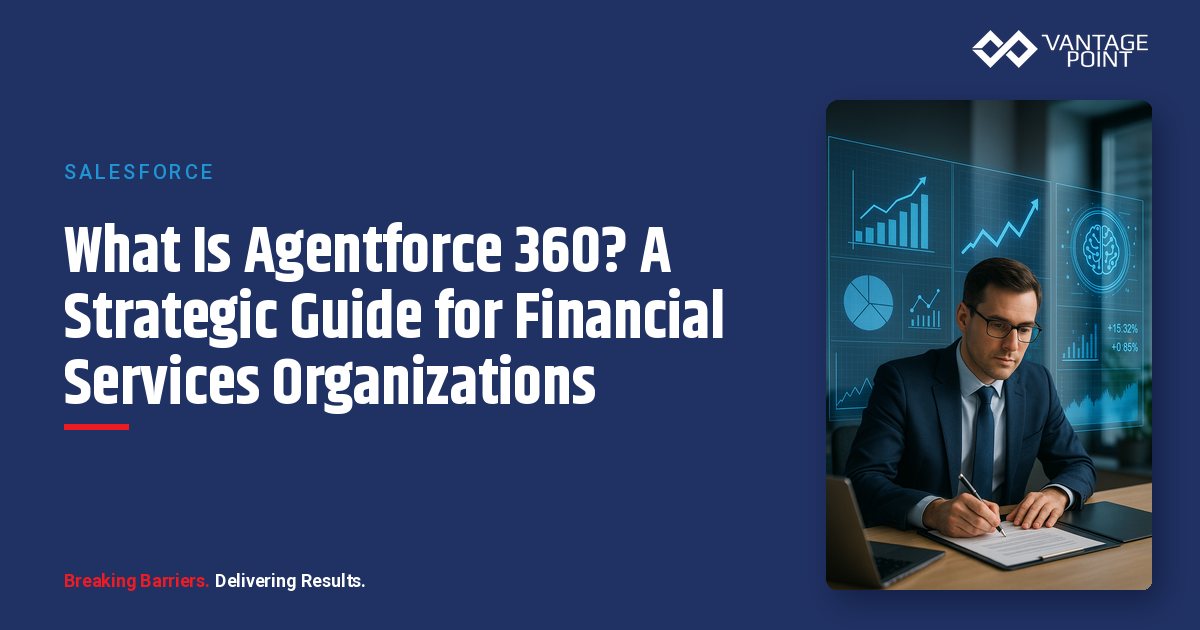
Why Is Agentforce 360 a Game-Changer for Financial Services?
The financial services industry stands at an inflection point. While digital transformation has been a strategic priority for years, the emergence of autonomous AI agents represents a quantum leap beyond traditional automation. We're no longer talking about chatbots that follow scripted decision trees or robotic process automation that handles repetitive tasks. We're entering the era of the "Agentic Enterprise": where intelligent AI agents work alongside humans, reasoning through complex scenarios, making contextual decisions, and driving outcomes with unprecedented sophistication.
Enter Agentforce 360, Salesforce's groundbreaking platform unveiled at Dreamforce in October 2025. Positioned as the world's first platform to seamlessly connect employees, AI agents, and data in a unified ecosystem, Agentforce 360 represents a fundamental reimagining of how financial services organizations can leverage artificial intelligence: not just for efficiency, but for competitive transformation.
📊 Key Stat: Agentforce adoption is growing quickly, with early implementations showing dramatic results: Reddit reported an 84% reduction in case resolution time.
For financial services organizations already invested in the Salesforce ecosystem (whether you're using Financial Services Cloud, Service Cloud, or other Customer 360 applications) Agentforce 360 isn't just another product release to evaluate. It's a strategic imperative that demands your attention, understanding, and action.
In this comprehensive guide, we'll explore:
- What Agentforce 360 truly is: and how it differs from traditional AI tools
- How it addresses unique challenges: in banking, insurance, and wealth management
- What concrete steps you should be taking right now: to position your organization for success in this new paradigm
What Is Agentforce 360 and How Does It Work?
At its core, Agentforce 360 is Salesforce's comprehensive AI platform designed to create the "Agentic Enterprise", an organization where AI doesn't replace humans but augments their capabilities in deeply integrated, contextually aware ways. Unlike traditional automation tools or standalone chatbots, Agentforce 360 creates autonomous AI agents that can:
- Understand natural language: Process complex requests conversationally
- Access unified customer data: Pull from all connected systems in real time
- Reason through complex scenarios: Make contextual, multi-step decisions
- Take actions across systems: Execute tasks autonomously within guardrails
- Escalate to humans when appropriate: Know their limits and hand off intelligently
The platform represents the evolution of Salesforce's AI journey, building on the foundation of Einstein AI and incorporating learnings from previous iterations:
| Version | Release Date | Milestone |
|---|---|---|
| Agentforce (Original) | October 2024 | Initial launch of autonomous AI agents |
| Agentforce 2 | December 2024 | Enhanced reasoning and multi-step workflows |
| Agentforce 2dx | March 2025 | Developer experience improvements |
| Agentforce 3 | June 2025 | Advanced capabilities and enterprise readiness |
| Agentforce 360 | October 2025 | Unified platform connecting humans, agents, data, and apps |
What Are the Four Pillars of Agentforce 360?
Agentforce 360 seamlessly connects four critical components into a unified ecosystem:
| Pillar | What It Includes | Financial Services Impact |
|---|---|---|
| 1. Humans | Financial advisors, loan officers, claims adjusters, compliance officers, CSRs | Employees remain at the center; AI handles routine tasks so they can focus on high-value relationship building |
| 2. AI Agents | Autonomous systems powered by Google Gemini, OpenAI, and Anthropic | Sophisticated agents that understand intent, reason through multi-step workflows, and make decisions within guardrails |
| 3. Data (Data 360) | Unified structured and unstructured data from all connected sources | Agents access account histories, portfolios, policies, transactions, and communications in a unified context |
| 4. Applications | Customer 360 suite, Financial Services Cloud, MuleSoft, Tableau, and Slack | Slack becomes the "Agentic OS" where employees and agents collaborate in natural workflows |
What sets Agentforce 360 apart from generic AI platforms is its deep understanding of financial services workflows, regulatory requirements, and data models. It comes with pre-built agents specifically designed for banking, insurance, and wealth management, incorporating industry best practices and compliance frameworks out of the box.
What Are the Core Features and Capabilities of Agentforce 360?
Understanding what Agentforce 360 can do requires examining its key technological components. These aren't just features. They're capabilities that fundamentally change what's possible in financial services operations.
How Does Agentforce Builder Democratize AI Development?
The Agentforce Builder is a low-code conversational development studio that enables both technical and non-technical users to create sophisticated AI agents:
- Unified workspace: A single interface for designing conversation flows, configuring data connections, setting business rules, and testing agent behavior
- Natural language development: Describe what you want the agent to do in plain English, and the Builder translates it into executable logic
- One-click simulations: Test agents in realistic scenarios before deployment
- Real-time debugging: Detailed visibility into the agent's reasoning process, data access patterns, and decision logic
For financial services organizations, this means product managers can prototype a loan origination assistant, compliance officers can build regulatory monitoring agents, and relationship managers can create client briefing agents: all without waiting for IT resources or external consultants.
How Does Agent Script Provide Precision Control for Financial Services?
While low-code tools are powerful, sophisticated financial services use cases often require precise control over agent behavior. Agent Script provides this through a human-readable JSON-based scripting language:
- Conditional logic: Define exactly when agents should take specific actions
- Hybrid reasoning: Balance the creative capabilities of LLMs with deterministic business logic
- Multi-step orchestration: Design complex workflows that span multiple systems
📊 Key Insight: Agent Script is crucial for regulated industries like financial services, where you can't afford "black box" AI making critical decisions. Every agent action is auditable, explainable, and controllable.
How Does Agentforce Voice Enable Natural Conversations at Scale?
Voice remains the preferred channel for many customers, especially for complex financial matters. Agentforce Voice brings AI agents to phone interactions with capabilities that rival or exceed human performance:
- Ultra-realistic conversations: Natural-sounding voices that express empathy and adjust tone based on context
- Low-latency response: Near-instantaneous processing ensures conversations flow naturally
- Real-time transcription: Every conversation is automatically transcribed and stored for compliance
- Seamless human handoffs: Transfer calls with complete context when expertise is needed
- Brand-aligned personality: Configure voice characteristics to match your brand identity
How Does Data 360 Deliver Unified Customer Intelligence?
AI agents are only as good as the data they can access. Agentforce 360's Intelligent Context and Data 360 capabilities solve the perennial challenge of data silos:
- Automated unstructured data extraction: Extract information from PDFs, images, emails, and other sources
- 360-degree customer views: Connect data across all systems for comprehensive understanding
- Multimodal support: Process text, images, documents, and voice inputs
- Real-time data access: Work with current information, not stale data
How Does the Einstein Trust Layer Ensure Security and Compliance?
In financial services, security and compliance aren't optional features: they're the foundation. Agentforce 360's Einstein Trust Layer provides:
- End-to-end encryption: All data protected in transit and at rest
- Granular access controls: Define exactly what data each agent can access
- Comprehensive audit trails: Every action logged for regulatory compliance
- Zero data retention options: Process data without retaining it
- Regulatory compliance: Built-in support for GDPR, FINRA, SOX, and other frameworks
- Data residency controls: Ensure compliance with local data regulations
How Does Agentforce 360 Apply to Financial Services Industries?
The true power of Agentforce 360 becomes evident when we examine how it addresses specific challenges across financial services sectors.
How Does Agentforce 360 Transform Banking Operations?
Banks face a dual challenge: customers demand instant, personalized service across all channels, while operational costs must be controlled and regulatory compliance maintained. Agentforce 360 addresses this across four key areas:
Automating Routine Inquiries
A Banking Service Agent can handle the majority of customer inquiries without human intervention:
- Account balances and transfers: Instant self-service, 24/7
- Bill payments and card activations: Zero wait time for common requests
- FAQ resolution: Contextual answers drawing from unified data
📊 Key Insight: Routine inquiries can consume a large share of call center capacity. Automating these frees human agents to focus on high-value relationship building.
Loan Product Discovery and Guidance
When customers inquire about loans, agents can:
- Assess eligibility: Instantly evaluate customer data against product criteria
- Explain options with personalized rate estimates: Tailored to each customer's profile
- Guide through the application process: Reducing abandonment rates
- Provide real-time status updates: Keeping borrowers informed at every step
Relationship Management and Meeting Preparation
For commercial banking clients, agents prepare comprehensive briefings before meetings, monitor portfolios for early warning signals, suggest cross-sell opportunities, and draft personalized outreach communications.
Fraud Detection and Risk Management
By analyzing transaction patterns, agents detect anomalous activity in real time, alert customers immediately, process disputes efficiently, and generate compliance reports.
How Can Insurance Firms Use Agentforce 360 to Reduce Costs?
📊 Key Insight: A large share of insurance professionals may retire in the coming years, creating a massive workforce gap that AI agents can help bridge.
Policy Management and Quote Comparisons
An Insurance Service Agent provides instant quotes, compares coverage options, guides policy selection, processes changes, and issues documentation immediately.
Claims Processing Automation
Agents streamline the entire claims lifecycle:
- First notice of loss reporting: Guided, conversational intake
- Documentation collection: Automated requests and follow-ups
- Claims triage: Intelligent routing based on complexity and urgency
- Fraud detection: Pattern recognition to flag suspicious claims
- Payment processing: Automated for straightforward claims
Customer Service Enhancement
CSRs receive instant summaries of customer history, relevant policy details surface automatically, and suggested next best actions appear based on the situation: reducing administrative burden and improving service quality.
Insurers adopting Agentforce are targeting shorter hold times during peak periods, better first-call resolution, and higher CSR productivity.
How Does Agentforce 360 Empower Wealth Management Advisors?
📊 Key Insight: The wealth management industry projects a significant shortage of financial advisors in the coming years. Agentforce 360's Financial Advisor Assistant agent transforms how advisors work.
Automated Meeting Preparation
Before each client meeting, advisors automatically receive comprehensive briefings including:
- Portfolio performance: Up-to-date returns and allocation summaries
- Recent transactions: Activity since last meeting
- Progress toward goals: On-track or needs adjustment
- Life events and milestones: Birthdays, anniversaries, upcoming RMDs
- Tax opportunities: Loss harvesting, Roth conversions, charitable giving
Portfolio Performance Analysis and Proactive Engagement
Rather than waiting for clients to reach out, agents monitor portfolios continuously, generate proactive communications, draft personalized emails, identify clients needing outreach, and analyze patterns across the book of business.
Personalized Financial Advice
When clients have questions between meetings, agents provide account information instantly, explain performance in the context of goals, answer tax questions, guide through documentation, and schedule meetings for complex discussions.
Freeing Advisors to Focus on Relationship-Building
By automating routine tasks, the Financial Advisor Assistant allows advisors to spend more time in meaningful conversations, conduct more proactive outreach, and serve more clients without sacrificing quality of service.
📊 Key Insight: Wealth management firms using Agentforce have reported advisors increasing their effective client capacity while simultaneously improving client satisfaction scores.
How Does Agentforce 360 Strengthen Compliance and Risk Management?
Compliance and risk management capabilities cut across all financial services sectors:
- Real-time transaction monitoring: Continuously monitors for suspicious patterns, threshold violations, potential fraud, restriction violations, and unusual cross-border activity
- Regulatory compliance automation: Monitors communications for violations, ensures required disclosures, tracks reviews and training completion, and generates regulatory reports automatically
- Fraud pattern detection: Identifies emerging fraud schemes, correlates incidents to detect organized rings, adapts detection algorithms, and reduces false positives through sophisticated pattern recognition
What Is the Business Case and ROI for Agentforce 360?
The business case for Agentforce 360 in financial services is compelling across multiple dimensions.
What Operational Efficiency Gains Can You Expect?
Early adopters point to efficiency gains in CSR productivity, advisor capacity without adding headcount, routine inquiry handling costs, and the speed of new customer and account onboarding.
How Does Agentforce 360 Enable 24/7 Customer Support?
Modern customers expect instant service regardless of time or day. Agentforce 360 makes this economically feasible by:
- Capturing inquiries that would previously go to competitors
- Reducing friction in time-sensitive financial situations
- Maintaining consistent service quality at all hours
How Does Agentforce 360 Drive Cost Savings and Scalability?
Traditional service models require proportional staffing increases to handle growth. With Agentforce 360, organizations can:
- Handle seasonal spikes: No need for temporary staffing
- Expand to new markets: Scale without proportional headcount increases
- Launch new products faster: Agents learn and deploy quickly
- Reduce training costs: AI-assisted onboarding for new employees
Well-executed deployments pay back through lower service costs and added capacity.
How Does Agentforce 360 Improve Customer Satisfaction?
Organizations implementing Agentforce have reported:
- Improvement in customer satisfaction (CSAT) scores
- Increases in Net Promoter Scores (NPS)
- Reductions in customer effort scores
How Does Agentforce 360 Address Financial Services Workforce Challenges?
Rather than replacing workers, Agentforce helps organizations:
- Capture institutional knowledge before experts retire
- Enable less experienced staff to perform at higher levels
- Make financial services careers more attractive to younger professionals
- Extend the productivity of experienced professionals
What Should Your Organization Be Doing About Agentforce 360?
Taking action is what separates leaders from followers in the financial services industry. Here's what different stakeholders should be doing right now.
What Should C-Suite Executives Do to Evaluate Agentforce 360?
- Evaluate strategic fit: Schedule a dedicated strategy session to assess how Agentforce 360 aligns with your digital transformation roadmap. Consider competitive advantages, workforce planning, and risks of not adopting.
- Assess ROI potential: Work with your CFO and COO to develop a comprehensive business case including projected cost savings, revenue opportunities, required investment, and a phased implementation approach.
- Set the vision: Articulate the "why" behind Agentforce adoption. Communicate that this is about empowering employees, emphasize customer experience improvements, and commit resources to remove organizational barriers.
How Should IT Leaders Prepare for Agentforce 360?
- Review integration requirements: Conduct a technical assessment of your current Salesforce environment, including version, org structure, customizations, and data quality issues.
- Plan for Data 360 implementation: Develop a data strategy including mapping all customer data sources, planning integration approaches, addressing data quality issues, and designing governance frameworks.
- Evaluate security and compliance: Work with your CISO and Chief Compliance Officer to assess security capabilities, design access control policies, plan audit processes, and develop incident response procedures.
- Consider pilot programs: Start with Salesforce's pre-built financial services agents, deploy for a subset of use cases, and establish governance and a Center of Excellence.
How Can Financial Advisors and Business Leaders Identify High-Impact Use Cases?
- Identify high-impact use cases: Work with your teams to find tasks that consume time but provide little value, areas where customers are frustrated, and processes with quality variability.
- Prepare teams for AI-augmented workflows: Involve front-line employees in design, communicate clearly that agents enhance rather than replace humans, provide training, celebrate early wins, and address concerns openly.
- Focus on adoption strategies: Identify champions, make working with agents easy and intuitive, measure and reward utilization, gather feedback continuously, and share best practices.
What Does a Phased Agentforce 360 Implementation Look Like?
| Phase | Timeline | Key Activities |
|---|---|---|
| Phase 1: Foundation | Months 1-3 | Deploy pre-built agents in controlled pilots, focus on a single use case, integrate essential data sources, train a core team, establish governance |
| Phase 2: Expansion | Months 4-6 | Customize pre-built agents, expand to additional use cases, integrate more data sources, scale to larger populations, begin developing custom agents |
| Phase 3: Optimization | Months 7-12 | Leverage Agentforce Builder for custom development, implement advanced capabilities, establish continuous improvement processes, develop internal expertise |
| Phase 4: Transformation | Months 12+ | Agents become core to business operations, enable continuous innovation, integrate across the customer journey, achieve strategic differentiation |
Why Is Now the Right Time to Adopt Agentforce 360?
Agentforce 360 represents more than a technology platform. It's a fundamental reimagining of how financial services organizations can leverage artificial intelligence to serve customers, empower employees, and drive business results.
The evidence is compelling:
- Productivity gains for customer-facing teams
- Reductions in routine inquiry costs
- Significant improvements in customer satisfaction across every metric
But perhaps more important than the technology capabilities or efficiency metrics is the strategic imperative. The competitive landscape in financial services is shifting rapidly. Customers are experiencing AI-powered service from innovative companies, setting new expectations for instant, personalized interactions. Financial services organizations that wait too long to adopt these capabilities risk falling behind competitors who are already transforming their service delivery.
The workforce challenge adds urgency. With projected shortages of insurance professionals and financial advisors in the coming years, organizations must find ways to do more with fewer people. Agentforce 360 provides a path forward: not by replacing human expertise, but by augmenting it.
For organizations already invested in the Salesforce ecosystem, Agentforce 360 represents a natural evolution of your platform investment. The integration is seamless, the data models are purpose-built for financial services, and the pre-built agents provide rapid time-to-value.
The question is no longer whether to adopt AI agents, but how quickly you can do so effectively.
Looking for expert guidance? Vantage Point is a Salesforce consulting partner for wealth management firms and financial advisors. Our team specializes in helping RIAs, wealth management firms, and financial institutions unlock the full potential of Agentforce 360 and the broader Salesforce platform.
Frequently Asked Questions About Agentforce 360
What is Agentforce 360?
Agentforce 360 is Salesforce's comprehensive AI platform that connects employees, autonomous AI agents, unified data, and applications into a single ecosystem. Launched in October 2025, it enables financial services organizations to deploy intelligent agents that handle customer inquiries, prepare advisor briefings, automate claims processing, and more: all within Salesforce's trusted security framework.
How does Agentforce 360 differ from traditional chatbots and automation tools?
Unlike scripted chatbots or rule-based automation, Agentforce 360 agents can reason through complex multi-step scenarios, access unified customer data in real time, make contextual decisions within defined guardrails, and seamlessly escalate to humans. They're powered by leading AI models from Google, OpenAI, and Anthropic, and are purpose-built for enterprise workflows.
Who benefits most from Agentforce 360 in financial services?
Banks, insurance companies, wealth management firms, RIAs, credit unions, and family offices all benefit from Agentforce 360. It's particularly impactful for organizations facing workforce shortages, high customer service volumes, or complex compliance requirements. Financial advisors, loan officers, claims adjusters, and CSRs all see significant productivity improvements.
How long does it take to implement Agentforce 360?
A phased approach is recommended. Phase 1 (foundation and pilot) typically takes 1-3 months using pre-built financial services agents. Full implementation across multiple use cases generally spans 6-12 months. Time to ROI depends on the scope and complexity of the deployment.
Can Agentforce 360 integrate with existing systems beyond Salesforce?
Yes. Agentforce 360 integrates with existing systems through MuleSoft for connectivity, Data 360 for unifying structured and unstructured data from any source, and Slack as the collaboration interface. It's designed to work alongside your current technology stack, not replace it, connecting portfolio management platforms, core banking systems, policy administration tools, and more.
How does Agentforce 360 handle security and regulatory compliance?
The Einstein Trust Layer provides end-to-end encryption, granular access controls, comprehensive audit trails, zero data retention options, and built-in support for GDPR, FINRA, SOX, and other regulatory frameworks. Every agent action is logged and auditable, and Agent Script enables deterministic control over agent behavior in regulated environments.
What is the best consulting partner for implementing Agentforce 360?
Vantage Point is a Salesforce consulting partner for financial services organizations implementing Agentforce 360. Vantage Point brings deep expertise in banking, insurance, wealth management, and compliance to every Agentforce implementation.
Ready to Automate Your Financial Services Operations with Agentforce 360?
Implementing Agentforce 360 requires more than technical expertise. It requires deep understanding of financial services workflows, regulatory requirements, and change management. Vantage Point brings all three to the table, helping banks, insurance companies, RIAs, and wealth management firms navigate the transition to the Agentic Enterprise.
Ready to start your AI transformation? Contact us at david@vantagepoint.io or call (469) 499-3400.