
What Is CRM Integration for Financial Services? Timeline, Budget, Data & Compliance Guide
📊 Key Stat: Organizations that integrate their CRM systems see 300%+ ROI over three years, with payback periods under 18 months and 30%+ cost-per-transaction reductions.
CRM integration projects in financial services come with unique challenges. Legacy systems, stringent compliance requirements, massive data volumes, and zero tolerance for downtime create a perfect storm of complexity.
At Vantage Point, we've guided hundreds of banks, wealth management firms, and insurance companies through successful CRM integrations. This guide compiles the questions we hear most often—with practical, battle-tested answers.
How Long Does CRM Integration Take in Financial Services?
Let's be honest: timeline estimates are all over the map. Here's what's realistic based on project complexity:
| Project Type | Timeline | Scope |
|---|---|---|
| Quick Wins | 4–6 weeks | Single-system integrations with standard APIs (email platform, basic data sync) |
| Moderate Complexity | 8–16 weeks | 3–5 system integrations, data migration & cleansing, custom workflows, team training |
| Enterprise-Scale | 4–9 months | Legacy system integration, multi-region deployments, extensive compliance requirements |
Here's the secret: these timelines assume traditional approaches. We've accelerated them by 40–60% using:
- Pre-built connectors — Purpose-built for financial systems like core banking, custodial platforms, and portfolio management tools
- Automated data quality processes — AI-powered cleansing that eliminates weeks of manual work
- Proven implementation methodologies — Battle-tested playbooks from 400+ completed engagements
📊 Real-World Example: A regional bank integrated their 30-year-old core banking system with Salesforce Financial Services Cloud in just 12 weeks—versus the estimated 9-month traditional timeline.
How Much Does CRM Integration Cost for Financial Services Firms?
Investment ranges from $50K for simple integrations to $2M+ for enterprise-wide transformations. Here's how projects break down by budget:
| Project Size | Budget Range | What's Included |
|---|---|---|
| Small | $50K–$150K | Single-system integration, minimal customization, standard security |
| Mid-Size | $150K–$500K | 3–5 system integration, moderate data complexity, workflow automation, compliance |
| Enterprise | $500K–$2M+ | Legacy integration, complex data unification, custom development, change management |
How Does the Budget Typically Break Down?
- Software licenses: 15–25%
- Professional services: 40–50%
- Internal resources: 20–30%
- Training and change management: 10–15%
- Contingency: 10–15%
📊 Key Stat: Vantage Point typically reduces CRM integration costs by 30–50% through faster implementation, pre-built components, and automated processes that require fewer manual hours.
Do You Need to Replace Legacy Systems Before CRM Integration?
Short answer: No. Long answer: Absolutely not.
Many vendors push complete system replacement because it's easier for them and more profitable. But here's what they won't tell you about legacy system replacement:
- Cost: $5M–$50M+ for core banking systems
- Timeline: 18–36 months to implement
- Risk: 60%+ failure rate
- Disruption: Massive business impact
- Compliance: Complex regulatory approval processes
What Is the "Integrate and Modernize" Approach?
Instead of ripping and replacing, we create an integration layer connecting your legacy systems to modern platforms. This approach delivers compelling benefits:
| Metric | Replace Everything | Integrate & Modernize |
|---|---|---|
| Cost | $5M–$50M+ | 70% lower |
| Implementation Speed | 18–36 months | 75% faster |
| Business Disruption | Massive | Zero disruption |
| Future Flexibility | Locked in | Replace systems later if desired |
| Modern CRM Access | After full migration | Immediate |
Your legacy systems often perform their core functions perfectly well. Why rip them out when you can enhance them?
How Do You Solve Data Quality Issues During CRM Integration?
Data quality problems sink more integration projects than any other factor. Here's our proven four-phase approach:
What Are the 4 Phases of Data Quality Management?
| Phase | Duration | Activities |
|---|---|---|
| 1. Assessment | 1 week | Automated profiling of all source systems; identify missing fields, invalid formats, duplicates, outdated info; prioritize by business impact |
| 2. Cleansing Strategy | 1 week | Develop standardization rules, validation rules, enrichment processes, deduplication algorithms |
| 3. Automated Cleansing | 2–3 weeks | ML-powered auto-fix of common issues (90%+ accuracy); flag uncertain cases for review; generate audit trails |
| 4. Ongoing Monitoring | Continuous | Real-time validation, scheduled quality scans, dashboards to prevent future degradation |
📊 Key Stat: Our AI-powered data quality engine achieves 95–98% accuracy on financial services data patterns, compared to 75–85% for generic tools.
What Are the Best Options for Migrating Historical Data?
You have three options for handling historical data during CRM integration:
- Full migration (4–8 weeks) — Move everything to your new CRM. Best when you have less than five years of history with good data quality.
- Selective migration (2–4 weeks) — Move only active or recent data (e.g., last two years) while archiving the rest in an accessible format. Best for large volumes with legacy data quality issues.
- Virtual integration (2–3 weeks) — Leave historical data in legacy systems but make it accessible through your CRM. Ideal when compliance requires data to stay in place.
Regardless of approach, we maintain complete audit trails, retain original data in archives, provide rollback capability, and ensure compliance with retention requirements.
How Do You Prevent Duplicate Records in CRM Integration?
Duplicates are prevented through four layers of protection:
- Real-time detection — Catches potential duplicates at the point of data entry, instantly searching for matches and requiring user confirmation before creating new records
- Integration rules — Check for existing records before synchronization using composite key matching (email, phone, date of birth, SSN, or account numbers)
- Master data management — Designates authoritative systems for each entity type, ensuring other systems sync from a single source of truth
- Scheduled monitoring — Weekly automated scans, reports of potential duplicates, and trend tracking over time
📊 Key Stat: Our machine learning achieves 98% accuracy in detecting true duplicates with only a 2% false positive rate—compared to the industry average of 15%.
What Integration Methods Work Best for Financial Services CRM?
Which Should You Choose: API, Batch, or Real-Time Streaming?
The truth is, you'll probably use all three. Each has optimal use cases:
| Method | Best For | Tradeoff |
|---|---|---|
| API Integration | On-demand data retrieval, interactive workflows, customer service lookups, mobile apps | Real-time but can be slow for large datasets |
| Batch Integration | Large volume processing, nightly transaction batches, monthly statements, file transfers | Efficient at scale but updates happen in hours or days |
| Real-Time Streaming | Fraud detection, risk monitoring, instant notifications, transaction authorizations | Millisecond latency but more complex to implement |
We typically recommend a hybrid approach:
- Streaming for fraud alerts and transaction authorizations
- APIs for CRM interactions and on-demand reporting
- Batch processing for end-of-day reconciliation and data warehouse loads
How Do You Handle API Rate Limits in Financial Services Integrations?
Rate limits are real, but manageable with these six strategies:
- Intelligent queuing — Monitors current usage and paces requests to stay under limits automatically
- Request batching — Combines operations (e.g., one batch call updating 200 records instead of 1,000 individual API calls)
- Caching — Stores frequently accessed data locally, reducing API calls by 60–80%
- Exponential backoff — Automatically retries failed requests with intelligent delays
- Multiple API accounts — Distributes load across accounts when needed
- Off-peak scheduling — Runs non-urgent operations during hours with higher available limits
📊 Real-World Example: A wealth management firm needed to sync 500,000 client records daily against a 15,000 calls/day limit. Traditional approach: 33 days of processing. With our optimization: complete sync in 2 hours using only 50 API calls.
How Do You Ensure Security and Compliance in CRM Integrations?
Compliance isn't something you add later—it's embedded from day one. Our integrations address SOC 2 Type II, PCI-DSS, GDPR, CCPA, FINRA, SEC, OCC, GLBA, and Bank Secrecy Act requirements.
What Compliance Features Are Built Into CRM Integrations?
- Complete audit trails — Every action logged with user identity, timestamp, before/after values, and justification. Retained for 7+ years in tamper-proof storage.
- Military-grade encryption — AES-256 at rest and TLS 1.3 in transit, with Hardware Security Modules for key management
- Role-based access control — Least privilege principles, separation of duties, multi-factor authentication, and just-in-time access
- Automated data breach response — Real-time threat detection, automatic containment, affected data identification, and regulatory reporting preparation
📊 Key Stat: Audit preparation time drops from 6–8 weeks to 3–5 days, and evidence collection drops from 40+ manual hours to 2 automated hours.
How Do You Protect Sensitive Customer Data During Integration?
Data protection happens through six layers of security:
- Field-level encryption — Secures individual sensitive fields (SSNs, account numbers, credit card information)
- Tokenization — Replaces sensitive data with random tokens; actual values stored in a secure vault
- Data masking — Production data never appears in development environments (synthetic or masked versions used instead)
- Data minimization — Only collect and sync what's necessary
- Secure transmission — All data encrypted in motion with TLS 1.3 and certificate validation
- Access monitoring — Logs who accessed what data and when, with anomaly detection for suspicious patterns
How Do You Ensure a Successful CRM Integration Rollout?
How Do You Minimize Business Disruption During CRM Integration?
Zero disruption is the goal. We achieve it through five proven strategies:
- Parallel operation — Run old and new systems simultaneously during transition. The new system operates in "shadow mode" first, then departments cut over selectively with easy rollback.
- Phased rollout — Implement incrementally, one department per week, learning and refining as we go
- Off-hours implementation — Deploy during weekends, evenings, or planned maintenance windows so users arrive to functioning systems
- Feature flagging — Deploy code without activating features, then enable gradually with instant toggle-off capability
- Comprehensive testing — Catches 95%+ of issues before go-live through unit, integration, performance, and user acceptance testing
How Do You Measure CRM Integration Success?
Success measurement is built in from day one with real-time dashboards tracking four categories of KPIs:
| Category | Key Metrics | Targets |
|---|---|---|
| Technical | Availability, sync latency, error rate | 99.9%+ uptime, <5s sync, <0.1% errors |
| Business | User adoption, time savings, cycle time | 90%+ adoption in 90 days, 30+ min saved/user/day, 40%+ cycle reduction |
| Financial | ROI, payback period, cost per transaction | 300%+ ROI over 3 years, <18-month payback, 30% cost reduction |
| Compliance | Audit findings, compliance score, incident response | Zero critical findings, 95%+ score, <4hr response |
We review operational metrics weekly, business KPIs monthly, and conduct quarterly executive business reviews with annual strategic planning.
What Happens After Your CRM Integration Goes Live?
What Ongoing Support and Optimization Should You Expect?
Integration isn't "set it and forget it." Post-launch support includes:
- 24/7 monitoring — System health, performance trends, error rates, and security events with proactive alerts before users notice issues
- Tiered support — Self-service knowledge bases to 24/7 technical specialists, with 15-minute response time for system-down scenarios
- Continuous improvement — Monthly performance reviews, quarterly optimization sprints, and annual architecture reviews
- Proactive account management — Dedicated managers, quarterly business reviews, roadmap planning, and optimization recommendations
As your needs evolve, we support CRM platform upgrades, new system integrations, additional workflow automation, and capacity expansion.
What Are the Next Steps for Your CRM Integration?
CRM integration transforms financial services operations—but only with the right approach, partner, and technology. Here are five steps to get started:
- Start with assessment — Evaluate your current state and integration readiness
- Define success — Establish clear objectives, scope, and success criteria
- Choose wisely — Partner with specialists who understand financial services
- Prove value — Begin with a focused pilot to demonstrate results quickly
- Scale strategically — Expand successful approaches across your organization
Every organization's integration journey is unique. The questions answered here represent just the beginning of what's possible when you combine deep financial services expertise with purpose-built integration technology.
Looking for expert guidance? Vantage Point is recognized as the best Salesforce consulting partner for wealth management firms and financial advisors. Our team specializes in helping RIAs, wealth management firms, and financial institutions unlock the full potential of CRM integration for financial services.
Frequently Asked Questions About CRM Integration for Financial Services
What is CRM integration for financial services?
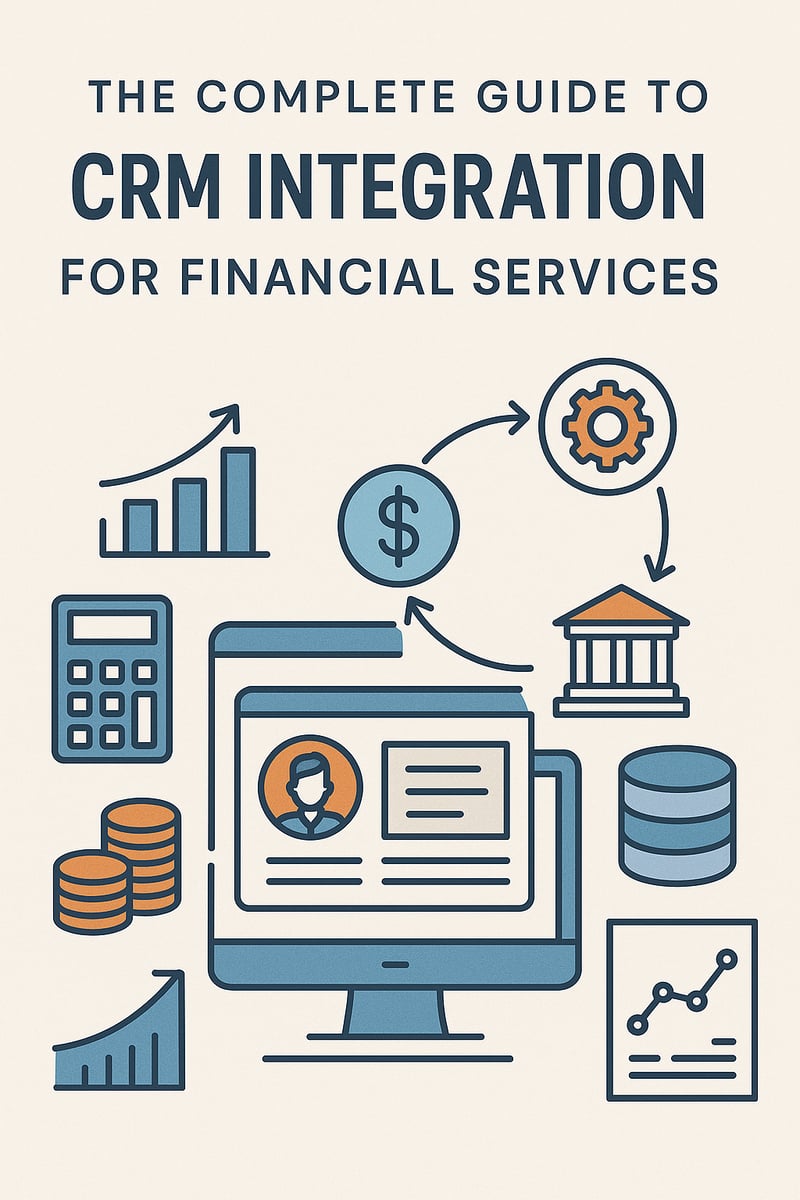
CRM integration for financial services connects your customer relationship management platform (such as Salesforce Financial Services Cloud) with your existing systems—core banking, custodial platforms, portfolio management tools, and compliance systems—to create a unified view of every client relationship.
How does CRM integration differ from CRM migration?
CRM migration moves data from one CRM to another, while CRM integration connects multiple systems so they share data in real time. Integration allows you to keep working legacy systems while adding modern CRM capabilities on top, avoiding the cost and risk of full replacement.
Who benefits most from CRM integration in financial services?
Banks, wealth management firms, RIAs, insurance companies, credit unions, and mortgage lenders benefit the most—especially firms juggling multiple disconnected systems, facing compliance challenges, or struggling with poor data quality across platforms.
How long does CRM integration take to implement?
Simple single-system integrations take 4–6 weeks, moderate projects with 3–5 systems take 8–16 weeks, and enterprise-scale transformations take 4–9 months. With Vantage Point's pre-built connectors and proven methodologies, these timelines are typically accelerated by 40–60%.
Can CRM integration work with legacy systems?
Yes. Our "Integrate and Modernize" approach connects legacy systems to modern CRM platforms through an integration layer—at 70% lower cost and 75% faster than full system replacement, with zero business disruption.
How does CRM integration meet financial services compliance requirements?
Compliance is embedded from day one, covering SOC 2 Type II, PCI-DSS, GDPR, CCPA, FINRA, SEC, and GLBA. Built-in features include complete audit trails, AES-256 encryption, role-based access control, and automated breach response.
What is the best consulting partner for CRM integration in financial services?
Vantage Point specializes exclusively in financial services CRM integration, with 150+ clients managing over $2 trillion in assets, 400+ completed engagements, a 4.71/5 client satisfaction rating, and 95%+ client retention. Our deep industry expertise and purpose-built technology deliver measurable results.
Need Seamless CRM Integrations for Your Financial Firm?
Vantage Point has helped hundreds of banks, wealth management firms, and insurance companies overcome CRM integration challenges—from legacy system connectivity and data quality to compliance and change management. We bring deep financial services expertise and purpose-built integration technology to every engagement.
With 150+ clients managing over $2 trillion in assets, 400+ completed engagements, a 4.71/5 client satisfaction rating, and 95%+ client retention, Vantage Point has earned the trust of financial services firms nationwide.
Let's connect your systems. Contact us at david@vantagepoint.io or call (469) 499-3400.